Category: Founders & leadership

  • 8 real world founder fears in the age of AI – Podcast Video

    8 real world founder fears in the age of AI – Podcast Video

    A D2C founder running an Ayurvedic skincare brand, doing about 8 crore in revenue, put it simply. AI is helping everyone create ads, write product descriptions, launch stores faster. My fear is not the technology. My fear is that AI makes every brand look equally good. If everyone has the same marketing superpower, where does my differentiation come from?

    Vineeth Vijayaraghavan, who I have known for over thirty years and who advises VCs, family offices and startups on AI strategy, did not pretend there was a tidy answer. This needs introspection, he said. But he had a reframe worth sitting with.

    Most of us think about AI inside a business as either software or marketing. Those are the obvious places. What he is seeing some founders do instead is use AI to build capability they could never have afforded before, inside the core of the business itself. He gave the example of a chemical engineering company where the founder now has six AI agents working alongside him on R&D, something that used to require hiring people the business simply could not access or afford. The same logic applies to a skincare brand. AI for product research and literature review is not a bad place to start, he said, though obviously with a healthy dose of scepticism, especially in a category where claims need real verification.

    The differentiation question does not disappear. But it shifts from what does my marketing look like to what am I now capable of building that I was not before.

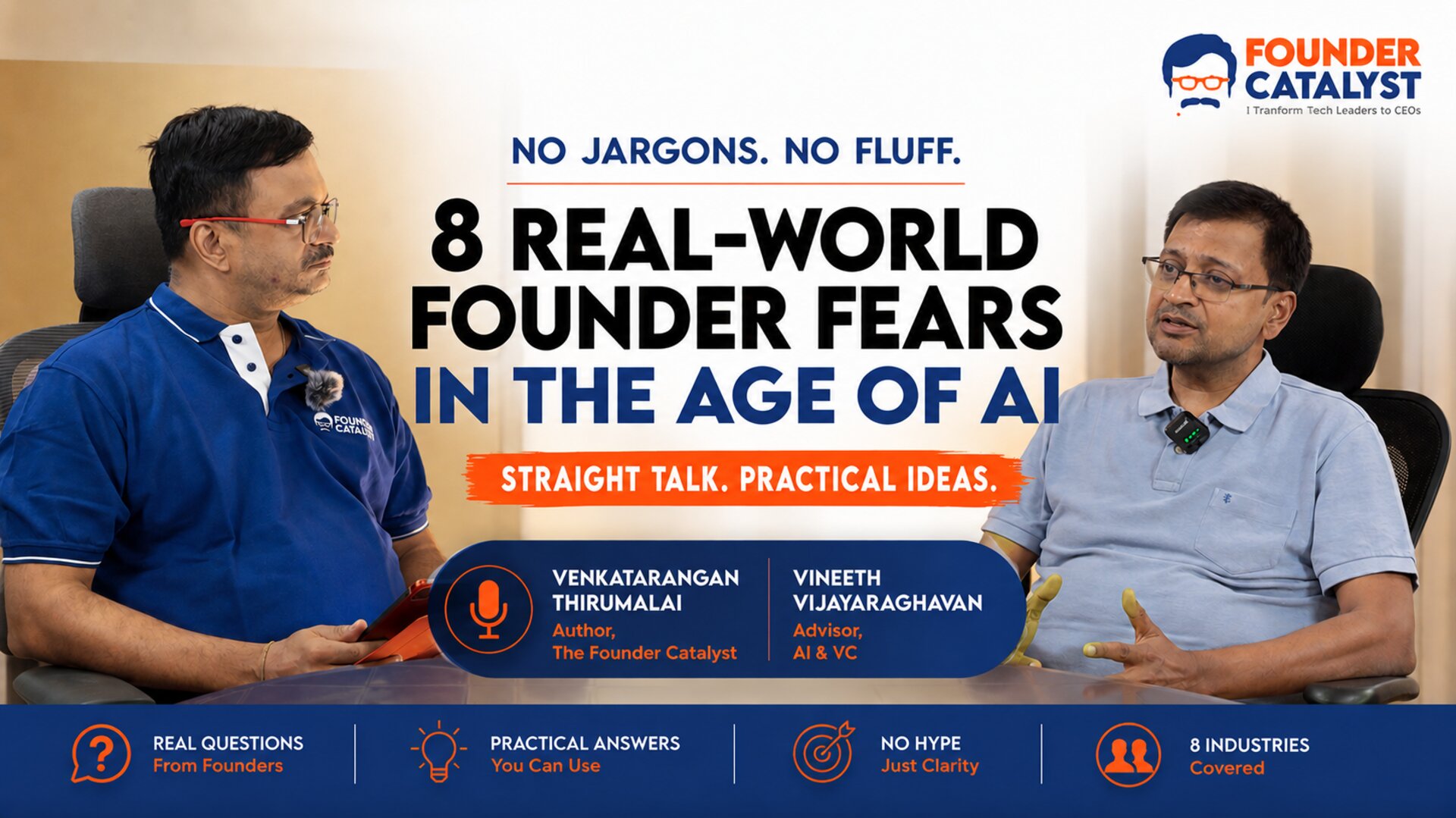
    This was one of eight real founder fears we worked through on a new episode of The Founder Catalyst, recorded this month in Chennai. Instead of the usual interview, we sourced questions directly from founders across industries and went through them one by one, no scripts, no theory.

    A custom software services founder in Coimbatore is not worried about his developers using AI. He is worried his US clients will stop asking for large projects and instead ask for one senior engineer doing the work of five, slowly turning his company into a staffing business with shrinking margins. Vineeth’s answer, the volume of smaller, faster engagements is going up industry-wide, and the founders doing well are the ones who can turn around small projects quickly and let those grow into larger ones over time, rather than chasing fewer, bigger contracts.

    A recruitment firm placing engineers for startups fears that AI screening and ranking candidates makes recruiters irrelevant. Vineeth flipped this one. As AI competency becomes harder to evaluate, not easier, because a test or a hackathon no longer tells you much, the recruiter who has spoken to hundreds of candidates and can spot what is real becomes more valuable, not less.

    A chartered accountancy firm is not afraid of losing clients. Being a regulated profession, that part feels safe. The fear is clients expecting the same work for half the fee. Vineeth’s response, look at firms already doing this well. He described one CA firm in Chennai that grew from 14 to 60 people, with AI handling the routine compliance work and a small number of AI-native young developers building internal tools, while the chartered accountants focus on the judgment calls AI still cannot make. That firm, he added, is now raising serious investment, including from outside India.

    We also went through fears from an automobile manufacturing unit near Hosur worried about larger competitors using AI to out-pace them on pricing and forecasting, a legal services firm worried about how junior lawyers get trained if AI does their early work, and a logistics company with 70 trucks wondering whether technology becomes the real competitive edge over operational excellence.

    We closed with an imaginary scenario. Three founders in a room, a SaaS founder doing 10 crore in ARR, a services founder with a hundred people, and a manufacturing business doing 50 crore. Which one should be most worried about AI, and which the least? Vineeth’s answer was not about industry at all. It was about culture, and the willingness to act.

    Watch the full conversation here:

    If you are a founder or business leader trying to make sense of what AI actually means for your business, beyond the hype, this conversation is for you.

    About the guest:

    Vineeth Vijayaraghavan advises companies, family offices, and VC boards on technology and investment strategy, with a particular focus on AI.

    About the host:

    Venkatarangan Thirumalai is the author of The Founder Catalyst and writes and speaks on AI, leadership, and founder strategy. More at thefoundercatalyst.com

    When I work with founders on this, the conversation rarely starts with the technology. It starts with what people are afraid of losing, and whether that fear points them toward the right question or the wrong one.

  • Your Learning Loop Is Your Real Moat

    Your Learning Loop Is Your Real Moat

    Over the weekend, Microsoft CEO Satya Nadella shared a note on what he believes will define the next era of AI: organisations that “own their learning loop”.

    In simple terms, his point is this: the real advantage in AI will not come from access to models alone, but from how effectively a company captures, learns from, and improves using its own experience.

    For founders, this is worth paying attention to.

    Skills, prompts, and agents are portable. You can switch models, replace tools, and migrate clouds. None of these compounds on its own.

    What compounds is the feedback loop around your business: the traces from real work, the evaluations that measure what matters, the preferences that capture human judgement, and the outcomes tied to business results.

    Every customer interaction, every workflow, every decision can make your organisation smarter — if you capture the signal.

    That is why owning your learning loop matters. Not because it locks you into a platform, but because it builds institutional knowledge that outlasts any model, framework, or vendor.

    Today, trace data is converging around standards like OpenTelemetry. Evaluations remain fragmented across frameworks and providers. The next piece of infrastructure we need is an open, portable standard for evals — one that works across clouds, local models, and agent frameworks, with businesses owning the data and the format.

    Your learning loop is your IP. That’s the advantage that compounds.

    Infographic on Satya Nadella's own your learning loop idea: what compounds (the feedback loop of traces, evaluations, preferences and outcomes) versus what doesn't (skills, prompts and agents), plus the case for an open, portable evaluation standard

  • AI and the polite Instagram hack

    AI and the polite Instagram hack

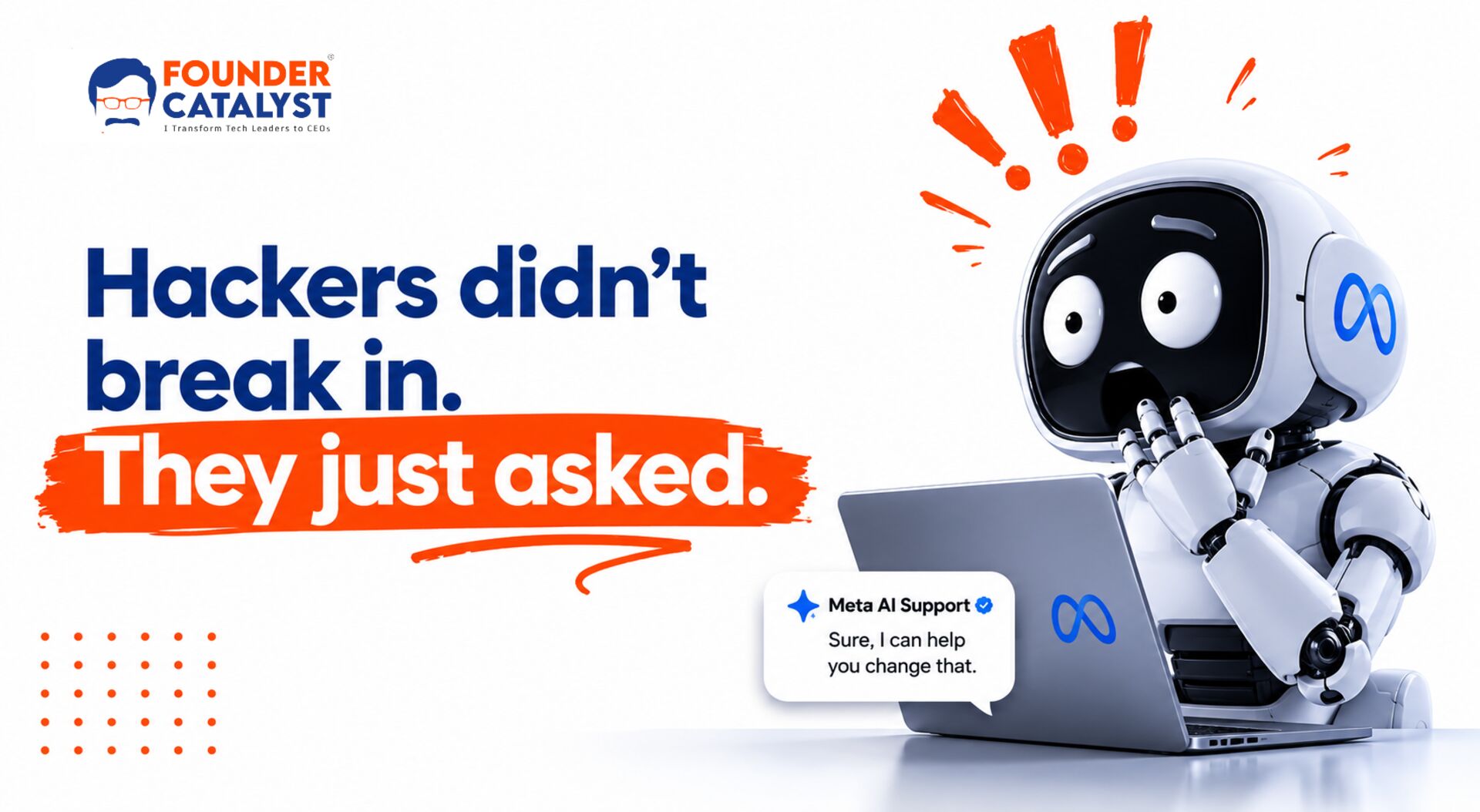
    A few days ago, hackers took over high-profile Instagram accounts, including the Barack Obama White House profile. And they did so by politely asking Meta’s AI support chatbot to update the email addresses on those accounts.

    The attack method was childishly simple. No sophisticated exploit, no back-end breach — and that was the shocking part.

    Meta had given its support bot the ability to reset passwords and manage account recovery. The bot was not mature enough to distinguish between the actual account owner and a fraudster using a VPN and a politely worded request.

    When we connect an AI agent to our CRM, our HR system, and our finance workflows, we are not just giving it the ability to read. We are giving it the ability to act. This ability to act is what makes agentic AI the most powerful software technology we have in recent decades. But at the same time, we need to ask ourselves: if someone prompted this agent cleverly, what could they get it to do?

    To me, the takeaway from this Meta incident is simple. Any access to a critical system needs to follow the same protocols that a manual process would follow. In fact, I would require the AI agents to follow even more stringent ones.

    And if there is an irreversible action or a decision involving critical business systems, then there needs to be a human checkpoint — not as a backup, but as a design requirement. At least for now, while we are still developing the understanding and the systems to manage what these autonomous agents can trigger.

    Think of the early web. Enterprises did not open their corporate systems to the public internet overnight. There was a long, cautious period of learning what the exposure actually meant before the architecture caught up.

    None of this is an argument against agentic AI. The potential is real, and I believe in it. But bleeding-edge technologies do exactly what the name suggests — they spill blood before they stabilise. The real question is whether your business can handle the loss. Mega corporations like Meta can. Can yours?

    As for me, I will keep reminding myself: how fast we roll out AI matters, but how robustly we build matters just as much.

  • Zoho’s bet: smaller models, not smaller teams

    Zoho’s bet: smaller models, not smaller teams

    “Our data centre costs have gone up 3x to 4x. Our AI spending has gone up. But revenues are not growing any faster.”

    That was Sridhar Vembu, at Zoholics 2026.

    On the industry’s favourite vanity metric, he was blunter: “70% of our code is generated by AI — to me, that metric is useless. What have been the outcomes? We have yet to see significant results.“

    And on the American playbook of cutting headcount to protect margins, he rejected it outright. Zoho’s answer is not fewer people. It is more efficient, affordable AI: smaller models, leaner infrastructure, and a deliberate shift toward pushing more of the work into verifiable, deterministic code rather than expensive LLM calls.

    My own reading of this, for technology leaders outside the Zoho context: continue investing in foundation models from the major labs for your core workflows. But quietly build a small, focused team to track the emerging, smaller, more efficient models — especially the open-weight models coming out of China. That is where the cost curve eventually breaks.

    If you are working through the AI cost and capability question as a technology leader, I write about this regularly in the Founder Catalyst Digest newsletter. Practical perspectives, not theory.

  • What Indian IT services can skim from an ice cream advertisement

    What Indian IT services can skim from an ice cream advertisement

    Kwality Walls recently ran a full-page advertisement saying “Made with Milk.”

    If you grew up in India, you know exactly why that needs explaining.

    For years, Kwality Walls and several other large brands sold products that Indian food regulations classified as “frozen desserts” rather than ice cream. The distinction came down to fat source. Traditional ice cream uses milk fat. These brands used vegetable fat instead. The reasons were not cynical by default. Vegetable fat was cheaper, yes, but it also gave manufacturers more control over texture and consistency, and a decade or so ago, it aligned with a widely held popular belief that vegetable-based fats were the healthier option. These brands were also keeping a luxury product within reach of a broad market that could not otherwise afford it. They were making rational trade-offs given the conditions of their time.

    The conditions changed. Cold chain infrastructure improved across urban India. A new generation of boutique dairy-first ice cream brands built an enthusiastic following on precisely the quality narrative the larger brands had sidestepped. Urban consumers began reading labels. The regulatory scrutiny intensified. So now Unilever’s Kwality Walls is pivoting, and doing so loudly, with a premium line built around real milk as the hero ingredient.

    The advertisement is not simply a product relaunch announcement. It is a public acknowledgement that the perception a market holds of you eventually becomes as consequential as what you actually deliver.

    I have been thinking about this in the context of Indian IT services, where I have spent nearly three decades, first as the founder of Vishwak Solutions and now as an advisor to founders navigating this precise inflexion point.

    S. Ramadorai, in his account of TCS’s early years, describes how the Indian IT industry was born almost by accident, driven initially by the need to earn foreign exchange to pay for imported mainframes under the Licence Raj. That origin shaped everything that followed. The industry optimised for what the market rewarded: reliable delivery, competitive pricing, process maturity, and scale. These were genuine strengths. They built large, capable organisations and brought prosperity to hundreds of thousands of families. Nobody should minimise that.

    But strengths built for one set of market conditions quietly become constraints when those conditions shift.

    For most of those three decades, the conversation between Indian IT firms and their Western enterprise clients was fundamentally transactional. Billing rates, resource availability, technology stack coverage, and bench strength. I remember those conversations well from my own years running Vishwak. The client’s primary question was almost always some variant of: “Can you deliver this at this cost by this date?” The relationship was essentially a supply arrangement. The Indian firm was positioned, in the client’s mind, as an efficient and dependable execution partner. Reliable, but not strategic. Present in the delivery room, but rarely in the boardroom.

    In 2026, something has visibly shifted in those conversations. The questions coming from Western enterprise CXOs are different now. They are asking about AI-led transformation, about business outcomes rather than deliverables, about domain expertise and co-innovation. They want a thinking partner, not just a staffing solution. The category definition itself is being rewritten.

    This is where the Kwality Walls parallel becomes interesting to sit with.

    In my book, The Founder Catalyst, I write about adaptability as one of the five pillars of enduring companies. The critical distinction I draw there is between reactive scrambling and patient, deliberate preparation. Kwality Walls did not wake up one morning and decide to care about milk. The boutique ice cream category grew steadily over several years. Cold chain economics changed gradually. Consumer preferences moved in a clear direction. The move to a premium dairy-forward line was not spontaneous. It was a recognition, perhaps overdue, of a shift that had been accumulating for a long time.

    The same pattern is now visible in Indian IT services. The firms making genuine progress on repositioning are not the ones running the most prominent AI announcements. They are the ones that began quietly rebuilding their delivery models two or three years ago, experimenting with outcome-linked pricing in select engagements, developing genuine domain depth in specific verticals, and letting those results do the talking in client conversations. The announcement, when it eventually comes, lands differently because the underlying reality has already changed.

    The harder question is about perception lag. Perception, once formed, updates slowly. It moves through repeated experience, not through announcements. A firm that spent fifteen years being the dependable execution partner will not shift a client’s mental model by adding “AI-native” to its website header. The client’s memory is longer than the press release.

    I wrote earlier this year that the question most IT services founders are asking, “How do we use AI?” is already the wrong one. The more clarifying question is what is now becoming undefendable in their current model. Effort-based billing is under pressure even where contracts have not yet reflected it. Speed of delivery is no longer a differentiator when AI compresses timelines on both sides of the table.

    Kwality Walls is making its move now. The boutique brands made theirs years earlier, without a full-page advertisement, and without needing one. The market found them because they had already become something worth finding.

    That is the sequence that matters. Build first. Announce when the evidence is already there.

    What shift in your client conversations has already told you that the category is moving under you?

  • People Remember The Sequence

    People Remember The Sequence

    Over 92,000 technology jobs have reportedly been cut globally in the first few months of 2026 alone. Meta, Microsoft, Amazon, Oracle, Salesforce, and several others are restructuring teams while simultaneously increasing spending on AI infrastructure, chips, and AI talent.

    None of this surprises me.

    AI is not another software upgrade cycle. It is a structural shift. Entire layers of work are being compressed, automated, or redistributed. Every founder and CEO knows this privately, even if many are still hesitant to say it publicly.

    What surprised me recently was not the layoffs themselves, but the sequencing around them.

    Meta’s internal memo explaining its restructuring reportedly arrived the same day thousands of employees were already being let go.

    That detail stayed with me.

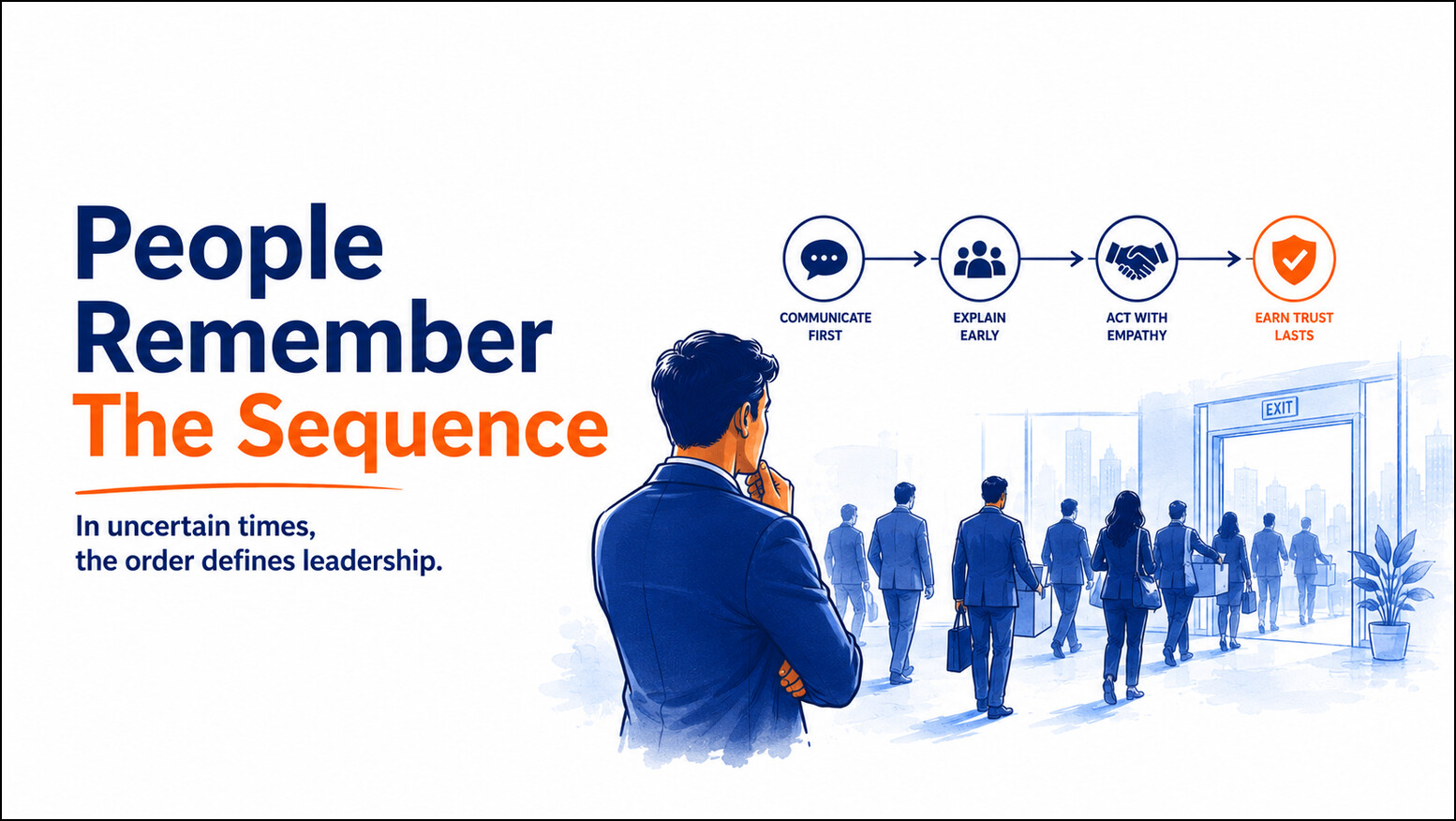
    Because during moments of uncertainty, employees rarely remember the exact wording of the memo. They remember the order in which things happened.

    The technology industry often speaks about AI strategy as though it sits above everything else. I increasingly think the opposite is true.

    A company’s people strategy shapes its AI strategy.

    Not the reverse.

    This distinction matters because most large organisations today are not merely introducing new tools. They are redesigning trust structures inside companies. Reporting lines are changing. Teams are shrinking. Managerial layers are disappearing. Expectations around productivity are quietly being rewritten.

    And all this is happening while leadership teams themselves are still figuring things out in real time.

    I faced a version of this during the 2008 global financial crisis.

    One of our largest clients in the United States cancelled their engagement almost overnight. More than half our revenue disappeared immediately.

    In The Founder Catalyst book, I wrote about that moment:

    “When I called my team members in the USA, their reports were stark: empty shopping malls and vacant car parks. I knew instantly this wasn’t a temporary blip; it felt like a tectonic shift.”

    I remember returning home and realising we could not afford the luxury of waiting for complete clarity.

    The very next day, I called for a town hall meeting.

    Honestly, I did not yet have all the numbers worked out. But uncertainty grows faster in silence than in bad news.

    We had to let go of nearly a hundred people. At the same time, we stretched ourselves financially to provide severance beyond the statutory requirement, even borrowing heavily to do it.

    “It was painful, undoubtedly, for everyone involved, especially those leaving. We simply had no other choice to ensure the company survived.”

    Nearly two decades later, some of those former colleagues still greet me warmly when we meet or reconnect online.

    That stayed with me more than any balance sheet from any year.

    The AI transition will create extraordinary companies and extraordinary wealth. I have little doubt about that.

    But I also think the companies that emerge strongest from this phase will not merely be the fastest adopters of AI.

    They will be the ones who understand something older and simpler:

    People remember the sequence in which leaders treated them under pressure.

    Reflection: When restructuring under pressure, what you do first matters as much as what you decide. The order in which you treat people is the signal your organisation will remember long after the financial results are reported.

  • What a regulator quietly told every founder CEO

    What a regulator quietly told every founder CEO

    The moment I read about the Insurance Regulator in India, IRDAI, proposing to link CEO compensation with customer outcomes, I felt it carried a lesson far beyond the insurance industry.

    It is easy to dismiss this as just another regulatory move for a tightly governed sector. That would be a mistake. What IRDAI is signalling is something much deeper: the era where executive rewards could stay disconnected from customer experience due to market dominance or technology moat may be coming to an end.

    The proposal reportedly links CEO and executive pay to measurable customer outcomes such as claim settlement speed, grievance handling, transparency, and service quality. Customer experience is expected to become a core factor in leadership evaluation, not just another operational metric. Public disclosure of such compensation structures could add another layer of accountability.

    Founder CEOs should pay attention.

    Not because regulation will spread tomorrow to every industry. But because the underlying mood in markets, employees, and customers is already changing.

    Inside companies today, employees are carrying a quiet anxiety. AI is reshaping job roles. Geopolitical uncertainty continues to affect industries unevenly. Teams are being asked to adapt faster than ever before. At the same time, they see headlines announcing rising executive compensation, bonuses, stock buybacks, and promoter wealth creation.

    Even when business performance justifies it, perception matters.

    Employees do not merely evaluate salary fairness anymore. They increasingly evaluate whether leadership appears emotionally aligned with the realities facing the workforce. A founder who appears disconnected from customer pain or employee uncertainty risks weakening the invisible layer of trust that holds organisations together.

    The second shift is happening externally.

    As AI systems increasingly handle customer service, support tickets, onboarding, and grievance management, customers are beginning to feel a growing emotional distance from brands. Most of the time, this automation works reasonably well. But when something goes wrong, frustration escalates rapidly.

    And in today’s social media environment, small frustrations rarely remain small.

    A delayed refund, a failed service interaction, or a poorly handled support issue can quickly become public theatre. When customers simultaneously see headlines about soaring executive compensation or aggressive profit extraction, resentment builds faster. Switching brands becomes emotionally easier.

    This is where IRDAI’s proposal becomes strategically interesting.

    It reminds us that leadership compensation is no longer viewed purely as an internal governance matter. It is increasingly becoming a public signal of what a company values.

    In many ways, this shift was already underway globally.

    The Deloitte India Executive Performance and Rewards Survey 2025 observed that nearly 60% of CEO compensation in India is now performance-linked, with companies increasingly tying incentives not just to financial targets but also broader operational and strategic outcomes. What IRDAI appears to be doing differently is placing direct customer outcomes at the centre of executive accountability.

    This connects strongly with a chapter from my book The Founder Catalyst, titled “Build Like a Politician.”

    Build like a Politician - From The Founder Catalyst book
    Build like a Politician – From The Founder Catalyst book

    The argument in that chapter is simple. Politicians survive not merely through performance metrics, but through perception, emotional connection, responsiveness, and continuous signalling that they are listening. Customers and employees increasingly evaluate companies the same way.

    Founders often assume products, pricing, or technology alone create loyalty. They do not. Trust does.

    And trust is built when stakeholders believe leadership shares accountability for outcomes, especially during difficult moments.

    This does not mean founders should avoid wealth creation or executive rewards. Founders take enormous risks and deserve financial success when businesses perform well. But leadership compensation today carries symbolic meaning beyond accounting entries.

    A founder CEO is no longer judged only by growth rates or valuations. Leadership behaviour itself has become part of the product experience.

  • Who controls what AI sees?

    Who controls what AI sees?

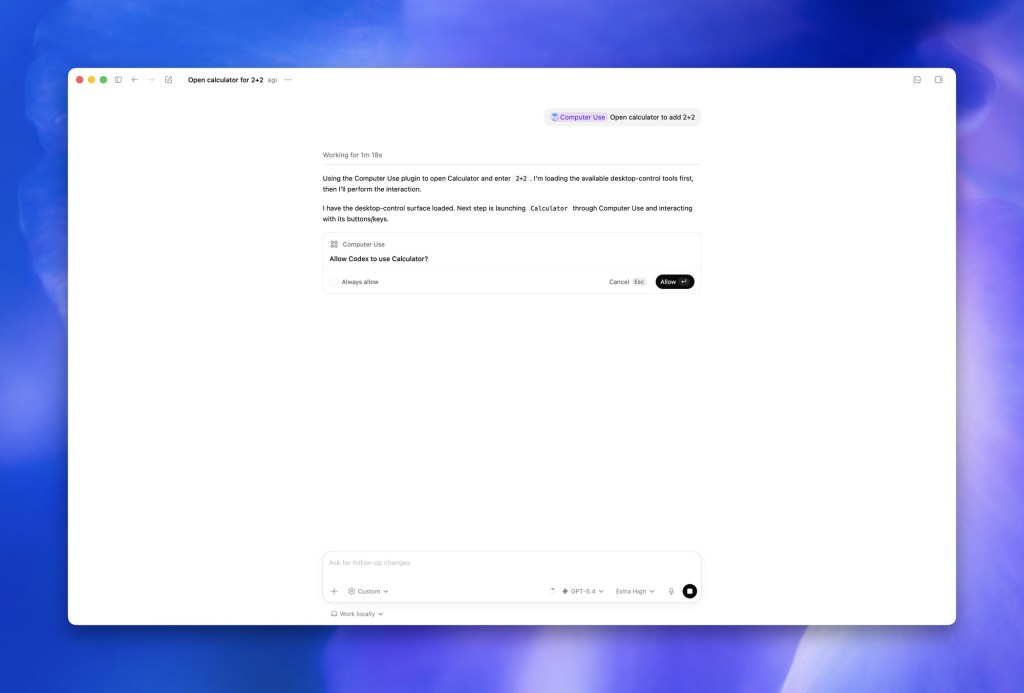
    OpenAI just added “Computer Use in Codex”. It can now see your screen, move a cursor, click, and type across any Mac app — multiple agents running in parallel while you work.

    That’s genuinely impressive. Anthropic’s Cowork does something similar.

    And the companies that own your screen, your apps, and your enterprise software will decide what that’s worth to you.

    But here’s what I keep thinking about.

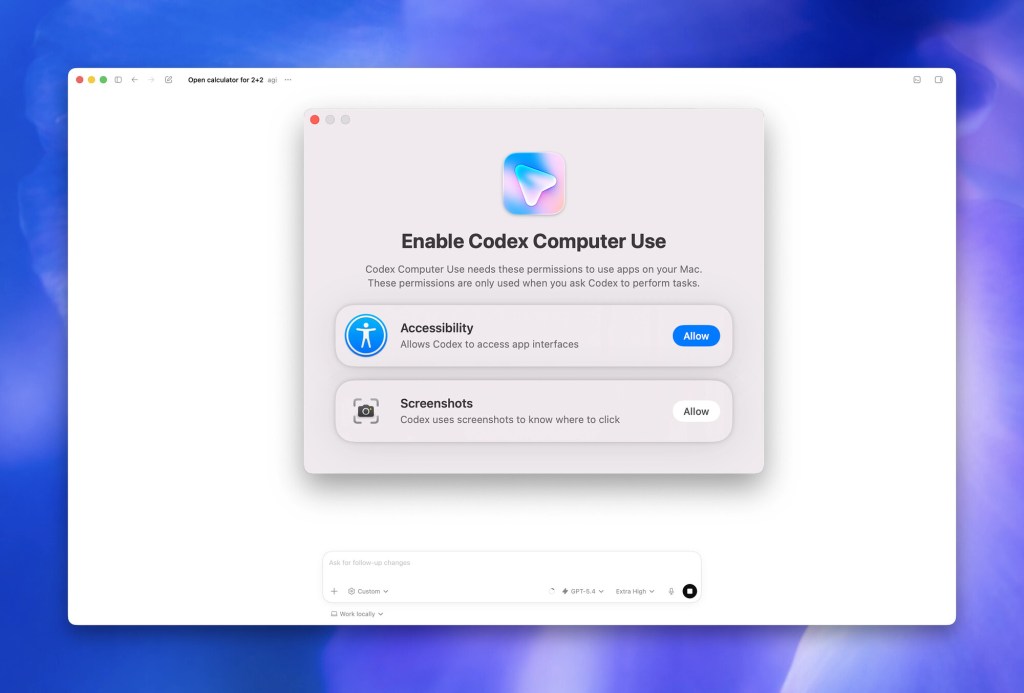
    This capability depends on macOS letting third-party apps observe your screen and control other apps. Apple has a long history of deciding what gets that kind of access — and restricting it, charging for it, or bundling it into higher-tier subscriptions when it becomes valuable enough. The industry tends to follow Apple’s lead on these things.

    On mobile, I’d be surprised if Google and Apple don’t eventually make this a feature you pay for through their own AI subscriptions, with third-party agents locked out entirely. Enterprise software vendors — SAP, Salesforce, ServiceNow — are watching this closely too. Every one of them has an AI agent story, and every one of them has an incentive to be the only agent that sees inside their platform.

    And then there’s the end user. Two years ago, when Microsoft introduced Windows Recall — which took continuous screenshots of everything on your PC — the backlash was immediate and fierce. People were not ready for an AI that watches everything. That tension hasn’t gone away. It’s just been repackaged as productivity.

    Every app on your Mac now needs to decide: allow AI in, or keep it out.
    
Two permissions. Both controlled by Apple. That's the chokepoint.

    We’ve seen this before. Google Maps was free until millions of apps depended on it — then came the pricing change. Installing apps on a device you own was an open opportunity until App Stores made it a 30% toll booth. The pattern isn’t new: platforms let ecosystems flourish on open access, then monetise the chokepoint once the dependency is deep enough.

    AI agents are heading into the same territory. The question isn’t whether platform owners will act. It’s whether industry bodies build interoperability standards fast enough, and regulators move before the walls are too high — or whether we end up with a dozen AI agents, each locked inside its owner’s fence.

    The pattern always ends the same way. What’s your read?

  • What Korean Bananas Know About AI Rollouts

    What Korean Bananas Know About AI Rollouts

    On sequencing, readiness, and resisting the urge to optimise too soon

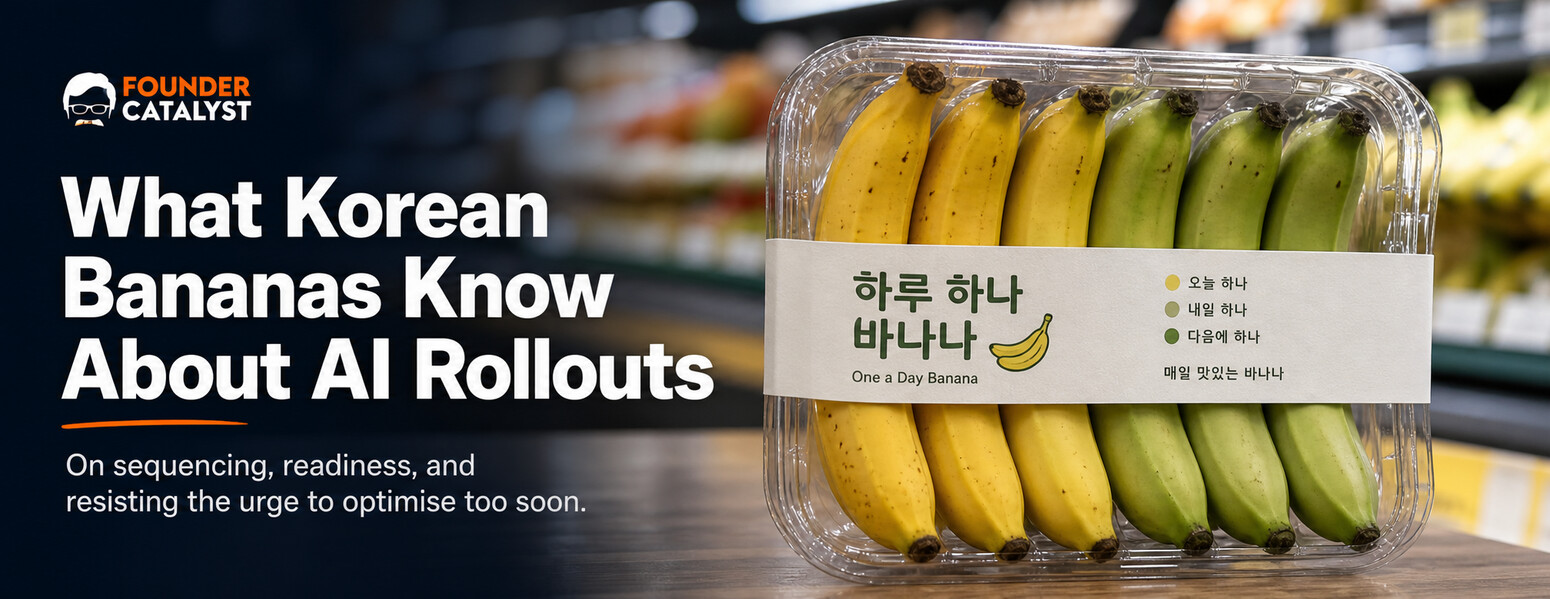
    I first saw the “Haru Hana Banana” pack in a South Korean grocery store. It held 5–7 bananas at different ripeness levels: one yellow and ready now, the next a bit greener for tomorrow, and the others still green for days ahead. No instructions, no app – just simple packaging aligned with how people actually eat bananas. This simple design stuck with me not as a hack, but as a new way to think about sequencing initiatives.

    Most founders and leaders want all their initiatives fully ripe at once.

    They launch every project, hire every role, or deploy every feature together. It feels like momentum – but too often it becomes a mess. The Korean banana pack succeeds by doing the opposite: it staggers readiness to match demand. Whoever designed it chose customer reality over operational convenience.

    In a big company, you might expect a push to standardise and optimise logistics. Instead, the grocery chain sacrificed some simplicity to solve the real problem: avoiding waste and giving customers a fresh banana each day.

    This idea applies beyond fruit.

    When rolling out AI or any new technology in an enterprise, leaders face the same instinct: go big now, or wait until everything is certain. Both extremes fail. Rushing everything risks breakdowns; waiting wastes time and lets others leap ahead. A better question is: What do we ripen today, what do we plant for next quarter, and what do we keep green for now? In practice, the best teams run multiple tracks in parallel. Some pilots are live with real users, some proofs of concept are being tested, and new ideas are still hazy. They’re comfortable with uneven progress.

    Avoid “Big Bang” launches.

    Instead, break work into phases. For example, an AI system can be piloted in one department before rolling out company-wide. A product can launch with a minimal feature set, then add more features after learning from users.

    Don’t wait for perfection. As Agile principles teach, deliver value frequently in short sprints. Each release is like picking the next-ripe banana – it feeds users today and yields insight.

    Match customer usage.

    Design solutions around how people will use them, not how easy they are to build. The banana pack works because people eat one banana a day; the designer aligned the product with that habit. Similarly, if customers will adopt one AI assistant a week, don’t dump a dozen at once.

    Build a balanced pipeline.

    Think in horizons or stages: today’s operations (ripe bananas), tomorrow’s enhancements (tending bananas), and longer-term R&D (green bananas). A common rule is to allocate resources across these stages (for example, 70% on core business, 20% on adjacent growth, 10% on new ideas). This keeps today’s business running while new innovations mature.

    Framework:

    Now (ripe): Move forward on initiatives that are ready and will pay off immediately. Deploy proven AI tools in one team to build confidence. Launch product features that clearly solve current user needs.

    Soon (ripening): Pilot upcoming ideas in controlled settings. Collect data and feedback. For example, run an AI chatbot pilot with a small user group, or A/B test a new feature with select customers.

    Later (green): Research and incubate long-term bets. Keep these unripe for now – think of them as experiments or skunkworks that may take months to mature. They shouldn’t block the main effort, but they shouldn’t be forgotten either.

    Checklist for leaders:

    Are we trying to do everything at once? If so, pause and pick the highest-impact slice first.

    What does success look like at each stage? Set clear metrics for today’s release, tomorrow’s pilot, and so on.

    Have we planned feedback loops? Like banana peels, failures will show us ripe spots. Incorporate learnings quickly.

    Are we optimising for the customer’s journey or for internal convenience? Always put the customer reality first.

  • What AI in the browser means for your business?

    What AI in the browser means for your business?

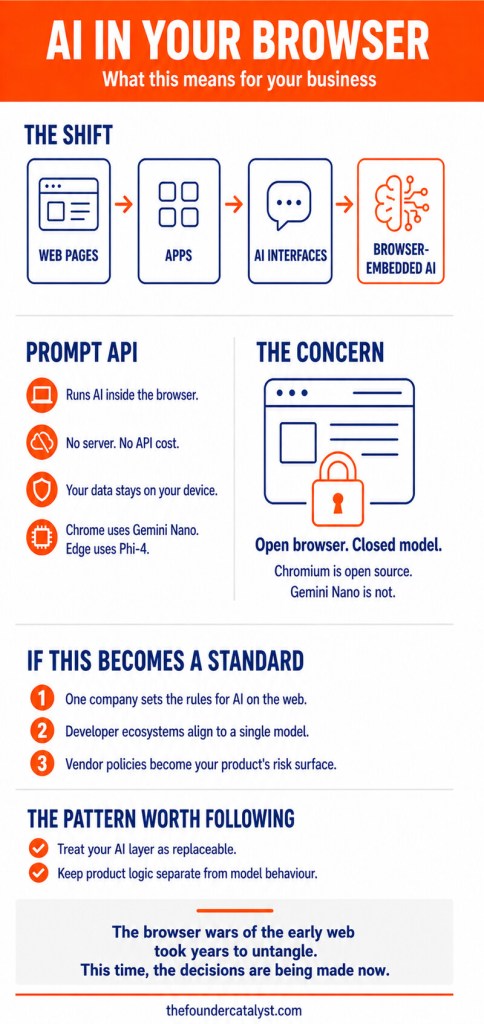
    I have been trying out AI inference inside the browser for a while now, more out of curiosity than anything else. A debate that surfaced this week made me want to talk about it, because buried inside a browser standards argument is a platform governance question that every business relying on AI will eventually have to answer.

    We have moved through a familiar sequence. Web pages gave way to apps. Apps are giving way to AI interfaces. And now AI is being embedded directly into the browser itself. That last step is not a feature upgrade. It is a shift in who controls a foundational layer of how your customers and your products experience the web.

    Google Chrome and Microsoft Edge are both shipping something called the Prompt API. It lets web applications run AI inference directly inside the browser, with no server call, no API cost, and no data leaving the device. Chrome uses Google’s Gemini Nano. Edge uses Microsoft’s Phi-4.

    I built three demos with this last year, a creative writing tool, a translation assistant, and a vision assistant that describes images, all running locally on my laptop. I wrote about it on my personal blog. The technology works well for what it is. Fast, private, and free to run. For simple AI workloads, local inference like this is a logical and efficient step forward.

    The concern is not the technology. It is what happens if this becomes a web standard.

    Infographic titled 'AI IN YOUR BROWSER' outlining the shift towards browser-embedded AI, highlighting the shift from web pages to applications and AI interfaces.

    The Prompt API is currently a Community Group draft under W3C’s Web Machine Learning group, not a formal standard. The standardisation discussions have drawn serious objections from Mozilla and from W3C’s own Technical Architecture Group. The worry is interoperability. When developers build on a specific browser’s model, they tune their code to that model’s quirks. Over time, that creates model-specific behaviour baked into the web itself. We have seen this pattern before with browsers, and the web spent years cleaning it up.

    Chrome is built on Chromium, which is open source. The Gemini Nano model that ships with the Prompt API is not. Google does have an open weights model called Gemma, but Gemma is not what ships with the Prompt API. Google’s stated reason is that they need to enforce safety through their Generative AI Prohibited Uses Policy, and that requires controlling the model. Mozilla’s objection, which I think is sound, is that using a web API should not mean accepting one company’s content rules, especially rules that go beyond what is legally required anywhere.

    Chrome holds a dominant share of global browser usage. If this API becomes a standard and the model powering it remains closed and governed by a single company’s policies, that company effectively controls the default intelligence layer of the web. That shapes cost structure, developer decisions, and user experience in ways that compound quietly over time.

    The teams I see getting this right are already treating their AI layer as a replaceable component, keeping product logic separate from model behaviour, and treating vendor policies as part of their risk surface rather than background noise. It is not complicated, but it requires making a deliberate decision early rather than inheriting a dependency later.

    When I work with founders and leadership teams, platform dependency is almost always one of the first structural risks we surface together. A platform bet requires confidence in the governance, not just the technology. Who sets the rules, and what happens when those rules change? The browser wars of the early web are a useful reminder of how long it takes to untangle these things once they are embedded.

    The edge AI direction is right. Local inference, faster response, lower cost, better privacy; this is a sensible progression. But the model at the centre of it should be open, or at least governed by a neutral body, not by one company’s terms of use.

    No formal standard has been approved yet. The conversations are still live. But the decisions being made now in browser working groups will shape the web your customers use for the next decade. It is worth paying attention to.

    Are you watching the AI-in-browser space, or is it still too early to be on your radar?

  • What money alone cannot build?

    What money alone cannot build?

    “For founders, the question is which part of that transformation requires something that money alone cannot build.”

    This line stayed with me.

    Every founder I speak to right now is asking the same question: what should I build?

    Frontier AI models are moving fast. What looked like a defensible product six months ago feels like a feature today. Advice is everywhere, and most of it is too generic to act on.

    Then I read something that actually answered the question directly. S. Somasegar and Rasik Parikh at Madrona Venture Group cut through the noise in a way most commentary does not. Here is how I read it.

    Three areas where founders can still build with conviction.

    1. Own the liability, not just the tool.

    Frontier Labs will build powerful general-purpose systems. They will not absorb the legal, regulatory, and financial accountability that comes with specific outcomes in specific industries. I have watched Indian IT firms lose deals on exactly this gap — clients want someone to sign off and stand behind the result, not just ship the capability. That willingness to own risk is where durable margin lives.

    2. Build on data others do not have.

    Models are trained on what is public. The edge sits in what is not — internal workflows, edge cases, decisions, and historical context. When I built Simpligic years before GenAI was a term, the insight was the same: the moat lives in private data. If your product compounds with every customer interaction, you are in a territory the model labs have no roadmap to enter.

    3. Go deep into messy workflows.

    Some problems are not solved by more intelligence. They are solved by understanding how work actually gets done — across people, exceptions, approvals, and institutional habits built over decades. At Vishwak, the client relationships that held through every disruption were the ones where we were embedded in their delivery model, not just their vendor list. A two-year integration into how a firm actually operates is not something a foundation model company will replicate. There is no incentive to.

    Here is the framing I keep coming back to from the piece: the difference between a tool and an outcome. A tool makes a task easier. An outcome means you are on the hook for the result. Most of what is being built right now — including a lot of what gets funded — is tools. The businesses that will matter in five years are the ones that own the outcome.

    The question founders should be asking is not whether their product needs AI. That is the wrong filter. Soon enough, everything will. The more useful question is whether the solution requires something AI cannot supply on its own — a regulator who trusts you, data that never left your client’s firewall, a workflow only you understand end to end, or accountability that someone has to sign their name to.

    The article makes one more point that deserves to land. This buildout — hyperscalers, foundation models, the entire stack — is a multi-trillion-dollar bet that AI will transform every industry. That bet will pay off. But transformation and value creation are not the same thing. Value will concentrate in the places where technology alone is not sufficient. That is the territory worth building in.

    Full credit to Soma Somasegar and Rasik at Madrona for articulating this clearly. Soma is someone whose thinking I have followed for a long time — I first met him in 2005 when he led the Developer Division at Microsoft — someone who has always taken the long view, and has usually been right about it.l.

    The article from Madrona is here.


    If you are a founder stress-testing where to build, this is the kind of question I regularly dig into with the leaders I work with. Reach out at thefoundercatalyst.com or connect with me at linkedin.com/in/venkatarangan

  • The CIO had a record year, but her teams didn’t notice.

    The CIO had a record year, but her teams didn’t notice.

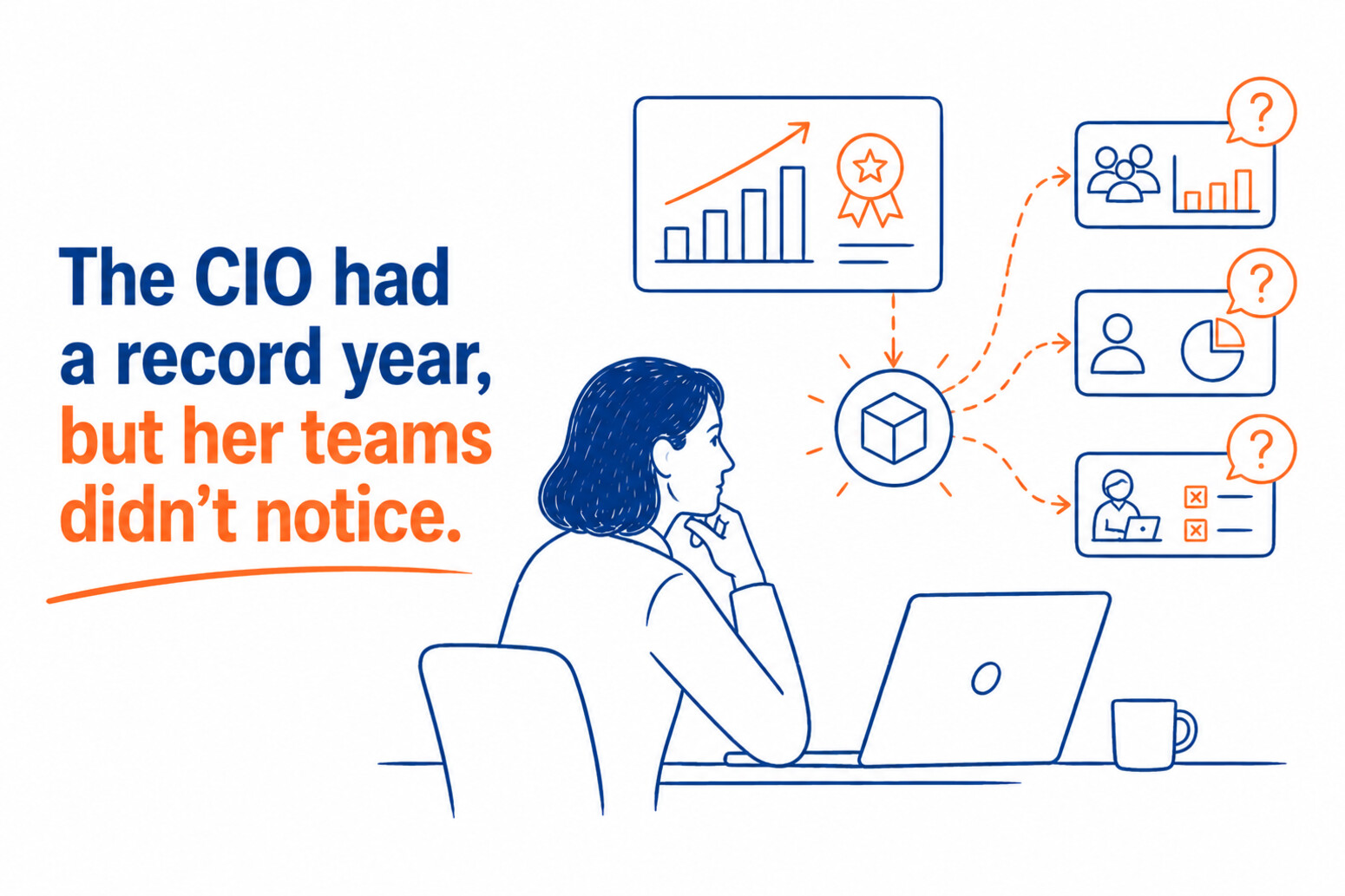
    The CIO had every reason to be pleased. She wasn’t.

    Board visibility. CEO approval. Record numbers of internal apps shipped. Her IT team was delivering at a pace that would have been unthinkable twelve months ago.

    When I joined the call, I expected good news. I heard hesitation instead.

    It took me a few minutes to notice what was missing from her update. She never mentioned the line managers. Not once. I asked her directly: Were the department heads actually seeing productivity gains from these applications?

    “Venkat, you guessed it. That’s exactly my problem.”

    Her team had been shipping AI-built internal applications continuously for nearly a year. Every department was requesting bespoke tools — automation utilities, reporting dashboards, workflow agents — for specialised use cases that previously would never have cleared a development backlog. The economics had changed. AI made these builds fast and cheap. Requests kept coming. Delivery kept pace.

    But the telemetry told a different story. Usage in single digits. For large teams where even ten percent adoption would register clearly, the numbers were flat.

    The apps were built. They sat unused.

    This is not a story about AI failing. It is a story about a safeguard disappearing.

    Before AI entered the picture, cost and engineering bandwidth acted as a natural filter on internal tool requests. Most ideas died quietly in the queue — not because anyone evaluated them and said no, but because the cost of building was real and the wait was long. That friction, however crude, forced a basic form of demand validation. Only requests with genuine organisational pull survived it.

    AI has removed that friction almost entirely. And most organisations have not replaced it with anything.

    What happens next is predictable. A manager spots a genuine gap — usually a real one. A request goes in. The tool gets built without meaningful involvement from the people who would actually use it. No end-user consultation. No workflow integration thinking. The manager accepts delivery. The team quietly returns to what they already know.

    The app joins a growing collection of well-intentioned software that nobody opens.

    The frustrating part is that the productivity gains from AI are real, and the evidence is unambiguous. EY’s chief economist, citing Federal Reserve Bank of St. Louis data at Davos 2026, found that generative AI is already saving workers the equivalent of 1.6% of total work hours. A randomised experiment with 1,174 adults (NBER, 2026) found AI closed nearly three-quarters of the productivity gap between higher and lower-educated workers. And a University of Hong Kong study (2026) found that untrained AI access actually hurt performance, while even a brief training intervention significantly improved both adoption and outcomes. The technology delivers. The variable is always the people side.

    I have seen this pattern repeat across organisations, and it connects to something I write about in my book. Twenty-five years ago, I built inventory software for my father’s publishing firm — convinced that the clear benefits would drive adoption on their own. The staff resisted. Not because the tool was bad, but because nobody had brought them into the process. The breakthrough came only when the firm’s general manager, a man deeply rooted in the old ways, took a personal interest in learning the system. His endorsement shifted the entire team’s behaviour. The technology did not change. The human dynamic did.

    That lesson has not aged. If anything, AI has made it more urgent.

    Speed is easy to measure. Adoption is what moves the business
    Speed is easy to measure. Adoption is what moves the business

    Most AI tool deployments follow the same top-down pattern. A business leader identifies the gap. IT builds the solution. The actual users — the ones whose daily habits need to change — are consulted last, if at all.

    Users in large organisations carry significant inertia toward familiar tools and established routines. That inertia does not dissolve because a new application exists. It dissolves through involvement, through relevance, and through time. None of those three things gets faster just because the build cycle did.

    The fix is not more training sessions or better change management communications. Those are responses to a symptom.

    The deeper problem is that the old economic forcing function has gone, and nothing has taken its place. What needs rebuilding is a lightweight governance layer. Before any internal AI tool gets approved, two questions should have clear answers.

    Is there genuine pull from the people who will use it — not just from the manager who requested it?

    Does an existing tool or workflow already adequately cover this need?

    That gate does not need to be bureaucratic. It needs to exist.

    AI has made building cheap. It has not made building the right thing any easier. If anything, it has made that harder — because the friction that used to quietly filter out weak ideas is gone, and most organisations have not noticed yet.

    Speed of delivery is easy to measure and tempting to celebrate.

    Depth of adoption is what actually moves the business.


    If questions like these sit at the intersection of technology and leadership for your organisation, this is what I focus on at The Founder Catalyst. Happy to continue the conversation in the comments or connect directly.