
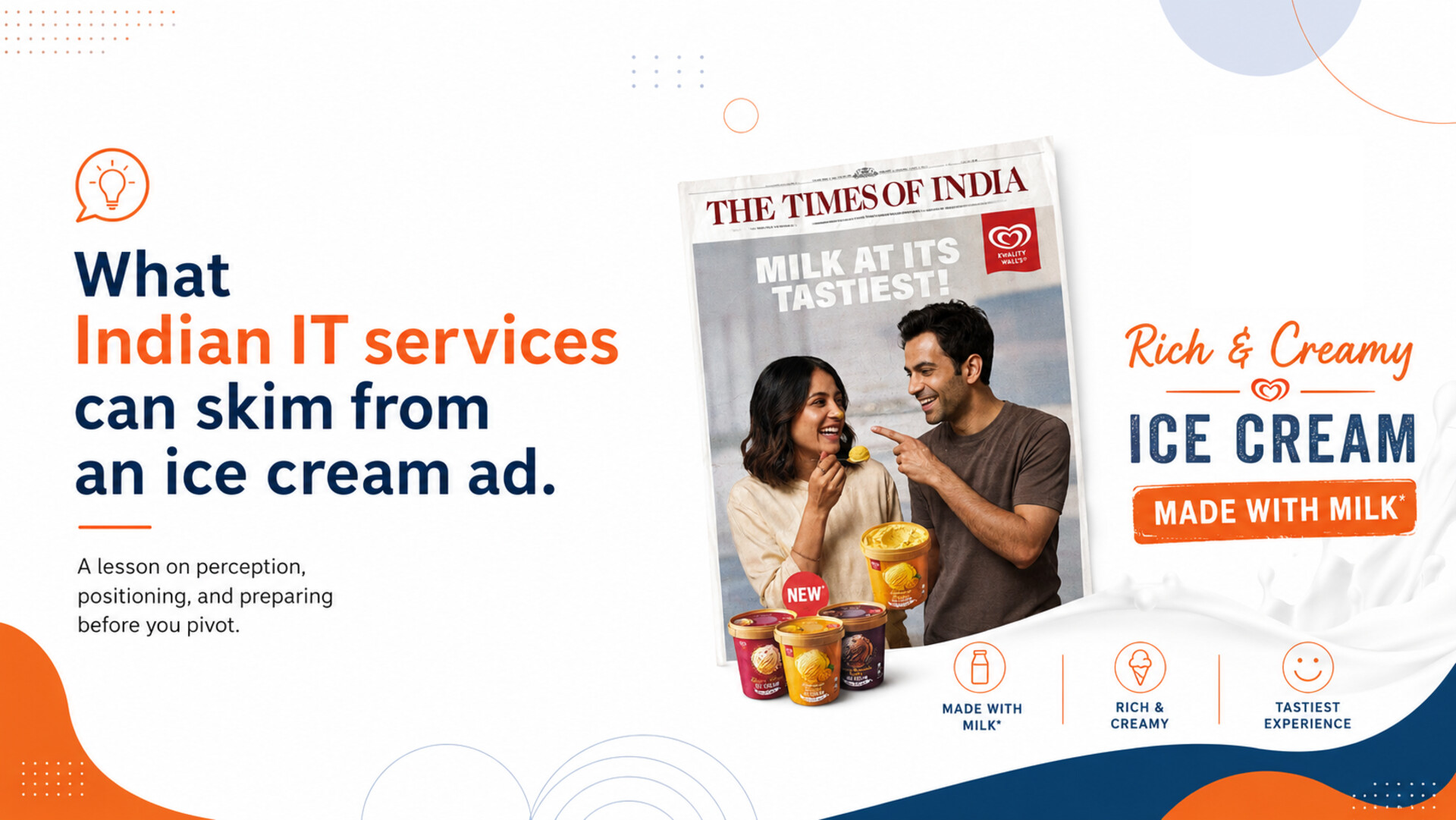
Kwality Walls recently ran a full-page advertisement saying “Made with Milk.”
If you grew up in India, you know exactly why that needs explaining.
For years, Kwality Walls and several other large brands sold products that Indian food regulations classified as “frozen desserts” rather than ice cream. The distinction came down to fat source. Traditional ice cream uses milk fat. These brands used vegetable fat instead. The reasons were not cynical by default. Vegetable fat was cheaper, yes, but it also gave manufacturers more control over texture and consistency, and a decade or so ago, it aligned with a widely held popular belief that vegetable-based fats were the healthier option. These brands were also keeping a luxury product within reach of a broad market that could not otherwise afford it. They were making rational trade-offs given the conditions of their time.
The conditions changed. Cold chain infrastructure improved across urban India. A new generation of boutique dairy-first ice cream brands built an enthusiastic following on precisely the quality narrative the larger brands had sidestepped. Urban consumers began reading labels. The regulatory scrutiny intensified. So now Unilever’s Kwality Walls is pivoting, and doing so loudly, with a premium line built around real milk as the hero ingredient.
The advertisement is not simply a product relaunch announcement. It is a public acknowledgement that the perception a market holds of you eventually becomes as consequential as what you actually deliver.
I have been thinking about this in the context of Indian IT services, where I have spent nearly three decades, first as the founder of Vishwak Solutions and now as an advisor to founders navigating this precise inflexion point.
S. Ramadorai, in his account of TCS’s early years, describes how the Indian IT industry was born almost by accident, driven initially by the need to earn foreign exchange to pay for imported mainframes under the Licence Raj. That origin shaped everything that followed. The industry optimised for what the market rewarded: reliable delivery, competitive pricing, process maturity, and scale. These were genuine strengths. They built large, capable organisations and brought prosperity to hundreds of thousands of families. Nobody should minimise that.
But strengths built for one set of market conditions quietly become constraints when those conditions shift.
For most of those three decades, the conversation between Indian IT firms and their Western enterprise clients was fundamentally transactional. Billing rates, resource availability, technology stack coverage, and bench strength. I remember those conversations well from my own years running Vishwak. The client’s primary question was almost always some variant of: “Can you deliver this at this cost by this date?” The relationship was essentially a supply arrangement. The Indian firm was positioned, in the client’s mind, as an efficient and dependable execution partner. Reliable, but not strategic. Present in the delivery room, but rarely in the boardroom.
In 2026, something has visibly shifted in those conversations. The questions coming from Western enterprise CXOs are different now. They are asking about AI-led transformation, about business outcomes rather than deliverables, about domain expertise and co-innovation. They want a thinking partner, not just a staffing solution. The category definition itself is being rewritten.
This is where the Kwality Walls parallel becomes interesting to sit with.
In my book, The Founder Catalyst, I write about adaptability as one of the five pillars of enduring companies. The critical distinction I draw there is between reactive scrambling and patient, deliberate preparation. Kwality Walls did not wake up one morning and decide to care about milk. The boutique ice cream category grew steadily over several years. Cold chain economics changed gradually. Consumer preferences moved in a clear direction. The move to a premium dairy-forward line was not spontaneous. It was a recognition, perhaps overdue, of a shift that had been accumulating for a long time.
The same pattern is now visible in Indian IT services. The firms making genuine progress on repositioning are not the ones running the most prominent AI announcements. They are the ones that began quietly rebuilding their delivery models two or three years ago, experimenting with outcome-linked pricing in select engagements, developing genuine domain depth in specific verticals, and letting those results do the talking in client conversations. The announcement, when it eventually comes, lands differently because the underlying reality has already changed.
The harder question is about perception lag. Perception, once formed, updates slowly. It moves through repeated experience, not through announcements. A firm that spent fifteen years being the dependable execution partner will not shift a client’s mental model by adding “AI-native” to its website header. The client’s memory is longer than the press release.
I wrote earlier this year that the question most IT services founders are asking, “How do we use AI?” is already the wrong one. The more clarifying question is what is now becoming undefendable in their current model. Effort-based billing is under pressure even where contracts have not yet reflected it. Speed of delivery is no longer a differentiator when AI compresses timelines on both sides of the table.
Kwality Walls is making its move now. The boutique brands made theirs years earlier, without a full-page advertisement, and without needing one. The market found them because they had already become something worth finding.
That is the sequence that matters. Build first. Announce when the evidence is already there.
What shift in your client conversations has already told you that the category is moving under you?
Leave a Reply