Category: News & industry updates

  • What a weekend Solitaire game told me about the app economy

    What a weekend Solitaire game told me about the app economy

    Last week I built a Solitaire game. Not because the world needed one, but because GPT-6 Astra had just released and I wanted to feel what it could actually do.

    I picked a project close to home: an ad-free Solitaire game that runs in the browser, on any device, no login, no cloud, nothing leaving the machine. Draw 1 Klondike, three difficulty levels, the ability to resume mid-game, Chola and Mughal-era visuals, period-appropriate music.

    One detailed prompt covered the brief. After that, three small tweaks and two rounds of corrections. That was the entire interaction. GPT-6 Astra, working through GitHub Copilot, wrote the code, set up the repository, and published it. I tested the finished game myself. No code review, no hand-holding.

    The game itself is unremarkable. What it proves is not.

    A working, polished product, in a category people used to build small businesses on, took one prompt, a handful of corrections, and a weekend. No team. No funding.

    I have spent enough years around software to know what changed here and what did not. The Solitaire game never needed judgment. The brief was clear, the constraints were simple, and the output could be checked by playing a few hands. That is exactly the kind of task a model can now carry end to end, with a human only at the two ends: writing the brief and checking the result.

    Most consumer utilities sit in that same zone. A converter, a habit tracker, a simple game, a single-purpose calculator. No network effect holds a user in place. No real infrastructure cost keeps a competitor out. The business case for these apps was never really the software. It was the cost of building it well. That cost has just collapsed.

    This does not mean software is going away, or that everything is suddenly free. It means the question a founder building a utility-style product has to ask has changed. Not “can I build this,” but “why would anyone pay me to keep building this, when they can build their own version in a weekend.”

    Apps built on integration, on switching cost, on data that compounds, or on infrastructure that is expensive to replicate, are not touched by this in the same way. Their advantage was never the code. It was everything around the code that a weekend prompt cannot reach.

    When I work with founders in Chennai, this is usually the first question I push them on: is your product defensible because of what it does, or because of what it took to build it. After this week, the second kind of answer has a much shorter shelf life.

    I still have the Solitaire game open on my laptop. It plays well, the artwork turned out nice, and I have already moved on to testing what else fits in a weekend. That, more than the finished game, is the part worth paying attention to.

    If you want to see what all that took, the game is live to play here, and the code behind it, prompt-generated and untouched by hand, is on GitHub here.
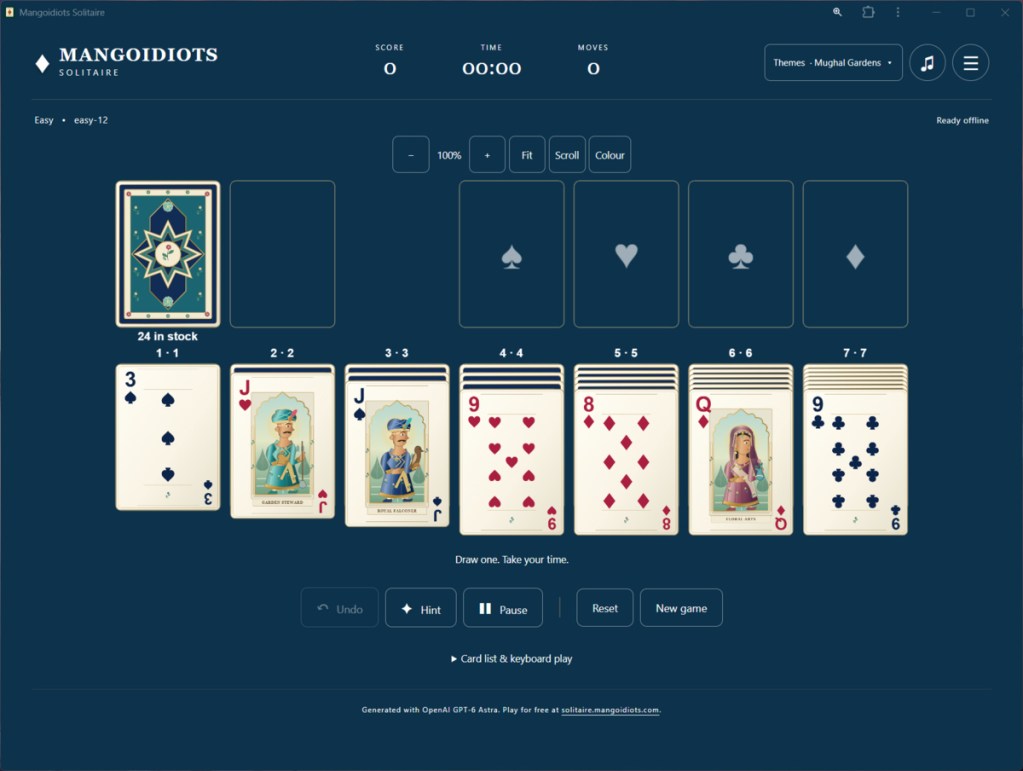
    Screenshot of Mangoidiots Solitaire showing a Klondike game in progress with Mughal Gardens themed playing cards
    Screenshot of Mangoidiots Solitaire mid-game with several tableau columns nearly emptied and a score of zero after 125 moves
  • When AI replaced the product

    When AI replaced the product

    Many founders in India may not recognise the name Chegg. Yet, for nearly two decades, it was one of the most successful education technology companies in America.

    Founded in 2005, Chegg built a subscription business around helping students with textbook solutions, homework assistance and tutoring. For millions of college students, it became a daily habit. If you had a difficult assignment, chances were you searched Google, landed on Chegg, and paid for access to the answer.

    Then came ChatGPT.

    Unlike many businesses that found AI to be another productivity tool, Chegg faced something far more fundamental. Students no longer needed to search for answers. They could simply ask an AI assistant. The experience was faster, conversational, and often free.

    The change in user behaviour happened much faster than anyone expected.

    The numbers reflect that shift. Chegg’s revenue declined from about US$767 million in 2022 to about US$377 million in 2025. During the same period, the company went through repeated restructurings, reduced its workforce significantly, closed offices and began searching for new growth areas beyond its original business.

    To be fair, AI was not the only reason. College enrolments softened in some markets. Textbook usage changed. Google’s AI-generated search summaries reduced traffic to many educational websites. Competition increased. Even Chegg acknowledges that these forces arrived together.

    What makes Chegg’s story remarkable is not that a company struggled. Businesses have always faced disruption.

    What makes it remarkable is that its core product was displaced so directly.

    In many industries, AI helps employees work faster, write better code, analyse data or improve customer support. The business still exists; AI simply makes it more efficient.

    For Chegg, AI became the product that customers wanted instead.

    That distinction is important.

    Looking back, Chegg will probably be remembered as one of the first large, publicly listed companies whose primary value proposition was overtaken by generative AI within a remarkably short period.

    Whether the company successfully reinvents itself remains to be seen. It is still operating, investing in new businesses and attempting to find its next chapter. But its journey is already an important business story.

    Technology disruptions are usually discussed in hindsight, years after they unfold. This one is happening in front of us.

    Twenty years from now, when people write about the early impact of generative AI on business, I suspect Chegg will occupy a chapter of its own.

  • What Indian IT services can skim from an ice cream advertisement

    What Indian IT services can skim from an ice cream advertisement

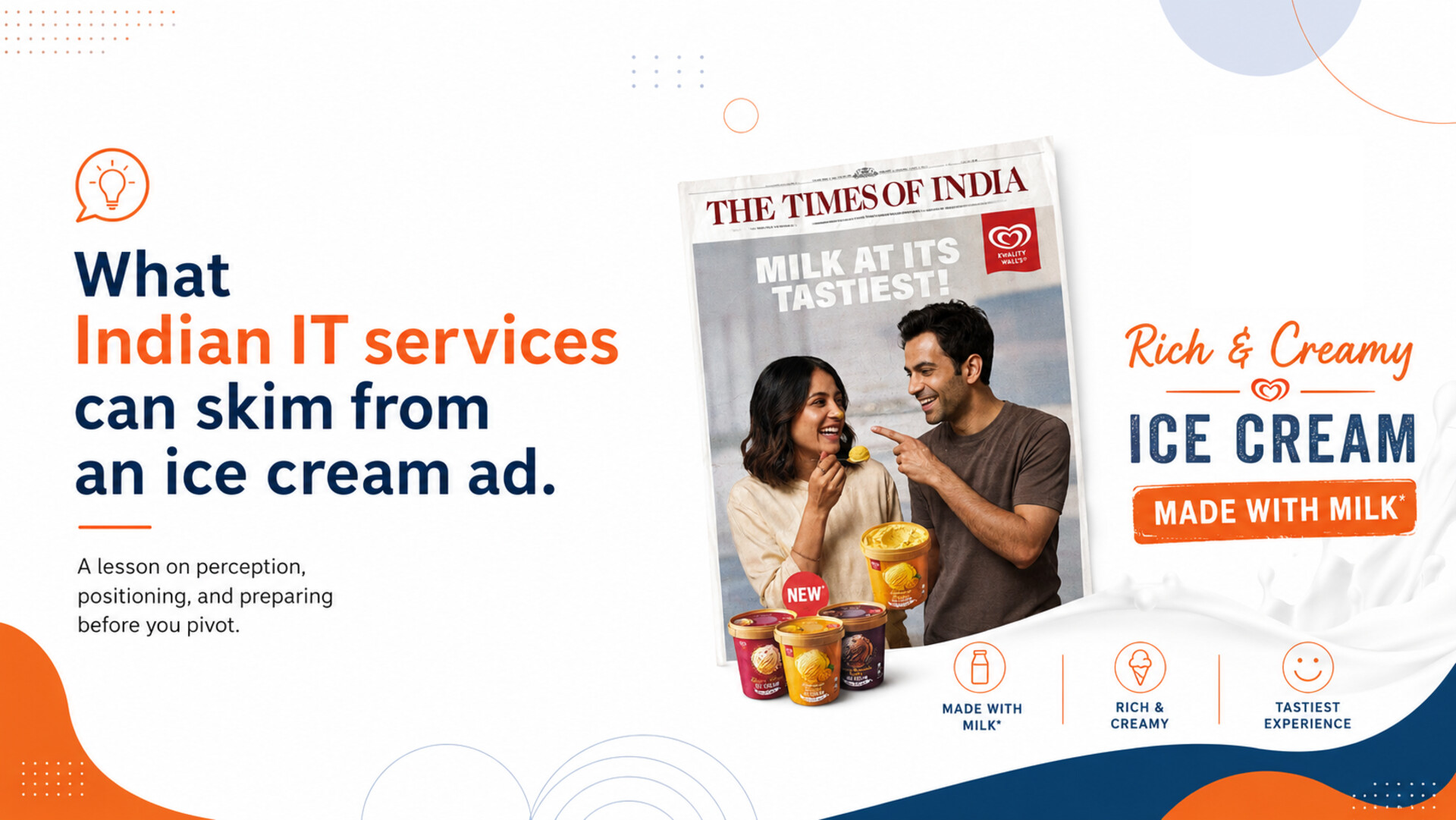
    Kwality Walls recently ran a full-page advertisement saying “Made with Milk.”

    If you grew up in India, you know exactly why that needs explaining.

    For years, Kwality Walls and several other large brands sold products that Indian food regulations classified as “frozen desserts” rather than ice cream. The distinction came down to fat source. Traditional ice cream uses milk fat. These brands used vegetable fat instead. The reasons were not cynical by default. Vegetable fat was cheaper, yes, but it also gave manufacturers more control over texture and consistency, and a decade or so ago, it aligned with a widely held popular belief that vegetable-based fats were the healthier option. These brands were also keeping a luxury product within reach of a broad market that could not otherwise afford it. They were making rational trade-offs given the conditions of their time.

    The conditions changed. Cold chain infrastructure improved across urban India. A new generation of boutique dairy-first ice cream brands built an enthusiastic following on precisely the quality narrative the larger brands had sidestepped. Urban consumers began reading labels. The regulatory scrutiny intensified. So now Unilever’s Kwality Walls is pivoting, and doing so loudly, with a premium line built around real milk as the hero ingredient.

    The advertisement is not simply a product relaunch announcement. It is a public acknowledgement that the perception a market holds of you eventually becomes as consequential as what you actually deliver.

    I have been thinking about this in the context of Indian IT services, where I have spent nearly three decades, first as the founder of Vishwak Solutions and now as an advisor to founders navigating this precise inflexion point.

    S. Ramadorai, in his account of TCS’s early years, describes how the Indian IT industry was born almost by accident, driven initially by the need to earn foreign exchange to pay for imported mainframes under the Licence Raj. That origin shaped everything that followed. The industry optimised for what the market rewarded: reliable delivery, competitive pricing, process maturity, and scale. These were genuine strengths. They built large, capable organisations and brought prosperity to hundreds of thousands of families. Nobody should minimise that.

    But strengths built for one set of market conditions quietly become constraints when those conditions shift.

    For most of those three decades, the conversation between Indian IT firms and their Western enterprise clients was fundamentally transactional. Billing rates, resource availability, technology stack coverage, and bench strength. I remember those conversations well from my own years running Vishwak. The client’s primary question was almost always some variant of: “Can you deliver this at this cost by this date?” The relationship was essentially a supply arrangement. The Indian firm was positioned, in the client’s mind, as an efficient and dependable execution partner. Reliable, but not strategic. Present in the delivery room, but rarely in the boardroom.

    In 2026, something has visibly shifted in those conversations. The questions coming from Western enterprise CXOs are different now. They are asking about AI-led transformation, about business outcomes rather than deliverables, about domain expertise and co-innovation. They want a thinking partner, not just a staffing solution. The category definition itself is being rewritten.

    This is where the Kwality Walls parallel becomes interesting to sit with.

    In my book, The Founder Catalyst, I write about adaptability as one of the five pillars of enduring companies. The critical distinction I draw there is between reactive scrambling and patient, deliberate preparation. Kwality Walls did not wake up one morning and decide to care about milk. The boutique ice cream category grew steadily over several years. Cold chain economics changed gradually. Consumer preferences moved in a clear direction. The move to a premium dairy-forward line was not spontaneous. It was a recognition, perhaps overdue, of a shift that had been accumulating for a long time.

    The same pattern is now visible in Indian IT services. The firms making genuine progress on repositioning are not the ones running the most prominent AI announcements. They are the ones that began quietly rebuilding their delivery models two or three years ago, experimenting with outcome-linked pricing in select engagements, developing genuine domain depth in specific verticals, and letting those results do the talking in client conversations. The announcement, when it eventually comes, lands differently because the underlying reality has already changed.

    The harder question is about perception lag. Perception, once formed, updates slowly. It moves through repeated experience, not through announcements. A firm that spent fifteen years being the dependable execution partner will not shift a client’s mental model by adding “AI-native” to its website header. The client’s memory is longer than the press release.

    I wrote earlier this year that the question most IT services founders are asking, “How do we use AI?” is already the wrong one. The more clarifying question is what is now becoming undefendable in their current model. Effort-based billing is under pressure even where contracts have not yet reflected it. Speed of delivery is no longer a differentiator when AI compresses timelines on both sides of the table.

    Kwality Walls is making its move now. The boutique brands made theirs years earlier, without a full-page advertisement, and without needing one. The market found them because they had already become something worth finding.

    That is the sequence that matters. Build first. Announce when the evidence is already there.

    What shift in your client conversations has already told you that the category is moving under you?

  • People Remember The Sequence

    People Remember The Sequence

    Over 92,000 technology jobs have reportedly been cut globally in the first few months of 2026 alone. Meta, Microsoft, Amazon, Oracle, Salesforce, and several others are restructuring teams while simultaneously increasing spending on AI infrastructure, chips, and AI talent.

    None of this surprises me.

    AI is not another software upgrade cycle. It is a structural shift. Entire layers of work are being compressed, automated, or redistributed. Every founder and CEO knows this privately, even if many are still hesitant to say it publicly.

    What surprised me recently was not the layoffs themselves, but the sequencing around them.

    Meta’s internal memo explaining its restructuring reportedly arrived the same day thousands of employees were already being let go.

    That detail stayed with me.

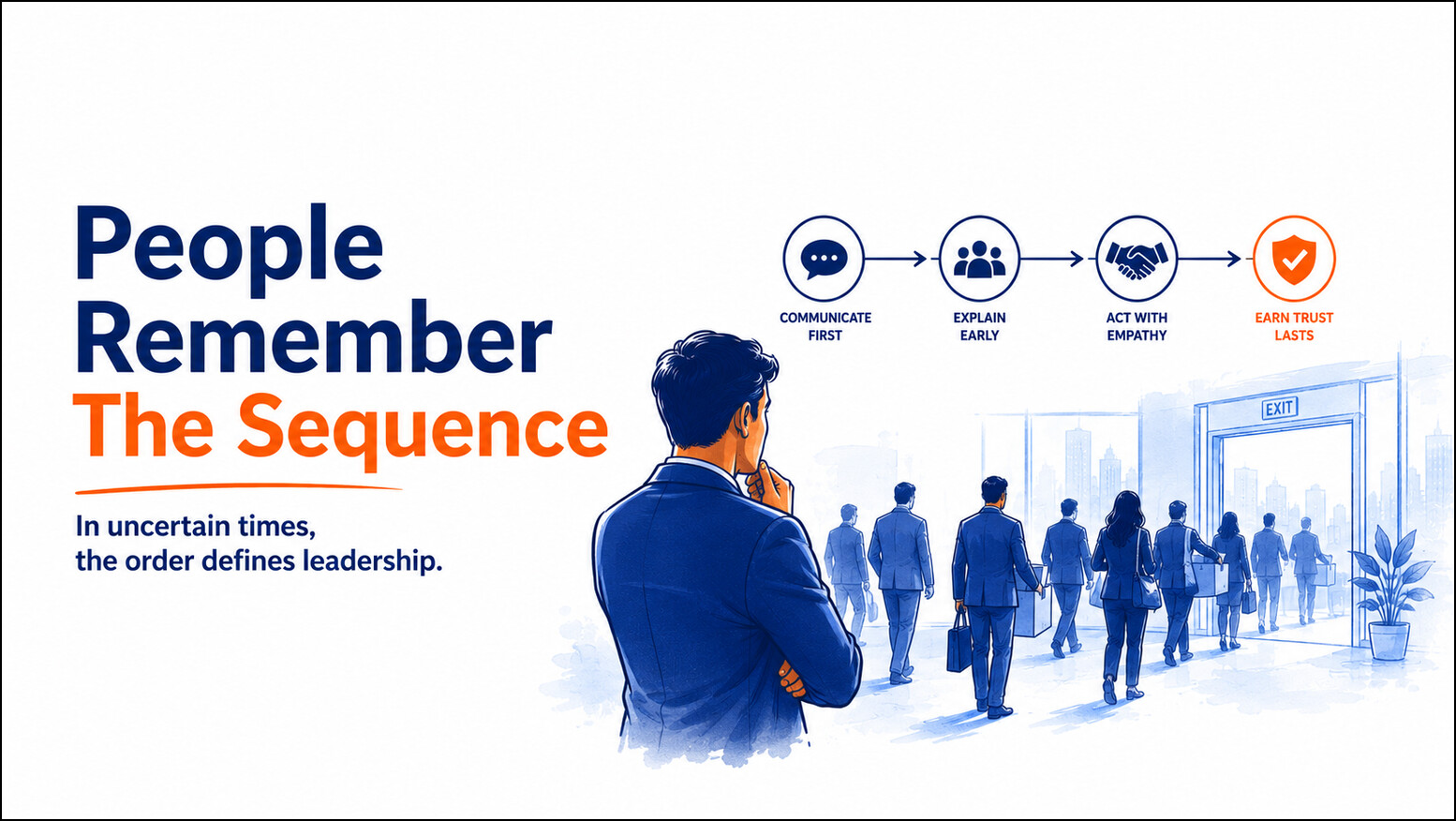
    Because during moments of uncertainty, employees rarely remember the exact wording of the memo. They remember the order in which things happened.

    The technology industry often speaks about AI strategy as though it sits above everything else. I increasingly think the opposite is true.

    A company’s people strategy shapes its AI strategy.

    Not the reverse.

    This distinction matters because most large organisations today are not merely introducing new tools. They are redesigning trust structures inside companies. Reporting lines are changing. Teams are shrinking. Managerial layers are disappearing. Expectations around productivity are quietly being rewritten.

    And all this is happening while leadership teams themselves are still figuring things out in real time.

    I faced a version of this during the 2008 global financial crisis.

    One of our largest clients in the United States cancelled their engagement almost overnight. More than half our revenue disappeared immediately.

    In The Founder Catalyst book, I wrote about that moment:

    “When I called my team members in the USA, their reports were stark: empty shopping malls and vacant car parks. I knew instantly this wasn’t a temporary blip; it felt like a tectonic shift.”

    I remember returning home and realising we could not afford the luxury of waiting for complete clarity.

    The very next day, I called for a town hall meeting.

    Honestly, I did not yet have all the numbers worked out. But uncertainty grows faster in silence than in bad news.

    We had to let go of nearly a hundred people. At the same time, we stretched ourselves financially to provide severance beyond the statutory requirement, even borrowing heavily to do it.

    “It was painful, undoubtedly, for everyone involved, especially those leaving. We simply had no other choice to ensure the company survived.”

    Nearly two decades later, some of those former colleagues still greet me warmly when we meet or reconnect online.

    That stayed with me more than any balance sheet from any year.

    The AI transition will create extraordinary companies and extraordinary wealth. I have little doubt about that.

    But I also think the companies that emerge strongest from this phase will not merely be the fastest adopters of AI.

    They will be the ones who understand something older and simpler:

    People remember the sequence in which leaders treated them under pressure.

    Reflection: When restructuring under pressure, what you do first matters as much as what you decide. The order in which you treat people is the signal your organisation will remember long after the financial results are reported.

  • Who controls what AI sees?

    Who controls what AI sees?

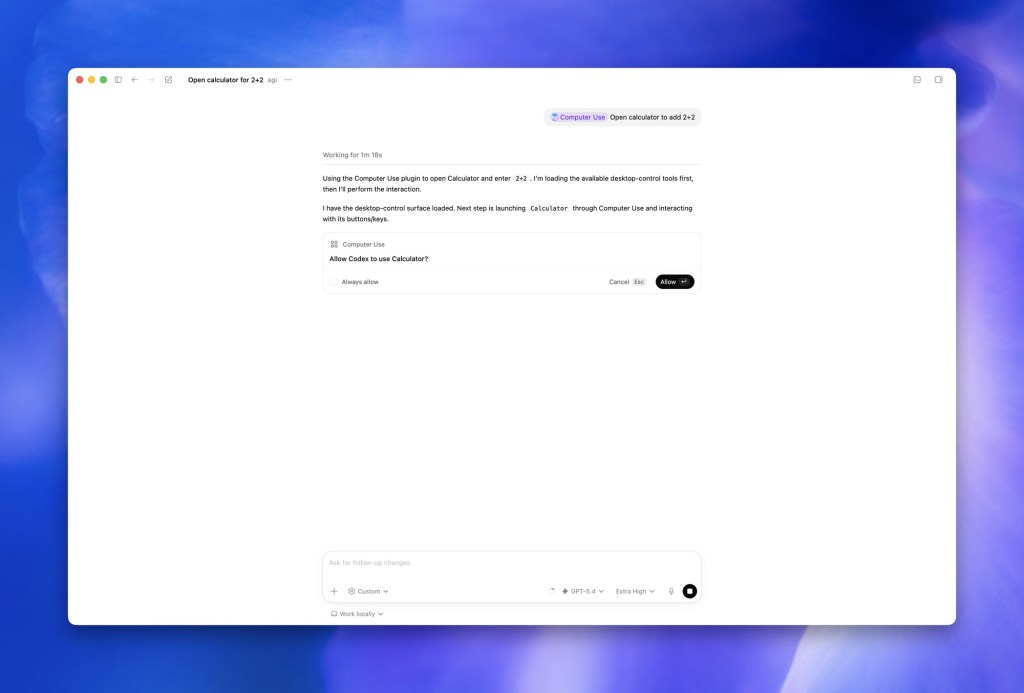
    OpenAI just added “Computer Use in Codex”. It can now see your screen, move a cursor, click, and type across any Mac app — multiple agents running in parallel while you work.

    That’s genuinely impressive. Anthropic’s Cowork does something similar.

    And the companies that own your screen, your apps, and your enterprise software will decide what that’s worth to you.

    But here’s what I keep thinking about.

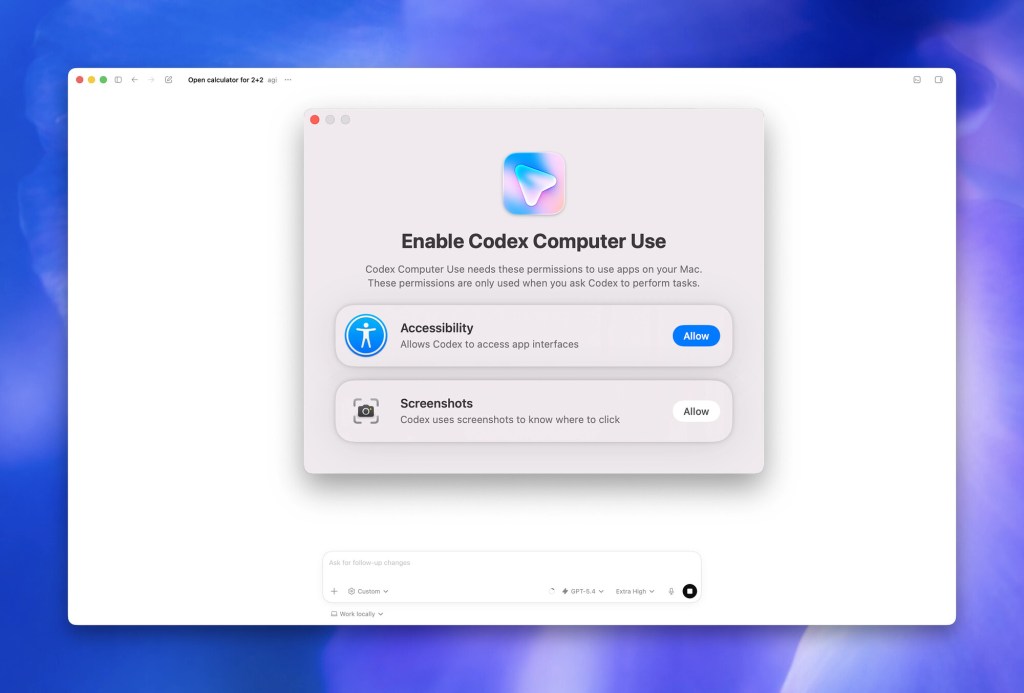
    This capability depends on macOS letting third-party apps observe your screen and control other apps. Apple has a long history of deciding what gets that kind of access — and restricting it, charging for it, or bundling it into higher-tier subscriptions when it becomes valuable enough. The industry tends to follow Apple’s lead on these things.

    On mobile, I’d be surprised if Google and Apple don’t eventually make this a feature you pay for through their own AI subscriptions, with third-party agents locked out entirely. Enterprise software vendors — SAP, Salesforce, ServiceNow — are watching this closely too. Every one of them has an AI agent story, and every one of them has an incentive to be the only agent that sees inside their platform.

    And then there’s the end user. Two years ago, when Microsoft introduced Windows Recall — which took continuous screenshots of everything on your PC — the backlash was immediate and fierce. People were not ready for an AI that watches everything. That tension hasn’t gone away. It’s just been repackaged as productivity.

    Every app on your Mac now needs to decide: allow AI in, or keep it out.
    
Two permissions. Both controlled by Apple. That's the chokepoint.

    We’ve seen this before. Google Maps was free until millions of apps depended on it — then came the pricing change. Installing apps on a device you own was an open opportunity until App Stores made it a 30% toll booth. The pattern isn’t new: platforms let ecosystems flourish on open access, then monetise the chokepoint once the dependency is deep enough.

    AI agents are heading into the same territory. The question isn’t whether platform owners will act. It’s whether industry bodies build interoperability standards fast enough, and regulators move before the walls are too high — or whether we end up with a dozen AI agents, each locked inside its owner’s fence.

    The pattern always ends the same way. What’s your read?

  • What AI in the browser means for your business?

    What AI in the browser means for your business?

    I have been trying out AI inference inside the browser for a while now, more out of curiosity than anything else. A debate that surfaced this week made me want to talk about it, because buried inside a browser standards argument is a platform governance question that every business relying on AI will eventually have to answer.

    We have moved through a familiar sequence. Web pages gave way to apps. Apps are giving way to AI interfaces. And now AI is being embedded directly into the browser itself. That last step is not a feature upgrade. It is a shift in who controls a foundational layer of how your customers and your products experience the web.

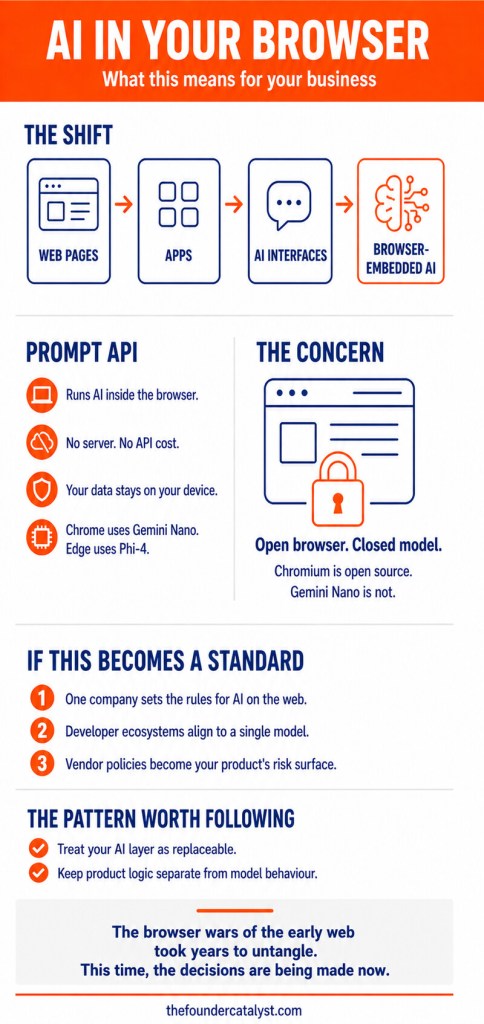
    Google Chrome and Microsoft Edge are both shipping something called the Prompt API. It lets web applications run AI inference directly inside the browser, with no server call, no API cost, and no data leaving the device. Chrome uses Google’s Gemini Nano. Edge uses Microsoft’s Phi-4.

    I built three demos with this last year, a creative writing tool, a translation assistant, and a vision assistant that describes images, all running locally on my laptop. I wrote about it on my personal blog. The technology works well for what it is. Fast, private, and free to run. For simple AI workloads, local inference like this is a logical and efficient step forward.

    The concern is not the technology. It is what happens if this becomes a web standard.

    Infographic titled 'AI IN YOUR BROWSER' outlining the shift towards browser-embedded AI, highlighting the shift from web pages to applications and AI interfaces.

    The Prompt API is currently a Community Group draft under W3C’s Web Machine Learning group, not a formal standard. The standardisation discussions have drawn serious objections from Mozilla and from W3C’s own Technical Architecture Group. The worry is interoperability. When developers build on a specific browser’s model, they tune their code to that model’s quirks. Over time, that creates model-specific behaviour baked into the web itself. We have seen this pattern before with browsers, and the web spent years cleaning it up.

    Chrome is built on Chromium, which is open source. The Gemini Nano model that ships with the Prompt API is not. Google does have an open weights model called Gemma, but Gemma is not what ships with the Prompt API. Google’s stated reason is that they need to enforce safety through their Generative AI Prohibited Uses Policy, and that requires controlling the model. Mozilla’s objection, which I think is sound, is that using a web API should not mean accepting one company’s content rules, especially rules that go beyond what is legally required anywhere.

    Chrome holds a dominant share of global browser usage. If this API becomes a standard and the model powering it remains closed and governed by a single company’s policies, that company effectively controls the default intelligence layer of the web. That shapes cost structure, developer decisions, and user experience in ways that compound quietly over time.

    The teams I see getting this right are already treating their AI layer as a replaceable component, keeping product logic separate from model behaviour, and treating vendor policies as part of their risk surface rather than background noise. It is not complicated, but it requires making a deliberate decision early rather than inheriting a dependency later.

    When I work with founders and leadership teams, platform dependency is almost always one of the first structural risks we surface together. A platform bet requires confidence in the governance, not just the technology. Who sets the rules, and what happens when those rules change? The browser wars of the early web are a useful reminder of how long it takes to untangle these things once they are embedded.

    The edge AI direction is right. Local inference, faster response, lower cost, better privacy; this is a sensible progression. But the model at the centre of it should be open, or at least governed by a neutral body, not by one company’s terms of use.

    No formal standard has been approved yet. The conversations are still live. But the decisions being made now in browser working groups will shape the web your customers use for the next decade. It is worth paying attention to.

    Are you watching the AI-in-browser space, or is it still too early to be on your radar?

  • What Microsoft got wrong about Copilot?

    What Microsoft got wrong about Copilot?

    Underpromise and overdeliver — my message to founders on AI

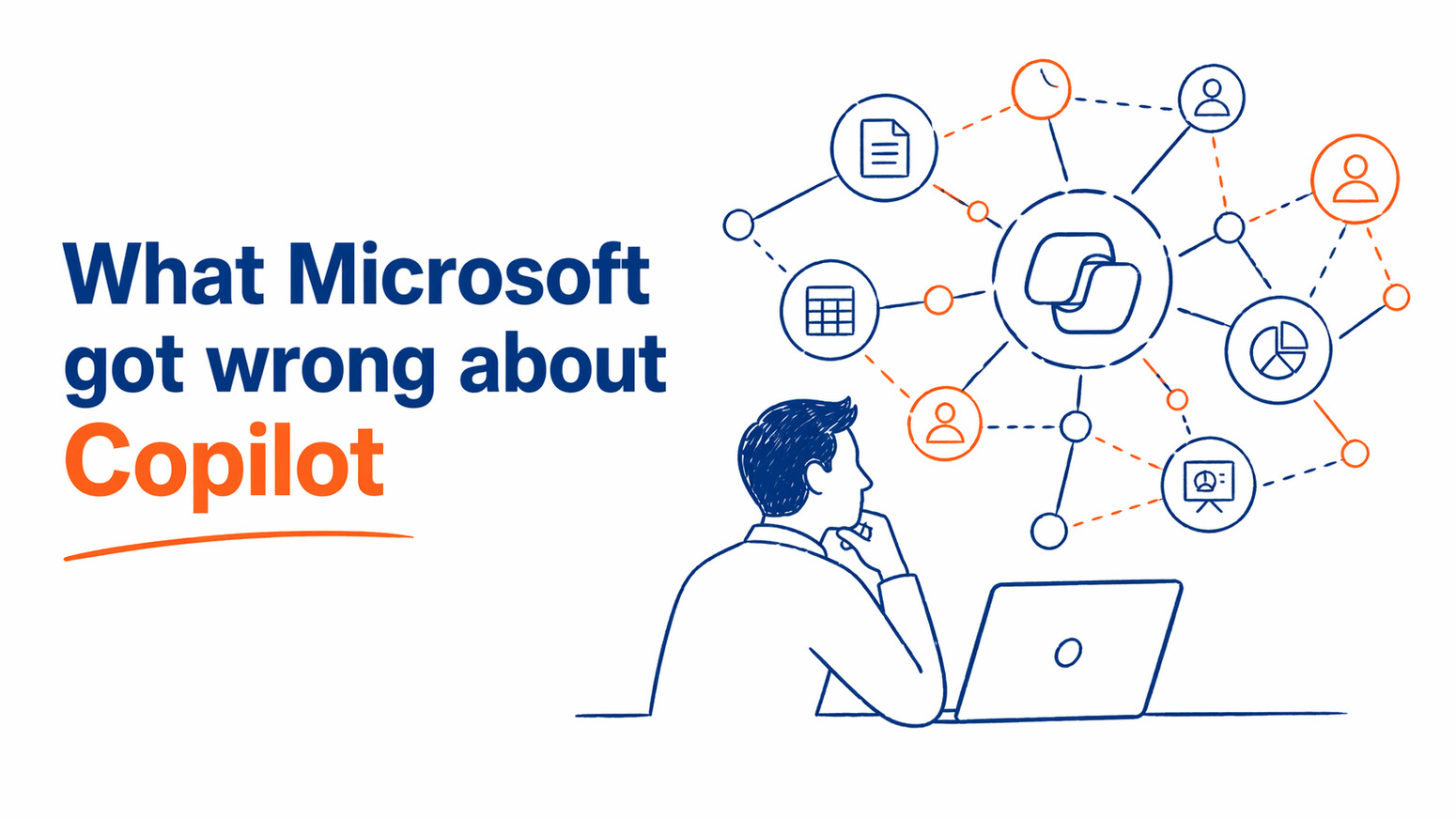
    Microsoft’s own corporate VP of the Office Product Group admitted it publicly this week: “When we first shipped Copilot, foundation models were not powerful enough to use Copilot to command the applications.”

    That is a remarkable thing to say out loud. And the right thing to say.

    Go back to late 2022. ChatGPT lands. Microsoft moves fast — faster than they should have — and Copilot arrives positioned as the AI-powered assistant that would transform how you work in Word, Excel, and PowerPoint. The demos were impressive. The promises were large. What landed in enterprise inboxes was a chatbot that could summarise a document but not meaningfully act on one.

    Users felt misled. Many quietly switched to ChatGPT. Enterprise teams started evaluating Gemini. And then Claude — particularly the disruption that Claude Cowork brought to real productivity workflows — reset the benchmark for what capable AI in the workplace could actually look like. Billions in market value moved. The pressure on Microsoft was real.

    They have now course-corrected. Agent Mode is rolling out across Word, Excel, and PowerPoint. Anthropic models sit alongside OpenAI models inside Copilot. The sidebar now shows you every step the AI takes on your document in real time. That is a genuine improvement, not a rebrand.

    Is it late? Yes. Is it too late? I don’t think so. Microsoft still owns the surface — Word, Excel, and PowerPoint are entrenched in enterprises and governments in a way that no AI startup can replicate overnight. Adding capable models to that distribution is a credible recovery. Not a comeback story, but a course correction that could hold.

    The lesson, though, is not really about Microsoft.

    It is about what you promise before you ship.

    Every CEO and CTO rolling out an AI initiative right now faces the same pressure Microsoft felt in 2022. The frontier lab demo is extraordinary. The consultant’s deck is compelling. The board wants to see momentum. So you make large claims. You announce something before the reality is ready. And then reality arrives.

    The smarter path is quieter. Pilot with a small, honest cross-section of your organisation — not the enthusiasts, the actual everyday users. Observe what actually gets used, not what gets praised in a feedback survey. Understand where the model genuinely helps and where it confidently fails. That gap between demo and daily use is where most AI rollouts go wrong, and no amount of training data or vendor reassurance closes it faster than watching your own people use it for two weeks.

    The good news today — which genuinely did not exist two years ago — is that AI coding agents let you iterate and fine-tune far faster than traditional development cycles allowed. The feedback loop is tighter. Use it before you go back to your board asking for the larger budget.

    Microsoft overpromised in 2022. They paid for it in user trust and adoption numbers, and they spent two years correcting course. They had the balance sheet and market position to absorb that. Most companies don’t.

    Promise less. Deliver more. Then expand.

    That is not caution. That is how you build something that compounds.


    If you are a founder or CXO working through an AI rollout — what to pilot, how to read real usage signals, when to scale — I work through exactly these decisions at thefoundercatalyst.com. Connect with me at linkedin.com/in/venkatarangan

  • Is Formula 1 telling us something about how to roll out AI?

    Is Formula 1 telling us something about how to roll out AI?

    Stay with me for a second.

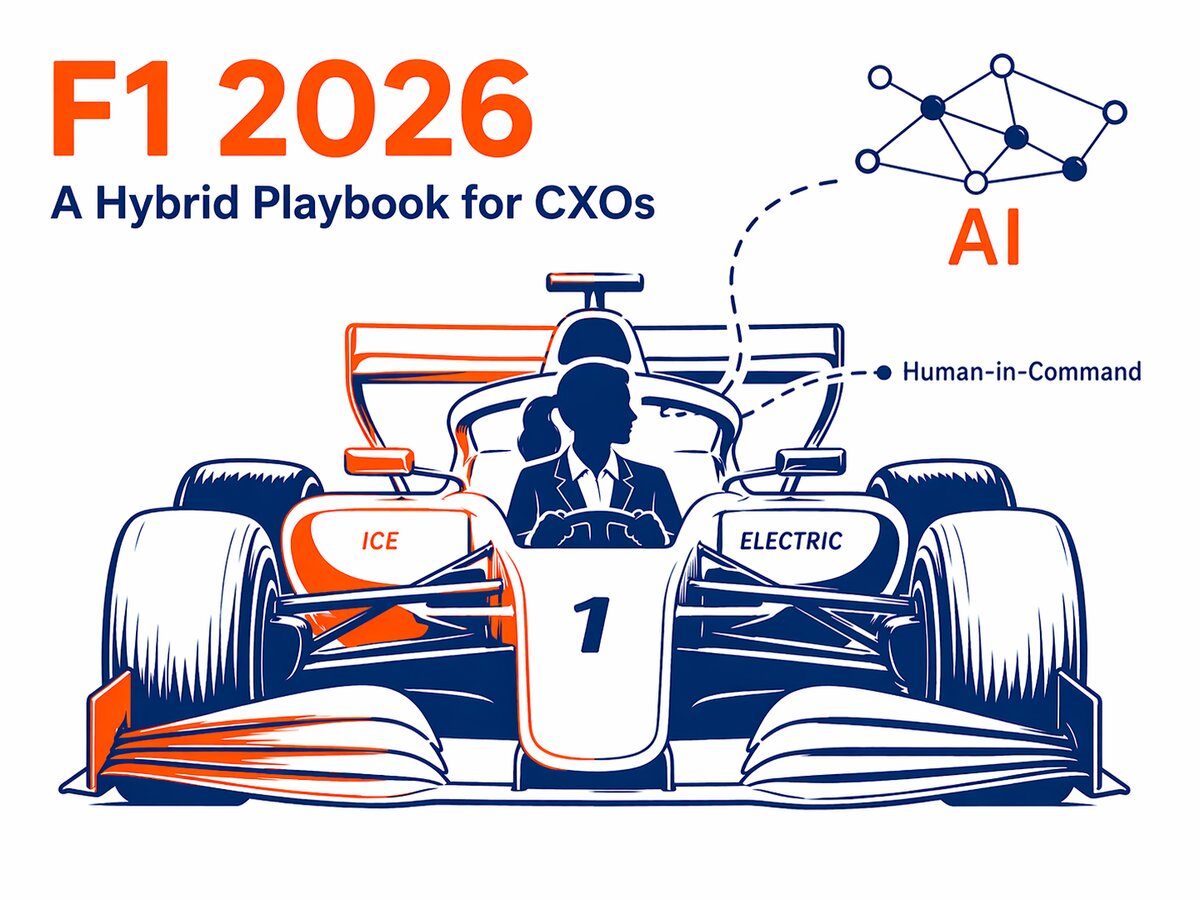
    Starting this 2026 season, F1 has quietly executed its biggest regulation overhaul in over a decade. The 1.6L V6 turbocharged engine stays. But the electric side of the hybrid system has been roughly tripled in power, and the sport is now targeting a 50:50 split between internal combustion and electric power. The cars are running on Advanced Sustainable Fuels for the first time, and DRS has been replaced by an electrically-driven Overtake Mode.

    A serious pivot. And yet F1’s own president has been categorical that the sport will never go fully electric. Not ideology — battery technology simply cannot sustain a Grand Prix, and pushing too fast would break the product itself. There is also a regulatory reality at play. Governments across the EU and elsewhere have been legislating hard on emissions and the long-term future of internal combustion engines. F1 had to respond to that pressure, just as every other industry has. It could not ignore the direction of travel, but it also could not pretend the technology was ready to go all the way.

    So here is what F1 has actually done. It read where the regulation is heading. It read where public sentiment is heading. It read where the technology is heading. And instead of picking a side, it built a hybrid architecture where the driver stays in the seat, but the electric system dramatically amplifies what the car can do. Even that has not been smooth, and the FIA is still tuning the rules with teams this month. Imperfect, but directionally right.

    This is the pattern I keep coming back to when founders and CXOs ask me how aggressively they should roll out AI inside their business.

    The temptation on both sides is to go to an extreme. One camp, in the name of optimisation, wants to rip humans out of workflows and hand entire functions over to agents. The other camp wants to wait, watch, and delay until things settle — play it safe. The data says both are mistakes.

    MIT’s NANDA initiative studied this through 2025 and found that around 95% of enterprise generative AI pilots deliver no measurable impact on the P&L, despite $30 to $40 billion spent. The 5% that did succeed shared a common pattern: they kept scope tight, focused on back-office automation where the ROI was clearest, and worked with specialised external partners rather than trying to build everything in-house. Firms that bought and partnered succeeded roughly twice as often as those that built internally.

    A Harvard Business School field experiment with BCG consultants sharpened the point further. For tasks inside AI’s current capability frontier, consultants using AI completed 12 percent more work, 25 percent faster, at higher quality. For tasks outside that frontier, the same consultants using AI were 19 percent less likely to get the right answer. Same people, same tools, different task. AI made them worse when the task was not the right fit.

    Now layer in the regulation piece. The EU AI Act’s core obligations for high-risk AI systems come into force on 2 August 2026. Article 14 of the Act uses a specific phrase that deserves attention: “human-in-command.” It is not a suggestion. It is a statutory requirement that high-risk AI — which includes recruitment, performance evaluation, credit decisions, medical diagnostics, and critical infrastructure — must be designed so a human can meaningfully supervise, intervene, and override. India is not there yet, but every serious jurisdiction is moving in the same direction.

    Put it together, and the picture is clear. The research says narrow deployments work, broad ones fail. The research says AI amplifies humans on the right tasks and actively harms them on the wrong ones. The regulation says, at least in high-stakes domains, a human must remain in the loop by law.

    The firms that will win the next few years are not the ones going all-in on autonomous AI, and not the ones hiding from it. They are the ones building a hybrid operating model now, keeping judgment with humans and leveraging AI, and getting good at the handoff long before it becomes mandatory.

    F1 worked out that an elegant hybrid is harder to build than a pure ICE or a pure EV. But it is the only architecture that keeps the sport competitive, relevant, and regulation-ready at the same time.

    The same logic applies to your business.


    If you are a CXO or founder thinking through how to sequence AI inside your organisation without getting ahead of your team, your customers, or the regulators, happy to talk. Reach me at v@thefoundercatalyst.com or connect on LinkedIn: linkedin.com/in/venkatarangan

  • How forecasts age in an AI moment?

    How forecasts age in an AI moment?

    Every quarter, someone in tech quietly walks back a confident prediction they made not long ago.

    In January 2026, Forrester published research showing that over half of all AI-attributed layoffs are likely to be reversed, because companies cut headcount based on AI promises that the technology was not yet ready to keep. The same month, Gartner forecast that generative AI in customer service would cost more than offshore human agents by 2030, prompting a pointed rebuttal from industry practitioners who argued Gartner was describing a vendor pricing failure, not an AI failure.

    The retractions are usually healthier than the original predictions. They just get a fraction of the attention.

    In October 2021, a year before ChatGPT, I delivered a talk called “The Future of Software Developers by 2040” to a developer conference. Looking back now is not about whether I got things right. The more useful question is which assumptions survived contact with a shock nobody saw coming.

    A few stood up reasonably well. The talk argued the (Indian) IT hiring boom would not last. TCS, Infosys, Wipro and HCL were on record quarters then, with attrition above 20 per cent. The direction was right, though the mechanism I imagined, gradual automation and growth of the global capability centres, turned out to be the smaller story. The larger one was a foundation AI model that could write working code from a plain English comment.

    One slide, titled “Going to be upside-down,” argued that the work mix in software would invert: more time on business understanding and customer needs, less on writing and testing code. That was framed as a gradual shift toward 2040. It is largely the reality in 2026 itself.

    The line that aged the worst was the one I closed with: let machines be machines, and let humans be human. It earned a warm nod in the room. Five years on, it has the ring of a sentence printed over a stock photo of a sunrise. Tidy aphorisms assume the boundary they describe will hold still. This one has not.

    Nobody in this industry predicts precisely. The people who navigate these shifts well are not the ones with the sharpest forecasts. They are the ones who revise quickly when the ground moves, before it costs them too much.

    There is a Chinese proverb associated with Deng Xiaoping: crossing the river by feeling the stones. You do not map the riverbed in advance. You step, test your footing, adjust, and step again. The destination matters. But the only honest method is one stone at a time.

    The next five years will not reward people who pick a single thesis and hold it. They will reward those who can hold a direction loosely, gather evidence weekly, and change their mind without ego when the facts demand it.

    The cost of a wrong forecast held too long is now measured in quarters, not years. The cost of revising one in public is mostly ego. And ego is the cheapest thing to spend.

    The forecasts that age worst are usually the ones that sound the wisest at the time.

  • Why Unhappy Leave Can Break a Startup

    Why Unhappy Leave Can Break a Startup

    The internet has a long memory, but a very selective one.

    Old news resurfaces without warning. Context quietly drops off. A half-forgotten announcement suddenly becomes today’s debate. That is exactly what has happened over the last few days with a decision taken in China in 2024.

    Many are now discussing something being called Unhappy Leave.

    On the surface, the idea is simple.

    Employees are given ten additional days of leave every year. These days can be taken purely at their own discretion. No medical certificate. No justification. Just the employee deciding they are unhappy, stressed, or mentally exhausted. The important detail is this. If a manager denies this leave, it is treated as a policy violation.

    In a country known for long working hours and intense workplace pressure, this sounded radical. Predictably, the internet amplified it. It praised it. Compared it. And in some cases, reduced it to a slogan.

    The policy was announced by Yu Donglai, the founder of Pang Dong Lai, a Chinese retail chain admired for its employee-first culture. The announcement was made in 2024 and quietly implemented. It went viral much later. That delay itself is telling. Good ideas do not always travel fast. Sometimes they wait for the right moment, or the right outrage cycle.

    At first glance, this feels like a bold and humane move. And it is. There is no denying that.

    It also reminds many people of earlier experiments in employee well-being, especially in the West.

    One obvious comparison I will make is with Tony Hsieh of Zappos. Long before workplace culture became fashionable, he spoke about trust, happiness, and unconventional benefits. At the time, many dismissed it as idealistic. History was kinder. Zappos built loyalty, reduced attrition, and created a culture that people still reference years later.

    So yes, Unhappy Leave is innovative. It is empathetic. It signals trust.

    But this is where founders and business leaders need to pause.

    Large organisations have buffers. They have HR teams, policy frameworks, and workforce planning models. They can simulate impact before announcing a benefit. They can course-correct if something breaks.

    Founder-led companies and startups do not have that luxury.

    This is where good intent can quietly turn into long-term damage.

    When a policy like this is announced without thorough internal thought, a few things happen quickly. Project timelines slip because key people are unavailable at critical moments. Managers hesitate to question leave decisions even when delivery risk is high. Teams compensate informally for absent colleagues. Resentment builds.

    The irony is this. A benefit meant to improve morale can end up eroding it.

    Missed delivery commitments create pressure elsewhere. Customers feel the impact first. Revenue follows. Leadership starts firefighting. Slowly, the same policy that was announced with warmth becomes a source of quiet frustration.

    And when leaders later attempt to dilute or roll back the policy, trust takes a direct hit.

    This is especially risky with Gen Z employees.

    Gen Z values authenticity more than perks. They sense inconsistency very quickly. If a benefit is announced and then poorly executed, the damage is not temporary. It creates a belief that leadership announcements cannot be taken at face value. That kind of trust loss is extremely hard to repair.

    In my experience, and this is my opinion, most employee benefit schemes fail not because of bad intent, but because of shallow implementation.

    Every founder who grows into a CEO learns this lesson sooner or later.

    Policies are promises. The moment you announce them, they become part of your culture. Culture cannot be paused, renegotiated, or quietly edited without consequences.

    Founder-led organisations should address key issues before announcing new ideas. Start with open conversations about challenges like fairness and peak periods, run small pilots to learn, and only expand once ready. Consistency, more than generosity, builds trust.

    This is also where founders benefit from an external sounding board. Someone who has seen these cycles play out across companies and stages, and can help leaders think through second-order effects before ideas turn into irreversible promises. That role, walking alongside founders as they translate intent into execution, is exactly why I do what I do as a Founder Catalyst.

    Unhappy Leave works at Pang Dong Lai because it sits inside a much larger system of values, planning, and discipline. It is not a standalone perk. It is a visible expression of an already mature culture.

    Stripped of that context, it becomes a slogan.

    The internet loves slogans. Organisations live with consequences.

    Reflection:  Every policy announcement feels reversible in the moment. Very few actually are. Founders do not just introduce benefits. They set expectations that quietly shape culture long after the applause fades.


    If you prefer to receive more of these insights directly, subscribe to my Founder Catalyst Digest, where I share practical lessons on leadership, AI, and building companies that last.

    Read my book “The Founder Catalyst” for more lived lessons: The Founder Catalyst on Amazon

  • The Future of Work: AI Skills vs Degrees – Let’s Stay Grounded

    The Future of Work: AI Skills vs Degrees – Let’s Stay Grounded

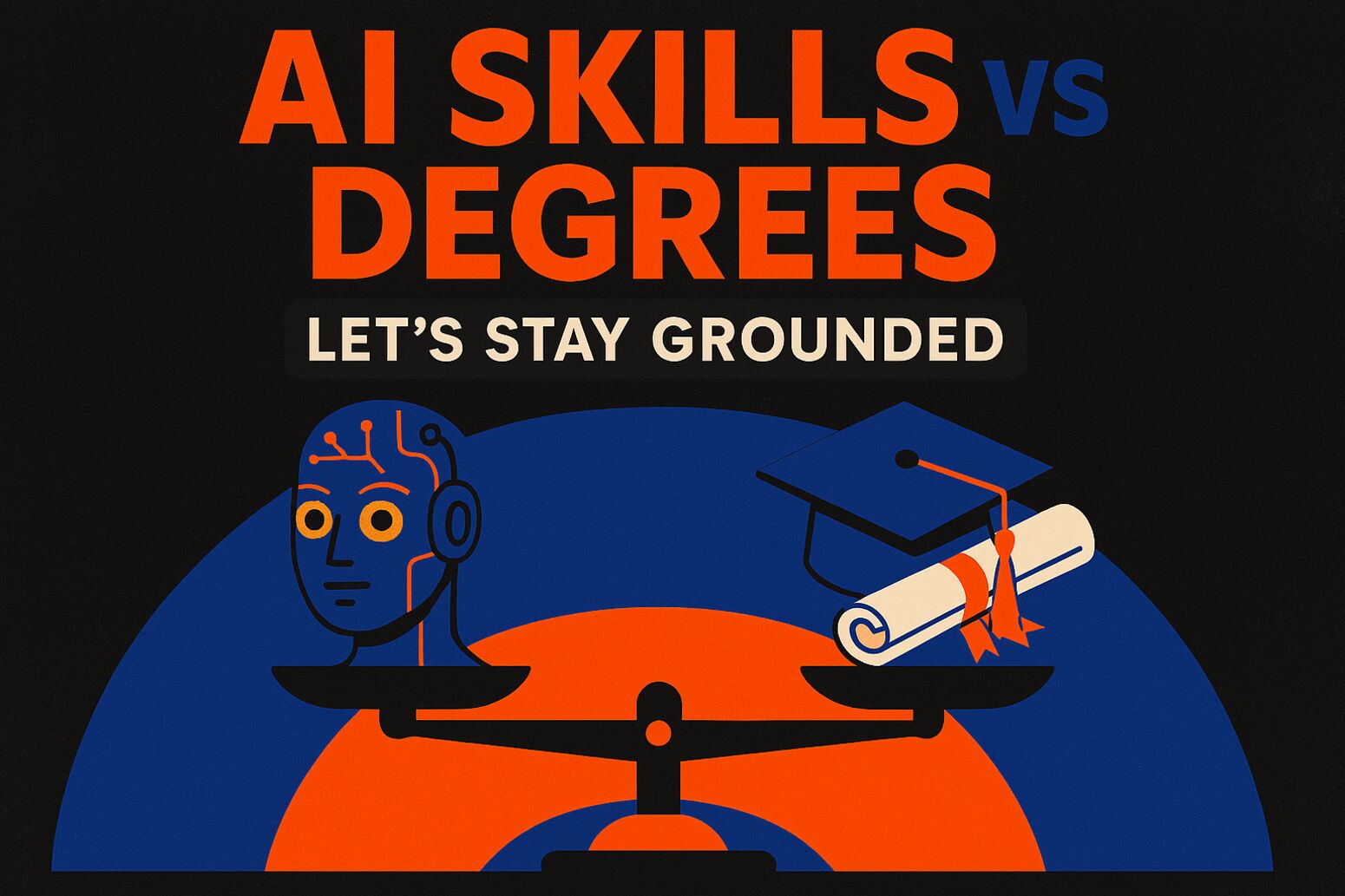
    Recently, Ryan Roslansky, CEO of LinkedIn, said that “the future of work no longer belongs to those with the fanciest degrees or who studied at the best colleges, but to those who are adaptable, forward-thinking, and ready to embrace AI tools.” It’s an important reminder of how fast the world of work is changing. But I’d like to add a word of balance for students — especially in a country like India. Please don’t take such statements literally as a reason to stop pursuing education. In a growing economy like ours, formal learning remains a lifelong asset. Even in an AI-driven world, education is still the most reliable path to improving one’s quality of life — ethically and sustainably. Many such statements, though well-intentioned, tend to amplify the aura around AI — sometimes to promote platforms, products, or investments. Even the most sincere innovators can fall in love with their own creations and overestimate their reach. I use AI every day. I read, write, and advise on it constantly. Yet I can say this with conviction — no matter how advanced AI becomes, a strong academic foundation and disciplined learning will always matter. Anyone who tells you otherwise is not being fully honest. Let’s embrace AI with curiosity, but hold on to education with conviction. The future belongs to those who can balance both — grounded in knowledge, guided by values, and open to change.
  • Are researchers gaming the AI peer reviews?

    Are researchers gaming the AI peer reviews?

    What if I told you some scientists are quietly “whispering” to AI, asking for only positive feedback on their research papers? Sounds like science fiction, but it’s happening right now. Recently, both The Guardian and Nature reported a new trend: researchers are hiding secret instructions—using invisible white text—in their academic papers. These hidden prompts are designed to influence AI tools that some reviewers use, nudging them to give glowing reviews and ignore negatives. While this trick will not be seen by humans, AI models like ChatGPT or Google Gemini may pick up these cues and change their review accordingly. This practice, called “prompt injection,” raises serious questions about academic integrity and the future of peer review. As AI becomes more common in research, we need to stay alert to such manipulations. For now, the best advice: don’t blindly trust AI-generated reviews, and always check the source. Watch this short talk for a quick explainer and my take on what this means for researchers, reviewers, and the future of academic publishing.