
Over 92,000 technology jobs have reportedly been cut globally in the first few months of 2026 alone. Meta, Microsoft, Amazon, Oracle, Salesforce, and several others are restructuring teams while simultaneously increasing spending on AI infrastructure, chips, and AI talent.
None of this surprises me.
AI is not another software upgrade cycle. It is a structural shift. Entire layers of work are being compressed, automated, or redistributed. Every founder and CEO knows this privately, even if many are still hesitant to say it publicly.
What surprised me recently was not the layoffs themselves, but the sequencing around them.
Meta’s internal memo explaining its restructuring reportedly arrived the same day thousands of employees were already being let go.
That detail stayed with me.
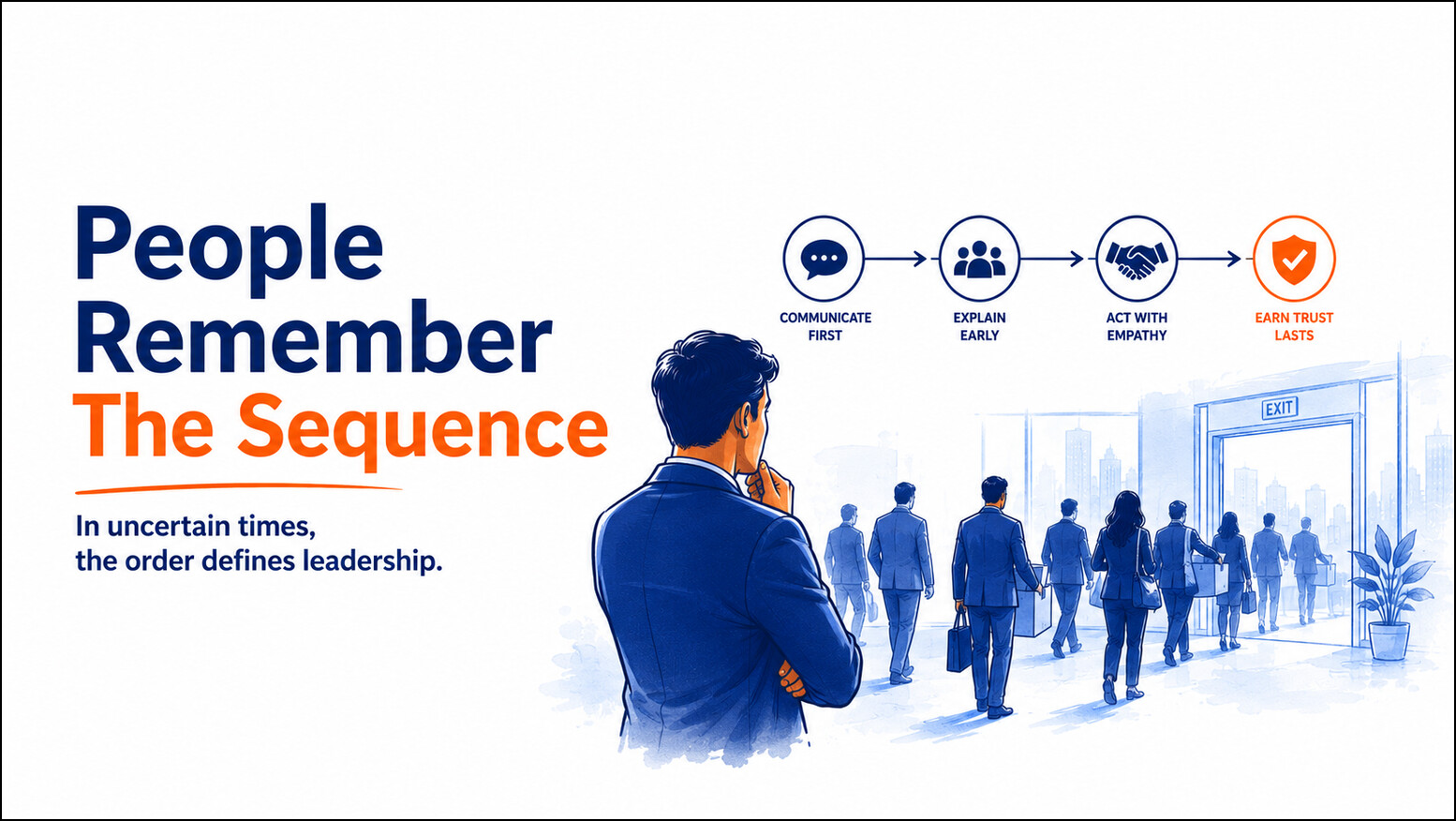
Because during moments of uncertainty, employees rarely remember the exact wording of the memo. They remember the order in which things happened.
The technology industry often speaks about AI strategy as though it sits above everything else. I increasingly think the opposite is true.
A company’s people strategy shapes its AI strategy.
Not the reverse.
This distinction matters because most large organisations today are not merely introducing new tools. They are redesigning trust structures inside companies. Reporting lines are changing. Teams are shrinking. Managerial layers are disappearing. Expectations around productivity are quietly being rewritten.
And all this is happening while leadership teams themselves are still figuring things out in real time.
I faced a version of this during the 2008 global financial crisis.
One of our largest clients in the United States cancelled their engagement almost overnight. More than half our revenue disappeared immediately.
In The Founder Catalyst book, I wrote about that moment:
“When I called my team members in the USA, their reports were stark: empty shopping malls and vacant car parks. I knew instantly this wasn’t a temporary blip; it felt like a tectonic shift.”
I remember returning home and realising we could not afford the luxury of waiting for complete clarity.
The very next day, I called for a town hall meeting.
Honestly, I did not yet have all the numbers worked out. But uncertainty grows faster in silence than in bad news.
We had to let go of nearly a hundred people. At the same time, we stretched ourselves financially to provide severance beyond the statutory requirement, even borrowing heavily to do it.
“It was painful, undoubtedly, for everyone involved, especially those leaving. We simply had no other choice to ensure the company survived.”
Nearly two decades later, some of those former colleagues still greet me warmly when we meet or reconnect online.
That stayed with me more than any balance sheet from any year.
The AI transition will create extraordinary companies and extraordinary wealth. I have little doubt about that.
But I also think the companies that emerge strongest from this phase will not merely be the fastest adopters of AI.
They will be the ones who understand something older and simpler:
People remember the sequence in which leaders treated them under pressure.
Reflection: When restructuring under pressure, what you do first matters as much as what you decide. The order in which you treat people is the signal your organisation will remember long after the financial results are reported.
Leave a Reply