Tag: Speaking Engagements

  • The Tools We Build, Build Us Back

    The Tools We Build, Build Us Back

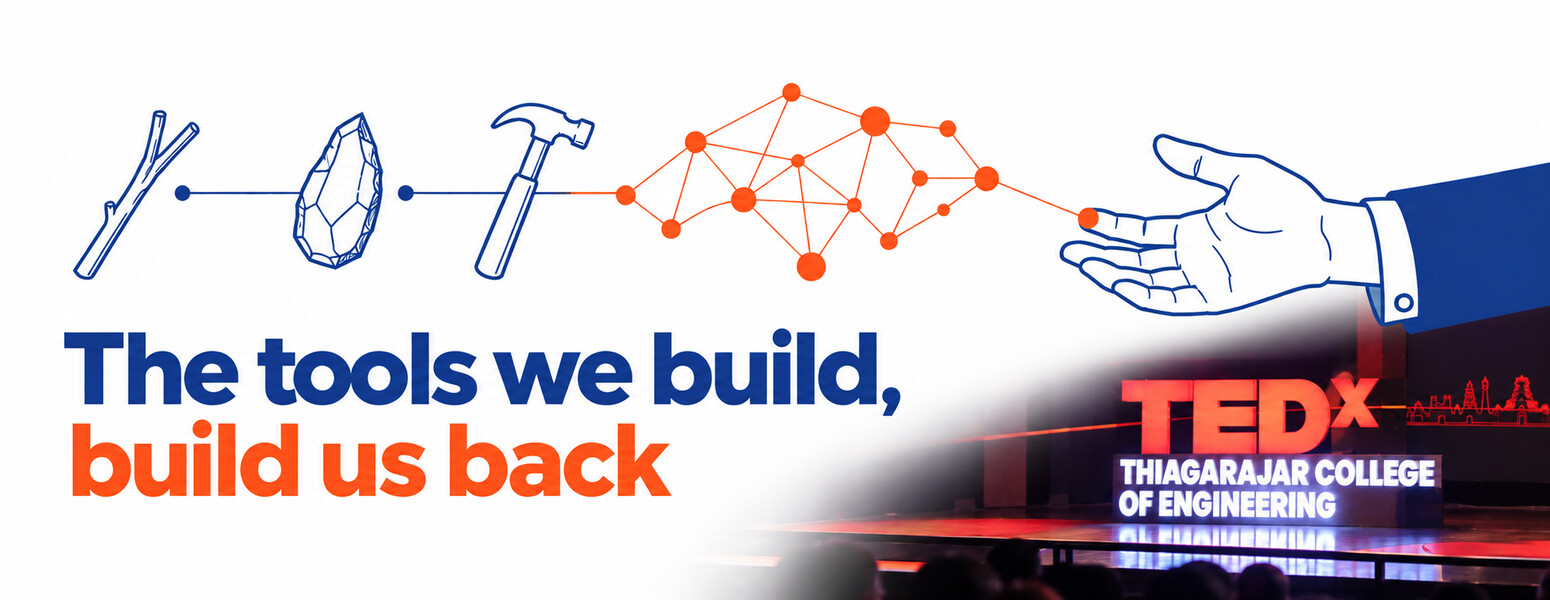
    Three weeks ago I stood on the TEDxTCE stage in Madurai and told a room full of engineering students a story that actually began 3.3 million years before any of us were born — a shaped stone found at a place called Lomekwi in Kenya, older than our own species. I told them about a chimpanzee Jane Goodall watched in 1960, stripping a twig and poking it into a termite mound. And I told them what every tool since then — the hammer, the book, the compiler, the search engine, my own LIFCO dictionaries, my own Easytools.com, the LED clocks I used to burn out as a teenager — had in common.

    Every single one of them waited for a hand to pick them up and decide what happens next.

    That is not true anymore, and this is the part that should matter to a founder reading this, not just to a hall full of students.

    For thirty years I built tools the old way: I had an idea, I decided what should happen, and the tool executed it — a compiler, a piece of taxi-booking software, a company. Somewhere around 2023 that changed. The tool in your pocket now does not wait for you to think first. It thinks first, hands you an answer already chewed, already judged, and waits for you to agree. Every large language model you use to write a pitch deck, a hiring email, or your own version of this blog post is doing exactly that.

    I found out how far this goes the hard way, twice.

    The first time was building a Tamil text editor last year. I did not write a single line of its code myself — not one — for the first time in thirty years of building software. I described the problem, and the machine wrote it. Somewhere in that project I stopped being a coder and became something closer to a specification: a person who describes what he wants and approves what comes back. That is a genuinely useful shift for a founder to notice — the distance between an idea and a working product has collapsed, and it is now open to anyone, not only to people who happened to grow up near the right engineering colleges.

    The second time was writing my book, The Founder Catalyst — yes, where this newsletter gets its name — and later, this very talk. I gave an AI my draft and asked it to clean it up. It fixed my grammar. Then it fixed my sentences. Then, without asking, it quietly dropped the one story that mattered most to me — my grandfather’s dictionary business, and the one rule my father ran it on for fifty years: an unquestioned refund, even years after the sale, even for a single missing page. The AI’s version read beautifully. It was also not mine anymore, and it was far less useful to another founder than the actual, messy truth of how my father built customer trust over five decades.

    That is the risk I actually want founders to sit with. These models are trained on the average of everything human beings have written, and what they hand back is that average. The deals you got wrong, the hires you regret, the one policy that cost you money in the short term and earned you a customer for life — none of that is in the average. It is exactly what makes your business yours, and it is precisely what a well-meaning AI edit will smooth away first, because it reads as too much detail.

    None of this is an argument against using these tools. I would not have built that Tamil editor without one, and I no longer believe founders should be writing code by hand either. Use the motor. I only know when it is pulling me in the wrong direction because I spent thirty years riding without one — and that is the part I would ask any founder to hold on to. Take on the projects that felt impossible before. Just do not hand over the deciding.

    We built the system. It is now good enough to build us back, one polished suggestion at a time. Whether it does depends entirely on what we let it delete.

    I go into the fuller argument in the complete 18-minute talk — including why access to expertise, and not talent, was always the real gap between an engineer in Bangalore and one in Madurai, and why that gap has just closed for good.

    Watch the full talk here:

  • What Indian IT services can skim from an ice cream advertisement

    What Indian IT services can skim from an ice cream advertisement

    Kwality Walls recently ran a full-page advertisement saying “Made with Milk.”

    If you grew up in India, you know exactly why that needs explaining.

    For years, Kwality Walls and several other large brands sold products that Indian food regulations classified as “frozen desserts” rather than ice cream. The distinction came down to fat source. Traditional ice cream uses milk fat. These brands used vegetable fat instead. The reasons were not cynical by default. Vegetable fat was cheaper, yes, but it also gave manufacturers more control over texture and consistency, and a decade or so ago, it aligned with a widely held popular belief that vegetable-based fats were the healthier option. These brands were also keeping a luxury product within reach of a broad market that could not otherwise afford it. They were making rational trade-offs given the conditions of their time.

    The conditions changed. Cold chain infrastructure improved across urban India. A new generation of boutique dairy-first ice cream brands built an enthusiastic following on precisely the quality narrative the larger brands had sidestepped. Urban consumers began reading labels. The regulatory scrutiny intensified. So now Unilever’s Kwality Walls is pivoting, and doing so loudly, with a premium line built around real milk as the hero ingredient.

    The advertisement is not simply a product relaunch announcement. It is a public acknowledgement that the perception a market holds of you eventually becomes as consequential as what you actually deliver.

    I have been thinking about this in the context of Indian IT services, where I have spent nearly three decades, first as the founder of Vishwak Solutions and now as an advisor to founders navigating this precise inflexion point.

    S. Ramadorai, in his account of TCS’s early years, describes how the Indian IT industry was born almost by accident, driven initially by the need to earn foreign exchange to pay for imported mainframes under the Licence Raj. That origin shaped everything that followed. The industry optimised for what the market rewarded: reliable delivery, competitive pricing, process maturity, and scale. These were genuine strengths. They built large, capable organisations and brought prosperity to hundreds of thousands of families. Nobody should minimise that.

    But strengths built for one set of market conditions quietly become constraints when those conditions shift.

    For most of those three decades, the conversation between Indian IT firms and their Western enterprise clients was fundamentally transactional. Billing rates, resource availability, technology stack coverage, and bench strength. I remember those conversations well from my own years running Vishwak. The client’s primary question was almost always some variant of: “Can you deliver this at this cost by this date?” The relationship was essentially a supply arrangement. The Indian firm was positioned, in the client’s mind, as an efficient and dependable execution partner. Reliable, but not strategic. Present in the delivery room, but rarely in the boardroom.

    In 2026, something has visibly shifted in those conversations. The questions coming from Western enterprise CXOs are different now. They are asking about AI-led transformation, about business outcomes rather than deliverables, about domain expertise and co-innovation. They want a thinking partner, not just a staffing solution. The category definition itself is being rewritten.

    This is where the Kwality Walls parallel becomes interesting to sit with.

    In my book, The Founder Catalyst, I write about adaptability as one of the five pillars of enduring companies. The critical distinction I draw there is between reactive scrambling and patient, deliberate preparation. Kwality Walls did not wake up one morning and decide to care about milk. The boutique ice cream category grew steadily over several years. Cold chain economics changed gradually. Consumer preferences moved in a clear direction. The move to a premium dairy-forward line was not spontaneous. It was a recognition, perhaps overdue, of a shift that had been accumulating for a long time.

    The same pattern is now visible in Indian IT services. The firms making genuine progress on repositioning are not the ones running the most prominent AI announcements. They are the ones that began quietly rebuilding their delivery models two or three years ago, experimenting with outcome-linked pricing in select engagements, developing genuine domain depth in specific verticals, and letting those results do the talking in client conversations. The announcement, when it eventually comes, lands differently because the underlying reality has already changed.

    The harder question is about perception lag. Perception, once formed, updates slowly. It moves through repeated experience, not through announcements. A firm that spent fifteen years being the dependable execution partner will not shift a client’s mental model by adding “AI-native” to its website header. The client’s memory is longer than the press release.

    I wrote earlier this year that the question most IT services founders are asking, “How do we use AI?” is already the wrong one. The more clarifying question is what is now becoming undefendable in their current model. Effort-based billing is under pressure even where contracts have not yet reflected it. Speed of delivery is no longer a differentiator when AI compresses timelines on both sides of the table.

    Kwality Walls is making its move now. The boutique brands made theirs years earlier, without a full-page advertisement, and without needing one. The market found them because they had already become something worth finding.

    That is the sequence that matters. Build first. Announce when the evidence is already there.

    What shift in your client conversations has already told you that the category is moving under you?

  • People Remember The Sequence

    People Remember The Sequence

    Over 92,000 technology jobs have reportedly been cut globally in the first few months of 2026 alone. Meta, Microsoft, Amazon, Oracle, Salesforce, and several others are restructuring teams while simultaneously increasing spending on AI infrastructure, chips, and AI talent.

    None of this surprises me.

    AI is not another software upgrade cycle. It is a structural shift. Entire layers of work are being compressed, automated, or redistributed. Every founder and CEO knows this privately, even if many are still hesitant to say it publicly.

    What surprised me recently was not the layoffs themselves, but the sequencing around them.

    Meta’s internal memo explaining its restructuring reportedly arrived the same day thousands of employees were already being let go.

    That detail stayed with me.

    Because during moments of uncertainty, employees rarely remember the exact wording of the memo. They remember the order in which things happened.

    The technology industry often speaks about AI strategy as though it sits above everything else. I increasingly think the opposite is true.

    A company’s people strategy shapes its AI strategy.

    Not the reverse.

    This distinction matters because most large organisations today are not merely introducing new tools. They are redesigning trust structures inside companies. Reporting lines are changing. Teams are shrinking. Managerial layers are disappearing. Expectations around productivity are quietly being rewritten.

    And all this is happening while leadership teams themselves are still figuring things out in real time.

    I faced a version of this during the 2008 global financial crisis.

    One of our largest clients in the United States cancelled their engagement almost overnight. More than half our revenue disappeared immediately.

    In The Founder Catalyst book, I wrote about that moment:

    “When I called my team members in the USA, their reports were stark: empty shopping malls and vacant car parks. I knew instantly this wasn’t a temporary blip; it felt like a tectonic shift.”

    I remember returning home and realising we could not afford the luxury of waiting for complete clarity.

    The very next day, I called for a town hall meeting.

    Honestly, I did not yet have all the numbers worked out. But uncertainty grows faster in silence than in bad news.

    We had to let go of nearly a hundred people. At the same time, we stretched ourselves financially to provide severance beyond the statutory requirement, even borrowing heavily to do it.

    “It was painful, undoubtedly, for everyone involved, especially those leaving. We simply had no other choice to ensure the company survived.”

    Nearly two decades later, some of those former colleagues still greet me warmly when we meet or reconnect online.

    That stayed with me more than any balance sheet from any year.

    The AI transition will create extraordinary companies and extraordinary wealth. I have little doubt about that.

    But I also think the companies that emerge strongest from this phase will not merely be the fastest adopters of AI.

    They will be the ones who understand something older and simpler:

    People remember the sequence in which leaders treated them under pressure.

    Reflection: When restructuring under pressure, what you do first matters as much as what you decide. The order in which you treat people is the signal your organisation will remember long after the financial results are reported.

  • Avoiding AI Overkill: Right Tool for the Right Job

    Avoiding AI Overkill: Right Tool for the Right Job

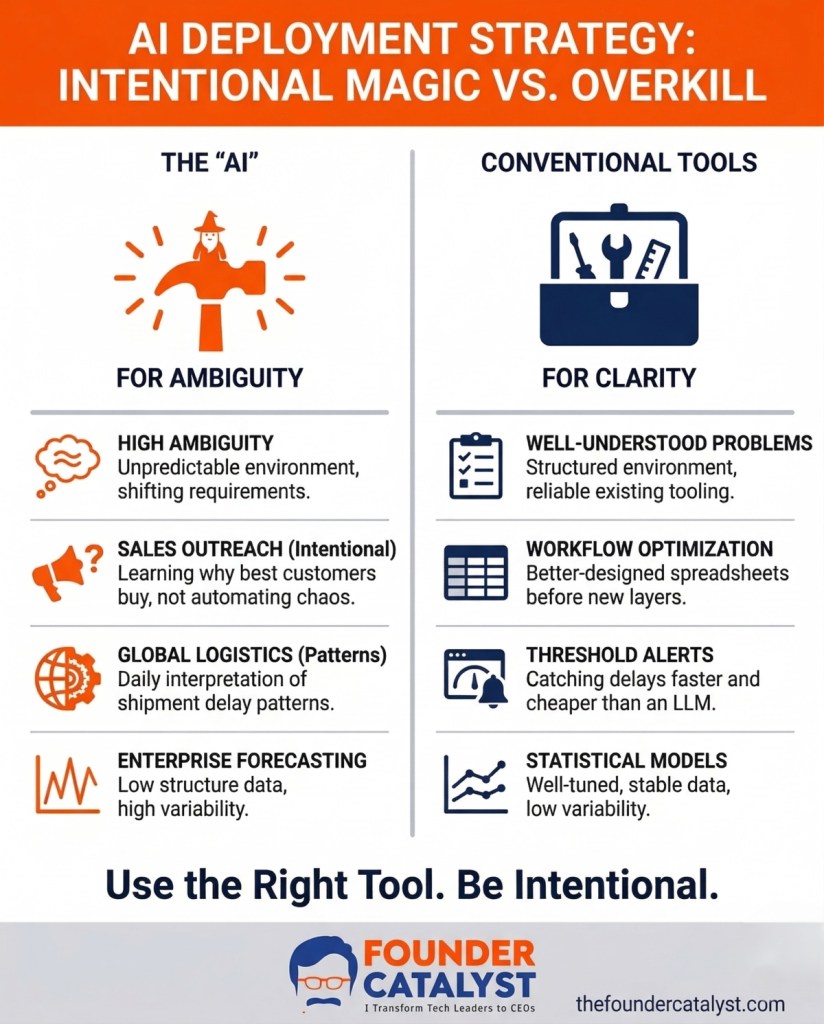
    The most expensive mistake in AI adoption is not using it correctly. It is using it on the wrong problem.

    I spent 100 minutes and nearly 19,000 tokens asking Claude Code to clean up my Windows PC — old .NET runtimes, NVIDIA CUDA versions, Visual Studio build tools — figuring out what to keep, what to drop, what to upgrade.

    It worked. Mostly. With a lot of permission dialogs, a few course corrections, and some very patient clicking on my part.

    Then I realised: Bulk Crap Uninstaller and Winget, two free Windows tools, would have done the same job in under ten minutes.

    That is not a complaint about the AI. Claude Code did something genuinely impressive. It reasoned through a messy, undocumented environment and wrote shell scripts without me spelling out every step. That kind of judgment in ambiguity is a real capability.

    But I had handed a magic hammer to a problem that had always had a perfectly good screwdriver.

    The mistake is not reaching for AI when things get complex. It is reaching for it when things are complex but well-mapped. Those are very different situations, and most adoption decisions right now are not making that distinction.

    LLMs are extraordinary when the environment is unpredictable, requirements are shifting, and no existing tool can handle the ambiguity. They are expensive, slow, and overkill when the problem is well-understood and reliable tooling already exists.

    This shows up everywhere. For founders, it is deploying AI agents for sales outreach before figuring out why your best customers actually buy. For operators, it is building an AI layer on top of a workflow that a better-designed spreadsheet would have solved.

    The pattern holds at scale, too. For global logistics teams, it is asking a model to interpret shipment delay patterns every morning, when a dashboard threshold alert would have caught the same issues faster and more cheaply. For large enterprises, it is routine to route quarterly demand forecasts through a model when the data is structured, the variability is low, and a well-tuned statistical model has always been the right tool.

    This is where the technology stands today. The boundary between what needs a model and what does not is shifting, and anyone who tells you it is fixed is not paying attention. The right answer next year may not be the right answer now. Stay curious, stay sceptical, and keep re-evaluating.

    Not every hard problem is ambiguous. And not every ambiguous problem needs a model.

    Use the magic deliberately.

    A comparison between artificial intelligence and conventional tools, illustrating the idea that not every complex problem requires AI, with a hammer and a toolbox depicted.
    Infographic comparing AI deployment strategies labeled 'Intentional Magic vs. Overkill', highlighting the use of AI for ambiguity and conventional tools for clarity. The left side lists AI applications like sales outreach and global logistics, while the right side covers conventional approaches like workflow optimization and statistical models. Includes a call to action to use the right tool intentionally.
  • My early days in professional speaking

    My early days in professional speaking

    Early in my career, I travelled across India with a desktop PC. I was delivering a keynote on a Microsoft web platform. The platform was still in beta.

    During one session, the power failed. The generator struggled to start. My PC rebooted slowly in front of a silent room.

    Those minutes felt endless.

    That moment stayed with me.

    The reason was not the failure of technology. Instead, it taught me that professional speaking is less about the perfect demo. It relies more on preparation, experience, and learning from those who have walked the path before me.

    Over the years, my own path on stage has evolved toward a central question. How do technology and AI truly help businesses and founders? It is a conversation rooted in real-world application, not just theory.

    Today, we can watch the masters online, but I still deeply value speaker communities. The ones where learning happens in conversation, through honest feedback, and over dinner with people who take the craft seriously.

    That is why I am looking forward to PSS 2026 this weekend. The annual summit of the Professional Speakers Association of India.
    I still enjoy being in rooms where speakers come together to learn, unlearn, and quietly get better.

    A meaningful bonus this year. It is happening right here in Chennai, my home city.

    If you are attending, let us connect. If you are curious about the craft, I am happy to share what I learn.

    #pss2026 #professionalspeaking #founders

  • AI for Founders: Simple, Strategic, and Safe Adoption

    AI for Founders: Simple, Strategic, and Safe Adoption

    Last week, I had the opportunity to interact with a vibrant group of young founders and CEOs at Corporate Connections Chennai. My talk, “AI for Founders,” was designed to give them not just an overview, but a practical way forward in this fast-moving space.

    We often hear about AI as the next big thing, but for many business leaders, the challenge is knowing where to begin. I shared a simple four-step approach to help organisations adopt AI in a way that’s both realistic and effective. The starting point is understanding what problems you’re trying to solve. Jumping on the AI bandwagon without clarity only leads to confusion. Once the goal is set, the focus shifts to building a core team, choosing the right tools, and keeping the process iterative—learn, adjust, and improve.

    Of course, adopting AI comes with its share of responsibilities. In the second part of my session, we discussed the four key things every founder should keep in mind to use AI safely and responsibly. This means paying attention to data privacy, watching out for built-in biases, not taking AI output at face value, and remembering that the objective is not to build flashy prototypes, but to deliver real, meaningful improvements for users.

    It was a lively session, with plenty of questions and practical discussions. My aim was not to make AI sound mystical or intimidating, but to bring it down to earth and make it something founders can actually use—without losing sleep over the headlines.

    The best part of these sessions is always the back-and-forth—hearing what’s on the minds of founders and what keeps them up at night. As AI continues to change the way we build and run businesses, I hope these simple frameworks help more leaders navigate the path with a bit more confidence—and a little less jargon.

    Venkatarangan presenting his "Unlock AI: Four Steps" framework on screen to a group of founders and CEOs seated at a boardroom table, with an inset photo of the group and the Corporate Connections Chennai meeting signage.
    AI for Founders – Four Steps to unlock AI for your business.