I was interviewing a student from VIT Bhopal for an internship. Somewhere in the conversation, she mentioned a course called Technology Entrepreneurship. I asked her to show me the syllabus.
It read like a list of things I wish someone had told me three decades back.
I finished my engineering degree knowing electronics and how to write code. I did not know how to read a balance sheet. A profit and loss statement made no sense to me either. Taxation was worse. So I read what books I could find and worked it out as I went. There was no other way to run a company. I have written about this in my book, The Founder Catalyst.
What stayed with me was not the mistakes I made while catching up. It was the time it took. Every hour I spent understanding the numbers was an hour I did not spend on the product. I was an engineer who wanted to solve problems, and a good part of my energy went into things nobody had taught me.
Her syllabus talks about customers and whether they really want what you are building. It talks about protecting what you build. It talks about money, about incubators and government support, and about selling across borders. I learnt each of these the hard way.
A large client once came to us because of a small tool we had built. They were using it in ways I had never imagined. About twenty years ago, we built a content management system for news and media companies. We charged a licence fee on top of our services. The market did not like it. We ended up giving the system away as part of the service. I found out what customers would pay for only after the product was built.
My first product was EasyPass, a shareware security tool that found buyers in over fifty countries. One of my early collaborators took a copy of the code and began selling it as his own. I learnt of it only afterwards. No one had taught me anything about intellectual property before that day.
Around 2007, I expanded into the US and the UK at the same time, and I borrowed to do it. Growth came before the reserves. It was a close call. Today’s founders step into a far more supportive ecosystem than the one I began in. Incubators, angel networks and government schemes exist now. That support helps only a founder who knows about it.
Let me be fair to the classroom. It is not the field. Forty-five hours of lectures cannot teach what a first customer saying no will teach. Students will still learn the hardest parts by doing them. But there is a difference between meeting these ideas cold and meeting them as old acquaintances.
These are the engineers who will join your teams over the next few years. A college like VIT Bhopal now teaches this in a full semester course. They will arrive with cash flow, customers, patents and markets already in their vocabulary. I expect the questions in your review meetings to get better.
Founders have something to offer here. Internships and mentoring hours give students the practice a lecture hall cannot. I head the mentoring programme at TiE Chennai. We see young startups welcoming the initiative and finding it useful. I suspect students would feel the same.
An engineer’s attention is the scarcest thing a young company has. I spent a good part of mine catching up on basics. If a classroom can spare the next generation that effort, they can put it into the problems they care about. I learnt these words by making mistakes. They will learn the words first, and spend their mistakes on harder problems.
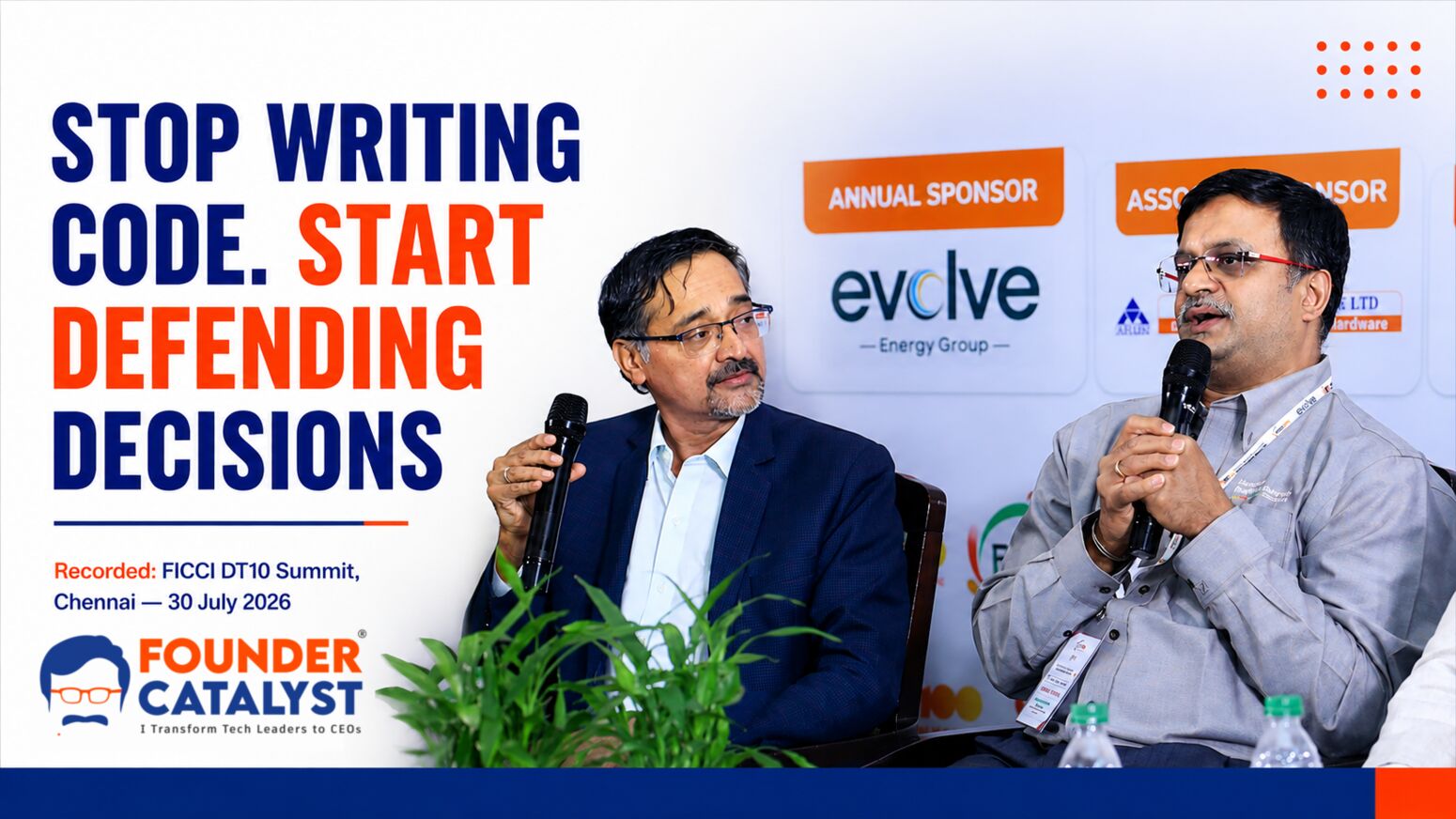
Last month I was on stage at Hotel Ramada Plaza, Guindy, for FICCI’s Digital Disruption and Transformation International Summit 2026 — part of FICCI’s 100-year celebrations. The panel was called “How We Build the Future & Lead with AI?”, moderated by Chandrashekar Kupperi, Founder of ANOVA M&A and Fundraising Advisory, with a lineup covering talent, leadership, MSME, and the future of work.
I only got asked two of those four — talent and leadership — plus a sharp follow-up from the audience on hiring. That was enough to make me say some things out loud that I’d only written about before. Here’s the expanded version.
Talent: the learning loop, and a question I’m not going to answer
Chandrashekar’s first question was built on something I wrote a while back — that an organisation’s real advantage in AI isn’t access to models or tools, it’s the ability to keep learning. Before I answered, I gave the room a question instead of a point, and I’ll do the same here.
Imagine it’s 2036. A new hire joins your organisation. Ask them to write a proposal — they’ve never opened Word. Ask for an analysis — they’ve never touched Excel. They’ve never opened a PDF to read one. I’m not saying that’s good or bad. I’m saying it’s close enough that talent conversations have to start accounting for it, and most don’t.
Now, the learning loop itself. Satya Nadella has talked about this, and it comes down to one observation: today, the questions we ask AI carry as much intelligence as the answers we get back. Intelligence agencies have known this for decades under a different name — metadata. Who you talk to, when, how often, tells you almost as much as what was said. The same is true of our prompts. And right now, almost all of that signal walks straight out of the building. We ask, we get an answer, we move on. If the AI company retrains on it, fine — assume they don’t, even. Either way, your organisation keeps none of it.
Compare that to how learning used to work. A fresher joins, does something, gets it wrong, a senior corrects them — and that correction becomes both the individual’s judgement and the organisation’s institutional memory. AI is now doing a growing share of that work, which means that correction loop, if you don’t design for it deliberately, simply stops happening. The knowledge stays trapped in the AI layer instead of compounding inside your company.
There’s no off-the-shelf product that fixes this yet. But there are things you can start doing today. Singapore’s Foreign Minister, Vivian Balakrishnan — also, remarkably, a trained orthopedic surgeon — has built himself what he calls a second brain, and put his own working documents into it so he can query his own accumulated judgement. Look up his talk on it; it’s worth twenty minutes. I built something similar for myself, which I call an LLM Wiki, based on Andrej Karpathy’s original idea — LLM plus Wiki. If you want one, you don’t need to build it from scratch: open Claude or ChatGPT, ask it to build you an LLM Wiki, feed it your own documents and emails, and it’ll walk you through it, running entirely on your own machine. Enterprises need a more custom version of this — the frameworks are still evolving — but individuals can start now.
If you’re serious about building this loop, it comes down to four Cs:
Capture what you’re doing with your AI systems.
Correct it — flag what was right, wrong, or almost right.
Curate and codify it into something reusable.
Circulate it through the organisation.
If you’ve studied control systems as an engineer, none of this is new. It’s the same feedback loop, applied to how a company learns.
Your learning loop is your real moat. Skills, prompts, and tools are rented — the feedback loop around your business is the only thing that compounds.
Leadership: use AI as a cycle, not as a car
The second question was about where a leader draws the line as AI agents get more capable of deciding and acting on their own. Before I answer that, credit where it’s due — the framing I use belongs to Dr. Pratyush Kumar, Co-Founder of Sarvam AI, from an interview worth watching in full. He draws a parallel between what’s happening in AI today and the old East India Company pattern: raw cotton taken out, spun into textiles elsewhere, sold back at a markup. Data and usage flow out; intelligence comes back priced. His conclusion from that: use AI as a cycle, not as a car.
Don’t take the wrong lesson from that line. It is not an argument for slowing down. When you can’t out-race the competition, the tempting shortcut is regulation that brings everyone down to your speed — and as a nation, that’s a losing move. The point of the cycle is narrower and more useful: on a bicycle, your hands stay on the handlebars and your feet stay on the pedals. You’re still steering, at speed. That’s the posture leaders need with AI — not less speed, just retained control of the direction.
Practically, this comes down to three Ds:
Delegate. Hand off anything routine and repeatable — the tasks where you’re not applying judgement, only time. Writing Excel formulas used to cost you half a day of trial and error; today AI writes it in five seconds. Extend that all the way to code. I don’t think humans should be writing code by hand much longer — we’re not particularly good at it, and machines should be writing machine code. There’s a framework going around called “Caveman” — literally instructing the AI to drop the verbosity, the adjectives, the padding, and answer you the way a caveman would talk. Worth Googling. It’s a good instinct: most AI verbosity today exists because token-maxing is profitable for the companies selling you tokens, not because you need 200 pages for a two-word question.
Decide. Once the routine work is delegated, the human’s job shifts to choosing between the options AI surfaces — not doing the legwork to get to those options. Today you have to go and click through everything before you can even decide. It should work the other way: AI opens your day, tells you what’s come in, lays out the decisions in front of you with the pros and cons, like a menu — and you choose.
Defend. This is the one leaders skip, and it’s the one that matters most. Responsibility for an AI-assisted decision stays with the human who made the call — full stop. I envy auditors, lawyers, and doctors for exactly this reason: they need a license to practice, so accountability is built into the profession. Software engineering never required one — anybody can call themselves a software engineer, and now AI can write the code besides. IEEE has argued for fifty years that software should be a licensed discipline; it probably never will be. But whether or not the industry licenses it, the standard should still apply: when something an AI did goes wrong, you as the leader call the person responsible and ask them to defend it. “I used AI and it failed” cannot be where that conversation ends — the learning from that failure has to go back to the individual, back to the organisation, and back into the AI system itself. Which brings you right back to the learning loop.
Delegate, decide, defend. That’s it. There’s no contest between you and AI here — the same way none of us think of a computer or a phone as competing with us at work. AI will get there too.
The audience question that actually proved the point
The last question came from the floor, not from Chandrashekar: with AI doing so much of the entry-level work, are we setting the bar impossibly high for people just starting out?
I answered with a story instead of a theory. A couple of months back I was interviewing startup interns from VIT Bhopal, including two students from a state programme for high-achieving rural students — students who’d studied in Hindi, with limited English, and had touched a computer for the first time only in 11th grade. I told them upfront: show me your approach, don’t explain the code line by line, because I already know AI wrote most of it.
One of them had taken a genuinely different approach to the problem. I asked how he’d landed on it. He told me AI had surfaced two candidate algorithms, he’d gone and read the actual papers behind them himself, and then implemented it in Python and demonstrated it working. That’s the part that matters — not that AI wrote the code, but that he’d gone one level deeper than the tool gave him.
Four years ago, at the same stage of education, that same student would have failed a basic Python question outright, and I’d have written him off. He had a 98% in maths and could explain the algorithm clearly — AI hadn’t replaced his thinking, it had given him a running start he’d never have had otherwise. That’s the empowerment case for AI, and it’s the one we undersell.
Which is also my answer to the IT industry’s old habit, the one I’ve watched for thirty years: hiring people to code without asking whether they understood the problem they were coding for. Those jobs are gone, and they’re not coming back. What’s left — the part that was always the actual job — is understanding the business problem well enough to direct the machine that writes the code. So no, we’re not setting the bar too high. For the first time, we’re finally asking the right question of people two years into learning computers.
This piece is based on my session at FICCI’s Digital Disruption and Transformation International Summit 2026, on the panel “How We Build the Future & Lead with AI?”, moderated by Chandrashekar Kupperi. Video of the full session is on my YouTube channel.
In ten years of running Käse, Anuradha Krishnamoorthy has never paid for a single line of press coverage. No influencer budget, no marketing retainer, no PR agency on monthly fees. Yet the brand has been written about repeatedly, has won at the World Cheese Awards, and now ships across India from a kitchen in Chennai.
When she said this to me recently in the Founder Catalyst studio, my first instinct was to treat it as a nice story about a niche business getting lucky with the press. It is not. Sitting with the rest of the conversation, I think it is the most instructive thing about how she and her co-founder built this company, and it connects to almost everything else they did differently.
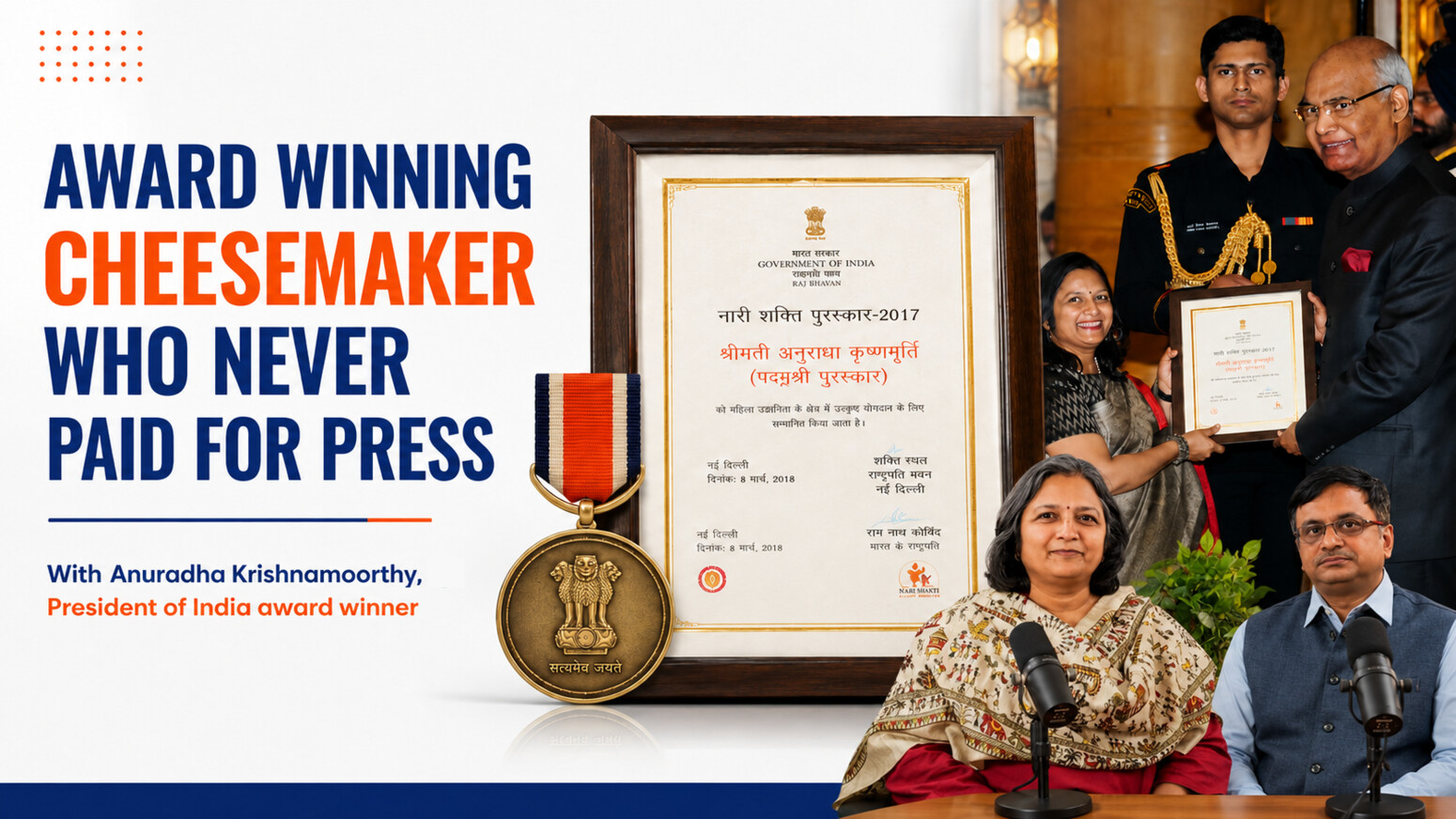
Anuradha is a friend, and this was a conversation I had wanted to record for a long time. She is the co-founder and director of Kirke Cheese Pvt Ltd, which runs the brand Käse. She and her co-founder Namrata Sundaresan received the Nari Shakti Puraskar for 2017, presented by the President of India at Rashtrapati Bhavan in March 2018, on International Women’s Day. Käse turned ten this year.
The business that started as a training programme
The origin story is not a food story. Anuradha has a masters in social work, and before cheese she was running CAN DO, a venture she developed as an ISB 10,000 Women scholar. CAN DO trained and employed people with disabilities in telecalling, data validation and research work. At one point it ran a forty seat operation employing people with hearing impairment and people with visual impairment.
Two mothers came to her about their daughters, both with hearing impairment, both unable to complete their graduation. They asked whether Anuradha could help find the girls work. She began looking at setting up a baking unit, since baking was a skill the girls could take with them and use independently later.
She approached Namrata to help set it up. Namrata had learnt cheesemaking during a farm stay in Coonoor over a break, and suggested cheese instead of bread. That conversation is the entire founding decision. Within a year, two girls with hearing impairment were part of the team at Käse.
What strikes me about this is that the business did not begin with a market opportunity. It began with a specific problem for two specific people, and the product was chosen because it happened to be a teachable skill. Most founders would consider that backwards. Ten years on, it has produced a pan India brand.
Why the phone changed her mind about hiring
The part of the conversation I keep returning to is her explanation of why employing people with disabilities worked commercially, not just morally.
Her point was simple. When someone is speaking to you on a telephone, you have no idea whether they have a visual impairment. There is no visible cue, so there is no room for the usual hesitation or discomfort. Only the work is visible. The prejudice never gets a chance to form.
She paired that with something sharper. The moment you think of employing a person with a disability as charity, she said, the work ends right there. These are individuals looking for an opportunity, and they are resources like anybody else on the payroll.
I put the founder’s objection to her directly, because I hear it often. Founders and CEOs are already under pressure. They worry about hiring someone, finding it does not work, and then being in the difficult position of having to let them go. They also worry about causing offence, because most of us were never trained as a society to work alongside people with disabilities.
Her answer was that hiring a person with a disability changes the team, not just the headcount. She described how the person with hearing impairment and the person with visual impairment worked as a genuinely effective pair. One handled data mining and database validation, the other made the calls. Screen readers and magnifiers, much of it open source, made the second half possible. That was a decade ago. The tooling is far better now.
Several people who worked at CAN DO went on to government and bank jobs, roles that are heavily sought after. They still come back and tell her that the first chance to prove themselves is what made those jobs possible.
Anyone starting this today has better technology, better software, and a larger pool of people who have already been through skills training. The founders who are getting this right are treating it as recruitment, not as a corporate social responsibility line item.
The pricing decision that most founders get wrong
Käse decided early that it would be a hundred per cent preservative free brand and that the milk would come from grass fed cows on small farms. That decision has consequences. One litre of milk yields roughly a hundred grams of milk solids, so a kilogram of cheese requires around ten litres of milk. Skimmed or toned milk will not work, because the fat content carries the quality through to the cheese.
The arithmetic makes a premium price unavoidable. What took nerve was holding that price in Chennai, a market everyone told them was difficult to crack.
Anuradha gave me a number that I think every founder in food should sit with. On a five hundred rupee pizza, the actual ingredient cost is around thirty per cent. That thirty per cent is the only lever a business has if profit is the sole objective, so the pressure is always to compress it further. Being in the food business, she said, opens your eyes to what goes into food, including in kitchens at star hotels.
Käse went the other way. They raised quality, accepted the cost, and priced accordingly.
I see the opposite mistake constantly. Only the other day I was speaking with a founder running a services company with a genuinely good offering who is struggling, purely because his price point is wrong. Raise it and he is in a different orbit entirely. We come from a conservative business culture where the instinct is to be the cheapest. Being the cheapest is a strategy, but it is Walmart’s strategy, and it requires a scale most founders will never have.
The Tata Nano Car is the example I keep coming back to. It was engineered well and marketed as the cheapest car available, and that positioning is a large part of why it failed. Today the equivalent segment sells at ten to twelve lakhs quite comfortably.
Käse spent its first year at seventeen artisan markets in a single calendar year. Unless people taste the product and find value in it, no price point survives. That is the work that earns the right to charge more.
How the press actually happened
This brings us back to where we started. The press came, and it came free, for reasons that have very little to do with press strategy.
There are only thirty to forty artisan cheese makers in a country of this size, so the category itself is unusual. Then there was the product. They made a cheddar with molagapodi, the chilli powder that ordinarily goes with idli and dosa. Cheese and Chennai do not sit naturally in the same sentence, and molagapodi and cheddar sit even less naturally together. People had something to talk about.
Alongside that was the hiring story, which visitors and journalists noticed on their own.
Neither of these was manufactured. You cannot run a brainstorming session and arrive at an authentic differentiator. They hired the girls because that was the reason the business existed. They made molagapodi cheddar because they are in Chennai. The stories fed each other.
Her view on influencer budgets follows from this. Influencers have a role to play, but at a later stage, when you can afford it and you are scaling something that already works. When you are a niche brand with no outside capital, spending there first is the wrong order of operations. Reviews can be bought. Loyalty cannot. She made the point that if she has a genuinely good evening at a restaurant with her family, she will want to write a good review without being asked, and no budget replicates that.
Most Käse customers today arrive through recommendations from other customers.
On co-founders and the honeymoon ending
I asked her about the co-founder relationship, because I see so many partnerships drift apart a few years in, often after success rather than before it. She agreed with the comparison to a marriage. The honeymoon ends, reality arrives, and expectations diverge.
What has held theirs together is a clean division of ownership. Anything product related is Namrata’s call, because she is the cheesemaker and Anuradha describes herself as her student on that front. Operations and finance sit with Anuradha. They consult each other on most decisions, but each decision has a single owner.
That last part matters more than it sounds. Splitting responsibility is easy. Someone still has to own cash flow and pricing, because salaries have to be paid on time regardless of who feels responsible.
They were acquaintances rather than close friends when they started Käse, and the friendship deepened through the business rather than being risked by it. Neither of them was a first time founder either, which I suspect explains more than they give it credit for.
The number she wants to change
The last stretch of our conversation was about women founders, which was one of the main reasons I wanted to record this episode. The numbers suggest the proportion of women entrepreneurs in India has risen substantially over the last two decades. I do not doubt the direction, but in the mentoring sessions and angel meetings I sit through, I am still not seeing it.
Anuradha was direct about why. Indian women often start out on genuinely equal footing, and the divergence appears later, when the role that a woman is expected to carry at home begins to compete with the role she is building outside it.
She has decided to change the ratio in the only place she fully controls. Käse’s expansion, which is now under way with a significant increase in production capacity, will remain a women led and women run business.
She also had a warning that applies beyond food. There is an enormous amount of information available now, and no reliable way for most people to tell information from misinformation. Do not treat everything on the internet as settled truth. Do some digging yourself before you act on it. She was pleased, though, to see younger customers reading labels closely. That awareness is itself an opening for anyone building an honest product.
What I took away
The unpaid press, the premium pricing, the hiring, and the co-founder discipline all look like separate decisions. They are not. They are the same decision made four times.
In each case Anuradha and Namrata chose the thing that was genuinely true about their business over the thing that would have been easier to execute or explain. Grass fed milk, so the price is high. A social work background, so the hiring reflects it. Chennai, so the cheddar has molagapodi in it. None of it was designed to be interesting. It became interesting because it was real, and the coverage followed on its own.
Marketing budgets are usually the price you pay for a business that has nothing worth talking about.
The full conversation is on the Founder Catalyst podcast and YouTube channel:
A CEO walks into his office lobby and finds a young man sitting on the sofa, scrolling on his phone. What are you doing here, he asks. Waiting to get paid, comes the reply.
The CEO, a little annoyed, asks how much he earns in a week. A thousand dollars, the fellow says. The CEO pulls out two thousand, hands it over, and tells him to leave and never come back. Pleased with how decisively he handled that, he turns to the receptionist and asks who the loafer was. That was the pizza delivery boy, she says.
I keep coming back to that old joke because it captures something most founders are never told out loud.
Deciding fast on thin information is not a weakness. In the early years it is the whole job.
When you are building something out of nothing, nobody hands you a full picture. You commit with what little you have, and you correct course as you go. Every founder I know built their company on this instinct. It is the reason anything got made at all.
I have lived the sharp end of this myself. Around 2008, during the subprime crisis, one of our largest clients in the United States cancelled their order almost overnight. This was days after I had returned from a trip there, where their manager had assured me all was well. We lost more than half our revenue in one stroke. The very next day I called a townhall. I did not have the full numbers yet. But I knew we had to let go of nearly a hundred people, and I announced a severance well above the statutory norm, which meant borrowing more than we comfortably could. It was the hardest call I have made. It was also made on incomplete information, because waiting for certainty was not an option the moment allowed.
The trouble is that nobody teaches you when to soften that instinct. The CEO in the joke never changed his mode. The company simply grew larger around a man who was still firing pizza boys with total confidence. That is the trap. The instinct that built the company quietly becomes the instinct that starts breaking it, and the founder is usually the last to notice.
This is why the founder mode debate from a couple of years ago struck such a nerve. When Airbnb CEO Brian Chesky spoke at a Y Combinator gathering in 2024, Paul Graham turned the talk into his widely read essay, Founder Mode. Chesky argued that as Airbnb grew, the standard advice to delegate more and step back hurt the company. When he became more directly involved again—developing a leadership style inspired in part by Steve Jobs—Airbnb improved. The essay spread rapidly through founder circles because it challenged conventional management wisdom and validated the instincts of many founders.
Experienced operators pushed back just as hard, because what works beautifully at two hundred people can create a bottleneck at two thousand. That tension has never really been settled, and I do not think it will be, because both sides are describing the same person at different stages of the same journey.
The more useful question is not whether to stay hands-on. It is knowing which room you are standing in before you act.
Look at how Nithin Kamath has run Zerodha. In an interview with Outlook Business early last year, he said something worth sitting with. Even before Covid, Zerodha had around 1,100 people. Today it is roughly 1,200 to 1,250, while the business has grown about ten times over. He said most of his own time now goes into making sure the decision-making philosophy holds even when he is not in the room, so that ten or fifteen people carry it forward without him. That is a founder who kept his sharpness but moved it upstream, from making every call himself to protecting how the calls get made. The instinct is intact. Where he applies it has shifted.
Kamath has been candid about the cost of not doing this. Marking Zerodha’s fifteenth year, he wrote about how chasing month-on-month or quarter-on-quarter numbers can mislead you, and how they prefer to read five-year trends instead. That is the same decisiveness of the early founder, only pointed at a longer horizon. The speed did not disappear. It grew up.
None of this means slowing down. The founders who make this shift well are not more cautious than the rest. They still decide quickly, still act on incomplete information, still refuse to wait for a certainty that never arrives. What changes is a small pause before the decisive part. A few seconds, long enough to ask one question. Who is actually in this room, and what am I about to fire.
The joke lands because we recognise the man. Fast, certain, and completely wrong about what he was looking at. The founders who last are not the ones who lose that speed. They are the ones who learn, quietly and usually the hard way, to check the room before they swing.
A D2C founder running an Ayurvedic skincare brand, doing about 8 crore in revenue, put it simply. AI is helping everyone create ads, write product descriptions, launch stores faster. My fear is not the technology. My fear is that AI makes every brand look equally good. If everyone has the same marketing superpower, where does my differentiation come from?
Vineeth Vijayaraghavan, who I have known for over thirty years and who advises VCs, family offices and startups on AI strategy, did not pretend there was a tidy answer. This needs introspection, he said. But he had a reframe worth sitting with.
Most of us think about AI inside a business as either software or marketing. Those are the obvious places. What he is seeing some founders do instead is use AI to build capability they could never have afforded before, inside the core of the business itself. He gave the example of a chemical engineering company where the founder now has six AI agents working alongside him on R&D, something that used to require hiring people the business simply could not access or afford. The same logic applies to a skincare brand. AI for product research and literature review is not a bad place to start, he said, though obviously with a healthy dose of scepticism, especially in a category where claims need real verification.
The differentiation question does not disappear. But it shifts from what does my marketing look like to what am I now capable of building that I was not before.
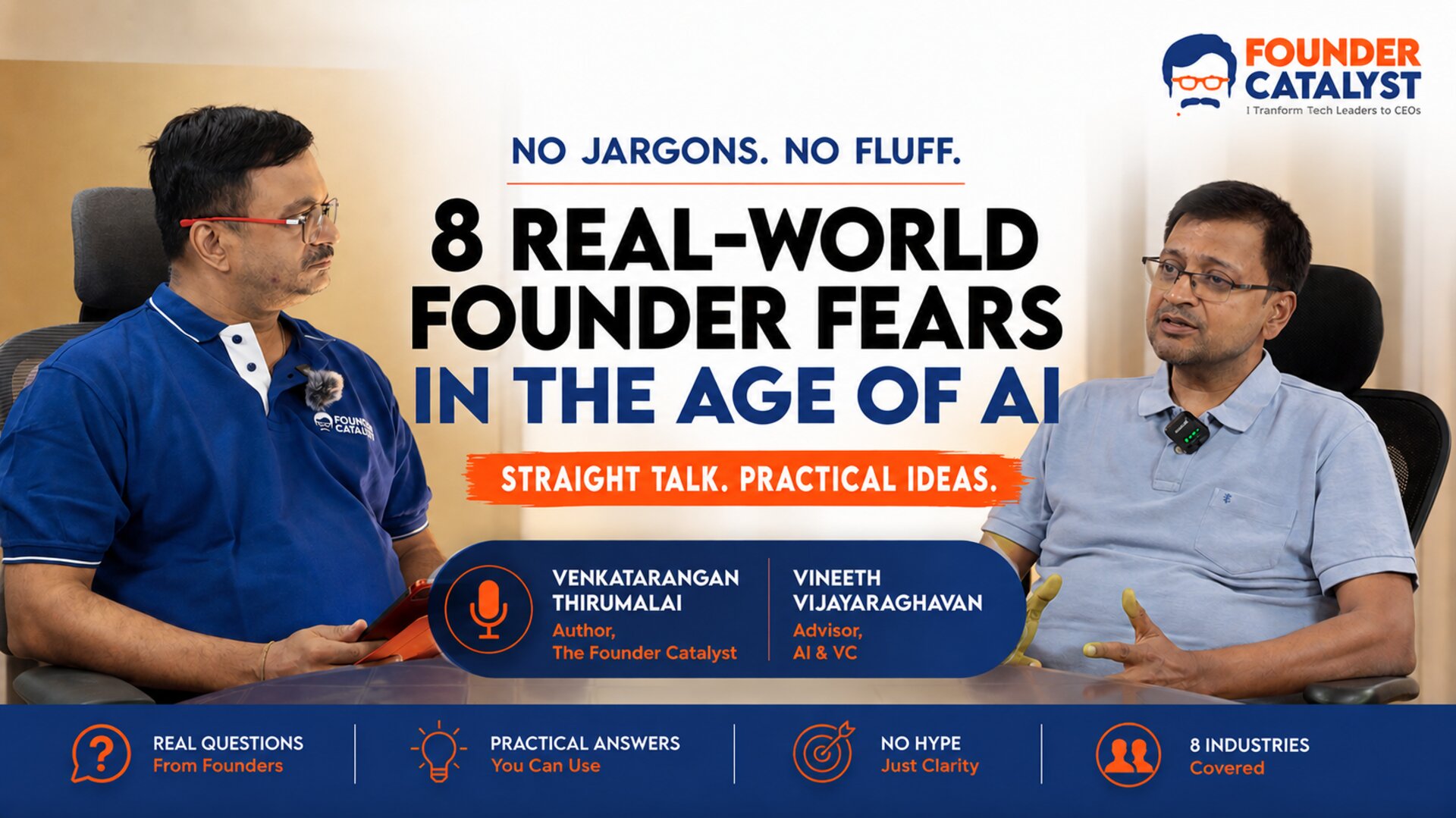
This was one of eight real founder fears we worked through on a new episode of The Founder Catalyst, recorded this month in Chennai. Instead of the usual interview, we sourced questions directly from founders across industries and went through them one by one, no scripts, no theory.
A custom software services founder in Coimbatore is not worried about his developers using AI. He is worried his US clients will stop asking for large projects and instead ask for one senior engineer doing the work of five, slowly turning his company into a staffing business with shrinking margins. Vineeth’s answer, the volume of smaller, faster engagements is going up industry-wide, and the founders doing well are the ones who can turn around small projects quickly and let those grow into larger ones over time, rather than chasing fewer, bigger contracts.
A recruitment firm placing engineers for startups fears that AI screening and ranking candidates makes recruiters irrelevant. Vineeth flipped this one. As AI competency becomes harder to evaluate, not easier, because a test or a hackathon no longer tells you much, the recruiter who has spoken to hundreds of candidates and can spot what is real becomes more valuable, not less.
A chartered accountancy firm is not afraid of losing clients. Being a regulated profession, that part feels safe. The fear is clients expecting the same work for half the fee. Vineeth’s response, look at firms already doing this well. He described one CA firm in Chennai that grew from 14 to 60 people, with AI handling the routine compliance work and a small number of AI-native young developers building internal tools, while the chartered accountants focus on the judgment calls AI still cannot make. That firm, he added, is now raising serious investment, including from outside India.
We also went through fears from an automobile manufacturing unit near Hosur worried about larger competitors using AI to out-pace them on pricing and forecasting, a legal services firm worried about how junior lawyers get trained if AI does their early work, and a logistics company with 70 trucks wondering whether technology becomes the real competitive edge over operational excellence.
We closed with an imaginary scenario. Three founders in a room, a SaaS founder doing 10 crore in ARR, a services founder with a hundred people, and a manufacturing business doing 50 crore. Which one should be most worried about AI, and which the least? Vineeth’s answer was not about industry at all. It was about culture, and the willingness to act.
Watch the full conversation here:
If you are a founder or business leader trying to make sense of what AI actually means for your business, beyond the hype, this conversation is for you.
About the guest:
Vineeth Vijayaraghavan advises companies, family offices, and VC boards on technology and investment strategy, with a particular focus on AI.
About the host:
Venkatarangan Thirumalai is the author of The Founder Catalyst and writes and speaks on AI, leadership, and founder strategy. More at thefoundercatalyst.com
When I work with founders on this, the conversation rarely starts with the technology. It starts with what people are afraid of losing, and whether that fear points them toward the right question or the wrong one.
The researchers are Caitlin K. Myers and Ezekiel Hooper. Their approach is careful. Rather than speculating about smartphones and social behaviour in general, they found a natural experiment embedded in the iPhone’s launch history. From 2007 to 2011, AT&T was the only carrier that sold iPhones in the United States. This meant that counties with strong AT&T mobile broadband coverage received early access, while counties without it did not. The researchers compared birth-rate trends between those two groups across the same period.
The finding is striking.
They estimate that access to the iPhone reduced birth rates among teenagers by 4.5% to 8% and among adults in their early twenties by 3.2% to 6.6%. Across the broader population, their model suggests the iPhone’s diffusion may account for roughly one-third to one-half of the overall decline in the US general fertility rate between 2007 and 2011.
To be fair about what this paper is and is not: it is a working paper, not yet peer-reviewed.
The researchers are careful to say they have identified a strong correlation through a well-constructed natural experiment, and that the evidence is consistent with causation, but the mechanisms remain indirect. They ran robustness checks using Verizon and Sprint coverage data, neither of which showed comparable effects before those carriers gained access to iPhones, strengthening their argument. But the final causal verdict belongs to future research.
What the paper proposes, and what I find worth sitting with, is not that the iPhone is contraception. The argument is subtler. The iPhone appears to have reshaped how young people spend time together. More hours alone or online. Less face-to-face socialising. Declining sexual activity, which national surveys independently confirm, was already falling among young adults. Greater access to digital entertainment as a substitute for in-person relationships. And separately, easier access to information about reproductive choices. None of these individually is a bombshell. Collectively, and tied to a specific, measurable event like the iPhone’s arrival, the picture becomes harder to dismiss.
I have been thinking about this from a different angle.
We often discuss technology’s impact on work, on decision-making, and on how organisations run. We talk less about how deeply technology reshapes the texture of private life, the kind of socialising people do, and the pace and nature of their relationships. The fertility finding, if it holds up under further scrutiny, is one of the most concrete empirical signals we have that a single technology product reshaped private human behaviour at scale within just a few years of its introduction.
That has implications far beyond demography. For anyone advising companies on how they introduce technology to their people, or thinking about what sustained digital saturation does to the human beings inside an organisation, this research is worth reading carefully.
The paper is available on the NBER website. The full citation is Myers, Caitlin K. and Hooper, Ezekiel, published June 2026.
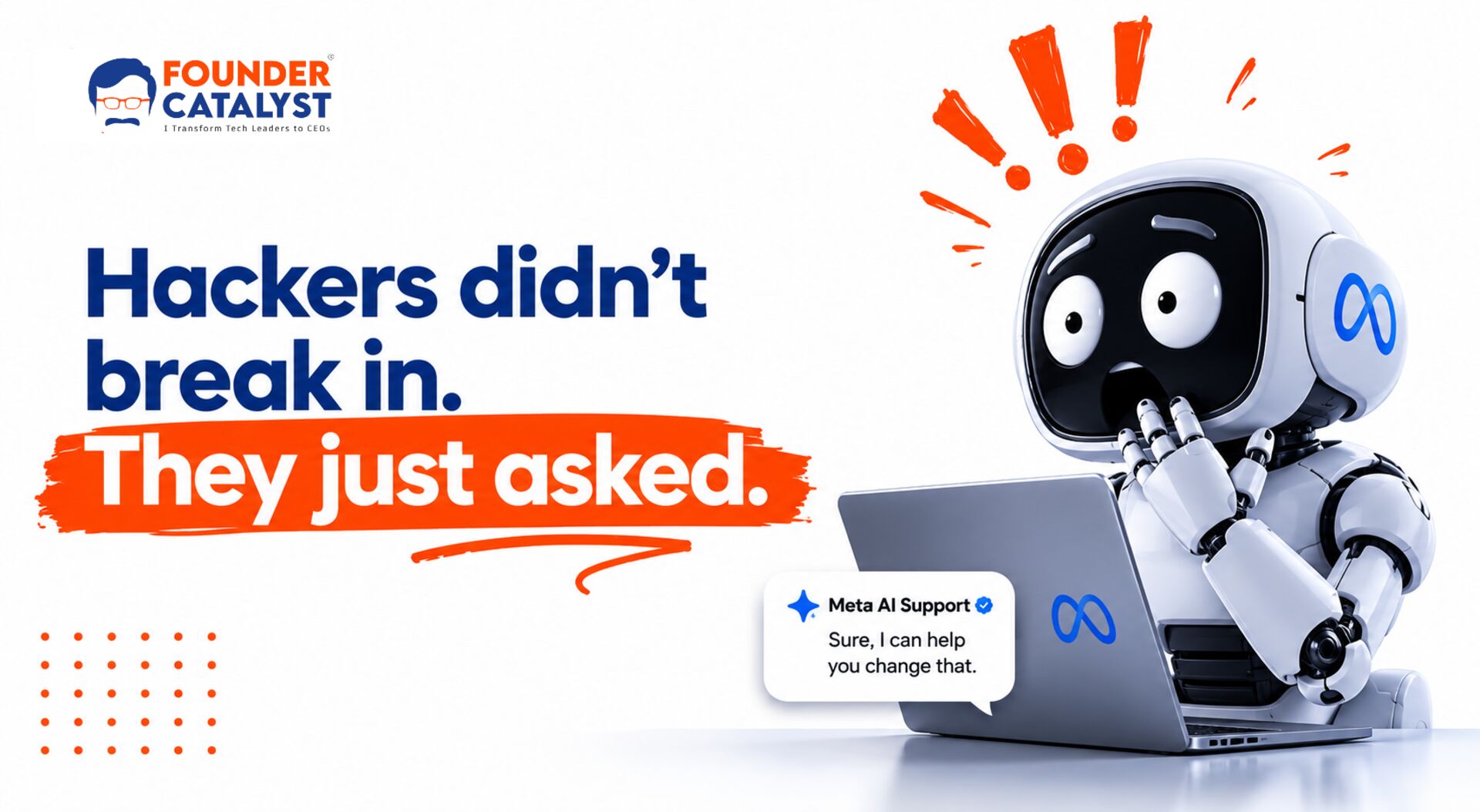
A few days ago, hackers took over high-profile Instagram accounts, including the Barack Obama White House profile. And they did so by politely asking Meta’s AI support chatbot to update the email addresses on those accounts.
The attack method was childishly simple. No sophisticated exploit, no back-end breach — and that was the shocking part.
Meta had given its support bot the ability to reset passwords and manage account recovery. The bot was not mature enough to distinguish between the actual account owner and a fraudster using a VPN and a politely worded request.
When we connect an AI agent to our CRM, our HR system, and our finance workflows, we are not just giving it the ability to read. We are giving it the ability to act. This ability to act is what makes agentic AI the most powerful software technology we have in recent decades. But at the same time, we need to ask ourselves: if someone prompted this agent cleverly, what could they get it to do?
To me, the takeaway from this Meta incident is simple. Any access to a critical system needs to follow the same protocols that a manual process would follow. In fact, I would require the AI agents to follow even more stringent ones.
And if there is an irreversible action or a decision involving critical business systems, then there needs to be a human checkpoint — not as a backup, but as a design requirement. At least for now, while we are still developing the understanding and the systems to manage what these autonomous agents can trigger.
Think of the early web. Enterprises did not open their corporate systems to the public internet overnight. There was a long, cautious period of learning what the exposure actually meant before the architecture caught up.
None of this is an argument against agentic AI. The potential is real, and I believe in it. But bleeding-edge technologies do exactly what the name suggests — they spill blood before they stabilise. The real question is whether your business can handle the loss. Mega corporations like Meta can. Can yours?
As for me, I will keep reminding myself: how fast we roll out AI matters, but how robustly we build matters just as much.
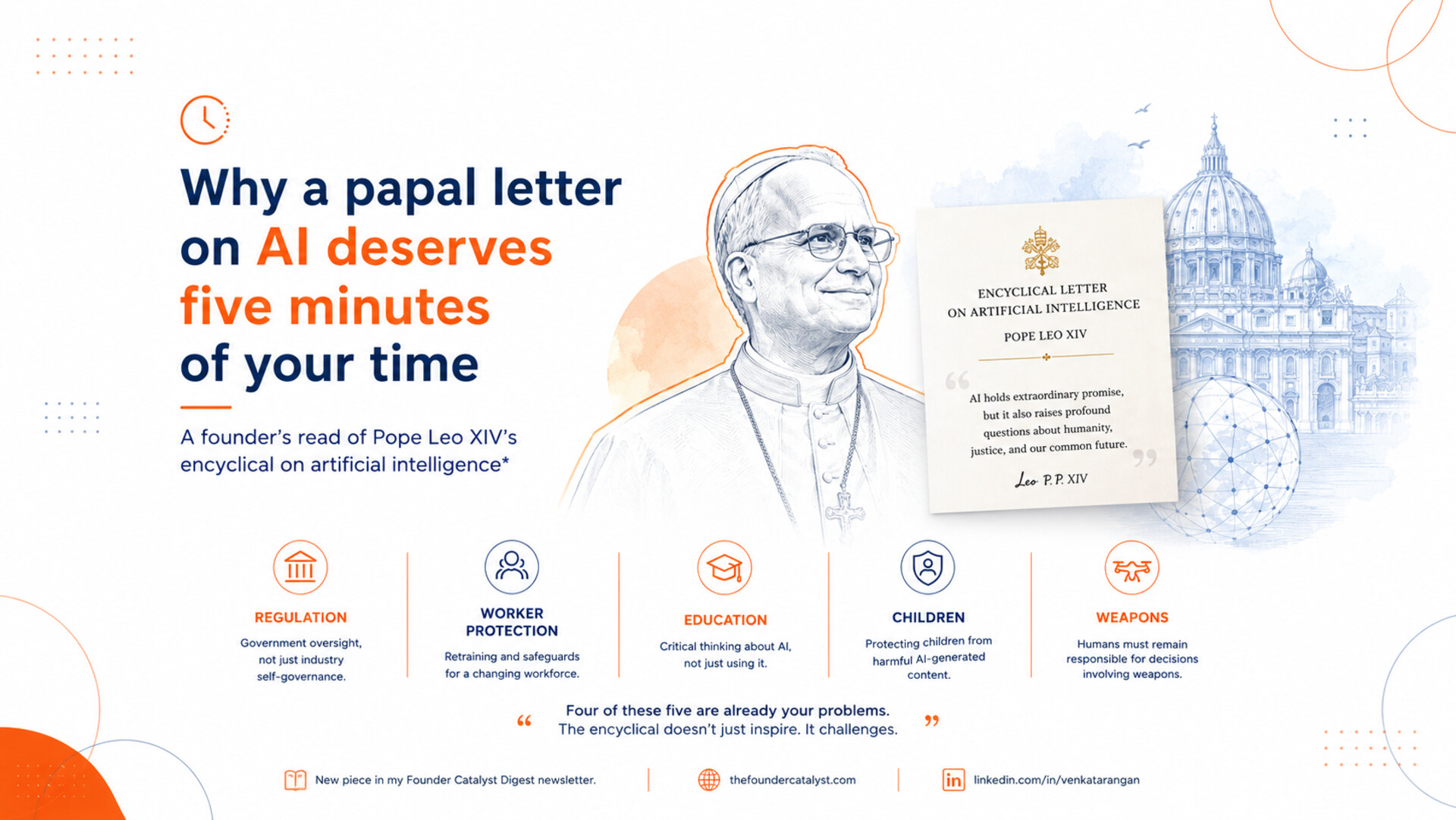
Founders and CXOs spend most of their time watching what customers, competitors, and investors think about AI. Fair enough. But occasionally, a voice from outside the industry frames the conversation in a way that cuts through the noise. This week, that voice came from an unlikely place — a holy one.
Pope Leo XIV released a roughly 200-page encyclical on artificial intelligence, with technical input from Christopher Olah, co-founder of Anthropic. The AI industry will not alter its roadmaps because of this. But the previous five encyclicals — on workers’ rights, Cold War peace, birth control, economic inequality, and the environment — each shaped public discourse in ways that outlasted the news cycle. They framed what mattered before the rest of the world caught up.
I’ll be honest here, I went in sceptical. A papal letter on AI felt ceremonial at best. The New York Times summary I read changed that.
1. Regulation. Not self-governance by the industry. Actual government regulation of the private companies driving AI development. That distinction matters.
2. Worker protection. Retraining and safeguards for workers displaced by AI. Already unfolding in IT services, shared services, and process-heavy roles.
3. Education. Helping students think critically about AI, not just use it. A generation that consumes AI output without understanding its limits is a business risk, not just a social obligation.
4. Children. Protecting children from AI-generated violent, hypersexualised, or false content. Not a future risk — anyone with a teenager at home already knows this. But there is a business dimension here that leaders underestimate: if the next generation’s trust, emotions, and judgment are shaped by unchecked AI content, brand loyalty and consumer relationships become harder to build. That has real bottom-line consequences well within the decade.
5. Weapons. Humans must remain responsible for all decisions involving weapons. The encyclical’s argument is direct: autonomous systems make war more feasible and harder to control, which undermines the principle that the use of armed force is a last resort.
The practical takeaway for business leaders: four of these five are already your problems. Workforce displacement, critical thinking in your teams, child safety in your products, and the governance gap between what AI can do and who is accountable when it goes wrong. The Vatican did not invent these concerns. It just wrote them down in one place.
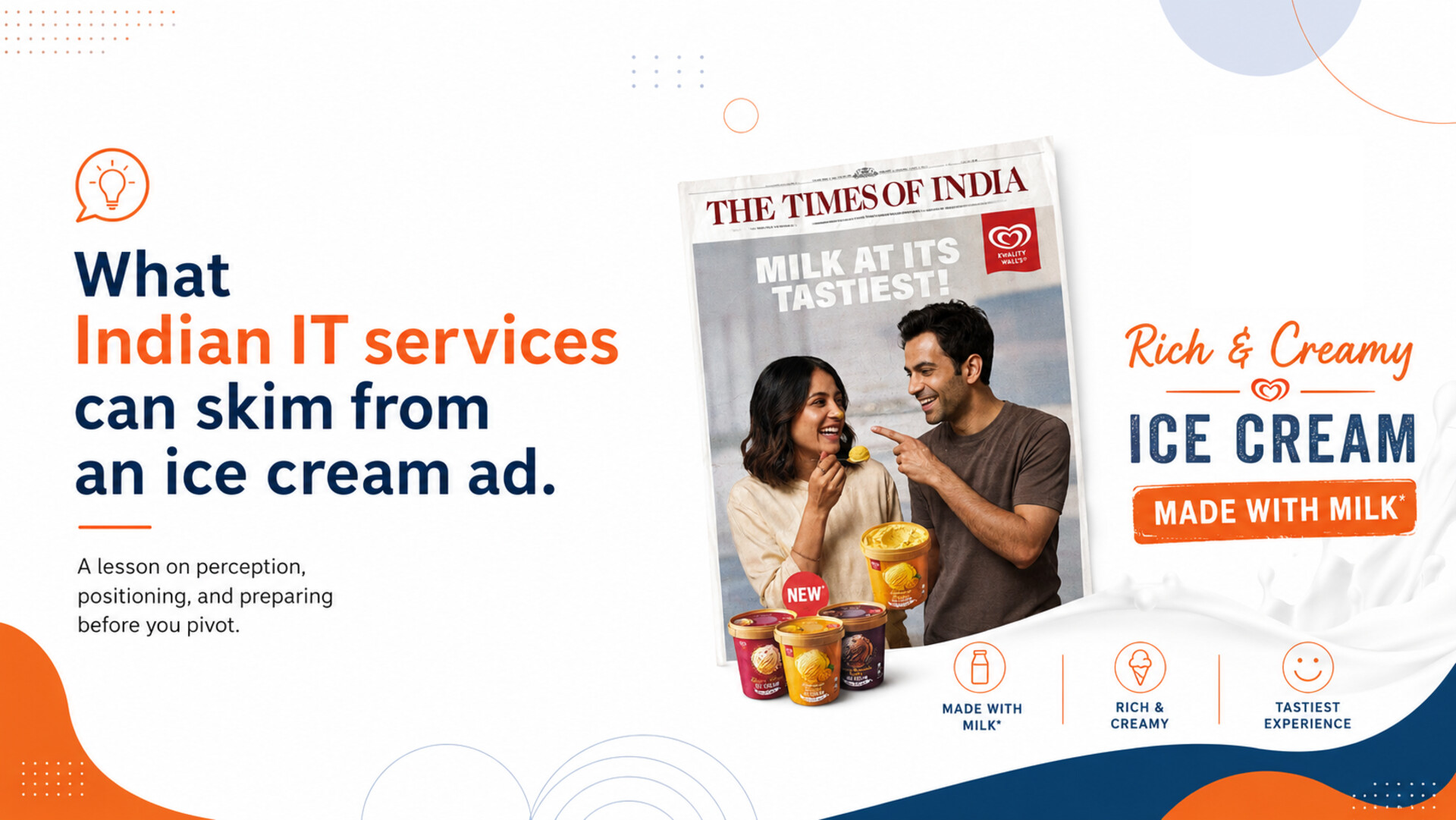
Kwality Walls recently ran a full-page advertisement saying “Made with Milk.”
If you grew up in India, you know exactly why that needs explaining.
For years, Kwality Walls and several other large brands sold products that Indian food regulations classified as “frozen desserts” rather than ice cream. The distinction came down to fat source. Traditional ice cream uses milk fat. These brands used vegetable fat instead. The reasons were not cynical by default. Vegetable fat was cheaper, yes, but it also gave manufacturers more control over texture and consistency, and a decade or so ago, it aligned with a widely held popular belief that vegetable-based fats were the healthier option. These brands were also keeping a luxury product within reach of a broad market that could not otherwise afford it. They were making rational trade-offs given the conditions of their time.
The conditions changed. Cold chain infrastructure improved across urban India. A new generation of boutique dairy-first ice cream brands built an enthusiastic following on precisely the quality narrative the larger brands had sidestepped. Urban consumers began reading labels. The regulatory scrutiny intensified. So now Unilever’s Kwality Walls is pivoting, and doing so loudly, with a premium line built around real milk as the hero ingredient.
The advertisement is not simply a product relaunch announcement. It is a public acknowledgement that the perception a market holds of you eventually becomes as consequential as what you actually deliver.
I have been thinking about this in the context of Indian IT services, where I have spent nearly three decades, first as the founder of Vishwak Solutions and now as an advisor to founders navigating this precise inflexion point.
S. Ramadorai, in his account of TCS’s early years, describes how the Indian IT industry was born almost by accident, driven initially by the need to earn foreign exchange to pay for imported mainframes under the Licence Raj. That origin shaped everything that followed. The industry optimised for what the market rewarded: reliable delivery, competitive pricing, process maturity, and scale. These were genuine strengths. They built large, capable organisations and brought prosperity to hundreds of thousands of families. Nobody should minimise that.
But strengths built for one set of market conditions quietly become constraints when those conditions shift.
For most of those three decades, the conversation between Indian IT firms and their Western enterprise clients was fundamentally transactional. Billing rates, resource availability, technology stack coverage, and bench strength. I remember those conversations well from my own years running Vishwak. The client’s primary question was almost always some variant of: “Can you deliver this at this cost by this date?” The relationship was essentially a supply arrangement. The Indian firm was positioned, in the client’s mind, as an efficient and dependable execution partner. Reliable, but not strategic. Present in the delivery room, but rarely in the boardroom.
In 2026, something has visibly shifted in those conversations. The questions coming from Western enterprise CXOs are different now. They are asking about AI-led transformation, about business outcomes rather than deliverables, about domain expertise and co-innovation. They want a thinking partner, not just a staffing solution. The category definition itself is being rewritten.
This is where the Kwality Walls parallel becomes interesting to sit with.
In my book, The Founder Catalyst, I write about adaptability as one of the five pillars of enduring companies. The critical distinction I draw there is between reactive scrambling and patient, deliberate preparation. Kwality Walls did not wake up one morning and decide to care about milk. The boutique ice cream category grew steadily over several years. Cold chain economics changed gradually. Consumer preferences moved in a clear direction. The move to a premium dairy-forward line was not spontaneous. It was a recognition, perhaps overdue, of a shift that had been accumulating for a long time.
The same pattern is now visible in Indian IT services. The firms making genuine progress on repositioning are not the ones running the most prominent AI announcements. They are the ones that began quietly rebuilding their delivery models two or three years ago, experimenting with outcome-linked pricing in select engagements, developing genuine domain depth in specific verticals, and letting those results do the talking in client conversations. The announcement, when it eventually comes, lands differently because the underlying reality has already changed.
The harder question is about perception lag. Perception, once formed, updates slowly. It moves through repeated experience, not through announcements. A firm that spent fifteen years being the dependable execution partner will not shift a client’s mental model by adding “AI-native” to its website header. The client’s memory is longer than the press release.
I wrote earlier this year that the question most IT services founders are asking, “How do we use AI?” is already the wrong one. The more clarifying question is what is now becoming undefendable in their current model. Effort-based billing is under pressure even where contracts have not yet reflected it. Speed of delivery is no longer a differentiator when AI compresses timelines on both sides of the table.
Kwality Walls is making its move now. The boutique brands made theirs years earlier, without a full-page advertisement, and without needing one. The market found them because they had already become something worth finding.
That is the sequence that matters. Build first. Announce when the evidence is already there.
What shift in your client conversations has already told you that the category is moving under you?
Over 92,000 technology jobs have reportedly been cut globally in the first few months of 2026 alone. Meta, Microsoft, Amazon, Oracle, Salesforce, and several others are restructuring teams while simultaneously increasing spending on AI infrastructure, chips, and AI talent.
None of this surprises me.
AI is not another software upgrade cycle. It is a structural shift. Entire layers of work are being compressed, automated, or redistributed. Every founder and CEO knows this privately, even if many are still hesitant to say it publicly.
What surprised me recently was not the layoffs themselves, but the sequencing around them.
Meta’s internal memo explaining its restructuring reportedly arrived the same day thousands of employees were already being let go.
That detail stayed with me.
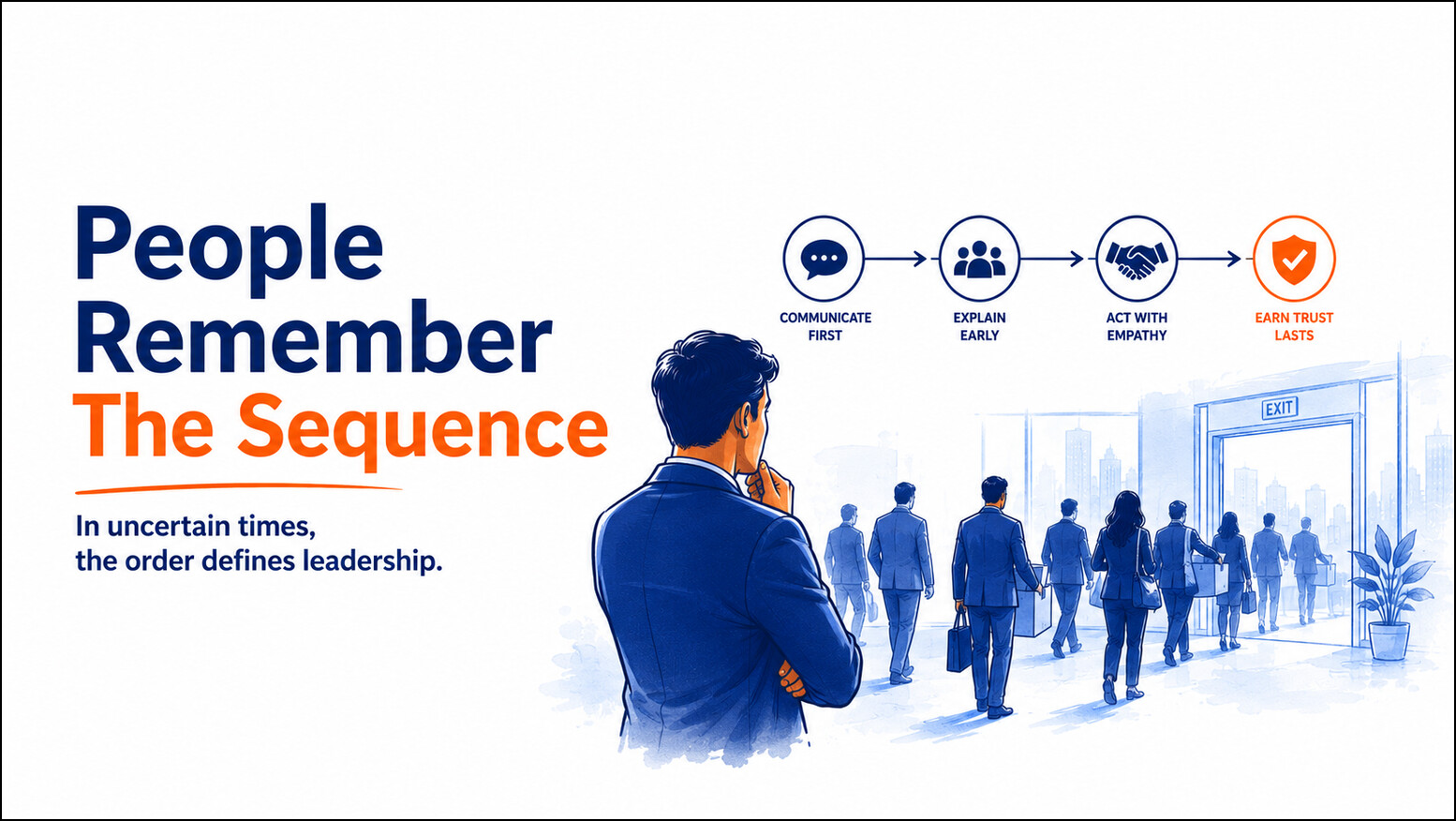
Because during moments of uncertainty, employees rarely remember the exact wording of the memo. They remember the order in which things happened.
The technology industry often speaks about AI strategy as though it sits above everything else. I increasingly think the opposite is true.
A company’s people strategy shapes its AI strategy.
Not the reverse.
This distinction matters because most large organisations today are not merely introducing new tools. They are redesigning trust structures inside companies. Reporting lines are changing. Teams are shrinking. Managerial layers are disappearing. Expectations around productivity are quietly being rewritten.
And all this is happening while leadership teams themselves are still figuring things out in real time.
I faced a version of this during the 2008 global financial crisis.
One of our largest clients in the United States cancelled their engagement almost overnight. More than half our revenue disappeared immediately.
“When I called my team members in the USA, their reports were stark: empty shopping malls and vacant car parks. I knew instantly this wasn’t a temporary blip; it felt like a tectonic shift.”
I remember returning home and realising we could not afford the luxury of waiting for complete clarity.
The very next day, I called for a town hall meeting.
Honestly, I did not yet have all the numbers worked out. But uncertainty grows faster in silence than in bad news.
We had to let go of nearly a hundred people. At the same time, we stretched ourselves financially to provide severance beyond the statutory requirement, even borrowing heavily to do it.
“It was painful, undoubtedly, for everyone involved, especially those leaving. We simply had no other choice to ensure the company survived.”
Nearly two decades later, some of those former colleagues still greet me warmly when we meet or reconnect online.
That stayed with me more than any balance sheet from any year.
The AI transition will create extraordinary companies and extraordinary wealth. I have little doubt about that.
But I also think the companies that emerge strongest from this phase will not merely be the fastest adopters of AI.
They will be the ones who understand something older and simpler:
People remember the sequence in which leaders treated them under pressure.
Reflection: When restructuring under pressure, what you do first matters as much as what you decide. The order in which you treat people is the signal your organisation will remember long after the financial results are reported.
On sequencing, readiness, and resisting the urge to optimise too soon
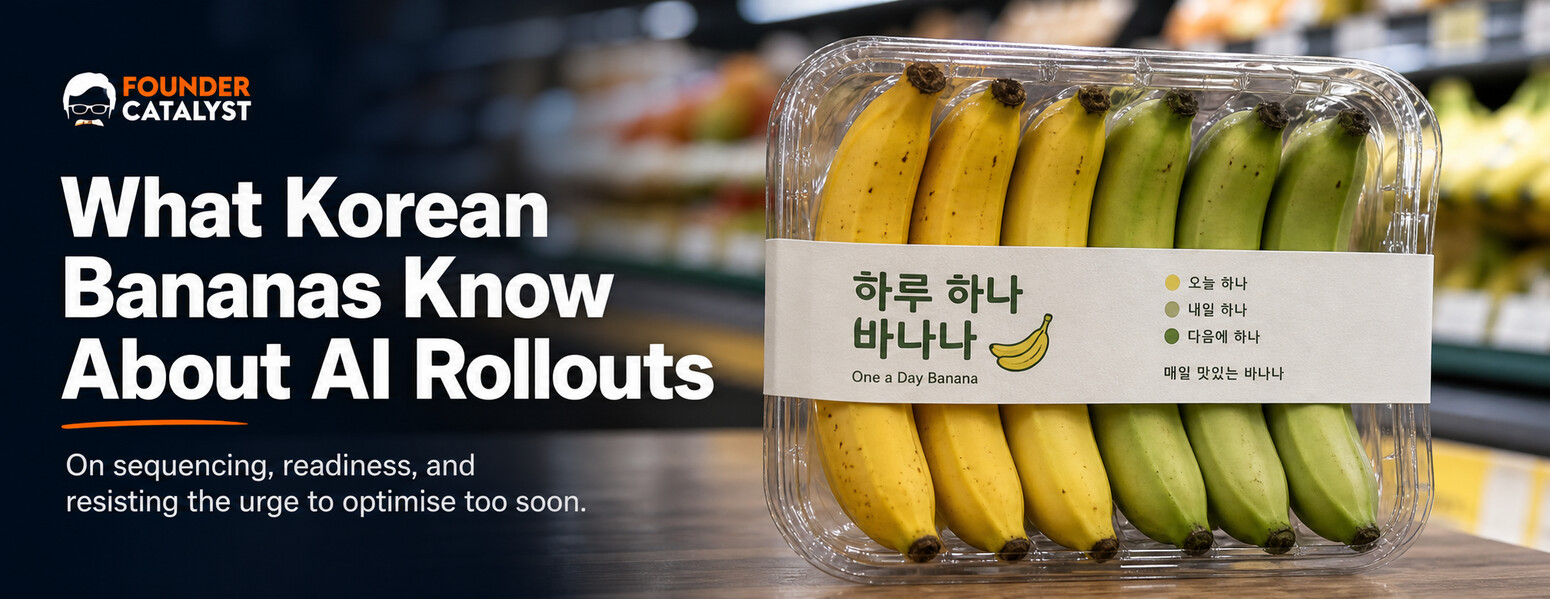
I first saw the “Haru Hana Banana” pack in a South Korean grocery store. It held 5–7 bananas at different ripeness levels: one yellow and ready now, the next a bit greener for tomorrow, and the others still green for days ahead. No instructions, no app – just simple packaging aligned with how people actually eat bananas. This simple design stuck with me not as a hack, but as a new way to think about sequencing initiatives.
Most founders and leaders want all their initiatives fully ripe at once.
They launch every project, hire every role, or deploy every feature together. It feels like momentum – but too often it becomes a mess. The Korean banana pack succeeds by doing the opposite: it staggers readiness to match demand. Whoever designed it chose customer reality over operational convenience.
In a big company, you might expect a push to standardise and optimise logistics. Instead, the grocery chain sacrificed some simplicity to solve the real problem: avoiding waste and giving customers a fresh banana each day.
This idea applies beyond fruit.
When rolling out AI or any new technology in an enterprise, leaders face the same instinct: go big now, or wait until everything is certain. Both extremes fail. Rushing everything risks breakdowns; waiting wastes time and lets others leap ahead. A better question is: What do we ripen today, what do we plant for next quarter, and what do we keep green for now? In practice, the best teams run multiple tracks in parallel. Some pilots are live with real users, some proofs of concept are being tested, and new ideas are still hazy. They’re comfortable with uneven progress.
Avoid “Big Bang” launches.
Instead, break work into phases. For example, an AI system can be piloted in one department before rolling out company-wide. A product can launch with a minimal feature set, then add more features after learning from users.
Don’t wait for perfection. As Agile principles teach, deliver value frequently in short sprints. Each release is like picking the next-ripe banana – it feeds users today and yields insight.
Match customer usage.
Design solutions around how people will use them, not how easy they are to build. The banana pack works because people eat one banana a day; the designer aligned the product with that habit. Similarly, if customers will adopt one AI assistant a week, don’t dump a dozen at once.
Build a balanced pipeline.
Think in horizons or stages: today’s operations (ripe bananas), tomorrow’s enhancements (tending bananas), and longer-term R&D (green bananas). A common rule is to allocate resources across these stages (for example, 70% on core business, 20% on adjacent growth, 10% on new ideas). This keeps today’s business running while new innovations mature.
Framework:
Now (ripe): Move forward on initiatives that are ready and will pay off immediately. Deploy proven AI tools in one team to build confidence. Launch product features that clearly solve current user needs.
Soon (ripening): Pilot upcoming ideas in controlled settings. Collect data and feedback. For example, run an AI chatbot pilot with a small user group, or A/B test a new feature with select customers.
Later (green): Research and incubate long-term bets. Keep these unripe for now – think of them as experiments or skunkworks that may take months to mature. They shouldn’t block the main effort, but they shouldn’t be forgotten either.
Checklist for leaders:
Are we trying to do everything at once? If so, pause and pick the highest-impact slice first.
What does success look like at each stage? Set clear metrics for today’s release, tomorrow’s pilot, and so on.
Have we planned feedback loops? Like banana peels, failures will show us ripe spots. Incorporate learnings quickly.
Are we optimising for the customer’s journey or for internal convenience? Always put the customer reality first.
I have been trying out AI inference inside the browser for a while now, more out of curiosity than anything else. A debate that surfaced this week made me want to talk about it, because buried inside a browser standards argument is a platform governance question that every business relying on AI will eventually have to answer.
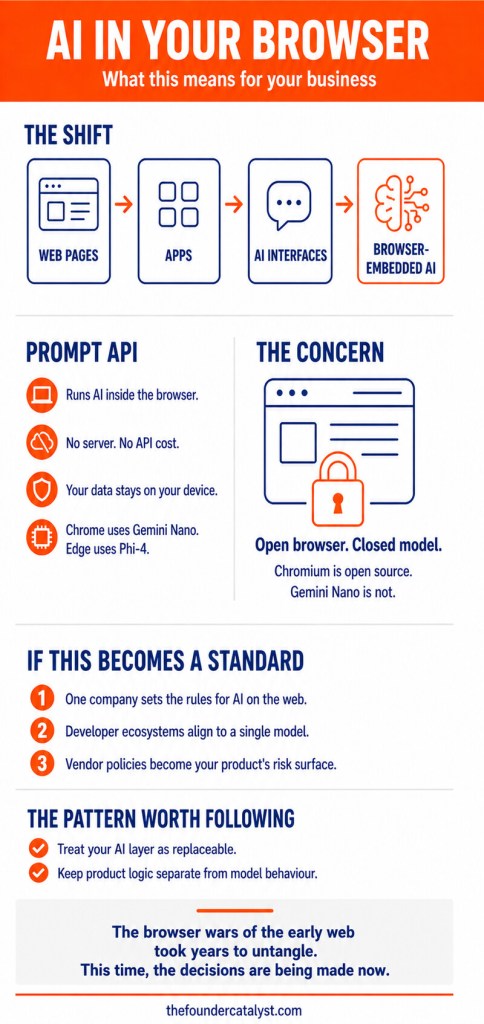
We have moved through a familiar sequence. Web pages gave way to apps. Apps are giving way to AI interfaces. And now AI is being embedded directly into the browser itself. That last step is not a feature upgrade. It is a shift in who controls a foundational layer of how your customers and your products experience the web.
Google Chrome and Microsoft Edge are both shipping something called the Prompt API. It lets web applications run AI inference directly inside the browser, with no server call, no API cost, and no data leaving the device. Chrome uses Google’s Gemini Nano. Edge uses Microsoft’s Phi-4.
I built three demos with this last year, a creative writing tool, a translation assistant, and a vision assistant that describes images, all running locally on my laptop. I wrote about it on my personal blog. The technology works well for what it is. Fast, private, and free to run. For simple AI workloads, local inference like this is a logical and efficient step forward.
The concern is not the technology. It is what happens if this becomes a web standard.
The Prompt API is currently a Community Group draft under W3C’s Web Machine Learning group, not a formal standard. The standardisation discussions have drawn serious objections from Mozilla and from W3C’s own Technical Architecture Group. The worry is interoperability. When developers build on a specific browser’s model, they tune their code to that model’s quirks. Over time, that creates model-specific behaviour baked into the web itself. We have seen this pattern before with browsers, and the web spent years cleaning it up.
Chrome is built on Chromium, which is open source. The Gemini Nano model that ships with the Prompt API is not. Google does have an open weights model called Gemma, but Gemma is not what ships with the Prompt API. Google’s stated reason is that they need to enforce safety through their Generative AI Prohibited Uses Policy, and that requires controlling the model. Mozilla’s objection, which I think is sound, is that using a web API should not mean accepting one company’s content rules, especially rules that go beyond what is legally required anywhere.
Chrome holds a dominant share of global browser usage. If this API becomes a standard and the model powering it remains closed and governed by a single company’s policies, that company effectively controls the default intelligence layer of the web. That shapes cost structure, developer decisions, and user experience in ways that compound quietly over time.
The teams I see getting this right are already treating their AI layer as a replaceable component, keeping product logic separate from model behaviour, and treating vendor policies as part of their risk surface rather than background noise. It is not complicated, but it requires making a deliberate decision early rather than inheriting a dependency later.
When I work with founders and leadership teams, platform dependency is almost always one of the first structural risks we surface together. A platform bet requires confidence in the governance, not just the technology. Who sets the rules, and what happens when those rules change? The browser wars of the early web are a useful reminder of how long it takes to untangle these things once they are embedded.
The edge AI direction is right. Local inference, faster response, lower cost, better privacy; this is a sensible progression. But the model at the centre of it should be open, or at least governed by a neutral body, not by one company’s terms of use.
No formal standard has been approved yet. The conversations are still live. But the decisions being made now in browser working groups will shape the web your customers use for the next decade. It is worth paying attention to.
Are you watching the AI-in-browser space, or is it still too early to be on your radar?