
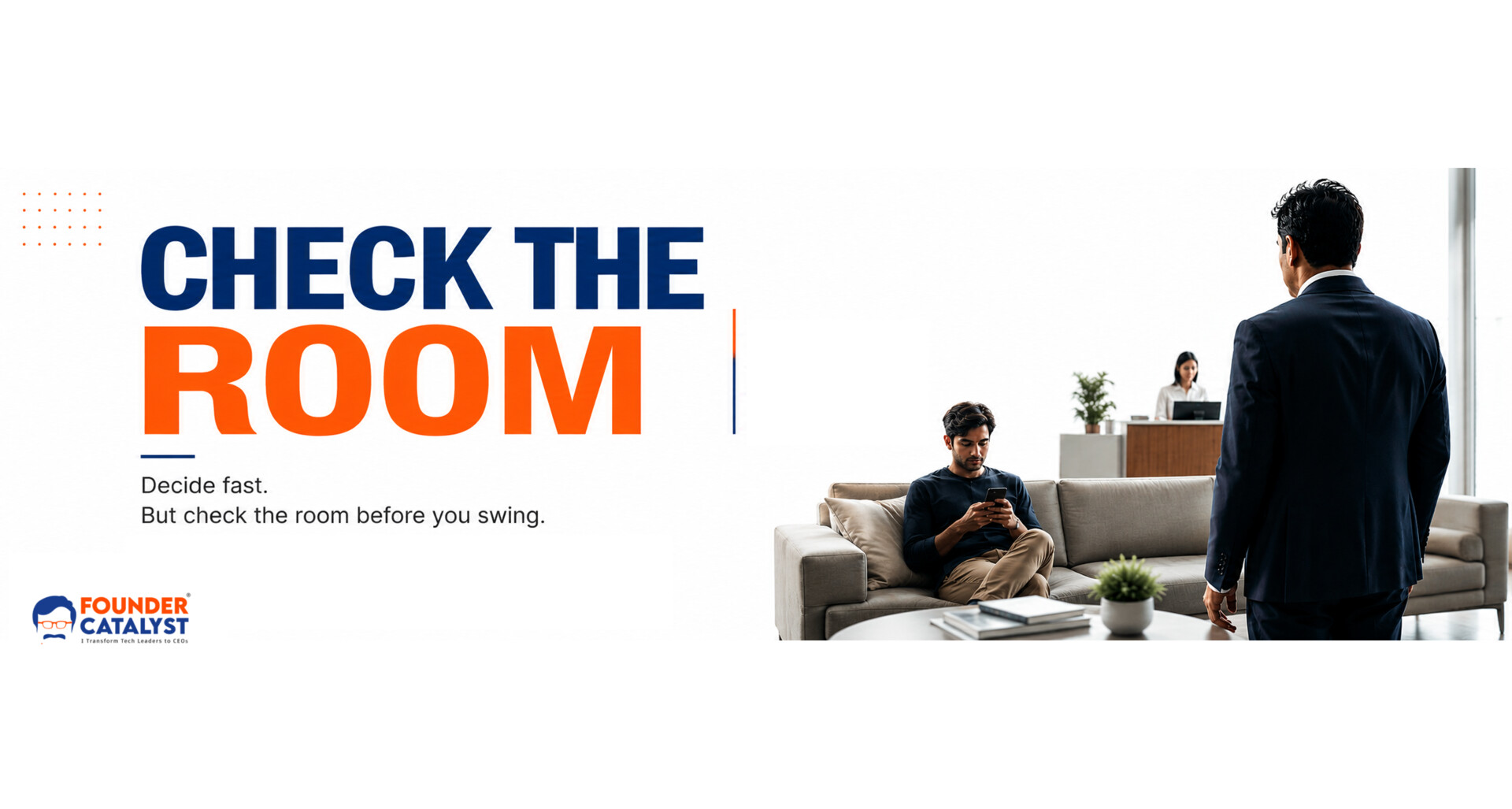
A CEO walks into his office lobby and finds a young man sitting on the sofa, scrolling on his phone. What are you doing here, he asks. Waiting to get paid, comes the reply.
The CEO, a little annoyed, asks how much he earns in a week. A thousand dollars, the fellow says. The CEO pulls out two thousand, hands it over, and tells him to leave and never come back. Pleased with how decisively he handled that, he turns to the receptionist and asks who the loafer was. That was the pizza delivery boy, she says.
I keep coming back to that old joke because it captures something most founders are never told out loud.
Deciding fast on thin information is not a weakness. In the early years it is the whole job.
When you are building something out of nothing, nobody hands you a full picture. You commit with what little you have, and you correct course as you go. Every founder I know built their company on this instinct. It is the reason anything got made at all.
I have lived the sharp end of this myself. Around 2008, during the subprime crisis, one of our largest clients in the United States cancelled their order almost overnight. This was days after I had returned from a trip there, where their manager had assured me all was well. We lost more than half our revenue in one stroke. The very next day I called a townhall. I did not have the full numbers yet. But I knew we had to let go of nearly a hundred people, and I announced a severance well above the statutory norm, which meant borrowing more than we comfortably could. It was the hardest call I have made. It was also made on incomplete information, because waiting for certainty was not an option the moment allowed.
The trouble is that nobody teaches you when to soften that instinct. The CEO in the joke never changed his mode. The company simply grew larger around a man who was still firing pizza boys with total confidence. That is the trap. The instinct that built the company quietly becomes the instinct that starts breaking it, and the founder is usually the last to notice.
This is why the founder mode debate from a couple of years ago struck such a nerve. When Airbnb CEO Brian Chesky spoke at a Y Combinator gathering in 2024, Paul Graham turned the talk into his widely read essay, Founder Mode. Chesky argued that as Airbnb grew, the standard advice to delegate more and step back hurt the company. When he became more directly involved again—developing a leadership style inspired in part by Steve Jobs—Airbnb improved. The essay spread rapidly through founder circles because it challenged conventional management wisdom and validated the instincts of many founders.
Experienced operators pushed back just as hard, because what works beautifully at two hundred people can create a bottleneck at two thousand. That tension has never really been settled, and I do not think it will be, because both sides are describing the same person at different stages of the same journey.
The more useful question is not whether to stay hands-on. It is knowing which room you are standing in before you act.
Look at how Nithin Kamath has run Zerodha. In an interview with Outlook Business early last year, he said something worth sitting with. Even before Covid, Zerodha had around 1,100 people. Today it is roughly 1,200 to 1,250, while the business has grown about ten times over. He said most of his own time now goes into making sure the decision-making philosophy holds even when he is not in the room, so that ten or fifteen people carry it forward without him. That is a founder who kept his sharpness but moved it upstream, from making every call himself to protecting how the calls get made. The instinct is intact. Where he applies it has shifted.
Kamath has been candid about the cost of not doing this. Marking Zerodha’s fifteenth year, he wrote about how chasing month-on-month or quarter-on-quarter numbers can mislead you, and how they prefer to read five-year trends instead. That is the same decisiveness of the early founder, only pointed at a longer horizon. The speed did not disappear. It grew up.
None of this means slowing down. The founders who make this shift well are not more cautious than the rest. They still decide quickly, still act on incomplete information, still refuse to wait for a certainty that never arrives. What changes is a small pause before the decisive part. A few seconds, long enough to ask one question. Who is actually in this room, and what am I about to fire.
The joke lands because we recognise the man. Fast, certain, and completely wrong about what he was looking at. The founders who last are not the ones who lose that speed. They are the ones who learn, quietly and usually the hard way, to check the room before they swing.

Leave a Reply