Tag: Founders

  • The quiet work of building a safe firm

    The quiet work of building a safe firm

    Some news is hard to read.

    Over the past week, two of India’s most respected IT firms have been in the headlines for reasons none of us wants to associate with the industry we grew up in. Tata Consultancy Services is facing a serious investigation in Nashik, with multiple police complaints, arrests, and a formal inquiry ordered by the Tata Sons Chairman himself. Infosys is responding to allegations surfacing on social media about its Pune operations. Both have shaken the industry.

    Having spent three decades in this space, I have no doubt the veterans at both firms, known for their integrity, will follow due process and address whatever is found. That is not what I want to write about today.

    I want to write to the young founders and early-stage CEOs who read my posts.

    Because the lessons here are not really about large firms with 100,000 employees. They are about what happens in your firm of twenty, fifty, or two hundred people, long before any headline is possible.

    The instinct that quietly hurts young firms

    When I started out almost three decades ago, I used to take every piece of misconduct in my firm personally. Thankfully, there were not many. But when something did happen, I felt it reflected on me as the founder. It took years, and guidance from my mentors, to understand that this view, while well-meaning, was not quite right.

    No founder can build a perfect firm. We must aspire to one and keep working towards it. What matters far more is whether your people have a safe, trusted way to raise concerns, and whether you act on them the moment they come in. That single question, asked honestly, will tell you more about your culture than any town hall ever will.

    In The Founder Catalyst, I devote an entire chapter to the idea that trust is the quiet currency of a business. It does not appear on any balance sheet, but it underwrites everything else. It is earned slowly, through small repeated acts of doing the right thing, and it can be damaged quickly, sometimes by a single moment of looking the other way. I wrote about a travel agent I had used for years, who processed a refund I was due, but only after I spotted the error myself. The money came back, but a small dent remained in my confidence. That is how trust works. It notices the moments when you could have acted and did not.

    Why young firms get this wrong

    In the early years, founders rarely have the experience or the tools to handle harassment complaints well. The instinct is often to downplay, to manage, to protect the team you worked so hard to build. That instinct, however understandable, is exactly how small problems become large ones.

    There is also a second trap. In a small firm, the accused is often someone the founder personally recruited, worked alongside in the trenches, and considers a friend. Objectivity becomes genuinely hard. This is precisely why the complaint process cannot rest on the founder’s judgement alone. It needs to sit with people who can act without that emotional entanglement, follow a defined process, and report findings honestly.

    I learnt a related lesson early in my publishing family’s business, which I write about in a chapter on guiding people through change. When I introduced new software into my father’s firm, the resistance came not from the technology but from people’s fear of the unfamiliar. I eventually realised that the breakthrough came through an unexpected internal champion, the senior-most manager, whose endorsement made the change acceptable to everyone else. The same principle applies here. A workplace safety policy on paper changes nothing. A respected senior person inside the firm, visibly committed to taking complaints seriously, changes everything.

    The founder sets the ceiling

    There is something I often remind myself. A team will not take safety, fairness, or ethics more seriously than the founder visibly does. If the founder rolls their eyes at compliance training, so will everyone else. If the founder treats an uncomfortable complaint as an inconvenience to be managed, the team learns that such complaints are inconvenient to raise.

    The same applies to safety. A founder who signals, through action, that no revenue target and no star performer is more important than the dignity of the team builds a firm that people stay in and recommend. A founder who signals the opposite, often without realising it, builds something more fragile than they know.

    What to do before you need to

    The good news is that today, unlike when I started, there are serious professionals who help firms build the right systems. My friend Viji Hari has spent years doing this work, and her book Behind Closed Cubicles is one I often recommend to founders. Industry bodies and local business chambers also run regular workplace conduct and anti-harassment programs for founders and their teams. Please attend them. Send your HR lead. Send yourself.

    A few practical steps any founder can take this quarter:

    I am not the person to give you a checklist for building these systems. That work belongs to specialists who spend their careers on it, and the rules vary by country, by industry, and by the size of your firm. What I can offer is a few questions worth asking yourself this quarter, the same questions I have seen good founders ask when I mentor them.

    Does every person in your firm know, without hesitation, whom they would go to if something happened?

    Is that person someone with enough independence to act, or someone who reports to the alleged offender?

    When was the last time you, as the founder, personally sat in a workplace conduct training session rather than sending a calendar decline?

    If a complaint landed on your desk tomorrow, do you have a clear process to follow, or would you be figuring it out under pressure?

    None of these questions has a universal answer. But sitting with them honestly and then finding people who do have expertise in your context is itself the first step. Speak to a lawyer who specialises in employment matters in your country. Speak to HR professionals who have built these systems in firms larger than yours. Speak to founders who have quietly handled difficult situations well; they exist, and most are willing to share if you ask privately.

    The long view

    When I look at firms that have lasted across generations, and I have studied many of them, including my own family’s seventy-year-old publishing business, one thing stands out. They treated the quiet, unglamorous work of keeping faith with their people as seriously as the glamorous work of winning new customers. They paid salaries on time, kept a clean record with vendors and governments, and when something went wrong, they fixed it without being asked twice.

    The firms that will earn the trust of the next generation of employees, customers, and investors are the ones that take workplace safety as seriously as product quality. In a world where every incident travels on social media within minutes, there is no quiet way to handle these things later. Only an honest way to prevent them now.

    Do not wait for a problem to force the learning.

    What are you doing this quarter to make sure someone in your firm can speak up without fear?

  • How forecasts age in an AI moment?

    How forecasts age in an AI moment?

    Every quarter, someone in tech quietly walks back a confident prediction they made not long ago.

    In January 2026, Forrester published research showing that over half of all AI-attributed layoffs are likely to be reversed, because companies cut headcount based on AI promises that the technology was not yet ready to keep. The same month, Gartner forecast that generative AI in customer service would cost more than offshore human agents by 2030, prompting a pointed rebuttal from industry practitioners who argued Gartner was describing a vendor pricing failure, not an AI failure.

    The retractions are usually healthier than the original predictions. They just get a fraction of the attention.

    In October 2021, a year before ChatGPT, I delivered a talk called “The Future of Software Developers by 2040” to a developer conference. Looking back now is not about whether I got things right. The more useful question is which assumptions survived contact with a shock nobody saw coming.

    A few stood up reasonably well. The talk argued the (Indian) IT hiring boom would not last. TCS, Infosys, Wipro and HCL were on record quarters then, with attrition above 20 per cent. The direction was right, though the mechanism I imagined, gradual automation and growth of the global capability centres, turned out to be the smaller story. The larger one was a foundation AI model that could write working code from a plain English comment.

    One slide, titled “Going to be upside-down,” argued that the work mix in software would invert: more time on business understanding and customer needs, less on writing and testing code. That was framed as a gradual shift toward 2040. It is largely the reality in 2026 itself.

    The line that aged the worst was the one I closed with: let machines be machines, and let humans be human. It earned a warm nod in the room. Five years on, it has the ring of a sentence printed over a stock photo of a sunrise. Tidy aphorisms assume the boundary they describe will hold still. This one has not.

    Nobody in this industry predicts precisely. The people who navigate these shifts well are not the ones with the sharpest forecasts. They are the ones who revise quickly when the ground moves, before it costs them too much.

    There is a Chinese proverb associated with Deng Xiaoping: crossing the river by feeling the stones. You do not map the riverbed in advance. You step, test your footing, adjust, and step again. The destination matters. But the only honest method is one stone at a time.

    The next five years will not reward people who pick a single thesis and hold it. They will reward those who can hold a direction loosely, gather evidence weekly, and change their mind without ego when the facts demand it.

    The cost of a wrong forecast held too long is now measured in quarters, not years. The cost of revising one in public is mostly ego. And ego is the cheapest thing to spend.

    The forecasts that age worst are usually the ones that sound the wisest at the time.

  • The Secrets to Successful AI Implementation Revealed

    The Secrets to Successful AI Implementation Revealed

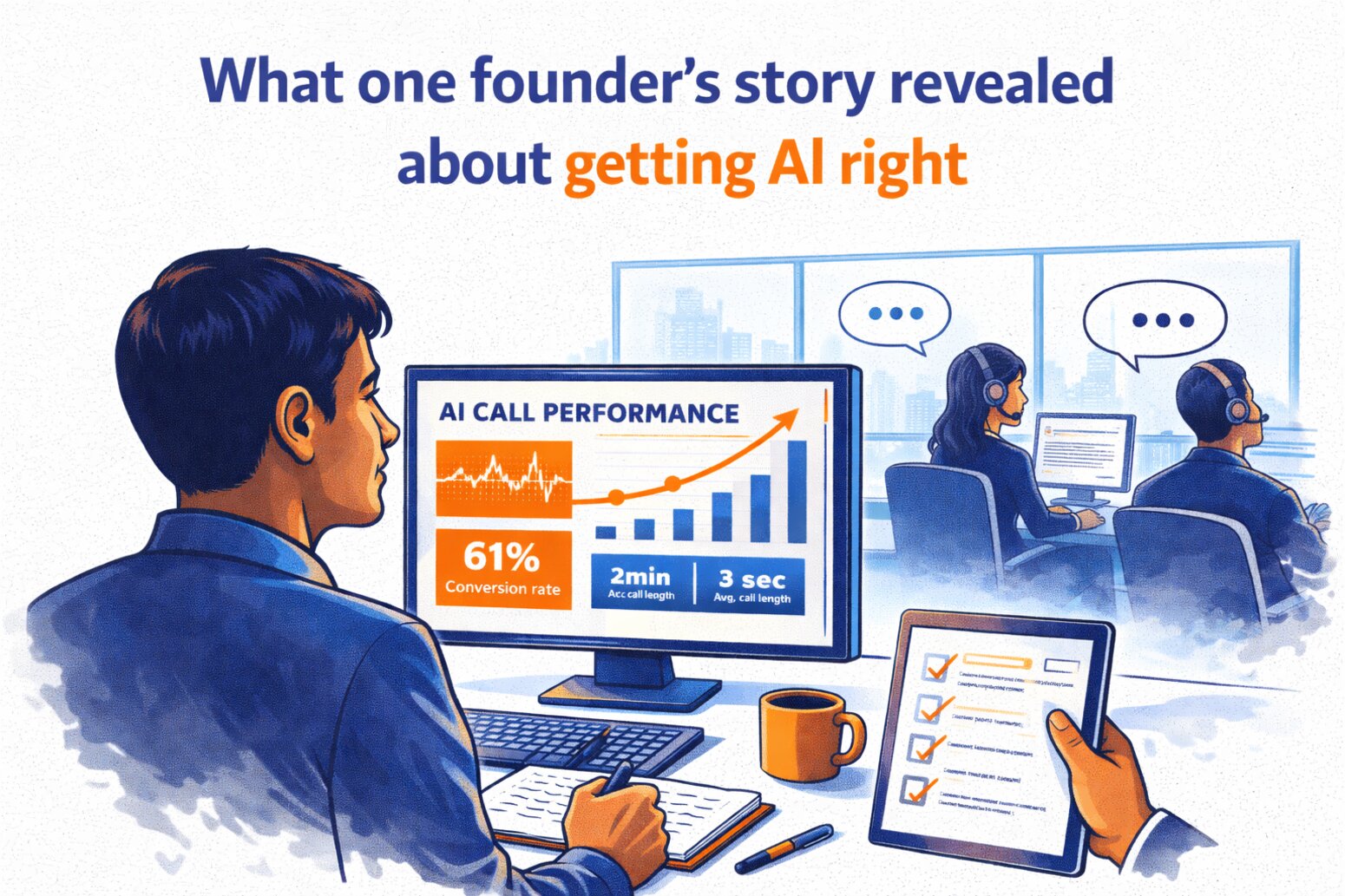
    Last week, a founder from Indore (India) shared a thread about deploying AI voice calling at scale. I could not put it down. Because the real lessons have nothing to do with voice calls.

    Strip away the telephony context, and what you have is a masterclass in how to deploy any AI solution in an enterprise. Here is what stood out.

    The first lesson is about trust, not technology. Their AI voice was technically flawless. Too flawless. People hung up. The moment they added small imperfections, pauses, and a little background noise, conversion went up 40%. The lesson here is not about phone calls. It is about how humans receive AI-assisted interactions in any setting. Perfection triggers suspicion. Naturalness builds trust. Keep that in mind, whether you are deploying an AI chatbot, an AI-assisted email, or an internal co-pilot for your team.

    The second lesson is about the real competitive advantage. Their human QA team could review 30 calls a day. The AI system lets them audit every single conversation, spot patterns, rewrite responses, and redeploy within the hour. Five improvement cycles in a day versus five in a quarter. That compounding speed of learning is what separates organisations that achieve extraordinary results with AI from those that achieve mediocre ones.

    The technology is not the edge. The speed of learning from it is.

    The third lesson is the one I want every CXO reading this to write down. They went through three vendors before they understood the real problem. Every vendor built them a technically functional system that did not convert. Because no vendor knows your business well enough. The vendor knows the platform. You know what your customer means when they pause before answering. You know when a “call me later” is a genuine request and when it is a polite exit. You know what a good conversation in your context sounds like.

    This is exactly the mistake I see enterprises make repeatedly with AI deployments. They treat it like an infrastructure purchase. Hand over the requirements, receive the system, and declare it live. Then, wonder why the numbers are disappointing.

    Every successful AI deployment I have seen has one thing in common. Not a premium vendor. Not a cutting-edge model. One internal person who owns the prompt. Who listens, observes, refines, and iterates daily. Someone who understands the customer deeply and has the judgment to shape how the AI responds.

    That person is not an AI engineer. They are a domain expert with curiosity and ownership. And they are the difference between a deployment that impresses in a boardroom presentation and one that actually moves the needle.

    Where did your AI deployment surprise you the most, in a good way or a bad way?

  • Nobody owns this and nobody will admit it

    Nobody owns this and nobody will admit it

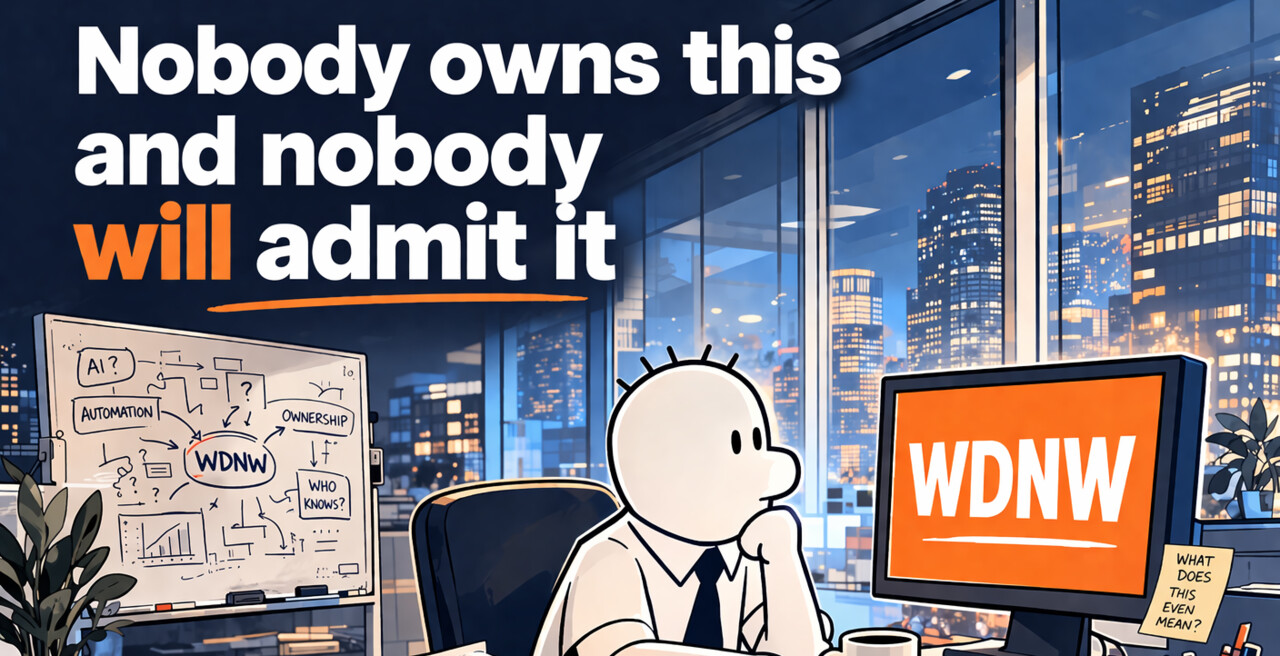
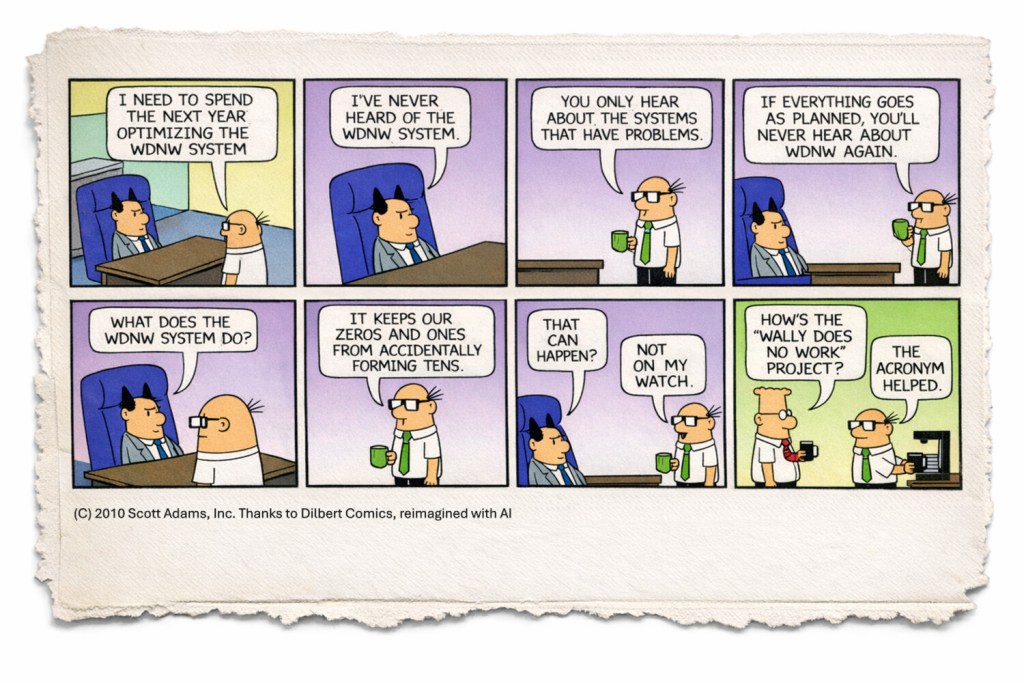
    Every organisation has a WDNW system. Most have several.

    A process that runs quietly in the background, consuming time and money, that nobody questions because it has never visibly broken. The moment someone asks what it actually does, the honest answer is usually some version of “we are not entirely sure, but we are afraid to touch it.”

    Every organisation has a WDNW system. Most have several.

    Startups are not immune to this. Technical debt accumulates faster than most founders realise. A workflow stitched together in year one, a third-party integration nobody remembers choosing, a report generated every Monday that nobody reads but everyone continues to produce. These are not dramatic failures. They are quiet drains.

    This is one area where I think AI genuinely earns the word superpower. Not in building new things, but in helping us see what already exists with fresh eyes. AI tools can now map workflows, surface redundancies, flag processes with unclear ownership, and help teams ask the question they were too busy or too hesitant to ask themselves: why are we still doing this?

    The best technical debt reviews are not always led by consultants or new CTOs brought in to shake things up. Sometimes all it takes is a founder sitting down with an AI tool and asking honest questions about their own workflows. No agenda, no politics, just a clear audit of what exists and why.

    And you do not need a fancy specialised auditing platform that costs a fortune to get started. Tools like Claude Code or GitHub Copilot are more than capable of helping you take those first steps. Start small, pick one corner of your codebase or one workflow, and go from there. Do not try to churn the ocean in one go. With frontier AI tools, there are no real experts yet. Everyone is figuring their way through. The important thing is to keep moving, keep experimenting, and keep learning, carefully and with guardrails in place.

    How many WDNW systems are hiding in your organisation right now? If you are not sure where to begin, I am happy to think it through with you.

  • Your competitors are going YOLO on AI, are you?

    Your competitors are going YOLO on AI, are you?

    This week, a quiet but important shift happened in the developer tools world. It hints at a wider change in how software itself will be developed and delivered.

    Microsoft announced that Visual Studio Code will now ship stable releases every week instead of monthly. Around the same time, developer tools from both Microsoft and Google began introducing a new capability inside coding assistants — AI agents that can act without waiting for human approval. In tools like Copilot and Gemini Code Assist, these agents can execute commands, modify files, retry failures, and continue working until they believe a task is complete. No hand-holding. No checkpoint at every step.

    Developers have started calling this “YOLO development.” The phrase borrows from the pop culture line “You Only Live Once“, and in this context means letting AI run without pausing for human sign-off at every turn. That may sound reckless. But beneath the humour, something real is changing — and for founders, the implications are worth understanding clearly.

    For most of the history of software companies, development velocity was a function of people. More engineers meant more output. Faster hiring meant faster product. The development loop — write, test, review, ship — was a human loop at every stage, and headcount was the lever you pulled when you needed to go faster. That assumption is quietly breaking down.

    What’s emerging looks meaningfully different. A human defines the goal, the constraints, and the expected outcomes. AI agents implement the changes. Automated systems run checks. Humans validate whether the result matches the intent. The human is still essential — but the role has shifted from executor to decision-maker.

    For a founder, that distinction matters enormously. It means the ceiling on your engineering output is no longer tied to the size of your team in the way it once was.

    But there’s a catch, and it’s worth being honest about it. AI can produce code across hundreds of files in minutes. That speed creates a new kind of problem: if the machine generates changes faster than your team can safely validate them, generation is no longer the constraint. Verification is.

    AWS CTO Werner Vogels calls this verification debt — the gap between how fast AI can produce changes and how fast an organisation can confirm those changes are correct, secure, and doing what was intended.

    This is where most companies will either pull ahead or fall behind. The bottleneck hasn’t disappeared. It has moved. And the founders who recognise where it now sits — and build systems around it — will have a structural advantage over those still thinking about AI purely as a way to write code faster.

    The deeper shift worth understanding is this: software engineering is moving from code-centric to specification-centric. Instead of writing every line, engineers define the objective, the boundaries, and the expected behaviour. The AI generates and iterates on the implementation.

    It happened in chip design decades ago. Engineers stopped drawing circuits by hand and began describing systems at a higher level of abstraction. The tooling handled the translation. Productivity leapt. The nature of the work transformed permanently.

    Software is entering the same phase now. The future isn’t YOLO. It’s AI on a leash — running fast, but you’re still holding the lead.

    For founders, this reframes the opportunity entirely. The question is no longer how do I use AI to write code faster. That’s a commodity improvement. The real question is: what can I now build that I couldn’t before — because development effort and cost are no longer the constraint?

    Some businesses will use this to go deeper into their existing product — adding complexity, personalisation, and capability that was previously too expensive to build. Others will use it to serve more customers without proportionally growing their team. Both are legitimate. Both represent compounding advantages that don’t show up immediately but become significant over eighteen to thirty-six months.

    The metrics to watch are not about AI adoption. They’re about business outcomes. Has the turnaround time of a key workflow come down? Has the team’s capacity to serve clients increased without a corresponding increase in cost? Has resolution time improved? Has your release cadence changed? These are the numbers that eventually show up in revenue, margins, and growth — and right now, most founding teams aren’t measuring them with enough discipline.

    So the real question isn’t whether your developers are going YOLO. It’s whether you, as a founder, are willing to go first.

  • Why Unhappy Leave Can Break a Startup

    Why Unhappy Leave Can Break a Startup

    The internet has a long memory, but a very selective one.

    Old news resurfaces without warning. Context quietly drops off. A half-forgotten announcement suddenly becomes today’s debate. That is exactly what has happened over the last few days with a decision taken in China in 2024.

    Many are now discussing something being called Unhappy Leave.

    On the surface, the idea is simple.

    Employees are given ten additional days of leave every year. These days can be taken purely at their own discretion. No medical certificate. No justification. Just the employee deciding they are unhappy, stressed, or mentally exhausted. The important detail is this. If a manager denies this leave, it is treated as a policy violation.

    In a country known for long working hours and intense workplace pressure, this sounded radical. Predictably, the internet amplified it. It praised it. Compared it. And in some cases, reduced it to a slogan.

    The policy was announced by Yu Donglai, the founder of Pang Dong Lai, a Chinese retail chain admired for its employee-first culture. The announcement was made in 2024 and quietly implemented. It went viral much later. That delay itself is telling. Good ideas do not always travel fast. Sometimes they wait for the right moment, or the right outrage cycle.

    At first glance, this feels like a bold and humane move. And it is. There is no denying that.

    It also reminds many people of earlier experiments in employee well-being, especially in the West.

    One obvious comparison I will make is with Tony Hsieh of Zappos. Long before workplace culture became fashionable, he spoke about trust, happiness, and unconventional benefits. At the time, many dismissed it as idealistic. History was kinder. Zappos built loyalty, reduced attrition, and created a culture that people still reference years later.

    So yes, Unhappy Leave is innovative. It is empathetic. It signals trust.

    But this is where founders and business leaders need to pause.

    Large organisations have buffers. They have HR teams, policy frameworks, and workforce planning models. They can simulate impact before announcing a benefit. They can course-correct if something breaks.

    Founder-led companies and startups do not have that luxury.

    This is where good intent can quietly turn into long-term damage.

    When a policy like this is announced without thorough internal thought, a few things happen quickly. Project timelines slip because key people are unavailable at critical moments. Managers hesitate to question leave decisions even when delivery risk is high. Teams compensate informally for absent colleagues. Resentment builds.

    The irony is this. A benefit meant to improve morale can end up eroding it.

    Missed delivery commitments create pressure elsewhere. Customers feel the impact first. Revenue follows. Leadership starts firefighting. Slowly, the same policy that was announced with warmth becomes a source of quiet frustration.

    And when leaders later attempt to dilute or roll back the policy, trust takes a direct hit.

    This is especially risky with Gen Z employees.

    Gen Z values authenticity more than perks. They sense inconsistency very quickly. If a benefit is announced and then poorly executed, the damage is not temporary. It creates a belief that leadership announcements cannot be taken at face value. That kind of trust loss is extremely hard to repair.

    In my experience, and this is my opinion, most employee benefit schemes fail not because of bad intent, but because of shallow implementation.

    Every founder who grows into a CEO learns this lesson sooner or later.

    Policies are promises. The moment you announce them, they become part of your culture. Culture cannot be paused, renegotiated, or quietly edited without consequences.

    Founder-led organisations should address key issues before announcing new ideas. Start with open conversations about challenges like fairness and peak periods, run small pilots to learn, and only expand once ready. Consistency, more than generosity, builds trust.

    This is also where founders benefit from an external sounding board. Someone who has seen these cycles play out across companies and stages, and can help leaders think through second-order effects before ideas turn into irreversible promises. That role, walking alongside founders as they translate intent into execution, is exactly why I do what I do as a Founder Catalyst.

    Unhappy Leave works at Pang Dong Lai because it sits inside a much larger system of values, planning, and discipline. It is not a standalone perk. It is a visible expression of an already mature culture.

    Stripped of that context, it becomes a slogan.

    The internet loves slogans. Organisations live with consequences.

    Reflection:  Every policy announcement feels reversible in the moment. Very few actually are. Founders do not just introduce benefits. They set expectations that quietly shape culture long after the applause fades.


    If you prefer to receive more of these insights directly, subscribe to my Founder Catalyst Digest, where I share practical lessons on leadership, AI, and building companies that last.

    Read my book “The Founder Catalyst” for more lived lessons: The Founder Catalyst on Amazon

  • A Lesson for Founders Who’ve Been Cheated

    A Lesson for Founders Who’ve Been Cheated

    I watched a short video of Frank Abagnale recently. It stayed with me longer than I expected. 

    (Video attached at the end)

    Frank Abagnale is best known as the real-life inspiration behind the movie “Catch Me If You Can“, played by Leonardo DiCaprio. But this two-minute clip has nothing to do with glamour or clever cons. It is about a quiet, painful reality that many founders face but rarely talk about.

    Every business owner, at some point, encounters theft or fraud from within.

    An employee lies. Someone manipulates accounts. Company assets quietly disappear.

    In a large organisation, this is absorbed by process. HR steps in. Finance handles it. Lawyers do their work. The founder signs papers and moves on.

    In a startup, it is very different.

    A small theft can be fatal. Cash flow is thin. Margins are fragile. More than the money, the emotional damage is deep. Almost every founder I have met who has gone through this carries that pain for years. The feeling of being cheated. The sense of having trusted the wrong person. The embarrassment of feeling foolish. This does not fade easily.

    In the video, Frank Abagnale talks about a pattern he sees almost every day. Small business owners write to him after an employee steals money. They do everything “right”. Police complaint. Court case. Trial. Depositions. And after years, they get nothing back. No restitution. Just exhaustion.

    His advice, in the US context, is pragmatic and slightly ruthless. He suggests using the tax system. Since stolen money is considered taxable income in the US, he advises filing a 1099 with the IRS. This gives the victim a tax write-off and puts the burden on the offender through the tax authorities, who have far more power than a criminal court in recovering money.

    This specific solution does not apply to most of the world. Certainly not in India. So I am not suggesting founders copy this approach.

    What struck me was the lesson beneath the advice.

    To me, the real message of the video is not about the IRS. It is about how a founder should respond after being cheated.

    • First, acknowledge the fraud honestly. No denial. No rationalising. No self-blame. Accept that it happened.
    • Second, fix the system, not the past. Put processes in place so it does not happen again. Separation of duties. Basic controls. Regular reviews. This is unglamorous work, but essential.
    • Third, stop obsessing over punishment. This is the hardest part. Wanting justice is natural. Wanting revenge is human. But chasing punishment rarely brings the money back. Worse, it steals your most valuable asset. Your time and mental energy. Time that should be spent rebuilding the business and creating future income.
    • Fourth, be brutally realistic and move on. Some losses will never be recovered. Accepting this is not weakness. It is survival.

    Frank Abagnale delivers this lesson calmly, without drama. That is what makes it powerful.

    So, thank you Mr Frank Abagnale, for a lesson many founders learn only after it hurts deeply.

    Sometimes, wisdom is not about winning. It is about knowing when to stop bleeding and start walking forward again.

    This strategy is from Frank Abagnale’s 2013 talk for Nevada State Bank. While US tax law does treat stolen funds as taxable income, using it as a recovery tool is a legal “gray area” and is shared here as a strategic insight, not formal advice. Consult a professional before application.

    Here’s the video:

    Short summary of the video transcript:

    Frank Abagnale explains that many small business owners write to him after employees steal money. They pursue police cases and court trials, but usually recover nothing. He says that in the US, stolen money is taxable income, so filing a 1099 with the IRS allows the victim to claim a tax deduction and shifts enforcement to the tax authorities, who have stronger powers than criminal courts. He believes the threat of tax consequences is often more effective than sending someone to jail.


    If you prefer to receive more of these insights directly, subscribe to my Founder Catalyst Digest, where I share practical lessons on leadership, AI, and building companies that last.

  • What is the AI question most founders are missing?

    What is the AI question most founders are missing?

    Most founders I meet are still asking the wrong AI question.

    They ask,

    “How do we use AI?”

    The better question today is,

    “What exactly is becoming undefendable?”

    I watched the recent Davos conversation between Dario Amodei of Anthropic and Demis Hassabis of Google DeepMind with that lens. Not as a technologist. As a founder who has seen waves come and go.

    The signal was clear. Coding is no longer the bottleneck. Thinking still is.

    When the CEO of a frontier AI company says his engineers no longer write code, only review it, founders should pause. This is not a future scenario. This is a current operating model.

    For Indian services and SaaS companies, this reveals uncomfortable truths.

    First, speed is no longer a moat.

    If your advantage is faster delivery, cheaper teams, or more engineers, assume that edge is already leaking. AI compresses time brutally. What differentiated you last year will be table stakes next year.

    Second, effort-based business models are breaking silently.

    Services companies are the first to feel it. Clients will not pay for hours (T&M) once outcomes are predictable. Billing models may lag reality, but not for long.

    This is not a sudden shift, nor are IT majors unaware of it.

    Tech Mahindra has publicly acknowledged that client conversations are moving from input-based billing to outcome-based models, where value is measured in tangible business impact.

    TCS has echoed the same reality, noting that many clients start projects on T&M and then transition to fixed-price or outcome-linked models once value becomes visible.

    Third, junior-heavy pyramids will strain.

    Entry-level roles will not disappear overnight. But hiring will slow. We are already seeing this in the recent quarterly results of Indian IT majors. Expectations from clients will rise. A fresher with AI fluency will outperform a five-year engineer who resists change.

    I see founders making one critical mistake. They are waiting for clarity.

    Clarity will not come. Capability will.

    The winners in the next 24 months will not be the ones with the best AI strategy decks. They will be the ones who redesign how work actually gets done and delivered.

    For services companies, the shift is painful but necessary. You must stop selling people. Start selling outcomes. Build internal platforms. Even if clients never see them. Treat AI as infrastructure, not tooling.

    For SaaS founders, the discomfort is different. Features will get copied faster than ever. Defensibility will move away from clever engineering. It will sit in deep customer context, data gravity, and the cost for customers to switch providers.

    This is also why large SaaS vendors like Microsoft, Google, HubSpot, and Zendesk have been able to raise prices and introduce more complex pricing tiers over the last year. Not because switching is easy, but because it is not. Customers complain, but they stay. That is what real switching costs look like.

    The AI in your product does not defend it.

    Dependency does. AI only accelerates that dependency.

    The real work, then, is not adding AI features. It is figuring out how the AI in your product becomes part of the customer’s daily decision-making. How it embeds itself into workflows, defaults, and judgement. How you go deeper without turning yourself into a services company.

    The question every SaaS founder should eventually reach is not “How do we use AI?”

    It is “How does the AI in our product make it harder for customers to leave us?”

    This is where founder behaviour matters.

    1. If you are not personally using AI daily, you are already late.
    1. If your team uses AI but your processes assume old timelines, you are self-sabotaging.
    1. If your roadmap assumes stable pricing models, roles and skills, it is fiction.

    I am not pessimistic. I am practical.

    Every technology wave flattens something. This one flattens execution advantage. What remains is judgment, trust, and responsibility.

    Founders who accept this early will redesign calmly. Founders who deny it will call it disruption later.

    As Spock says to Bele in Star Trek The Original Series,

    ‘Change is the essential process of all existence.’

    Reflection:

    AI will not kill businesses. Delay will. The next two years are not about prediction. They are about honest redesign.


    👉 If you want to discuss AI for your venture, reach out for a consultation: v@thefoundercatalyst.com

    📩 And if you’d prefer to receive more of these insights directly, subscribe to my Founder Catalyst Digest, where I share practical lessons on leadership, AI, and building companies that last.

  • Remembering Louis Gerstner and the Elephant That Learned to Dance

    Remembering Louis Gerstner and the Elephant That Learned to Dance

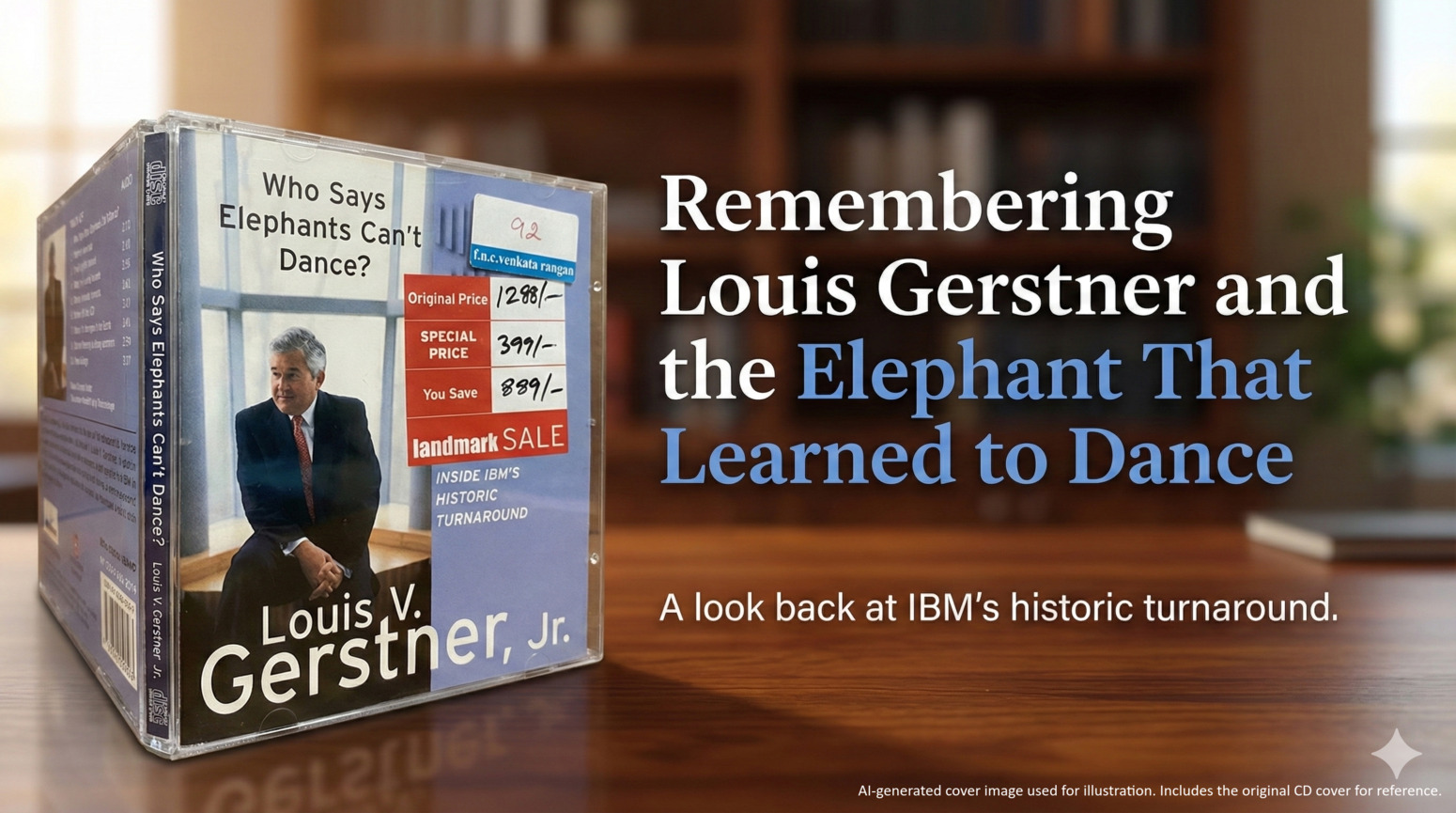
    I learnt on 27 December 2025 that Louis V. Gerstner Jr. had passed away. That news made me pause. It took me back more than two decades, to a phase when I was still finding my feet as a CEO, and to a book that quietly but firmly shaped how I looked at leadership.

    I first read Who Says Elephants Can’t Dance in the early 2000s. At that time, I was far more comfortable being close to technology than being close to people problems. Management felt like something I had to do, not something I wanted to learn. Gerstner’s book did not try to inspire me with slogans. It simply showed me, page after page, that leadership is about decisions, execution, and an honest understanding of how organisations really behave.

    One anecdote from the book has stayed with me. This is recalled from memory. Soon after accepting the CEO role, Gerstner visited IBM’s headquarters in Armonk, New York. He is stopped by a security guard because he does not yet have an identification card. Even after explaining that he is the new CEO, he is not allowed inside. He later reflects on this moment as a small but telling sign of how deeply bureaucracy had set in at IBM. What struck me was not the incident itself, but his ability to see it as a system problem, not a personal slight.

    By the end of his roughly decade-long tenure, IBM had become a very different organisation. More open. More responsive. More willing to confront reality. The contrast between those two moments says more about leadership than any abstract theory ever could. Culture does not change through speeches. It changes through consistent actions and clear priorities.

    When asked, soon after stepping into IBM, what his vision for the company was, Gerstner answered without flourish or theory. “The last thing IBM needs right now is a vision.”

    As a founder, what I took away from the book then, and what still resonates now, is Gerstner’s refusal to romanticise leadership. He was clear that turnarounds are messy. Those tough calls cannot be delegated. That listening matters, but so does deciding. These are lessons I have carried with me, and ones I have referenced in my own book, The Founder Catalyst, because they remain relevant for founders and CEOs even today.

    In an age where leadership advice is often reduced to sound bites, Who Says Elephants Can’t Dance continues to stand out for its honesty and practicality. I still recommend it to founders who are making the uncomfortable shift from builder to leader.

    Looking back, Louis Gerstner did not try to teach the world how to dance. He simply showed, through his work, that even the largest and most tired organisations can relearn the steps when led with clarity and courage. I realise how much that lesson shaped my own thinking as a founder. My quiet respect to him and to a legacy that influenced many of us more than we understood at the time.

  • Running Generative AI Models Locally Is Now Easy

    Running Generative AI Models Locally Is Now Easy

    Want to explore Generative AI without sending your data to the cloud? Running models locally on your PC or Mac is now surprisingly simple.
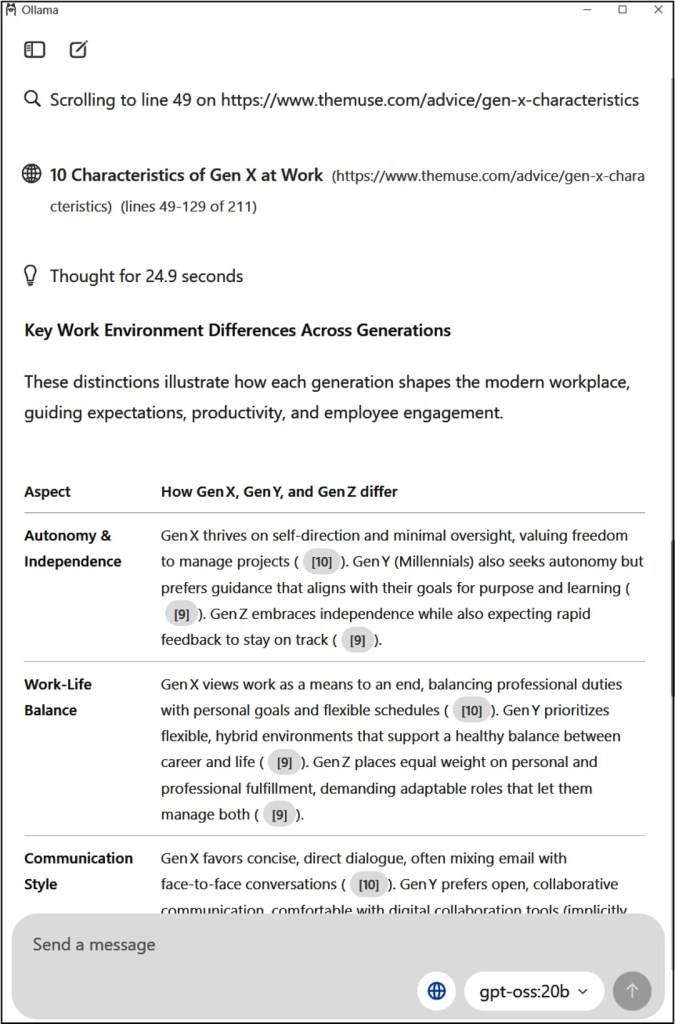
    Start with Ollama, a lightweight framework that makes it easy to run AI models locally on your computer. It supports both open-weight models and open-source models. Together, these models have made hands-on AI experimentation accessible to anyone with a capable machine, without depending entirely on cloud APIs. Ollama recently added a clean, chat-style desktop app to its command-line interface. I’ve been testing OpenAI’s GPT-OSS 20B open-weight reasoning models, which run locally through Ollama and even support limited web search. For routine tasks — summarising, drafting, quick analysis — it’s remarkably capable.
    Sample Output from GPT-OSS model running locally in a PC with Ollama
    Sample Output from GPT-OSS model running locally on a PC with Ollama
    Another option is Msty Studio, a free tool (for non-commercial use) that gives a visual interface to run these open models on your system. It connects seamlessly with Ollama and supports models from Hugging Face. Ideal for hands-on experimentation before making big AI bets. Why does this matter for founders and CEOs? 1. Data Privacy and Control – Running locally means your business data never leaves your system. For regulated industries, that’s a real advantage. 2. Independence and Learning – Most AI transformations rely on commercial APIs. Testing open models locally helps your team learn, experiment safely, and reduce vendor dependence. 3. Strategic Experimentation – Founders who explore AI hands-on make sharper choices about when to buy, build, or partner. It’s the difference between hearing about AI and understanding it. Two things to note: 1. Large models need powerful hardware — GPUs with high VRAM or plenty of system memory. 2. “Open” doesn’t mean “risk-free.” You’ll handle updates, licenses, and security yourself. Local AI isn’t replacing the cloud — it’s giving leaders another layer of control and insight. I cover these shifts — from cloud dependence to local AI — in my keynotes for decision makers. To invite me for a corporate talk, contact Kural at leadership@kuralkonnect.com
  • ChatGPT messed up the script of my AI talk!

    ChatGPT messed up the script of my AI talk!

    Generative AI tools like ChatGPT are a huge productivity booster. I use them daily as a writer and speaker. But here’s what I’ve learnt the hard way: they are not magic lamps, and when not handled correctly, they can take you further away from your own voice. When I was preparing for my talk on “How AI can coach Gen Z and Gen A to lead”, I started with my outline and gave it to ChatGPT for expansion. Instead of polishing my ideas, it kept rearranging the flow and adding new ones. After a few iterations, the draft looked polished, but it no longer sounded like me. It was generic and stripped of the personal experiences I wanted to share with founders and CEOs. So, I went back to basics. Whiteboard, pen and paper, rehearsal recording. Then I brought AI back into the process differently: I used it to transcribe my rehearsal, give me feedback, identify the low points, validate the ideas, and suggest improvements. This time, AI became a coach rather than a ghostwriter—and the final talk landed well with the audience. That’s the point I want to leave with founders: AI is excellent for ideation, for breaking a blank page, or for polishing drafts into the right tone. But it can’t replace your lived experience. If you let AI own the core of your message, you risk becoming a parrot of machine text. Your value as a founder is in bringing your own stories, scars, and convictions to the table. In my book The Founder Catalyst, I argue that the future of leadership is about combining technology with what humans do best—strategy, empathy, and authenticity. The same principle applies here: let AI make you sharper, not faceless.
  • AI is eating your profits

    AI is eating your profits

    Notion’s CEO recently revealed that 10% of their profits now go towards AI bills. That’s a significant shift for a SaaS company—and a warning sign for founders.

    AI was supposed to get cheaper. Instead, it’s becoming a major expense. The latest models are smarter, yes, but they also consume far more tokens. Especially when used for agent workflows, deep research, or coding tasks, the costs can spiral quickly.

    As a founder, you don’t always need the most advanced model. With clever prompts and a bit of experimentation, your team can often achieve great results using smaller or open models. This isn’t just about saving money—it’s about designing solutions that fit your business needs.

    From my book Founder Catalyst, I’ve written about the hidden costs of adopting new technologies. With AI, these include:

    1. Time spent learning new tools and interfaces
    2. Integration challenges across teams
    3. Legal risks from unlicensed datasets
    4. Vendor lock-in and platform dependency

    AI can bring productivity and a competitive advantage. But it must be implemented with clarity and expertise.

    Design before deploy. Profits still matter.

    If you’re a founder or CXO thinking of scaling AI across your organisation, don’t do it blindly. AI is not just another tool—it’s a shift in how your teams think, build, and deliver. But without the right guidance, it can also become a costly distraction.

    As a founder and CEO, with over 30 years in tech and a front-row seat to every major platform shift—from desktop to mobile to cloud—I help leaders cut through the noise. My keynotes and masterclasses are not about hype. They’re about clarity, context, and practical frameworks your team can act on.

    Let’s talk if your team needs:

    • A clear-eyed view of what AI can (and can’t) do
    • Real-world examples of how startups and enterprises are using AI
    • A roadmap to adopt AI responsibly, without burning budgets

    You don’t need more AI tools. You need better AI thinking.

    For keynote inquiries, call Kural through WhatsApp or write to v@thefoundercatalyst.com.