
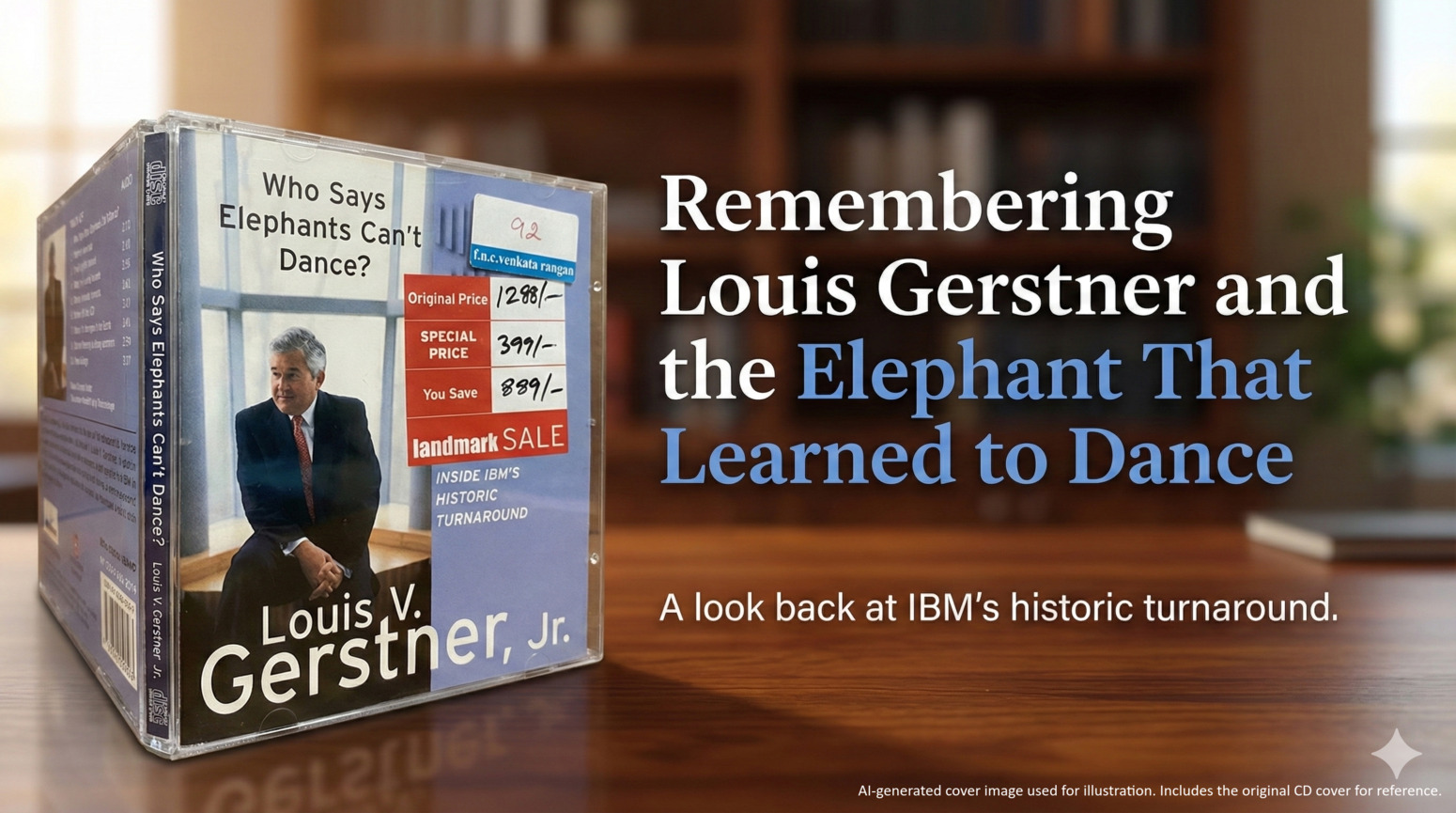
I learnt on 27 December 2025 that Louis V. Gerstner Jr. had passed away. That news made me pause. It took me back more than two decades, to a phase when I was still finding my feet as a CEO, and to a book that quietly but firmly shaped how I looked at leadership.
I first read Who Says Elephants Can’t Dance in the early 2000s. At that time, I was far more comfortable being close to technology than being close to people problems. Management felt like something I had to do, not something I wanted to learn. Gerstner’s book did not try to inspire me with slogans. It simply showed me, page after page, that leadership is about decisions, execution, and an honest understanding of how organisations really behave.
One anecdote from the book has stayed with me. This is recalled from memory. Soon after accepting the CEO role, Gerstner visited IBM’s headquarters in Armonk, New York. He is stopped by a security guard because he does not yet have an identification card. Even after explaining that he is the new CEO, he is not allowed inside. He later reflects on this moment as a small but telling sign of how deeply bureaucracy had set in at IBM. What struck me was not the incident itself, but his ability to see it as a system problem, not a personal slight.
By the end of his roughly decade-long tenure, IBM had become a very different organisation. More open. More responsive. More willing to confront reality. The contrast between those two moments says more about leadership than any abstract theory ever could. Culture does not change through speeches. It changes through consistent actions and clear priorities.
When asked, soon after stepping into IBM, what his vision for the company was, Gerstner answered without flourish or theory. “The last thing IBM needs right now is a vision.”
As a founder, what I took away from the book then, and what still resonates now, is Gerstner’s refusal to romanticise leadership. He was clear that turnarounds are messy. Those tough calls cannot be delegated. That listening matters, but so does deciding. These are lessons I have carried with me, and ones I have referenced in my own book, The Founder Catalyst, because they remain relevant for founders and CEOs even today.
In an age where leadership advice is often reduced to sound bites, Who Says Elephants Can’t Dance continues to stand out for its honesty and practicality. I still recommend it to founders who are making the uncomfortable shift from builder to leader.
Looking back, Louis Gerstner did not try to teach the world how to dance. He simply showed, through his work, that even the largest and most tired organisations can relearn the steps when led with clarity and courage. I realise how much that lesson shaped my own thinking as a founder. My quiet respect to him and to a legacy that influenced many of us more than we understood at the time.
Leave a Reply