
Founders and CXOs spend most of their time watching what customers, competitors, and investors think about AI. Fair enough. But occasionally, a voice from outside the industry frames the conversation in a way that cuts through the noise. This week, that voice came from an unlikely place — a holy one.
Pope Leo XIV released a roughly 200-page encyclical on artificial intelligence, with technical input from Christopher Olah, co-founder of Anthropic. The AI industry will not alter its roadmaps because of this. But the previous five encyclicals — on workers’ rights, Cold War peace, birth control, economic inequality, and the environment — each shaped public discourse in ways that outlasted the news cycle. They framed what mattered before the rest of the world caught up.
I’ll be honest here, I went in sceptical. A papal letter on AI felt ceremonial at best. The New York Times summary I read changed that.
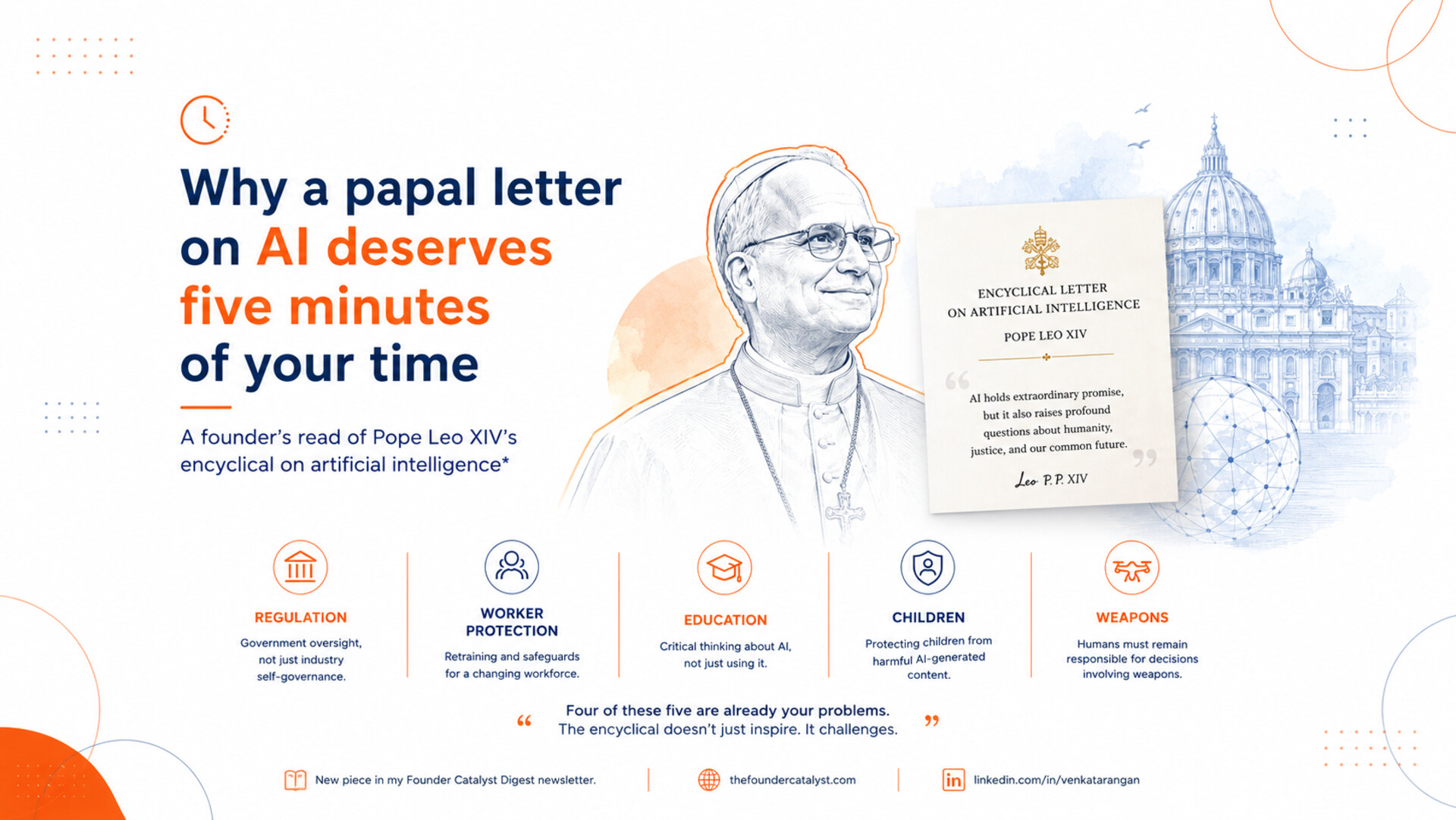
1. Regulation. Not self-governance by the industry. Actual government regulation of the private companies driving AI development. That distinction matters.
2. Worker protection. Retraining and safeguards for workers displaced by AI. Already unfolding in IT services, shared services, and process-heavy roles.
3. Education. Helping students think critically about AI, not just use it. A generation that consumes AI output without understanding its limits is a business risk, not just a social obligation.
4. Children. Protecting children from AI-generated violent, hypersexualised, or false content. Not a future risk — anyone with a teenager at home already knows this. But there is a business dimension here that leaders underestimate: if the next generation’s trust, emotions, and judgment are shaped by unchecked AI content, brand loyalty and consumer relationships become harder to build. That has real bottom-line consequences well within the decade.
5. Weapons. Humans must remain responsible for all decisions involving weapons. The encyclical’s argument is direct: autonomous systems make war more feasible and harder to control, which undermines the principle that the use of armed force is a last resort.
The practical takeaway for business leaders: four of these five are already your problems. Workforce displacement, critical thinking in your teams, child safety in your products, and the governance gap between what AI can do and who is accountable when it goes wrong. The Vatican did not invent these concerns. It just wrote them down in one place.
Worth your time to read this.

Leave a Reply