Some talks you write in a few weeks. This one, I have been living for thirty years.
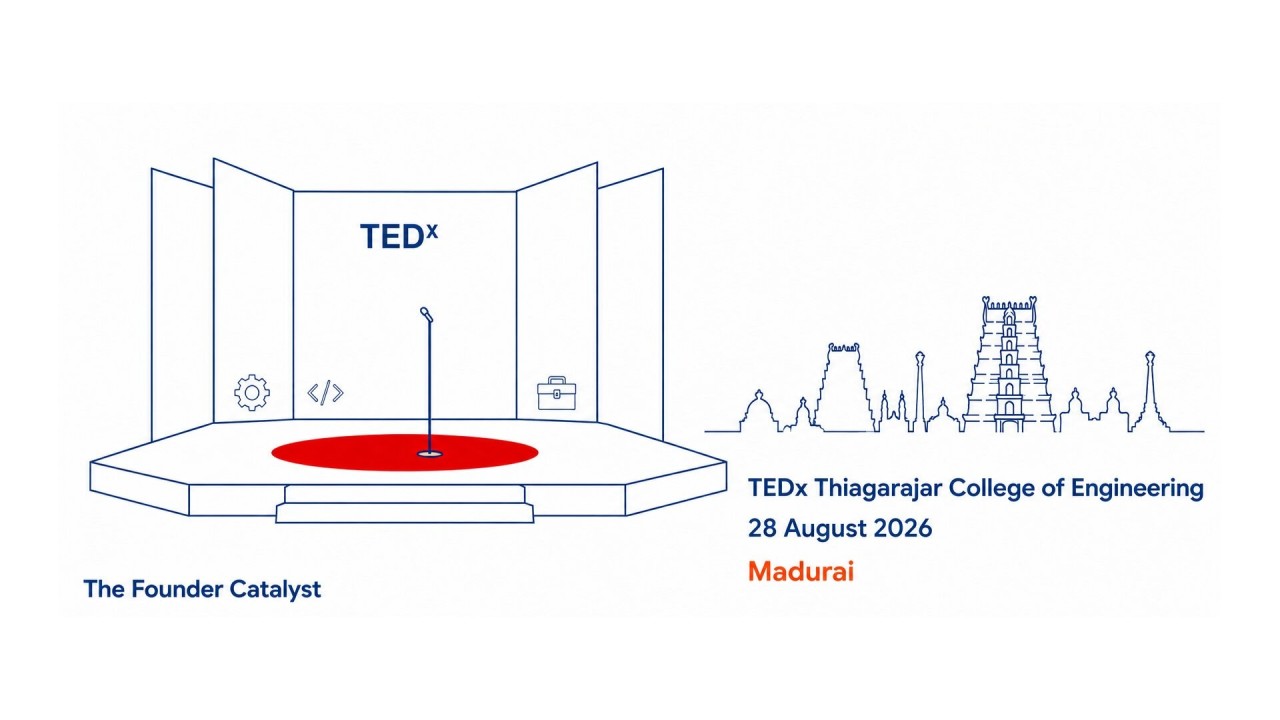
On 28 August, I will be speaking at TEDx Thiagarajar College of Engineering in Madurai.
I am not sharing the title here. That stays for the room. But if you remember Easytools, you already have half the hint. The other half is AI.
There is something fitting about going back to an engineering campus for this. My own years in electronics and communication engineering, some 400 kilometres away in Chennai, are where most of what I will talk about actually began. Not in a classroom, but in the freelance projects I took on for local clients while still a student, writing software for people who needed something to work, not something to impress.
Long before any of that, there was a publishing house. My grandfather started it in 1929, and my father ran it for over fifty years. I grew up around the hum of printing presses and a very specific kind of discipline, the kind where if a customer found a printing error in a book bought years earlier, you replaced it without a single question asked. I did not think of it as a business lesson at the time. It was just how our house worked.
A year after college, I built my first product, a shareware security app called EasyPass. It found buyers in over fifty countries, which told a twenty-something engineer in Chennai something he had no real way of grasping before then, that the internet did not care where you sat while you built something. It also taught me the other lesson early, the uncomfortable one. A collaborator copied the code and sold a version of it under his own name. Setbacks and success, I learned, tend to travel together from day one.
By the late 1990s, that first product had grown into Easytools.com, freeware and shareware sold online through Vishwak Associates, the company that would later become Vishwak Solutions, at a time when most Indian businesses were still deciding whether the internet was worth taking seriously, and a dial-up connection here involved a government department in one way or another. Nobody called what I did a startup then. Nobody called it product-led growth either. I was just trying to get software into people’s hands around the world, using whatever the internet allowed at the time, and carrying forward a habit I had absorbed without knowing it, that you own the problem fully and never make the customer feel at fault for it.
Three decades on, I am still working through some version of the same question, just with faster internet and higher stakes.
If you are around Madurai on the 28th, I would love to see you there.
Many founders in India may not recognise the name Chegg. Yet, for nearly two decades, it was one of the most successful education technology companies in America.
Founded in 2005, Chegg built a subscription business around helping students with textbook solutions, homework assistance and tutoring. For millions of college students, it became a daily habit. If you had a difficult assignment, chances were you searched Google, landed on Chegg, and paid for access to the answer.
Then came ChatGPT.
Unlike many businesses that found AI to be another productivity tool, Chegg faced something far more fundamental. Students no longer needed to search for answers. They could simply ask an AI assistant. The experience was faster, conversational, and often free.
The change in user behaviour happened much faster than anyone expected.
The numbers reflect that shift. Chegg’s revenue declined from about US$767 million in 2022 to about US$377 million in 2025. During the same period, the company went through repeated restructurings, reduced its workforce significantly, closed offices and began searching for new growth areas beyond its original business.
To be fair, AI was not the only reason. College enrolments softened in some markets. Textbook usage changed. Google’s AI-generated search summaries reduced traffic to many educational websites. Competition increased. Even Chegg acknowledges that these forces arrived together.
What makes Chegg’s story remarkable is not that a company struggled. Businesses have always faced disruption.
What makes it remarkable is that its core product was displaced so directly.
In many industries, AI helps employees work faster, write better code, analyse data or improve customer support. The business still exists; AI simply makes it more efficient.
For Chegg, AI became the product that customers wanted instead.
That distinction is important.
Looking back, Chegg will probably be remembered as one of the first large, publicly listed companies whose primary value proposition was overtaken by generative AI within a remarkably short period.
Whether the company successfully reinvents itself remains to be seen. It is still operating, investing in new businesses and attempting to find its next chapter. But its journey is already an important business story.
Technology disruptions are usually discussed in hindsight, years after they unfold. This one is happening in front of us.
Twenty years from now, when people write about the early impact of generative AI on business, I suspect Chegg will occupy a chapter of its own.
A D2C founder running an Ayurvedic skincare brand, doing about 8 crore in revenue, put it simply. AI is helping everyone create ads, write product descriptions, launch stores faster. My fear is not the technology. My fear is that AI makes every brand look equally good. If everyone has the same marketing superpower, where does my differentiation come from?
Vineeth Vijayaraghavan, who I have known for over thirty years and who advises VCs, family offices and startups on AI strategy, did not pretend there was a tidy answer. This needs introspection, he said. But he had a reframe worth sitting with.
Most of us think about AI inside a business as either software or marketing. Those are the obvious places. What he is seeing some founders do instead is use AI to build capability they could never have afforded before, inside the core of the business itself. He gave the example of a chemical engineering company where the founder now has six AI agents working alongside him on R&D, something that used to require hiring people the business simply could not access or afford. The same logic applies to a skincare brand. AI for product research and literature review is not a bad place to start, he said, though obviously with a healthy dose of scepticism, especially in a category where claims need real verification.
The differentiation question does not disappear. But it shifts from what does my marketing look like to what am I now capable of building that I was not before.
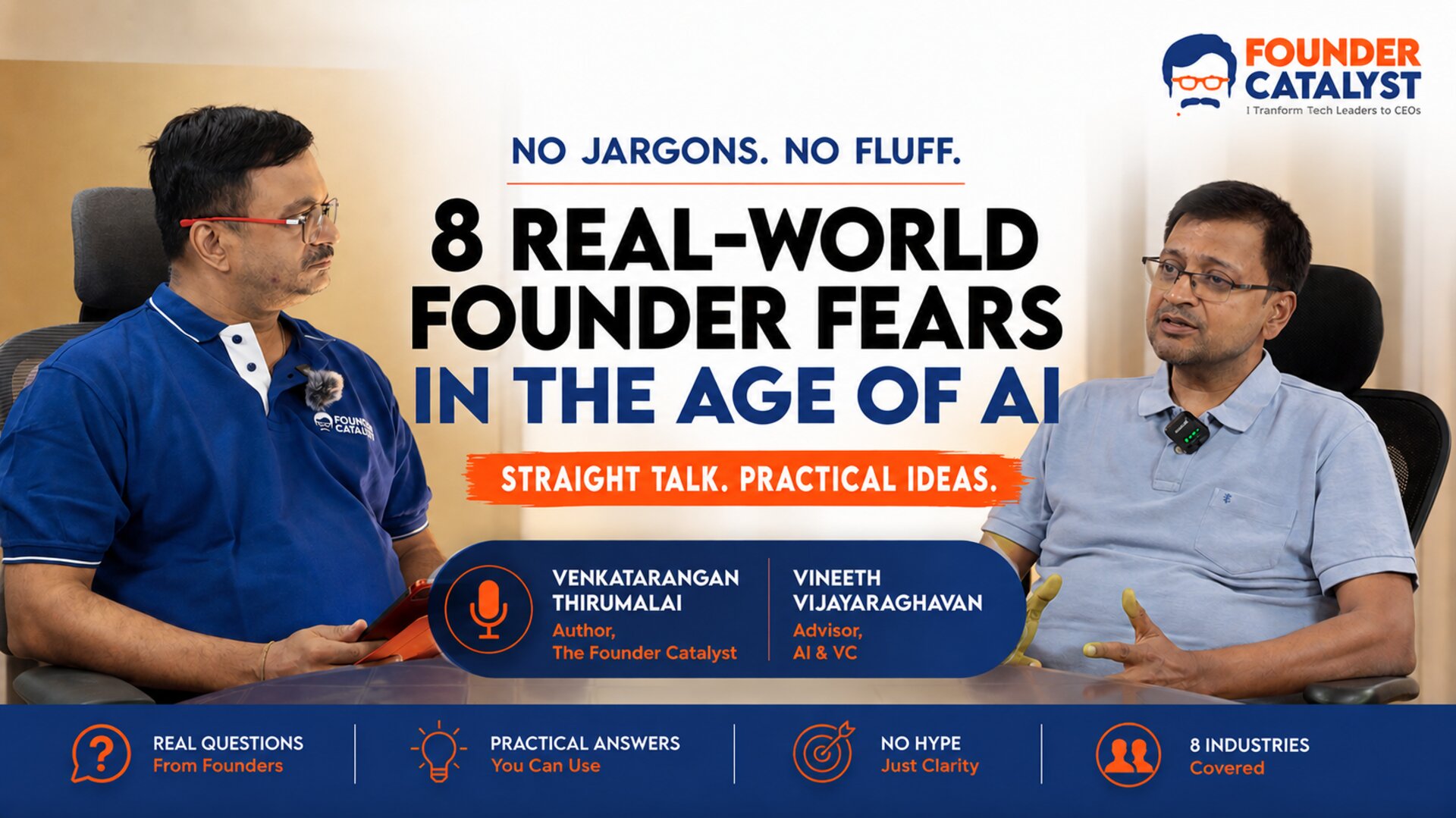
This was one of eight real founder fears we worked through on a new episode of The Founder Catalyst, recorded this month in Chennai. Instead of the usual interview, we sourced questions directly from founders across industries and went through them one by one, no scripts, no theory.
A custom software services founder in Coimbatore is not worried about his developers using AI. He is worried his US clients will stop asking for large projects and instead ask for one senior engineer doing the work of five, slowly turning his company into a staffing business with shrinking margins. Vineeth’s answer, the volume of smaller, faster engagements is going up industry-wide, and the founders doing well are the ones who can turn around small projects quickly and let those grow into larger ones over time, rather than chasing fewer, bigger contracts.
A recruitment firm placing engineers for startups fears that AI screening and ranking candidates makes recruiters irrelevant. Vineeth flipped this one. As AI competency becomes harder to evaluate, not easier, because a test or a hackathon no longer tells you much, the recruiter who has spoken to hundreds of candidates and can spot what is real becomes more valuable, not less.
A chartered accountancy firm is not afraid of losing clients. Being a regulated profession, that part feels safe. The fear is clients expecting the same work for half the fee. Vineeth’s response, look at firms already doing this well. He described one CA firm in Chennai that grew from 14 to 60 people, with AI handling the routine compliance work and a small number of AI-native young developers building internal tools, while the chartered accountants focus on the judgment calls AI still cannot make. That firm, he added, is now raising serious investment, including from outside India.
We also went through fears from an automobile manufacturing unit near Hosur worried about larger competitors using AI to out-pace them on pricing and forecasting, a legal services firm worried about how junior lawyers get trained if AI does their early work, and a logistics company with 70 trucks wondering whether technology becomes the real competitive edge over operational excellence.
We closed with an imaginary scenario. Three founders in a room, a SaaS founder doing 10 crore in ARR, a services founder with a hundred people, and a manufacturing business doing 50 crore. Which one should be most worried about AI, and which the least? Vineeth’s answer was not about industry at all. It was about culture, and the willingness to act.
Watch the full conversation here:
If you are a founder or business leader trying to make sense of what AI actually means for your business, beyond the hype, this conversation is for you.
About the guest:
Vineeth Vijayaraghavan advises companies, family offices, and VC boards on technology and investment strategy, with a particular focus on AI.
About the host:
Venkatarangan Thirumalai is the author of The Founder Catalyst and writes and speaks on AI, leadership, and founder strategy. More at thefoundercatalyst.com
When I work with founders on this, the conversation rarely starts with the technology. It starts with what people are afraid of losing, and whether that fear points them toward the right question or the wrong one.
In simple terms, his point is this: the real advantage in AI will not come from access to models alone, but from how effectively a company captures, learns from, and improves using its own experience.
For founders, this is worth paying attention to.
Skills, prompts, and agents are portable. You can switch models, replace tools, and migrate clouds. None of these compounds on its own.
What compounds is the feedback loop around your business: the traces from real work, the evaluations that measure what matters, the preferences that capture human judgement, and the outcomes tied to business results.
Every customer interaction, every workflow, every decision can make your organisation smarter — if you capture the signal.
That is why owning your learning loop matters. Not because it locks you into a platform, but because it builds institutional knowledge that outlasts any model, framework, or vendor.
Today, trace data is converging around standards like OpenTelemetry. Evaluations remain fragmented across frameworks and providers. The next piece of infrastructure we need is an open, portable standard for evals — one that works across clouds, local models, and agent frameworks, with businesses owning the data and the format.
Your learning loop is your IP. That’s the advantage that compounds.
Founders and CXOs spend most of their time watching what customers, competitors, and investors think about AI. Fair enough. But occasionally, a voice from outside the industry frames the conversation in a way that cuts through the noise. This week, that voice came from an unlikely place — a holy one.
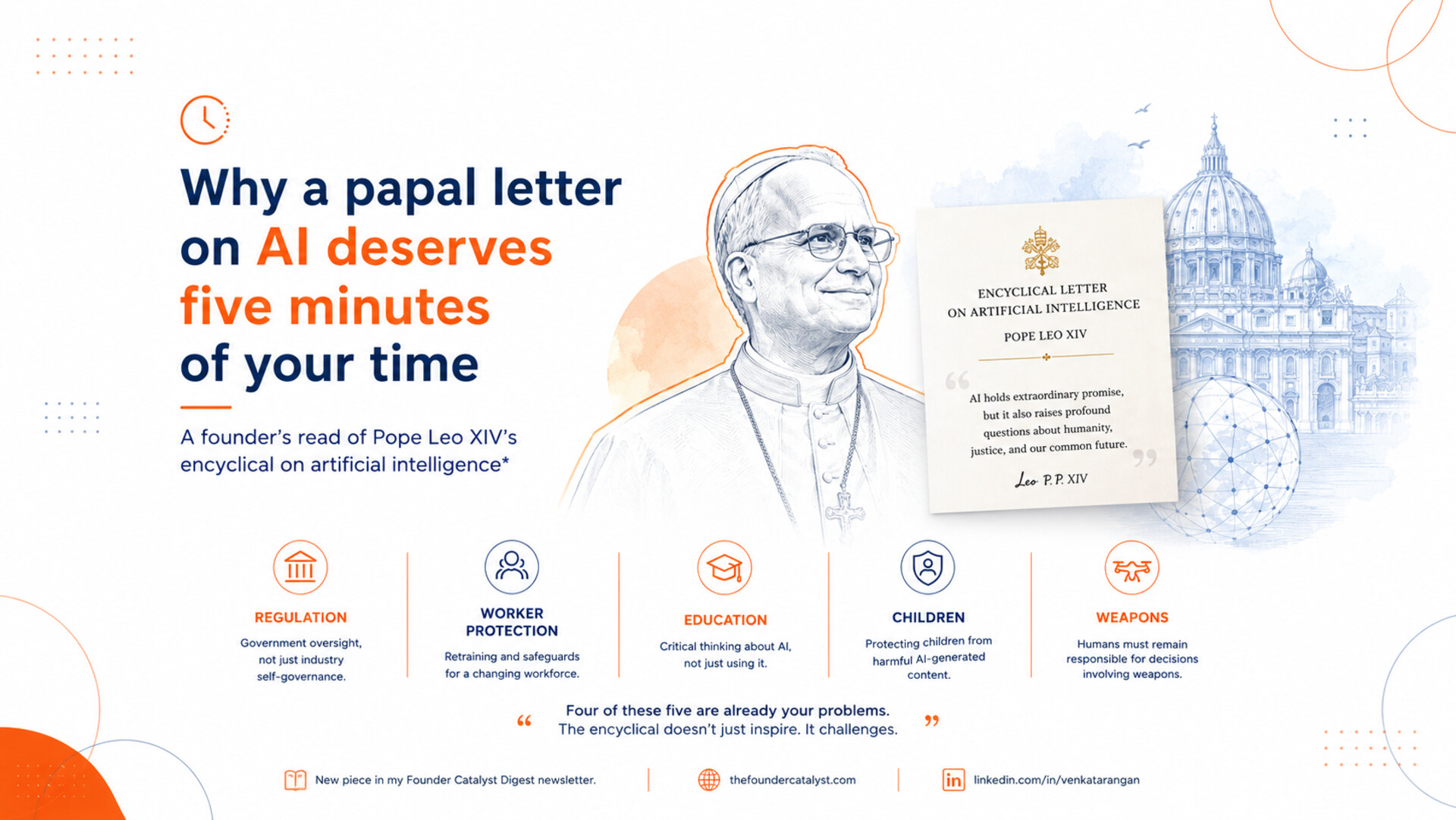
Pope Leo XIV released a roughly 200-page encyclical on artificial intelligence, with technical input from Christopher Olah, co-founder of Anthropic. The AI industry will not alter its roadmaps because of this. But the previous five encyclicals — on workers’ rights, Cold War peace, birth control, economic inequality, and the environment — each shaped public discourse in ways that outlasted the news cycle. They framed what mattered before the rest of the world caught up.
I’ll be honest here, I went in sceptical. A papal letter on AI felt ceremonial at best. The New York Times summary I read changed that.
1. Regulation. Not self-governance by the industry. Actual government regulation of the private companies driving AI development. That distinction matters.
2. Worker protection. Retraining and safeguards for workers displaced by AI. Already unfolding in IT services, shared services, and process-heavy roles.
3. Education. Helping students think critically about AI, not just use it. A generation that consumes AI output without understanding its limits is a business risk, not just a social obligation.
4. Children. Protecting children from AI-generated violent, hypersexualised, or false content. Not a future risk — anyone with a teenager at home already knows this. But there is a business dimension here that leaders underestimate: if the next generation’s trust, emotions, and judgment are shaped by unchecked AI content, brand loyalty and consumer relationships become harder to build. That has real bottom-line consequences well within the decade.
5. Weapons. Humans must remain responsible for all decisions involving weapons. The encyclical’s argument is direct: autonomous systems make war more feasible and harder to control, which undermines the principle that the use of armed force is a last resort.
The practical takeaway for business leaders: four of these five are already your problems. Workforce displacement, critical thinking in your teams, child safety in your products, and the governance gap between what AI can do and who is accountable when it goes wrong. The Vatican did not invent these concerns. It just wrote them down in one place.
“For founders, the question is which part of that transformation requires something that money alone cannot build.”
This line stayed with me.
Every founder I speak to right now is asking the same question: what should I build?
Frontier AI models are moving fast. What looked like a defensible product six months ago feels like a feature today. Advice is everywhere, and most of it is too generic to act on.
Then I read something that actually answered the question directly. S. Somasegar and Rasik Parikh at Madrona Venture Group cut through the noise in a way most commentary does not. Here is how I read it.
Three areas where founders can still build with conviction.
1. Own the liability, not just the tool.
Frontier Labs will build powerful general-purpose systems. They will not absorb the legal, regulatory, and financial accountability that comes with specific outcomes in specific industries. I have watched Indian IT firms lose deals on exactly this gap — clients want someone to sign off and stand behind the result, not just ship the capability. That willingness to own risk is where durable margin lives.
2. Build on data others do not have.
Models are trained on what is public. The edge sits in what is not — internal workflows, edge cases, decisions, and historical context. When I built Simpligic years before GenAI was a term, the insight was the same: the moat lives in private data. If your product compounds with every customer interaction, you are in a territory the model labs have no roadmap to enter.
3. Go deep into messy workflows.
Some problems are not solved by more intelligence. They are solved by understanding how work actually gets done — across people, exceptions, approvals, and institutional habits built over decades. At Vishwak, the client relationships that held through every disruption were the ones where we were embedded in their delivery model, not just their vendor list. A two-year integration into how a firm actually operates is not something a foundation model company will replicate. There is no incentive to.
Here is the framing I keep coming back to from the piece: the difference between a tool and an outcome. A tool makes a task easier. An outcome means you are on the hook for the result. Most of what is being built right now — including a lot of what gets funded — is tools. The businesses that will matter in five years are the ones that own the outcome.
The question founders should be asking is not whether their product needs AI. That is the wrong filter. Soon enough, everything will. The more useful question is whether the solution requires something AI cannot supply on its own — a regulator who trusts you, data that never left your client’s firewall, a workflow only you understand end to end, or accountability that someone has to sign their name to.
The article makes one more point that deserves to land. This buildout — hyperscalers, foundation models, the entire stack — is a multi-trillion-dollar bet that AI will transform every industry. That bet will pay off. But transformation and value creation are not the same thing. Value will concentrate in the places where technology alone is not sufficient. That is the territory worth building in.
Full credit to Soma Somasegar and Rasik at Madrona for articulating this clearly. Soma is someone whose thinking I have followed for a long time — I first met him in 2005 when he led the Developer Division at Microsoft — someone who has always taken the long view, and has usually been right about it.l.
The article from Madrona is here.
If you are a founder stress-testing where to build, this is the kind of question I regularly dig into with the leaders I work with. Reach out at thefoundercatalyst.com or connect with me at linkedin.com/in/venkatarangan
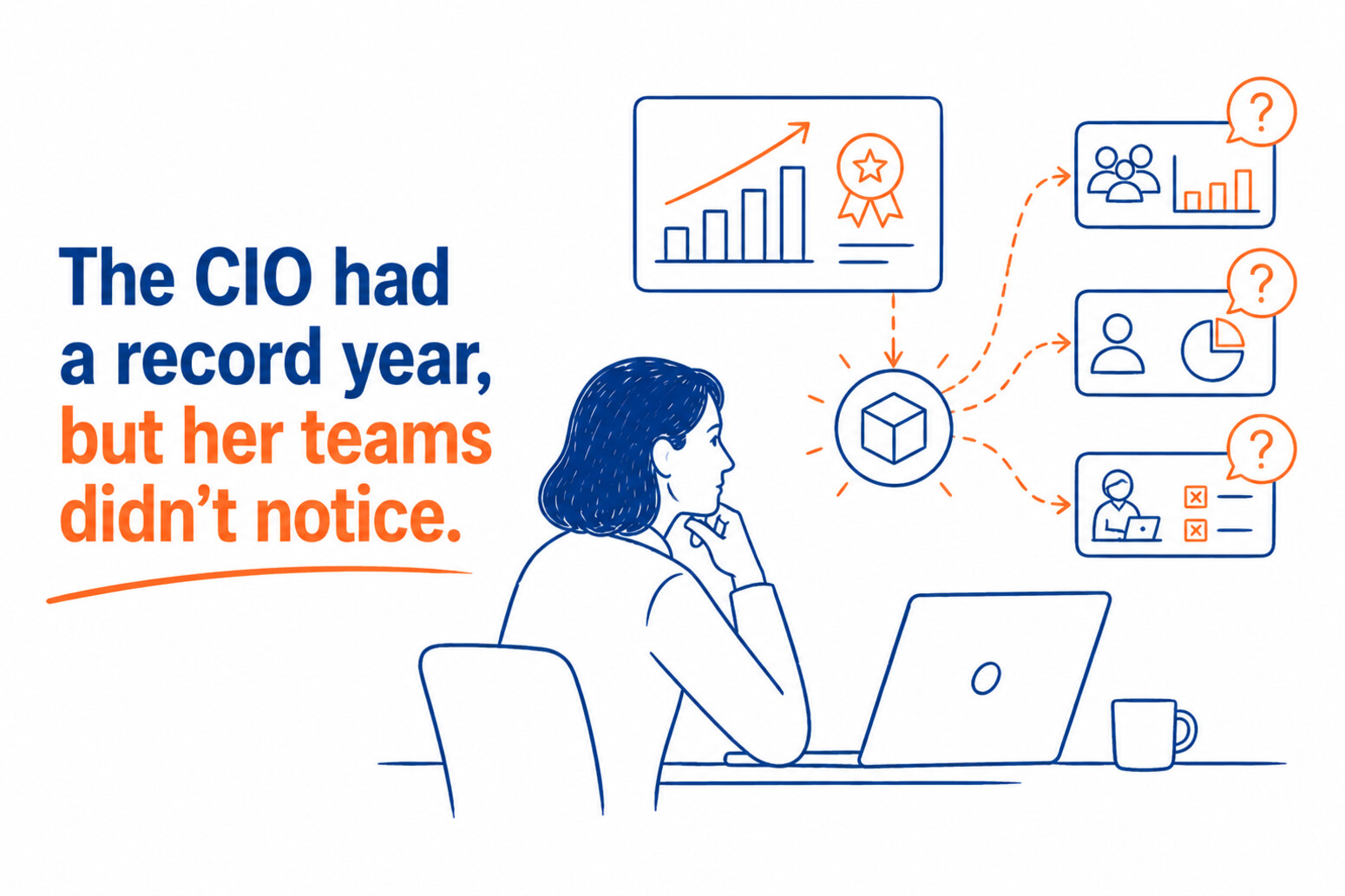
The CIO had every reason to be pleased. She wasn’t.
Board visibility. CEO approval. Record numbers of internal apps shipped. Her IT team was delivering at a pace that would have been unthinkable twelve months ago.
When I joined the call, I expected good news. I heard hesitation instead.
It took me a few minutes to notice what was missing from her update. She never mentioned the line managers. Not once. I asked her directly: Were the department heads actually seeing productivity gains from these applications?
“Venkat, you guessed it. That’s exactly my problem.”
Her team had been shipping AI-built internal applications continuously for nearly a year. Every department was requesting bespoke tools — automation utilities, reporting dashboards, workflow agents — for specialised use cases that previously would never have cleared a development backlog. The economics had changed. AI made these builds fast and cheap. Requests kept coming. Delivery kept pace.
But the telemetry told a different story. Usage in single digits. For large teams where even ten percent adoption would register clearly, the numbers were flat.
The apps were built. They sat unused.
This is not a story about AI failing. It is a story about a safeguard disappearing.
Before AI entered the picture, cost and engineering bandwidth acted as a natural filter on internal tool requests. Most ideas died quietly in the queue — not because anyone evaluated them and said no, but because the cost of building was real and the wait was long. That friction, however crude, forced a basic form of demand validation. Only requests with genuine organisational pull survived it.
AI has removed that friction almost entirely. And most organisations have not replaced it with anything.
What happens next is predictable. A manager spots a genuine gap — usually a real one. A request goes in. The tool gets built without meaningful involvement from the people who would actually use it. No end-user consultation. No workflow integration thinking. The manager accepts delivery. The team quietly returns to what they already know.
The app joins a growing collection of well-intentioned software that nobody opens.
The frustrating part is that the productivity gains from AI are real, and the evidence is unambiguous. EY’s chief economist, citing Federal Reserve Bank of St. Louis data at Davos 2026, found that generative AI is already saving workers the equivalent of 1.6% of total work hours. A randomised experiment with 1,174 adults (NBER, 2026) found AI closed nearly three-quarters of the productivity gap between higher and lower-educated workers. And a University of Hong Kong study (2026) found that untrained AI access actually hurt performance, while even a brief training intervention significantly improved both adoption and outcomes. The technology delivers. The variable is always the people side.
I have seen this pattern repeat across organisations, and it connects to something I write about in my book. Twenty-five years ago, I built inventory software for my father’s publishing firm — convinced that the clear benefits would drive adoption on their own. The staff resisted. Not because the tool was bad, but because nobody had brought them into the process. The breakthrough came only when the firm’s general manager, a man deeply rooted in the old ways, took a personal interest in learning the system. His endorsement shifted the entire team’s behaviour. The technology did not change. The human dynamic did.
That lesson has not aged. If anything, AI has made it more urgent.
Speed is easy to measure. Adoption is what moves the business
Most AI tool deployments follow the same top-down pattern. A business leader identifies the gap. IT builds the solution. The actual users — the ones whose daily habits need to change — are consulted last, if at all.
Users in large organisations carry significant inertia toward familiar tools and established routines. That inertia does not dissolve because a new application exists. It dissolves through involvement, through relevance, and through time. None of those three things gets faster just because the build cycle did.
The fix is not more training sessions or better change management communications. Those are responses to a symptom.
The deeper problem is that the old economic forcing function has gone, and nothing has taken its place. What needs rebuilding is a lightweight governance layer. Before any internal AI tool gets approved, two questions should have clear answers.
Is there genuine pull from the people who will use it — not just from the manager who requested it?
Does an existing tool or workflow already adequately cover this need?
That gate does not need to be bureaucratic. It needs to exist.
AI has made building cheap. It has not made building the right thing any easier. If anything, it has made that harder — because the friction that used to quietly filter out weak ideas is gone, and most organisations have not noticed yet.
Speed of delivery is easy to measure and tempting to celebrate.
Depth of adoption is what actually moves the business.
If questions like these sit at the intersection of technology and leadership for your organisation, this is what I focus on at The Founder Catalyst. Happy to continue the conversation in the comments or connect directly.