
A D2C founder running an Ayurvedic skincare brand, doing about 8 crore in revenue, put it simply. AI is helping everyone create ads, write product descriptions, launch stores faster. My fear is not the technology. My fear is that AI makes every brand look equally good. If everyone has the same marketing superpower, where does my differentiation come from?
Vineeth Vijayaraghavan, who I have known for over thirty years and who advises VCs, family offices and startups on AI strategy, did not pretend there was a tidy answer. This needs introspection, he said. But he had a reframe worth sitting with.
Most of us think about AI inside a business as either software or marketing. Those are the obvious places. What he is seeing some founders do instead is use AI to build capability they could never have afforded before, inside the core of the business itself. He gave the example of a chemical engineering company where the founder now has six AI agents working alongside him on R&D, something that used to require hiring people the business simply could not access or afford. The same logic applies to a skincare brand. AI for product research and literature review is not a bad place to start, he said, though obviously with a healthy dose of scepticism, especially in a category where claims need real verification.
The differentiation question does not disappear. But it shifts from what does my marketing look like to what am I now capable of building that I was not before.
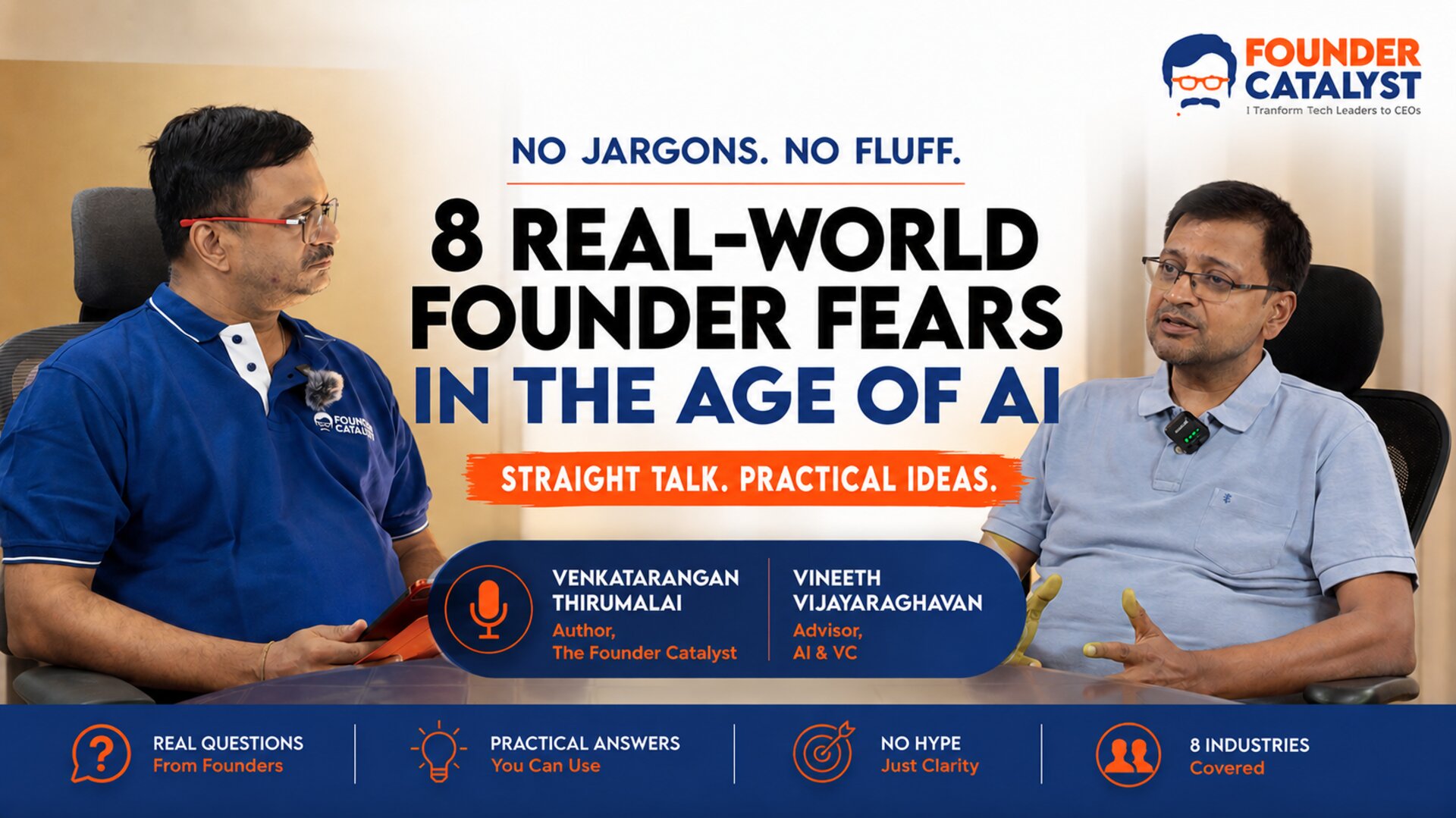
This was one of eight real founder fears we worked through on a new episode of The Founder Catalyst, recorded this month in Chennai. Instead of the usual interview, we sourced questions directly from founders across industries and went through them one by one, no scripts, no theory.
A custom software services founder in Coimbatore is not worried about his developers using AI. He is worried his US clients will stop asking for large projects and instead ask for one senior engineer doing the work of five, slowly turning his company into a staffing business with shrinking margins. Vineeth’s answer, the volume of smaller, faster engagements is going up industry-wide, and the founders doing well are the ones who can turn around small projects quickly and let those grow into larger ones over time, rather than chasing fewer, bigger contracts.
A recruitment firm placing engineers for startups fears that AI screening and ranking candidates makes recruiters irrelevant. Vineeth flipped this one. As AI competency becomes harder to evaluate, not easier, because a test or a hackathon no longer tells you much, the recruiter who has spoken to hundreds of candidates and can spot what is real becomes more valuable, not less.
A chartered accountancy firm is not afraid of losing clients. Being a regulated profession, that part feels safe. The fear is clients expecting the same work for half the fee. Vineeth’s response, look at firms already doing this well. He described one CA firm in Chennai that grew from 14 to 60 people, with AI handling the routine compliance work and a small number of AI-native young developers building internal tools, while the chartered accountants focus on the judgment calls AI still cannot make. That firm, he added, is now raising serious investment, including from outside India.
We also went through fears from an automobile manufacturing unit near Hosur worried about larger competitors using AI to out-pace them on pricing and forecasting, a legal services firm worried about how junior lawyers get trained if AI does their early work, and a logistics company with 70 trucks wondering whether technology becomes the real competitive edge over operational excellence.
We closed with an imaginary scenario. Three founders in a room, a SaaS founder doing 10 crore in ARR, a services founder with a hundred people, and a manufacturing business doing 50 crore. Which one should be most worried about AI, and which the least? Vineeth’s answer was not about industry at all. It was about culture, and the willingness to act.
Watch the full conversation here:
If you are a founder or business leader trying to make sense of what AI actually means for your business, beyond the hype, this conversation is for you.
About the guest:
Vineeth Vijayaraghavan advises companies, family offices, and VC boards on technology and investment strategy, with a particular focus on AI.
About the host:
Venkatarangan Thirumalai is the author of The Founder Catalyst and writes and speaks on AI, leadership, and founder strategy. More at thefoundercatalyst.com
When I work with founders on this, the conversation rarely starts with the technology. It starts with what people are afraid of losing, and whether that fear points them toward the right question or the wrong one.
Leave a Reply