Buying AI has become easy. It is cheap, quick and open to anyone with a card. What separates the companies that gain from it is something else, and I found a useful way into that from defence, of all places.
In October I wrote five short posts here on LinkedIn, one on each working day of a week. They began with two army leaders, one in India and one in the United States, and ended up being about how a company builds, buys and organises itself. This edition puts them together.
Wars are not won by technology. The other side gets it too.
General Dhiraj Seth, who took over as India’s Army Chief in June 2026, made much the same point at the NDTV Defence Summit in September.
The advantage goes to whoever adopts quickly and has the capability to use what they have adopted. Dan Driscoll, until recently the US Army Secretary, presses a version of it from Washington. In his Foreign Affairs essay, “Rewiring the Arsenal of Democracy“, he argues that Western militaries must learn commercial speed and commercial iteration. Two armies, two continents, one idea.
I have held this same view about AI in business for a while. Two companies buy the same tools, in the same week, at the same price. Deploying them proves very little.
The gap shows up a year later, and never in the tooling. One has changed something its customers can feel. The other has a usage bill and a pilot nobody got around to shutting down.
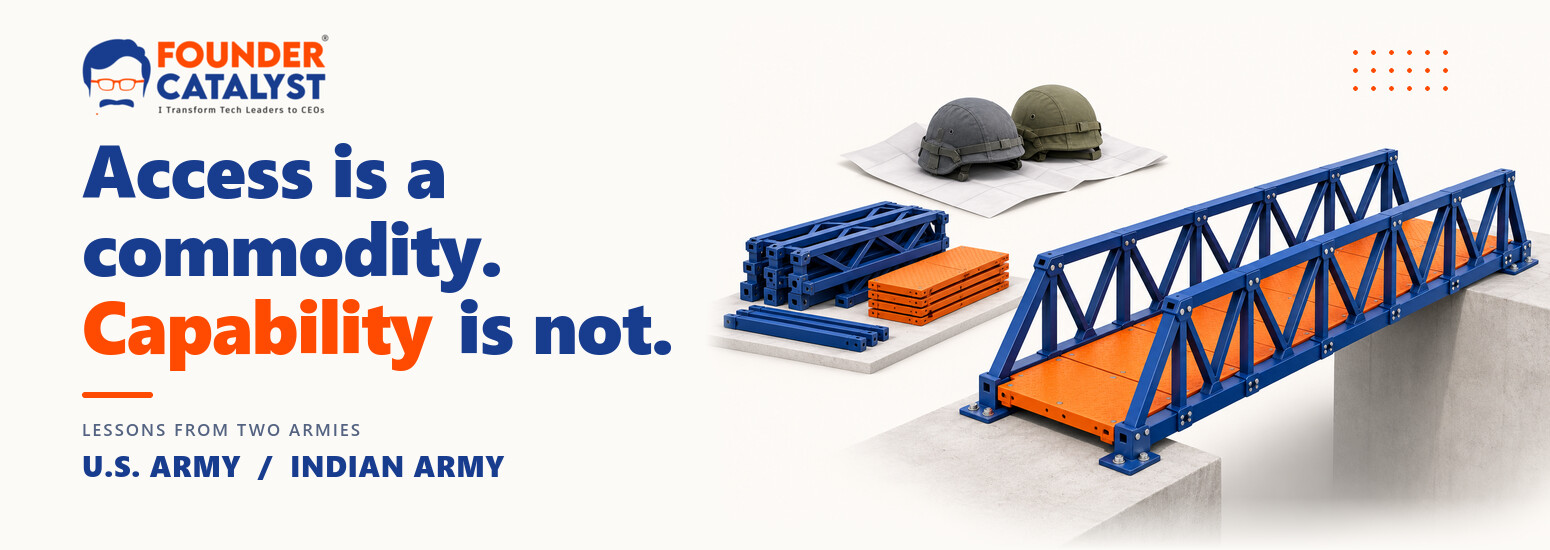
Access is a commodity. Capability is not.
Every technology cycle has had some version of this gap. What is different now is how little it costs to buy, and therefore how little it separates anybody.
Kipling did this arithmetic in 1886.
In “Arithmetic on the Frontier“, an officer trained at enormous expense is brought down in a border skirmish by a cheap local rifle. The costly education loses to the inexpensive weapon.
Enterprise software is having its frontier moment. A founder with a $100 monthly AI subscription can now build a good part of what once needed a $100,000 custom project and an army of outsourced engineers. The tender, the sprint plan and the offshore bench were all priced for a world in which writing code was the scarce thing.
It no longer is. Those of us who built services businesses on that arithmetic might want to read the poem again.
Cheap does more than shrink the budget line. It changes what’s worth holding on to.
Drones are not the fighter jets of the last century, prized and maintained for decades.
They are closer to bullets and shells: made in volume, used for the mission, expended.
Driscoll puts it plainly in the same essay. “Bespoke platforms are luxury items.”
Software is heading the same way. When AI can produce a working tool in days, code written for one need no longer has to be nurtured, documented and defended as a company asset. Build it for the job, use it, let it go when the need changes.
IT services taught a generation of us to treat the code as the asset, to be maintained, versioned and billed against for years. Looking back at what my teams carefully preserved, we could rebuild a fair amount of it in an afternoon today.
Some of it was genuinely an asset. Most of it was just old.
Letting go of something you built is among the harder founder instincts to unlearn.
Once what you build stops being permanent, the question of who builds it loosens as well.
Enterprises spent years consolidating IT vendors, for scale, price and one throat to choke. Sensible, for its time.
Driscoll argues the reverse for defence. An industry that had “devolved into an oligopoly” cannot produce the mass that modern war demands. He wants the wider industrial base, automotive and technology manufacturers included, able to plug in through open interfaces.
AI opens the same door in the enterprise. A specialist can now deliver a module for one purpose, and that specialist may be small, distant, even a single person. The empanelled vendor list was drawn up for a scarcity that has gone.
Not the whole list, though. The teams I see handling this well have kept a stable core for run-and-maintain and the regulated work, and opened a second lane alongside it for short, outcome-defined buys.
The second lane is where most of the interesting work is going. It is also the one procurement has no template for.
What gets built and who builds it are both procurement decisions in the end, and procurement makes them. How a company is organised is harder, because nobody can sign that into existence.
The best AI tools do very little inside a company that runs on silos.
Driscoll’s description of military systems will be familiar to anyone who has walked an enterprise floor: systems that cannot share data, each one a walled garden, impressive on its own and useless to anyone on the other side of the wall. His fix is open standards, mandated at the point of procurement. He reports that once the US Army connected hundreds of its business systems, it ran its first personnel audit in over fifty years.
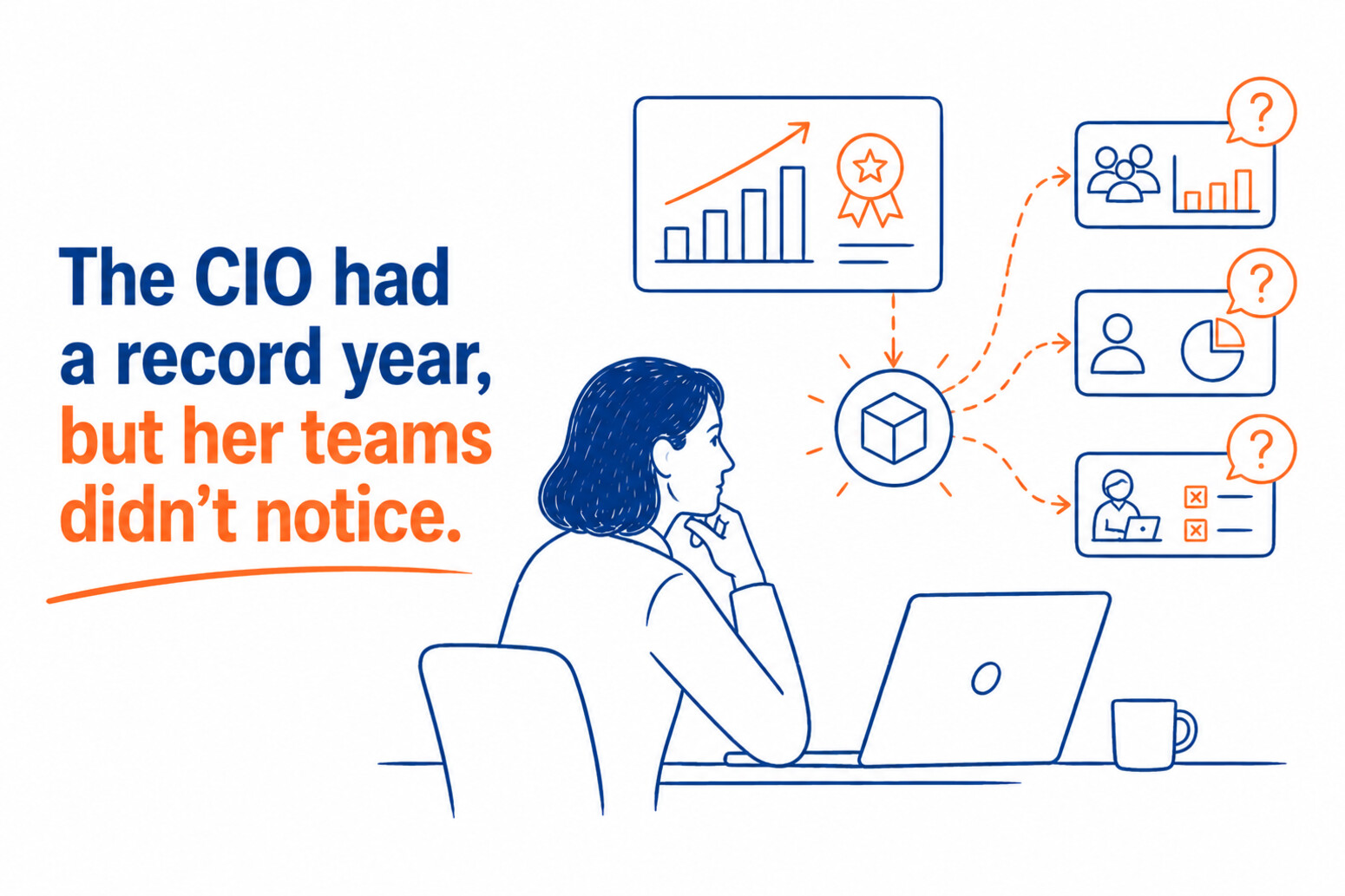
Companies have walled gardens too, and people keep the walls up. Sales, delivery, finance and support each hold a piece of the customer, and each one guards its piece. AI can assemble the whole picture only when the data flows across them, and customers notice when somebody finally acts on it.
Mandating a data standard is the easy half, and the half a CEO can sign. The hard half is that people with good reasons hold up the walls. I doubt that shifts without fewer layers and reporting on demand, in place of reporting up the chain.
Which is why the AI budget usually turns out to be the simplest line item in the whole exercise.
Building has become cheap, so what gets built no longer needs to last. The list of people who can build it has widened. And how a company is organised determines whether any of it reaches the customer. None of those three comes with the subscription.
None of this is an argument against buying the tools. The founders I see pulling ahead bought early, and then spent the year on everything the purchase did not decide: which problem was worth solving, who should build it, and whether the answer could travel from the people who had it to the people who needed it. The subscription purchase was the cheapest and quickest thing they did all year.
General Seth observed that technology may be making battles shorter without making wars any shorter. AI is behaving the same way inside companies. The tools shorten the distance to a working demo. What the customer feels depends on everything else.
Access is a commodity. Capability is not.
If you are a founder growing into the seat where these calls land, my book The Founder Catalyst is a practical guide to that transition.