
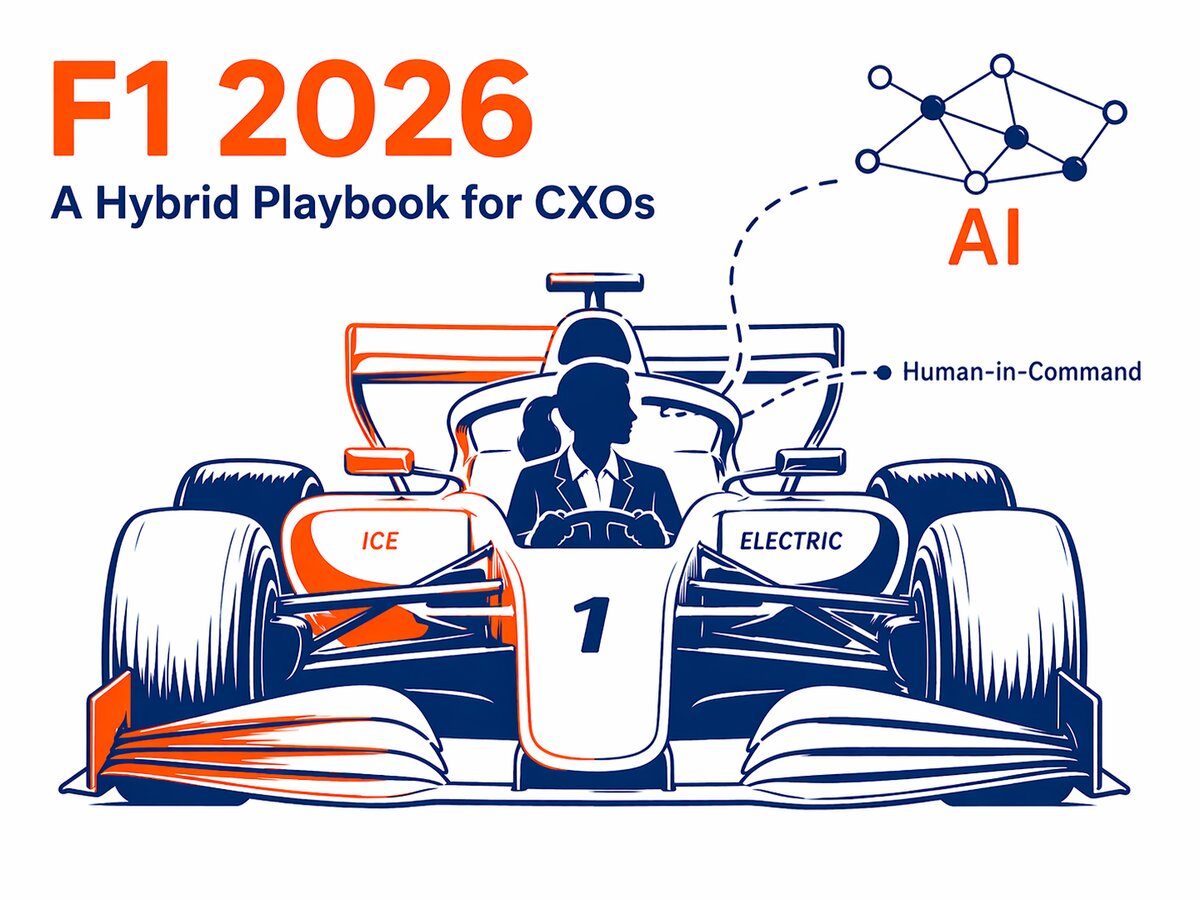
Stay with me for a second.
Starting this 2026 season, F1 has quietly executed its biggest regulation overhaul in over a decade. The 1.6L V6 turbocharged engine stays. But the electric side of the hybrid system has been roughly tripled in power, and the sport is now targeting a 50:50 split between internal combustion and electric power. The cars are running on Advanced Sustainable Fuels for the first time, and DRS has been replaced by an electrically-driven Overtake Mode.
A serious pivot. And yet F1’s own president has been categorical that the sport will never go fully electric. Not ideology — battery technology simply cannot sustain a Grand Prix, and pushing too fast would break the product itself. There is also a regulatory reality at play. Governments across the EU and elsewhere have been legislating hard on emissions and the long-term future of internal combustion engines. F1 had to respond to that pressure, just as every other industry has. It could not ignore the direction of travel, but it also could not pretend the technology was ready to go all the way.
So here is what F1 has actually done. It read where the regulation is heading. It read where public sentiment is heading. It read where the technology is heading. And instead of picking a side, it built a hybrid architecture where the driver stays in the seat, but the electric system dramatically amplifies what the car can do. Even that has not been smooth, and the FIA is still tuning the rules with teams this month. Imperfect, but directionally right.
This is the pattern I keep coming back to when founders and CXOs ask me how aggressively they should roll out AI inside their business.
The temptation on both sides is to go to an extreme. One camp, in the name of optimisation, wants to rip humans out of workflows and hand entire functions over to agents. The other camp wants to wait, watch, and delay until things settle — play it safe. The data says both are mistakes.
MIT’s NANDA initiative studied this through 2025 and found that around 95% of enterprise generative AI pilots deliver no measurable impact on the P&L, despite $30 to $40 billion spent. The 5% that did succeed shared a common pattern: they kept scope tight, focused on back-office automation where the ROI was clearest, and worked with specialised external partners rather than trying to build everything in-house. Firms that bought and partnered succeeded roughly twice as often as those that built internally.
A Harvard Business School field experiment with BCG consultants sharpened the point further. For tasks inside AI’s current capability frontier, consultants using AI completed 12 percent more work, 25 percent faster, at higher quality. For tasks outside that frontier, the same consultants using AI were 19 percent less likely to get the right answer. Same people, same tools, different task. AI made them worse when the task was not the right fit.
Now layer in the regulation piece. The EU AI Act’s core obligations for high-risk AI systems come into force on 2 August 2026. Article 14 of the Act uses a specific phrase that deserves attention: “human-in-command.” It is not a suggestion. It is a statutory requirement that high-risk AI — which includes recruitment, performance evaluation, credit decisions, medical diagnostics, and critical infrastructure — must be designed so a human can meaningfully supervise, intervene, and override. India is not there yet, but every serious jurisdiction is moving in the same direction.
Put it together, and the picture is clear. The research says narrow deployments work, broad ones fail. The research says AI amplifies humans on the right tasks and actively harms them on the wrong ones. The regulation says, at least in high-stakes domains, a human must remain in the loop by law.
The firms that will win the next few years are not the ones going all-in on autonomous AI, and not the ones hiding from it. They are the ones building a hybrid operating model now, keeping judgment with humans and leveraging AI, and getting good at the handoff long before it becomes mandatory.
F1 worked out that an elegant hybrid is harder to build than a pure ICE or a pure EV. But it is the only architecture that keeps the sport competitive, relevant, and regulation-ready at the same time.
The same logic applies to your business.
If you are a CXO or founder thinking through how to sequence AI inside your organisation without getting ahead of your team, your customers, or the regulators, happy to talk. Reach me at v@thefoundercatalyst.com or connect on LinkedIn: linkedin.com/in/venkatarangan
Leave a Reply