
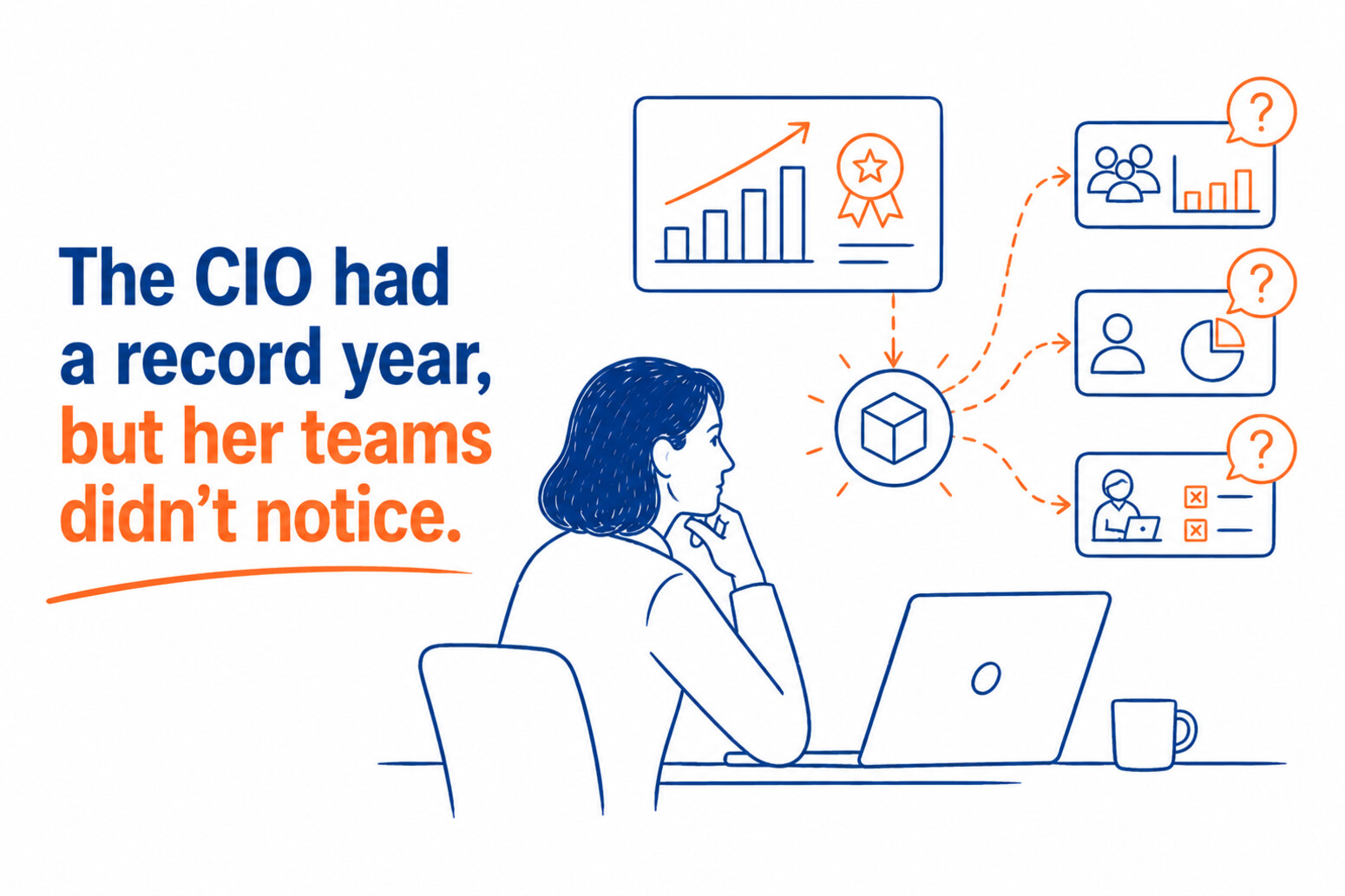
The CIO had every reason to be pleased. She wasn’t.
Board visibility. CEO approval. Record numbers of internal apps shipped. Her IT team was delivering at a pace that would have been unthinkable twelve months ago.
When I joined the call, I expected good news. I heard hesitation instead.
It took me a few minutes to notice what was missing from her update. She never mentioned the line managers. Not once. I asked her directly: Were the department heads actually seeing productivity gains from these applications?
“Venkat, you guessed it. That’s exactly my problem.”
Her team had been shipping AI-built internal applications continuously for nearly a year. Every department was requesting bespoke tools — automation utilities, reporting dashboards, workflow agents — for specialised use cases that previously would never have cleared a development backlog. The economics had changed. AI made these builds fast and cheap. Requests kept coming. Delivery kept pace.
But the telemetry told a different story. Usage in single digits. For large teams where even ten percent adoption would register clearly, the numbers were flat.
The apps were built. They sat unused.
This is not a story about AI failing. It is a story about a safeguard disappearing.
Before AI entered the picture, cost and engineering bandwidth acted as a natural filter on internal tool requests. Most ideas died quietly in the queue — not because anyone evaluated them and said no, but because the cost of building was real and the wait was long. That friction, however crude, forced a basic form of demand validation. Only requests with genuine organisational pull survived it.
AI has removed that friction almost entirely. And most organisations have not replaced it with anything.
What happens next is predictable. A manager spots a genuine gap — usually a real one. A request goes in. The tool gets built without meaningful involvement from the people who would actually use it. No end-user consultation. No workflow integration thinking. The manager accepts delivery. The team quietly returns to what they already know.
The app joins a growing collection of well-intentioned software that nobody opens.
The frustrating part is that the productivity gains from AI are real, and the evidence is unambiguous. EY’s chief economist, citing Federal Reserve Bank of St. Louis data at Davos 2026, found that generative AI is already saving workers the equivalent of 1.6% of total work hours. A randomised experiment with 1,174 adults (NBER, 2026) found AI closed nearly three-quarters of the productivity gap between higher and lower-educated workers. And a University of Hong Kong study (2026) found that untrained AI access actually hurt performance, while even a brief training intervention significantly improved both adoption and outcomes. The technology delivers. The variable is always the people side.
I have seen this pattern repeat across organisations, and it connects to something I write about in my book. Twenty-five years ago, I built inventory software for my father’s publishing firm — convinced that the clear benefits would drive adoption on their own. The staff resisted. Not because the tool was bad, but because nobody had brought them into the process. The breakthrough came only when the firm’s general manager, a man deeply rooted in the old ways, took a personal interest in learning the system. His endorsement shifted the entire team’s behaviour. The technology did not change. The human dynamic did.
That lesson has not aged. If anything, AI has made it more urgent.

Most AI tool deployments follow the same top-down pattern. A business leader identifies the gap. IT builds the solution. The actual users — the ones whose daily habits need to change — are consulted last, if at all.
Users in large organisations carry significant inertia toward familiar tools and established routines. That inertia does not dissolve because a new application exists. It dissolves through involvement, through relevance, and through time. None of those three things gets faster just because the build cycle did.
The fix is not more training sessions or better change management communications. Those are responses to a symptom.
The deeper problem is that the old economic forcing function has gone, and nothing has taken its place. What needs rebuilding is a lightweight governance layer. Before any internal AI tool gets approved, two questions should have clear answers.
Is there genuine pull from the people who will use it — not just from the manager who requested it?
Does an existing tool or workflow already adequately cover this need?
That gate does not need to be bureaucratic. It needs to exist.
AI has made building cheap. It has not made building the right thing any easier. If anything, it has made that harder — because the friction that used to quietly filter out weak ideas is gone, and most organisations have not noticed yet.
Speed of delivery is easy to measure and tempting to celebrate.
Depth of adoption is what actually moves the business.
If questions like these sit at the intersection of technology and leadership for your organisation, this is what I focus on at The Founder Catalyst. Happy to continue the conversation in the comments or connect directly.
Leave a Reply