I met Captain Picard in the mid-1990s. Star Trek: The Next Generation aired on Star Plus in India. Often at odd hours. No replay.
I missed many episodes. I saw enough to stay hooked.
What I admired most was the man. Steady. Fair. Never loud. Over the years I found he had also taught me a few things about running a company.
Here are the ones I still use.
1. Listen first. Then decide.
Picard rarely decided alone.
He turned to his crew. “Number One?” “Mr. Data?” “Counselor?” He heard each view out.
Then he said, “Make it so.”
Both halves matter. Skip the listening and you decide blind. Skip the deciding and you freeze. I wrote about the freezing half in What Captain Kirk can teach founder CEOs. Picard is the other half.
2. If they don’t get you, tell a story
In “Darmok”, Picard meets a race that speaks only in metaphor. Their words are references to their own stories. Plain language fails.
He bridges the gap by telling the Epic of Gilgamesh.
Founders hit this wall often. A team, a customer or an investor just doesn’t get it. So we explain louder. We add more slides.
The answer may be a shared story, not a better argument.
I learnt this the hard way. When I let ChatGPT expand the outline of one of my talks, it came back polished but generic. It only came alive when I went back to my own stories.
3. Build a crew that is not like you
Look at his bridge. A Klingon. An android. A blind engineer. A counselor who senses feelings.
None of them thought alike. That was the point.
Hard problems need many angles. If everyone in your room nods together, someone is holding something back.
4. Four lights
In “Chain of Command”, Picard is captured and interrogated. His captor holds up four lights and tells him to say five.
Picard refuses. “There are four lights!”
Later he admits that, at the very end, he had begun to see five.
No founder faces an ordeal like that. But we all feel a milder version of it.
A board wants growth. An investor wants a bigger story. A team wants good news. So a number gets bent a little to please the room. Revenue. Runway. Pipeline.
That is the fifth light.
Four is four. Report what is true. And know that pressure bends even the best of us.
5. Stay with what is in front of you
In “The Measure of a Man”, Picard defends Data in a hearing. Data is an android. Is he a person, or property?
Great television. Picard argues it superbly. What I take from him is his calm. He met a hard question with clear thinking, not fear.
But Data is a character in a story. He is not a forecast.
My view is simple. Don’t anthropomorphise today’s AI. It is not a being. It is not plotting anything. I use ChatGPT and Claude Code every day. They are capable assistants. Nothing more.
The fear of machines taking over humans is, to me, an unnecessary worry. It comes from drinking too much science fiction Kool-Aid. The later series Picard built whole storylines on fear of synthetic life. Good drama. Poor business guidance.
Founders have real questions today. What does AI do to my costs, my people, my customers, my community?
Work on those. Leave the far horizon to the experts in the field.
6. Your scars stay with you
“Tapestry” is a Next Generation episode. As a young man, Picard picked a bar fight and was stabbed through the heart. He has lived with an artificial heart since.
Now, near death, he wishes he could undo that reckless youth. A being called Q gives him the chance.
He avoids the fight. And wakes up a careful, forgettable junior officer who never commands a ship.
He begs to go back.
The scar was part of who he had become.
I carry one too. I was 14.
I was on an NCC trek near Pune. I had never spent a night away from my parents. We walked over 30 kilometres a day across hilltops and forts.
On one descent, I slipped. My canvas shoes made it worse. I slid fast towards a rock face several hundred feet below.
A senior cadet from a city college caught hold of me. He stayed by me for the rest of that day. I never learnt his name. I owe him my life.
The scar from that slip stayed with me for years.
It still does. Whenever I have faced an impossible situation, with no way out, my mind goes back to that slope. To the fall. And to the hand that caught me.
Every founder carries a scar like this. A moment that never quite leaves.
It returns when the pressure is highest. Know yours.
Then remember who caught you. A mentor cannot stop you from slipping. A mentor is the one who catches you when you do. In The Founder Catalyst, I wrote that “every founder needs a mentor — and every founder must also be one.”
The scar reminds you of the fall. The mentor is why it was not the end. Be that mentor for the next founder.
7. Optimism is a working tool
Star Trek’s future is not free of trouble. Its people just assume trouble can be solved.
That is not a mood. It is practical. A team that believes a problem is solvable will actually work on it.
Star Trek shaped how I think about complex issues, more than I realised at the time.
Sir Patrick Stewart has passed away at the age of 86. AI can now recreate a face and a voice. It will never be the real Patrick Stewart. For millions of fans like me, he will always be Captain Jean-Luc Picard.
What a voluntary exit at Microsoft may tell founders about AI and the size of organisations
When a company the size of Microsoft offers voluntary exits to about 60,000 people, the number takes the headline. The more interesting part sits behind it.
This is not a company in distress. It is highly profitable and holds strong cash reserves. A decision of this scale would also have been modelled carefully, with several outcomes weighed. So the question I keep returning to is why now.
I can see three possible reasons, and they are not mutually exclusive. These are my own reading of the move. Microsoft, as reported by GeekWire, says the offer does not signal a need for fewer employees, and that may well be true today.
The first reason is capital. Building and running AI infrastructure takes enormous sums, and lower operating costs free up some of it. The second is the shape of the workforce. AI is already changing how software gets written, and it could do the same for management and business functions. A company may be preparing for a time when it can run a larger business with a smaller team. The third is attention. Cloud and AI matter more to Microsoft with each passing year, and older areas such as Xbox, Windows or Office may not receive the same strategic focus.
A voluntary exit also carries a quiet complication. The company does not get to choose who accepts. Those who were ready for a change will leave, and that helps simplify the organisation. But some experienced and highly capable people will leave too, often because they have the most options. And 60,000 is only the number eligible. How many actually accept is the figure worth watching, and we should know once the offer window closes in early December.
I have seen the other side of this. Around 2008, during the subprime crisis, one of our largest clients in the USA cancelled their order almost overnight, and we lost over half our revenue. The next day I called a townhall and told the team we had to let go of nearly a hundred people. I promised a severance better than the statutory norms, even though it meant borrowing well beyond our usual limits. That decision was forced by circumstances, and the choice of who left was ours. Microsoft is in a very different position. It is acting from strength and handing the choice to its people.
Yet the two situations share something. The size and shape of an organisation is never fixed. It is a series of decisions, and leaders are now making them with a new variable in the room.
AI is not only changing the products companies build. It may also change how they organise themselves, how many people they need and where they choose to invest. For founders and business leaders, that question is worth thinking about today, and not five years from now.
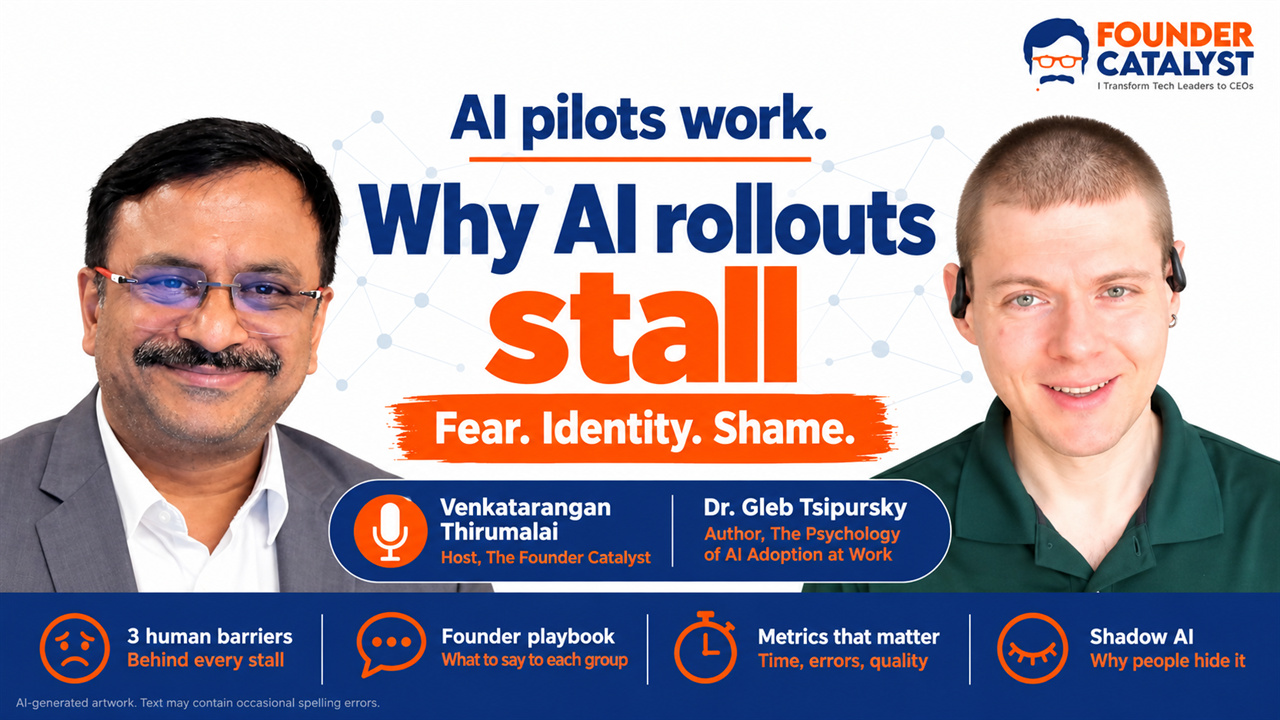
Dr Gleb Tsipursky described an employee I suspect most of us have met in some form. She uses an AI tool to do her work, and she finishes early. She tells no one. Not her supervisor, not her colleagues. She spends the extra time on herself, and the company’s numbers never show any of it.
She is not lazy or dishonest. She fears what her colleagues will say.
I spoke to Dr Gleb recently about his new book, The Psychology of AI Adoption at Work: From Resistance to Results. It was published by Georgetown University Press on 1 September 2026, with a foreword by Nick Bloom of Stanford. It was the first AI interview I have done that focused more on people and emotions than models.
The gap between the pilot and the rollout
Dr Gleb sees the same pattern in company after company. A founder gets excited about an AI tool. A small group on the team picks it up and likes it. The pilot works. Then the founder rolls it out to everyone else, and it goes nowhere.
He pointed to an MIT study that found 95% of the generative AI pilots it examined delivered no measurable return. He also cited Pew Research, where 52% of people said they were more concerned than excited about AI, and only about one in ten said they were more excited than concerned. Leaders sit in the excited group. So does a small share of their employees. Most people do not.
He calls this the emotional gap, or the empathy gap, and says most leaders aren’t thinking about it.
Take a CRM rollout. The hard part is making people learn new screens and follow a standard process. Top-down SOPs work there. AI tools are easy to learn, because you simply talk to them. But they are flexible, so one SOP cannot fit them. The head of IT does not know what a claims agent does all day. Even the head of claims doesn’t know every agent’s workflow. So each employee has to customise the tool for their own work, and that needs willing people. It does not happen when they are anxious.
Three groups, three different fears
Dr Gleb describes three groups, and each needs its own response.
He calls the first group the AI Alarmists. Their emotion is fear and anxiety. They think they are training their own replacements. His advice to founders is to get the leadership team aligned on a job-neutral promise. The company may not hire more people, but it will not cut jobs because of AI. The focus goes on growth and on winning market share. He believes this is doable. I would only say that a promise like this is as good as the founder’s cash position, so it should not be made lightly. He also suggested telling them that the people who keep their jobs will be the most productive, and those will be the people using AI well.
The second group is the Pragmatic Resistors. Their emotion is identity threat. Nobody feels threatened by a CRM. But when a tool can write a good sales email or a financial analysis, it touches what people take pride in. Companies often make it worse by automating exactly that work first. Dr Gleb does the opposite. He surveys the team on the tasks they hate, and on what blocks the work they love. Then he builds prompts and agents for those. He calls it “go slow to go fast”.
The third group is the Reluctant Adopters. They do use AI, but quietly. The emotion is shame and social stigma. For them, he suggests three things. Leaders should talk openly about how they use AI themselves. The same training that helps the second group widens what feels acceptable. And there should be a channel, in a weekly meeting or on Slack or Teams, where people share their AI wins and even their prompts, with leadership praising them for it.
Hiding AI use, and why India feels it more
Why do people hide it? Dr Gleb said the shame comes from colleagues. If someone is doing a job well and fast with AI, the anxious majority around them may say, “You’re cheating, you’re lazy.“
He said he has seen this more strongly in India than in the United States. He said the United States is more individualistic, and India is more collective, so the pull of what the group thinks is stronger. He called it a serious issue that leaders in India need to address.
I also asked whether startups, family businesses and large enterprises differ. He said the three groups appear everywhere, but in different proportions. Family businesses tend to be reluctant to lay people off, so there is less job anxiety and fewer AI Alarmists. They have more Reluctant Adopters, because the stigma around AI is stronger. Startups are the other way round. There is some stigma, as with developers, but more worry about losing jobs.
Measure the work, not the usage
Dr Gleb says too many leaders measure how much people use AI. That tells you little, because you can use AI badly. The term for this is AI workslop, from a study published in Harvard Business Review with Stanford and BetterUp. As Dr Gleb cited it, people estimate that around 15% of the work they receive from colleagues is workslop.
He measures three things with his clients. Time saved per workflow, such as writing a claims letter, a sales email or a PowerPoint. Error rates. And quality, since an email can be error-free and still have little impact.
Workslop is also where malicious compliance lives. People who fear AI or feel threatened by it, and who are forced to use it, may use it badly on purpose. They give a poor prompt and send the output without editing it. When the boss complains, they say they only did what they were told. The tool then looks like it doesn’t work. I called it active sabotage, and Dr. Gleb agreed.
His answer is to fix the motivation first. After that, training matters less than founders’ fear. The tools are not technically hard. He said a founder with more time than money can take five times as long and work it out alone, without hiring him.
Where human judgment stays
I closed by asking whether we give human judgment too much importance. He gave three reasons to keep it. In many cases, human judgment is still better than AI judgment, which is why people should edit what AI drafts. People would also feel a much bigger identity threat if the tool made the final call. And in regulated areas such as insurance, regulators require the final judgment to be human. As entrepreneurs, he said, we probably do not want governments stepping into more areas than they have to.
I have been an engineer all my working life, and I tend to look at everything from the technology side. After running a business for 30 years, I’ve learned that people make it. This conversation put that in sharper form for me. An AI tool is only as useful as the willingness of the person using it.
If you are weighing how to take AI beyond a pilot in your own organisation, and want more conversations with founders and leaders like this one, subscribe to The Founder Catalyst newsletter.
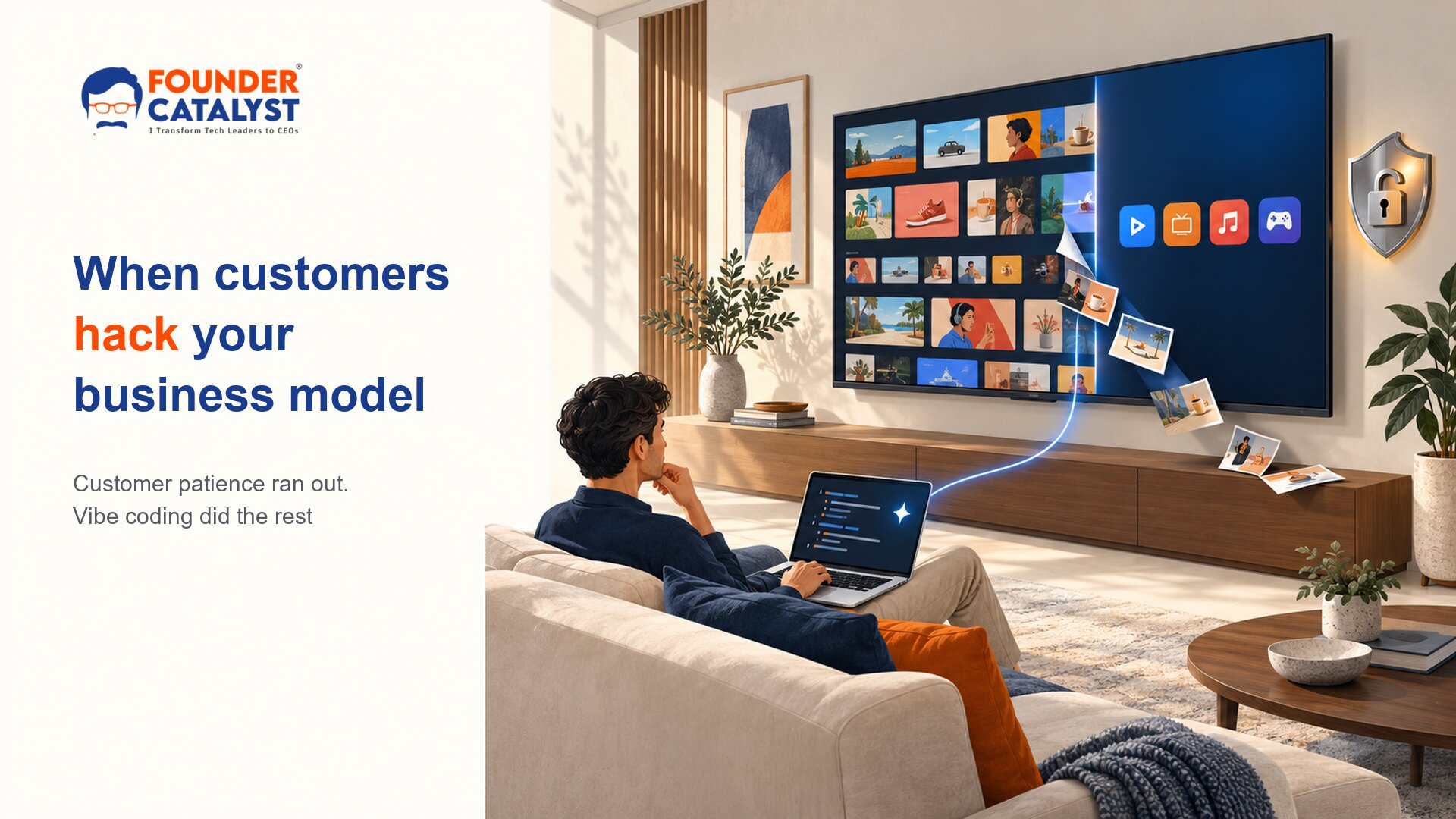
Smart TV owners are using AI coding agents to strip ads and bloatware from their sets. TV makers depend on that ad income, and they will be tempted to lock things down. I think the better path is to own the problem. The lesson reaches well beyond televisions.
On 17 October, a developer posting as Gathin shared how he fixed a family TV that showed an ad before Netflix would open. He pointed Claude Code at the Xiaomi set over home Wi-Fi. In one afternoon, it disabled 25 packages and wrote a clean new launcher. The project, now called CleanYourTV, passed 30,000 stars on GitHub within a week and lists over 240 models from 72 brands. Similar tools for Fire TV and LG appeared within days.
It is easy to file this under hobbyists having fun. I would look closer. This is what happens when customers have a grievance and, for the first time, a way to act on it beyond just complaining.
It is tempting to cast the manufacturers as villains driven by corporate greed. They deserve a fair hearing first. TV hardware has been a punishing business for years. A brand recovers its development cost in the few months after launch when it can charge a premium. After that, it is a price war, increasingly against well-made sets from Chinese brands. Ads, viewing data and home screen placements have become the recurring income that holds the model together. When Walmart agreed to buy Vizio for USD 2.3 billion in 2024, the announcement noted that Vizio’s advertising-led platform business already made up most of its gross profit. For many brands, the ads are the margin.
Owners see it differently. They paid full price for a TV that often feels slower after two years than on the day it arrived, with sponsored rows they never asked for. That is partly why people happily pay extra for an Apple TV box. They are paying to escape a home screen they already own. After a hard day’s work, all a viewer wants is to reach their show with as few hurdles as possible. A few years ago, an extra ad row might have been shrugged off. With rising household costs and streaming bills already piling up, even a small irritation can become the last straw.
I expect most makers to reach for the familiar tools that big tech firms go for. Firmware updates that quietly reinstall whatever users removed, something CleanYourTV’s own documentation already warns about. Locking the Home button to the stock launcher, as Fire OS and LG webOS already do. Closing developer mode, a hidden settings menu meant for app developers, and with it ADB (Android Debug Bridge), the channel that lets a computer on the same network send commands to the TV. That is exactly how these AI tools get in. They’re rewording warranty terms so any modification ends support.
Further out, I would not be surprised to see them lobby for the kind of legal protection Hollywood secured. In 1998, the studios helped push through a US law that made it illegal to get around copy protection, even on discs people had legally bought. They also made HDCP encryption on HDMI a condition for sending HD content to a screen. India added a similar anti-circumvention rule to its Copyright Act in 2012. After that could come startup software that only runs with a manufacturer key, sets that refuse to work after tampering, and streaming apps withdrawn from older sets sooner.
Each of these makes sense in a quarterly review. Together they tell customers the TV was never really theirs. The likely result is more buyers choosing a plain display, which Chinese makers will gladly sell for even less, and plugging in a box from a brand they trust, like Apple TV. Newer entrants will follow, because the same AI that set off this commotion has also made it far cheaper to build such a product. The ad revenue goes anyway, and the goodwill goes with it.
Another route exists, and it’s why I wrote this piece. Admit the experience has gone wrong. Offer existing owners an official update that removes ads and bloatware for a one-time fee, with a clear promise to replace any set it damages. Sell ad-free models with generous trade-in value on older ones, or a plan that lets customers upgrade every five years at a real discount. For enthusiasts, offer a paid tier with official AI access, an MCP server in today’s terms, or your own app that lets them customise the TV to their heart’s content without breaking it. Some of this costs money in the short run. It also turns the customers who have paid your bills all along, the very people now working around you, into your most loyal ones.
Large companies have taken this route before. In late 2009, Domino’s ran ads in which its own customers called the crust cardboard, then showed the company rebuilding its recipe from scratch. In 2010, Apple answered the iPhone 4 antenna complaints by offering every owner a free case or a refund. In 2013, Microsoft dropped the Xbox One’s mandatory online check-in and usage restrictions within weeks of announcing them, before the console shipped. None of these was comfortable. Each one admitted a mistake customers already knew about.
I learnt a smaller version of this at my own company. About two decades ago we built VPF, a content management system for large news and media groups, robust enough to serve millions of page views a day. We charged a licence fee on top of our development services, and clients resisted it. We stopped defending the fee and bundled the product free into our service engagements. It was the right call. In my book, The Founder Catalyst, I go a step further and admit that open sourcing it from the start might have served us even better.
AI agents have given ordinary customers the power to rewrite products they already own. Televisions are simply the first place it became visible. Any business whose margin depends on customers putting up with something they dislike is now on borrowed time. It is wiser to stop relying on that patience before customers decide for you.
I was interviewing a student from VIT Bhopal for an internship. Somewhere in the conversation, she mentioned a course called Technology Entrepreneurship. I asked her to show me the syllabus.
It read like a list of things I wish someone had told me three decades back.
I finished my engineering degree knowing electronics and how to write code. I did not know how to read a balance sheet. A profit and loss statement made no sense to me either. Taxation was worse. So I read what books I could find and worked it out as I went. There was no other way to run a company. I have written about this in my book, The Founder Catalyst.
What stayed with me was not the mistakes I made while catching up. It was the time it took. Every hour I spent understanding the numbers was an hour I did not spend on the product. I was an engineer who wanted to solve problems, and a good part of my energy went into things nobody had taught me.
Her syllabus talks about customers and whether they really want what you are building. It talks about protecting what you build. It talks about money, about incubators and government support, and about selling across borders. I learnt each of these the hard way.
A large client once came to us because of a small tool we had built. They were using it in ways I had never imagined. About twenty years ago, we built a content management system for news and media companies. We charged a licence fee on top of our services. The market did not like it. We ended up giving the system away as part of the service. I found out what customers would pay for only after the product was built.
My first product was EasyPass, a shareware security tool that found buyers in over fifty countries. One of my early collaborators took a copy of the code and began selling it as his own. I learnt of it only afterwards. No one had taught me anything about intellectual property before that day.
Around 2007, I expanded into the US and the UK at the same time, and I borrowed to do it. Growth came before the reserves. It was a close call. Today’s founders step into a far more supportive ecosystem than the one I began in. Incubators, angel networks and government schemes exist now. That support helps only a founder who knows about it.
Let me be fair to the classroom. It is not the field. Forty-five hours of lectures cannot teach what a first customer saying no will teach. Students will still learn the hardest parts by doing them. But there is a difference between meeting these ideas cold and meeting them as old acquaintances.
These are the engineers who will join your teams over the next few years. A college like VIT Bhopal now teaches this in a full semester course. They will arrive with cash flow, customers, patents and markets already in their vocabulary. I expect the questions in your review meetings to get better.
Founders have something to offer here. Internships and mentoring hours give students the practice a lecture hall cannot. I head the mentoring programme at TiE Chennai. We see young startups welcoming the initiative and finding it useful. I suspect students would feel the same.
An engineer’s attention is the scarcest thing a young company has. I spent a good part of mine catching up on basics. If a classroom can spare the next generation that effort, they can put it into the problems they care about. I learnt these words by making mistakes. They will learn the words first, and spend their mistakes on harder problems.
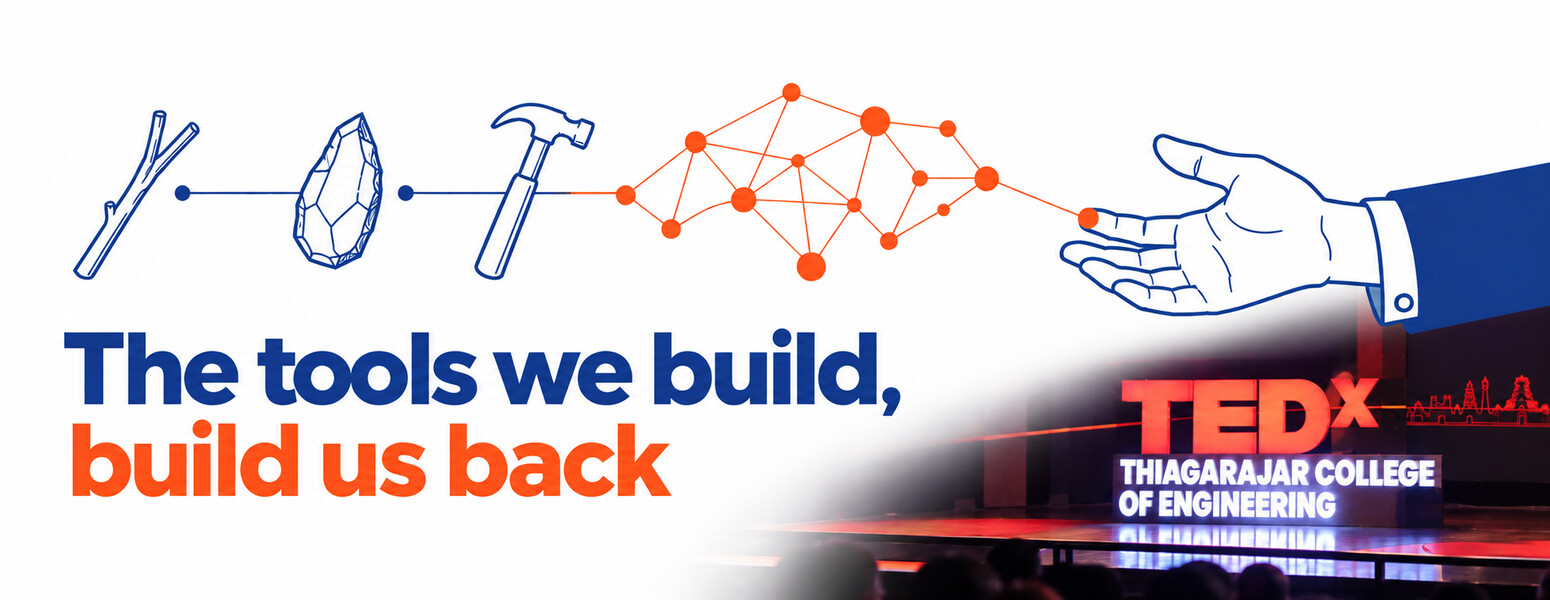
Three weeks ago I stood on the TEDxTCE stage in Madurai and told a room full of engineering students a story that actually began 3.3 million years before any of us were born — a shaped stone found at a place called Lomekwi in Kenya, older than our own species. I told them about a chimpanzee Jane Goodall watched in 1960, stripping a twig and poking it into a termite mound. And I told them what every tool since then — the hammer, the book, the compiler, the search engine, my own LIFCO dictionaries, my own Easytools.com, the LED clocks I used to burn out as a teenager — had in common.
Every single one of them waited for a hand to pick them up and decide what happens next.
That is not true anymore, and this is the part that should matter to a founder reading this, not just to a hall full of students.
For thirty years I built tools the old way: I had an idea, I decided what should happen, and the tool executed it — a compiler, a piece of taxi-booking software, a company. Somewhere around 2023 that changed. The tool in your pocket now does not wait for you to think first. It thinks first, hands you an answer already chewed, already judged, and waits for you to agree. Every large language model you use to write a pitch deck, a hiring email, or your own version of this blog post is doing exactly that.
I found out how far this goes the hard way, twice.
The first time was building a Tamil text editor last year. I did not write a single line of its code myself — not one — for the first time in thirty years of building software. I described the problem, and the machine wrote it. Somewhere in that project I stopped being a coder and became something closer to a specification: a person who describes what he wants and approves what comes back. That is a genuinely useful shift for a founder to notice — the distance between an idea and a working product has collapsed, and it is now open to anyone, not only to people who happened to grow up near the right engineering colleges.
The second time was writing my book, The Founder Catalyst — yes, where this newsletter gets its name — and later, this very talk. I gave an AI my draft and asked it to clean it up. It fixed my grammar. Then it fixed my sentences. Then, without asking, it quietly dropped the one story that mattered most to me — my grandfather’s dictionary business, and the one rule my father ran it on for fifty years: an unquestioned refund, even years after the sale, even for a single missing page. The AI’s version read beautifully. It was also not mine anymore, and it was far less useful to another founder than the actual, messy truth of how my father built customer trust over five decades.
That is the risk I actually want founders to sit with. These models are trained on the average of everything human beings have written, and what they hand back is that average. The deals you got wrong, the hires you regret, the one policy that cost you money in the short term and earned you a customer for life — none of that is in the average. It is exactly what makes your business yours, and it is precisely what a well-meaning AI edit will smooth away first, because it reads as too much detail.
None of this is an argument against using these tools. I would not have built that Tamil editor without one, and I no longer believe founders should be writing code by hand either. Use the motor. I only know when it is pulling me in the wrong direction because I spent thirty years riding without one — and that is the part I would ask any founder to hold on to. Take on the projects that felt impossible before. Just do not hand over the deciding.
We built the system. It is now good enough to build us back, one polished suggestion at a time. Whether it does depends entirely on what we let it delete.
I go into the fuller argument in the complete 18-minute talk — including why access to expertise, and not talent, was always the real gap between an engineer in Bangalore and one in Madurai, and why that gap has just closed for good.
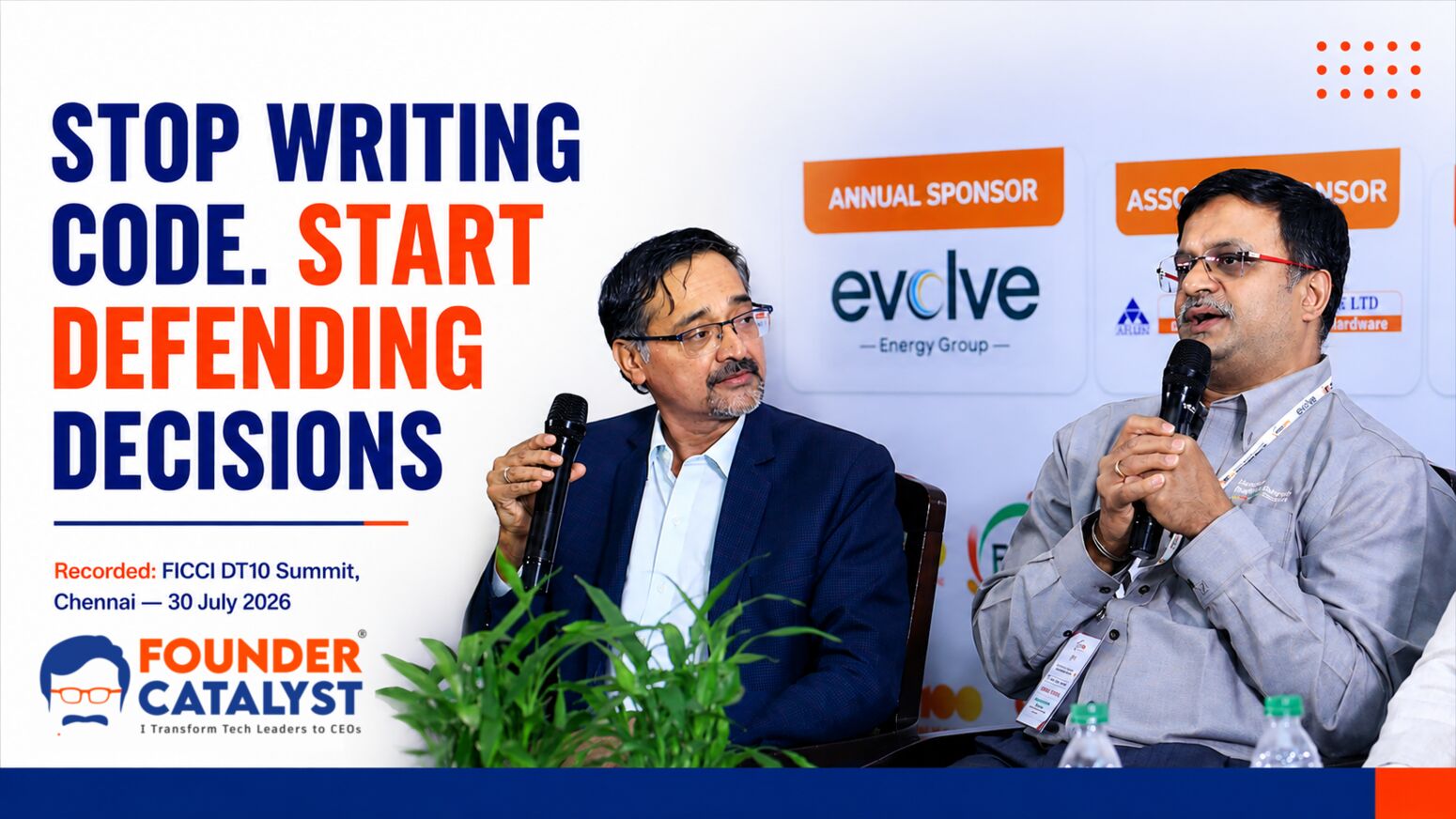
Last month I was on stage at Hotel Ramada Plaza, Guindy, for FICCI’s Digital Disruption and Transformation International Summit 2026 — part of FICCI’s 100-year celebrations. The panel was called “How We Build the Future & Lead with AI?”, moderated by Chandrashekar Kupperi, Founder of ANOVA M&A and Fundraising Advisory, with a lineup covering talent, leadership, MSME, and the future of work.
I only got asked two of those four — talent and leadership — plus a sharp follow-up from the audience on hiring. That was enough to make me say some things out loud that I’d only written about before. Here’s the expanded version.
Talent: the learning loop, and a question I’m not going to answer
Chandrashekar’s first question was built on something I wrote a while back — that an organisation’s real advantage in AI isn’t access to models or tools, it’s the ability to keep learning. Before I answered, I gave the room a question instead of a point, and I’ll do the same here.
Imagine it’s 2036. A new hire joins your organisation. Ask them to write a proposal — they’ve never opened Word. Ask for an analysis — they’ve never touched Excel. They’ve never opened a PDF to read one. I’m not saying that’s good or bad. I’m saying it’s close enough that talent conversations have to start accounting for it, and most don’t.
Now, the learning loop itself. Satya Nadella has talked about this, and it comes down to one observation: today, the questions we ask AI carry as much intelligence as the answers we get back. Intelligence agencies have known this for decades under a different name — metadata. Who you talk to, when, how often, tells you almost as much as what was said. The same is true of our prompts. And right now, almost all of that signal walks straight out of the building. We ask, we get an answer, we move on. If the AI company retrains on it, fine — assume they don’t, even. Either way, your organisation keeps none of it.
Compare that to how learning used to work. A fresher joins, does something, gets it wrong, a senior corrects them — and that correction becomes both the individual’s judgement and the organisation’s institutional memory. AI is now doing a growing share of that work, which means that correction loop, if you don’t design for it deliberately, simply stops happening. The knowledge stays trapped in the AI layer instead of compounding inside your company.
There’s no off-the-shelf product that fixes this yet. But there are things you can start doing today. Singapore’s Foreign Minister, Vivian Balakrishnan — also, remarkably, a trained orthopedic surgeon — has built himself what he calls a second brain, and put his own working documents into it so he can query his own accumulated judgement. Look up his talk on it; it’s worth twenty minutes. I built something similar for myself, which I call an LLM Wiki, based on Andrej Karpathy’s original idea — LLM plus Wiki. If you want one, you don’t need to build it from scratch: open Claude or ChatGPT, ask it to build you an LLM Wiki, feed it your own documents and emails, and it’ll walk you through it, running entirely on your own machine. Enterprises need a more custom version of this — the frameworks are still evolving — but individuals can start now.
If you’re serious about building this loop, it comes down to four Cs:
Capture what you’re doing with your AI systems.
Correct it — flag what was right, wrong, or almost right.
Curate and codify it into something reusable.
Circulate it through the organisation.
If you’ve studied control systems as an engineer, none of this is new. It’s the same feedback loop, applied to how a company learns.
Your learning loop is your real moat. Skills, prompts, and tools are rented — the feedback loop around your business is the only thing that compounds.
Leadership: use AI as a cycle, not as a car
The second question was about where a leader draws the line as AI agents get more capable of deciding and acting on their own. Before I answer that, credit where it’s due — the framing I use belongs to Dr. Pratyush Kumar, Co-Founder of Sarvam AI, from an interview worth watching in full. He draws a parallel between what’s happening in AI today and the old East India Company pattern: raw cotton taken out, spun into textiles elsewhere, sold back at a markup. Data and usage flow out; intelligence comes back priced. His conclusion from that: use AI as a cycle, not as a car.
Don’t take the wrong lesson from that line. It is not an argument for slowing down. When you can’t out-race the competition, the tempting shortcut is regulation that brings everyone down to your speed — and as a nation, that’s a losing move. The point of the cycle is narrower and more useful: on a bicycle, your hands stay on the handlebars and your feet stay on the pedals. You’re still steering, at speed. That’s the posture leaders need with AI — not less speed, just retained control of the direction.
Practically, this comes down to three Ds:
Delegate. Hand off anything routine and repeatable — the tasks where you’re not applying judgement, only time. Writing Excel formulas used to cost you half a day of trial and error; today AI writes it in five seconds. Extend that all the way to code. I don’t think humans should be writing code by hand much longer — we’re not particularly good at it, and machines should be writing machine code. There’s a framework going around called “Caveman” — literally instructing the AI to drop the verbosity, the adjectives, the padding, and answer you the way a caveman would talk. Worth Googling. It’s a good instinct: most AI verbosity today exists because token-maxing is profitable for the companies selling you tokens, not because you need 200 pages for a two-word question.
Decide. Once the routine work is delegated, the human’s job shifts to choosing between the options AI surfaces — not doing the legwork to get to those options. Today you have to go and click through everything before you can even decide. It should work the other way: AI opens your day, tells you what’s come in, lays out the decisions in front of you with the pros and cons, like a menu — and you choose.
Defend. This is the one leaders skip, and it’s the one that matters most. Responsibility for an AI-assisted decision stays with the human who made the call — full stop. I envy auditors, lawyers, and doctors for exactly this reason: they need a license to practice, so accountability is built into the profession. Software engineering never required one — anybody can call themselves a software engineer, and now AI can write the code besides. IEEE has argued for fifty years that software should be a licensed discipline; it probably never will be. But whether or not the industry licenses it, the standard should still apply: when something an AI did goes wrong, you as the leader call the person responsible and ask them to defend it. “I used AI and it failed” cannot be where that conversation ends — the learning from that failure has to go back to the individual, back to the organisation, and back into the AI system itself. Which brings you right back to the learning loop.
Delegate, decide, defend. That’s it. There’s no contest between you and AI here — the same way none of us think of a computer or a phone as competing with us at work. AI will get there too.
The audience question that actually proved the point
The last question came from the floor, not from Chandrashekar: with AI doing so much of the entry-level work, are we setting the bar impossibly high for people just starting out?
I answered with a story instead of a theory. A couple of months back I was interviewing startup interns from VIT Bhopal, including two students from a state programme for high-achieving rural students — students who’d studied in Hindi, with limited English, and had touched a computer for the first time only in 11th grade. I told them upfront: show me your approach, don’t explain the code line by line, because I already know AI wrote most of it.
One of them had taken a genuinely different approach to the problem. I asked how he’d landed on it. He told me AI had surfaced two candidate algorithms, he’d gone and read the actual papers behind them himself, and then implemented it in Python and demonstrated it working. That’s the part that matters — not that AI wrote the code, but that he’d gone one level deeper than the tool gave him.
Four years ago, at the same stage of education, that same student would have failed a basic Python question outright, and I’d have written him off. He had a 98% in maths and could explain the algorithm clearly — AI hadn’t replaced his thinking, it had given him a running start he’d never have had otherwise. That’s the empowerment case for AI, and it’s the one we undersell.
Which is also my answer to the IT industry’s old habit, the one I’ve watched for thirty years: hiring people to code without asking whether they understood the problem they were coding for. Those jobs are gone, and they’re not coming back. What’s left — the part that was always the actual job — is understanding the business problem well enough to direct the machine that writes the code. So no, we’re not setting the bar too high. For the first time, we’re finally asking the right question of people two years into learning computers.
This piece is based on my session at FICCI’s Digital Disruption and Transformation International Summit 2026, on the panel “How We Build the Future & Lead with AI?”, moderated by Chandrashekar Kupperi. Video of the full session is on my YouTube channel.
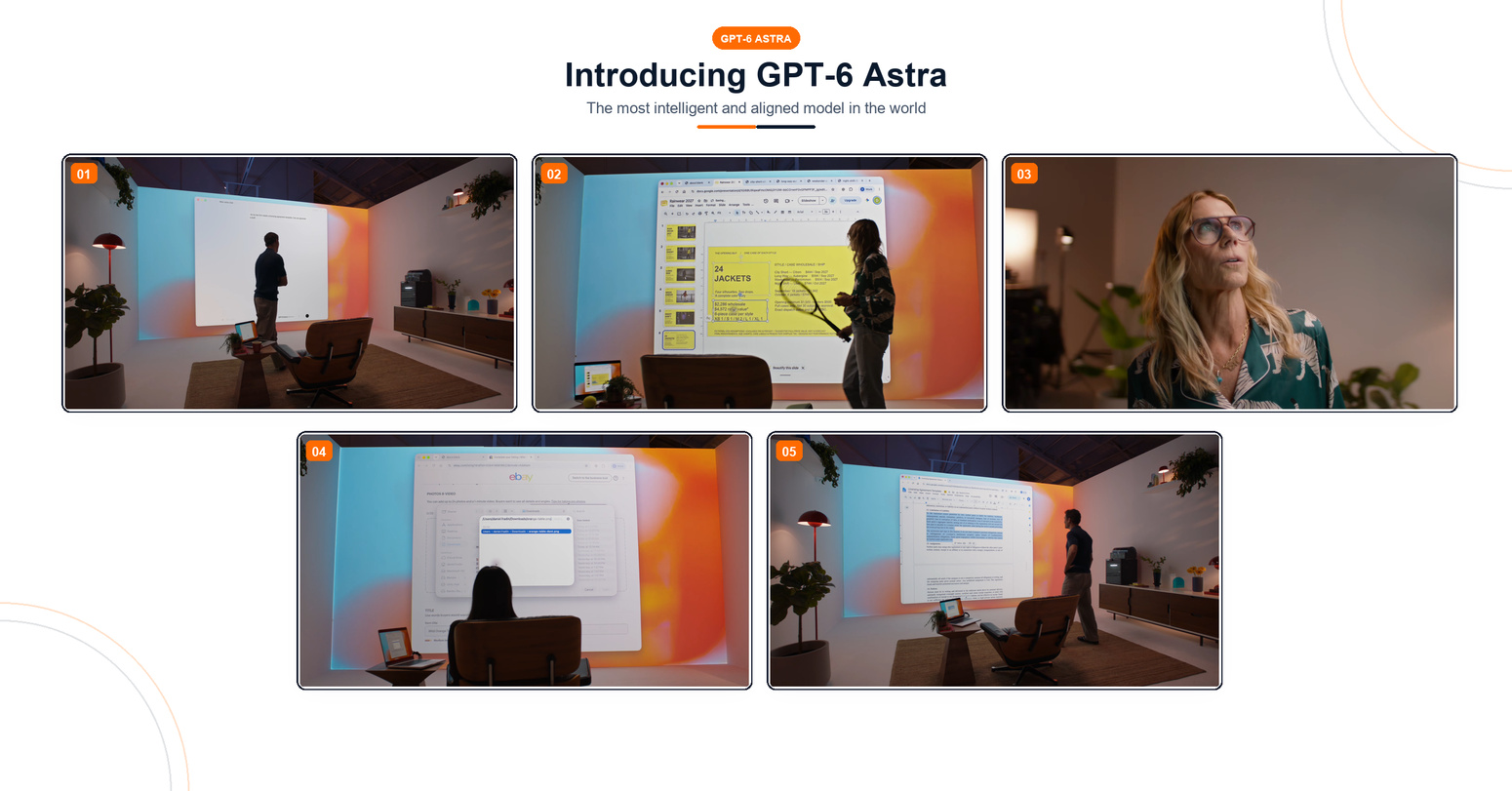
OpenAI released GPT-6 Astra yesterday. What caught my attention wasn’t the model itself — it was the two-minute video showing how OpenAI people were interacting with it.
People are seen talking to the model through their computer, and as they speak, Astra runs the same everyday apps we all use and finishes the task. Turning speech into software commands isn’t new. What’s different is the room itself: no desk, no keyboard, no screen on a table. People watch the output projected on a wall the way you’d watch a film — walking around, leaning back on a sofa, still talking and working.
Forty years of hunching over a keyboard have cost us our backs and our necks. It didn’t have to stay this way. What OpenAI is showing, to me, is a computer we can work with the way we’d work with someone else in the room — not a tool we operate at a desk.
Giving every employee in a company a setup like this isn’t realistic yet. But I have no doubt many managers will be working this way soon.
What do you think?
I regularly speak at leadership forums, founder circles, and CXO roundtables on generative AI and where work is headed next. If your leadership team wants a grounded, no-hype conversation on this shift, I’d be glad to bring it.
Some talks you write in a few weeks. This one, I have been living for thirty years.
On 28 August, I will be speaking at TEDx Thiagarajar College of Engineering in Madurai.
I am not sharing the title here. That stays for the room. But if you remember Easytools, you already have half the hint. The other half is AI.
There is something fitting about going back to an engineering campus for this. My own years in electronics and communication engineering, some 400 kilometres away in Chennai, are where most of what I will talk about actually began. Not in a classroom, but in the freelance projects I took on for local clients while still a student, writing software for people who needed something to work, not something to impress.
Long before any of that, there was a publishing house. My grandfather started it in 1929, and my father ran it for over fifty years. I grew up around the hum of printing presses and a very specific kind of discipline, the kind where if a customer found a printing error in a book bought years earlier, you replaced it without a single question asked. I did not think of it as a business lesson at the time. It was just how our house worked.
A year after college, I built my first product, a shareware security app called EasyPass. It found buyers in over fifty countries, which told a twenty-something engineer in Chennai something he had no real way of grasping before then, that the internet did not care where you sat while you built something. It also taught me the other lesson early, the uncomfortable one. A collaborator copied the code and sold a version of it under his own name. Setbacks and success, I learned, tend to travel together from day one.
By the late 1990s, that first product had grown into Easytools.com, freeware and shareware sold online through Vishwak Associates, the company that would later become Vishwak Solutions, at a time when most Indian businesses were still deciding whether the internet was worth taking seriously, and a dial-up connection here involved a government department in one way or another. Nobody called what I did a startup then. Nobody called it product-led growth either. I was just trying to get software into people’s hands around the world, using whatever the internet allowed at the time, and carrying forward a habit I had absorbed without knowing it, that you own the problem fully and never make the customer feel at fault for it.
Three decades on, I am still working through some version of the same question, just with faster internet and higher stakes.
If you are around Madurai on the 28th, I would love to see you there.
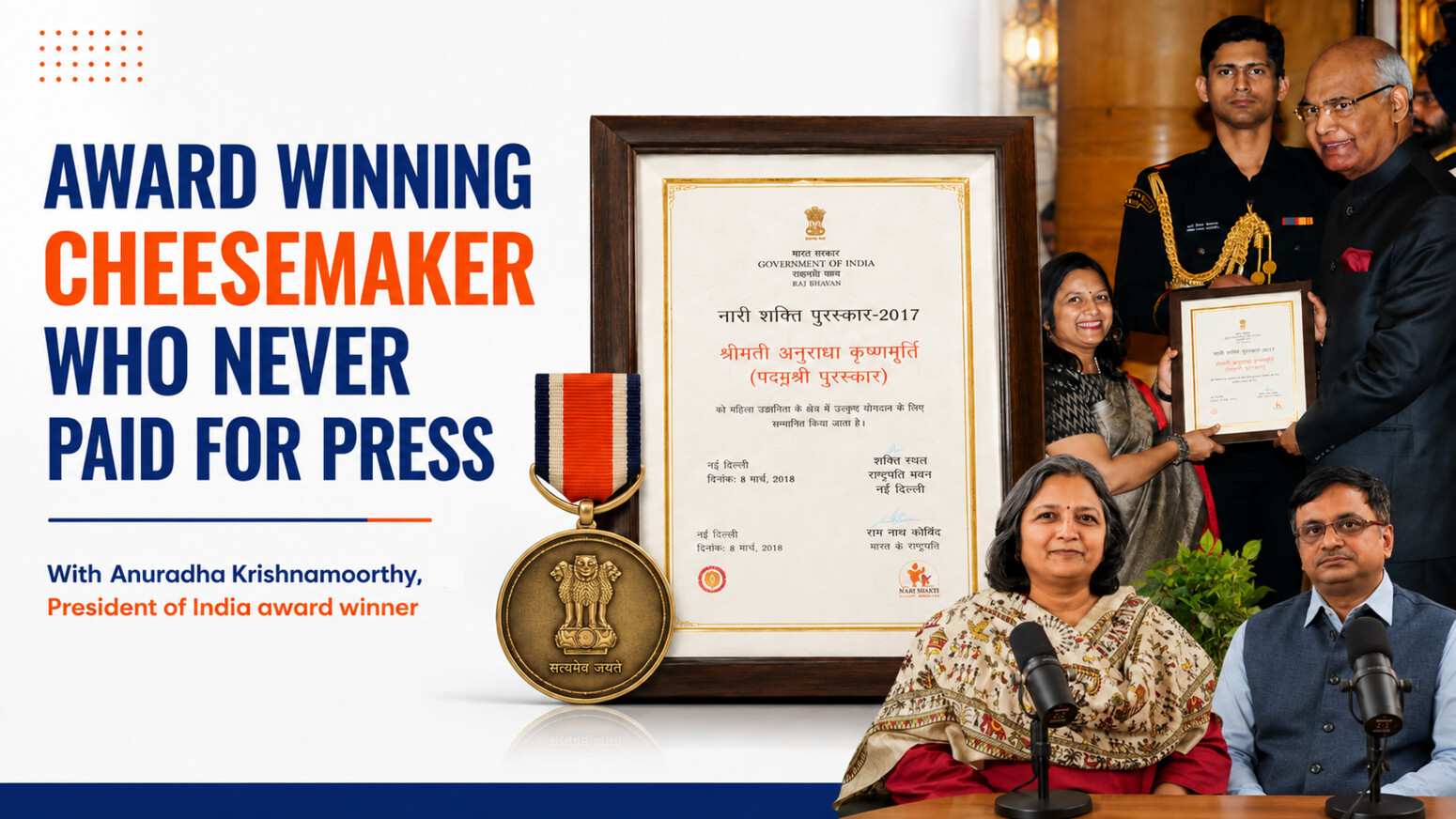
In ten years of running Käse, Anuradha Krishnamoorthy has never paid for a single line of press coverage. No influencer budget, no marketing retainer, no PR agency on monthly fees. Yet the brand has been written about repeatedly, has won at the World Cheese Awards, and now ships across India from a kitchen in Chennai.
When she said this to me recently in the Founder Catalyst studio, my first instinct was to treat it as a nice story about a niche business getting lucky with the press. It is not. Sitting with the rest of the conversation, I think it is the most instructive thing about how she and her co-founder built this company, and it connects to almost everything else they did differently.
Anuradha is a friend, and this was a conversation I had wanted to record for a long time. She is the co-founder and director of Kirke Cheese Pvt Ltd, which runs the brand Käse. She and her co-founder Namrata Sundaresan received the Nari Shakti Puraskar for 2017, presented by the President of India at Rashtrapati Bhavan in March 2018, on International Women’s Day. Käse turned ten this year.
The business that started as a training programme
The origin story is not a food story. Anuradha has a masters in social work, and before cheese she was running CAN DO, a venture she developed as an ISB 10,000 Women scholar. CAN DO trained and employed people with disabilities in telecalling, data validation and research work. At one point it ran a forty seat operation employing people with hearing impairment and people with visual impairment.
Two mothers came to her about their daughters, both with hearing impairment, both unable to complete their graduation. They asked whether Anuradha could help find the girls work. She began looking at setting up a baking unit, since baking was a skill the girls could take with them and use independently later.
She approached Namrata to help set it up. Namrata had learnt cheesemaking during a farm stay in Coonoor over a break, and suggested cheese instead of bread. That conversation is the entire founding decision. Within a year, two girls with hearing impairment were part of the team at Käse.
What strikes me about this is that the business did not begin with a market opportunity. It began with a specific problem for two specific people, and the product was chosen because it happened to be a teachable skill. Most founders would consider that backwards. Ten years on, it has produced a pan India brand.
Why the phone changed her mind about hiring
The part of the conversation I keep returning to is her explanation of why employing people with disabilities worked commercially, not just morally.
Her point was simple. When someone is speaking to you on a telephone, you have no idea whether they have a visual impairment. There is no visible cue, so there is no room for the usual hesitation or discomfort. Only the work is visible. The prejudice never gets a chance to form.
She paired that with something sharper. The moment you think of employing a person with a disability as charity, she said, the work ends right there. These are individuals looking for an opportunity, and they are resources like anybody else on the payroll.
I put the founder’s objection to her directly, because I hear it often. Founders and CEOs are already under pressure. They worry about hiring someone, finding it does not work, and then being in the difficult position of having to let them go. They also worry about causing offence, because most of us were never trained as a society to work alongside people with disabilities.
Her answer was that hiring a person with a disability changes the team, not just the headcount. She described how the person with hearing impairment and the person with visual impairment worked as a genuinely effective pair. One handled data mining and database validation, the other made the calls. Screen readers and magnifiers, much of it open source, made the second half possible. That was a decade ago. The tooling is far better now.
Several people who worked at CAN DO went on to government and bank jobs, roles that are heavily sought after. They still come back and tell her that the first chance to prove themselves is what made those jobs possible.
Anyone starting this today has better technology, better software, and a larger pool of people who have already been through skills training. The founders who are getting this right are treating it as recruitment, not as a corporate social responsibility line item.
The pricing decision that most founders get wrong
Käse decided early that it would be a hundred per cent preservative free brand and that the milk would come from grass fed cows on small farms. That decision has consequences. One litre of milk yields roughly a hundred grams of milk solids, so a kilogram of cheese requires around ten litres of milk. Skimmed or toned milk will not work, because the fat content carries the quality through to the cheese.
The arithmetic makes a premium price unavoidable. What took nerve was holding that price in Chennai, a market everyone told them was difficult to crack.
Anuradha gave me a number that I think every founder in food should sit with. On a five hundred rupee pizza, the actual ingredient cost is around thirty per cent. That thirty per cent is the only lever a business has if profit is the sole objective, so the pressure is always to compress it further. Being in the food business, she said, opens your eyes to what goes into food, including in kitchens at star hotels.
Käse went the other way. They raised quality, accepted the cost, and priced accordingly.
I see the opposite mistake constantly. Only the other day I was speaking with a founder running a services company with a genuinely good offering who is struggling, purely because his price point is wrong. Raise it and he is in a different orbit entirely. We come from a conservative business culture where the instinct is to be the cheapest. Being the cheapest is a strategy, but it is Walmart’s strategy, and it requires a scale most founders will never have.
The Tata Nano Car is the example I keep coming back to. It was engineered well and marketed as the cheapest car available, and that positioning is a large part of why it failed. Today the equivalent segment sells at ten to twelve lakhs quite comfortably.
Käse spent its first year at seventeen artisan markets in a single calendar year. Unless people taste the product and find value in it, no price point survives. That is the work that earns the right to charge more.
How the press actually happened
This brings us back to where we started. The press came, and it came free, for reasons that have very little to do with press strategy.
There are only thirty to forty artisan cheese makers in a country of this size, so the category itself is unusual. Then there was the product. They made a cheddar with molagapodi, the chilli powder that ordinarily goes with idli and dosa. Cheese and Chennai do not sit naturally in the same sentence, and molagapodi and cheddar sit even less naturally together. People had something to talk about.
Alongside that was the hiring story, which visitors and journalists noticed on their own.
Neither of these was manufactured. You cannot run a brainstorming session and arrive at an authentic differentiator. They hired the girls because that was the reason the business existed. They made molagapodi cheddar because they are in Chennai. The stories fed each other.
Her view on influencer budgets follows from this. Influencers have a role to play, but at a later stage, when you can afford it and you are scaling something that already works. When you are a niche brand with no outside capital, spending there first is the wrong order of operations. Reviews can be bought. Loyalty cannot. She made the point that if she has a genuinely good evening at a restaurant with her family, she will want to write a good review without being asked, and no budget replicates that.
Most Käse customers today arrive through recommendations from other customers.
On co-founders and the honeymoon ending
I asked her about the co-founder relationship, because I see so many partnerships drift apart a few years in, often after success rather than before it. She agreed with the comparison to a marriage. The honeymoon ends, reality arrives, and expectations diverge.
What has held theirs together is a clean division of ownership. Anything product related is Namrata’s call, because she is the cheesemaker and Anuradha describes herself as her student on that front. Operations and finance sit with Anuradha. They consult each other on most decisions, but each decision has a single owner.
That last part matters more than it sounds. Splitting responsibility is easy. Someone still has to own cash flow and pricing, because salaries have to be paid on time regardless of who feels responsible.
They were acquaintances rather than close friends when they started Käse, and the friendship deepened through the business rather than being risked by it. Neither of them was a first time founder either, which I suspect explains more than they give it credit for.
The number she wants to change
The last stretch of our conversation was about women founders, which was one of the main reasons I wanted to record this episode. The numbers suggest the proportion of women entrepreneurs in India has risen substantially over the last two decades. I do not doubt the direction, but in the mentoring sessions and angel meetings I sit through, I am still not seeing it.
Anuradha was direct about why. Indian women often start out on genuinely equal footing, and the divergence appears later, when the role that a woman is expected to carry at home begins to compete with the role she is building outside it.
She has decided to change the ratio in the only place she fully controls. Käse’s expansion, which is now under way with a significant increase in production capacity, will remain a women led and women run business.
She also had a warning that applies beyond food. There is an enormous amount of information available now, and no reliable way for most people to tell information from misinformation. Do not treat everything on the internet as settled truth. Do some digging yourself before you act on it. She was pleased, though, to see younger customers reading labels closely. That awareness is itself an opening for anyone building an honest product.
What I took away
The unpaid press, the premium pricing, the hiring, and the co-founder discipline all look like separate decisions. They are not. They are the same decision made four times.
In each case Anuradha and Namrata chose the thing that was genuinely true about their business over the thing that would have been easier to execute or explain. Grass fed milk, so the price is high. A social work background, so the hiring reflects it. Chennai, so the cheddar has molagapodi in it. None of it was designed to be interesting. It became interesting because it was real, and the coverage followed on its own.
Marketing budgets are usually the price you pay for a business that has nothing worth talking about.
The full conversation is on the Founder Catalyst podcast and YouTube channel:
Many founders in India may not recognise the name Chegg. Yet, for nearly two decades, it was one of the most successful education technology companies in America.
Founded in 2005, Chegg built a subscription business around helping students with textbook solutions, homework assistance and tutoring. For millions of college students, it became a daily habit. If you had a difficult assignment, chances were you searched Google, landed on Chegg, and paid for access to the answer.
Then came ChatGPT.
Unlike many businesses that found AI to be another productivity tool, Chegg faced something far more fundamental. Students no longer needed to search for answers. They could simply ask an AI assistant. The experience was faster, conversational, and often free.
The change in user behaviour happened much faster than anyone expected.
The numbers reflect that shift. Chegg’s revenue declined from about US$767 million in 2022 to about US$377 million in 2025. During the same period, the company went through repeated restructurings, reduced its workforce significantly, closed offices and began searching for new growth areas beyond its original business.
To be fair, AI was not the only reason. College enrolments softened in some markets. Textbook usage changed. Google’s AI-generated search summaries reduced traffic to many educational websites. Competition increased. Even Chegg acknowledges that these forces arrived together.
What makes Chegg’s story remarkable is not that a company struggled. Businesses have always faced disruption.
What makes it remarkable is that its core product was displaced so directly.
In many industries, AI helps employees work faster, write better code, analyse data or improve customer support. The business still exists; AI simply makes it more efficient.
For Chegg, AI became the product that customers wanted instead.
That distinction is important.
Looking back, Chegg will probably be remembered as one of the first large, publicly listed companies whose primary value proposition was overtaken by generative AI within a remarkably short period.
Whether the company successfully reinvents itself remains to be seen. It is still operating, investing in new businesses and attempting to find its next chapter. But its journey is already an important business story.
Technology disruptions are usually discussed in hindsight, years after they unfold. This one is happening in front of us.
Twenty years from now, when people write about the early impact of generative AI on business, I suspect Chegg will occupy a chapter of its own.
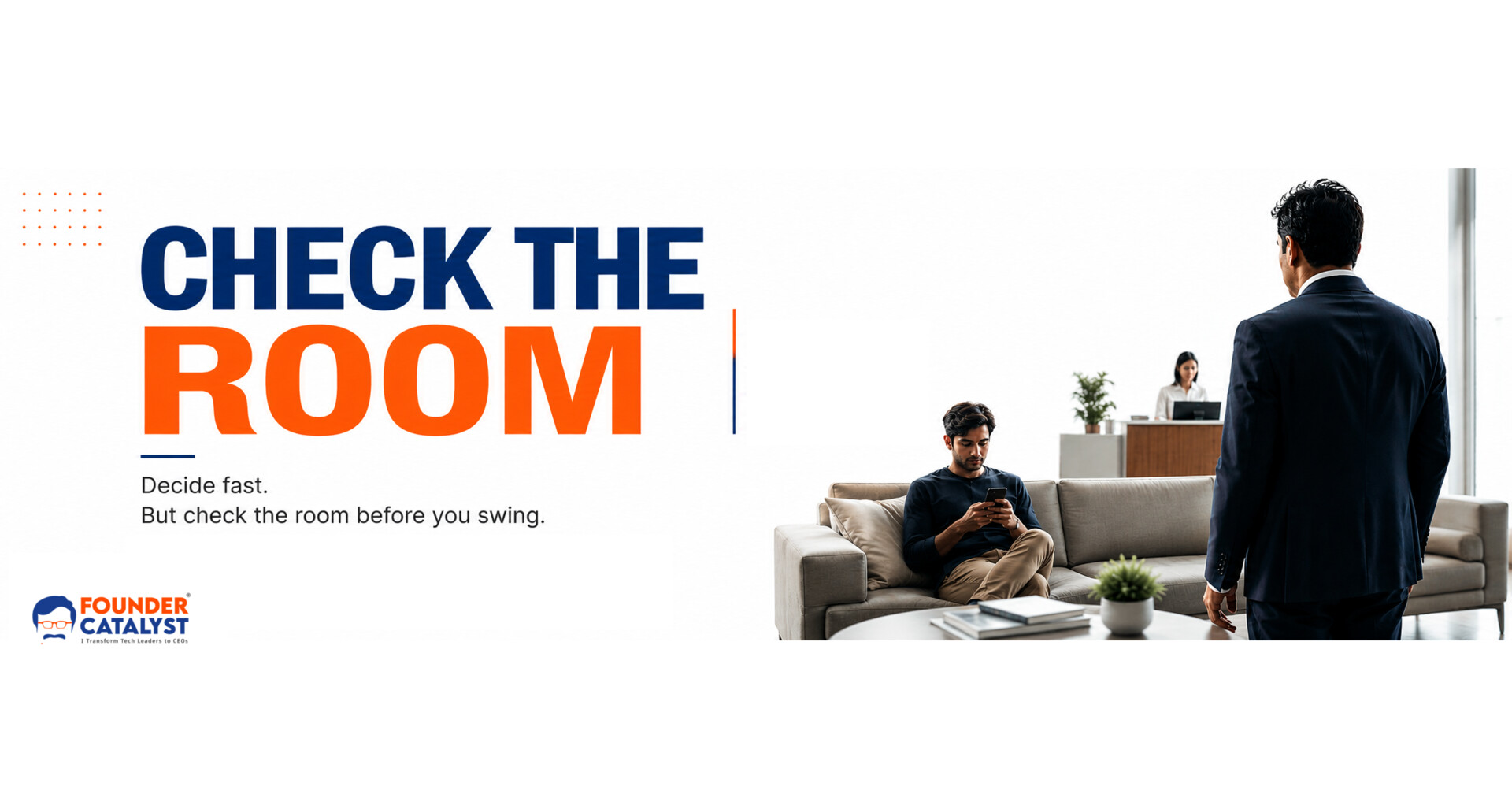
A CEO walks into his office lobby and finds a young man sitting on the sofa, scrolling on his phone. What are you doing here, he asks. Waiting to get paid, comes the reply.
The CEO, a little annoyed, asks how much he earns in a week. A thousand dollars, the fellow says. The CEO pulls out two thousand, hands it over, and tells him to leave and never come back. Pleased with how decisively he handled that, he turns to the receptionist and asks who the loafer was. That was the pizza delivery boy, she says.
I keep coming back to that old joke because it captures something most founders are never told out loud.
Deciding fast on thin information is not a weakness. In the early years it is the whole job.
When you are building something out of nothing, nobody hands you a full picture. You commit with what little you have, and you correct course as you go. Every founder I know built their company on this instinct. It is the reason anything got made at all.
I have lived the sharp end of this myself. Around 2008, during the subprime crisis, one of our largest clients in the United States cancelled their order almost overnight. This was days after I had returned from a trip there, where their manager had assured me all was well. We lost more than half our revenue in one stroke. The very next day I called a townhall. I did not have the full numbers yet. But I knew we had to let go of nearly a hundred people, and I announced a severance well above the statutory norm, which meant borrowing more than we comfortably could. It was the hardest call I have made. It was also made on incomplete information, because waiting for certainty was not an option the moment allowed.
The trouble is that nobody teaches you when to soften that instinct. The CEO in the joke never changed his mode. The company simply grew larger around a man who was still firing pizza boys with total confidence. That is the trap. The instinct that built the company quietly becomes the instinct that starts breaking it, and the founder is usually the last to notice.
This is why the founder mode debate from a couple of years ago struck such a nerve. When Airbnb CEO Brian Chesky spoke at a Y Combinator gathering in 2024, Paul Graham turned the talk into his widely read essay, Founder Mode. Chesky argued that as Airbnb grew, the standard advice to delegate more and step back hurt the company. When he became more directly involved again—developing a leadership style inspired in part by Steve Jobs—Airbnb improved. The essay spread rapidly through founder circles because it challenged conventional management wisdom and validated the instincts of many founders.
Experienced operators pushed back just as hard, because what works beautifully at two hundred people can create a bottleneck at two thousand. That tension has never really been settled, and I do not think it will be, because both sides are describing the same person at different stages of the same journey.
The more useful question is not whether to stay hands-on. It is knowing which room you are standing in before you act.
Look at how Nithin Kamath has run Zerodha. In an interview with Outlook Business early last year, he said something worth sitting with. Even before Covid, Zerodha had around 1,100 people. Today it is roughly 1,200 to 1,250, while the business has grown about ten times over. He said most of his own time now goes into making sure the decision-making philosophy holds even when he is not in the room, so that ten or fifteen people carry it forward without him. That is a founder who kept his sharpness but moved it upstream, from making every call himself to protecting how the calls get made. The instinct is intact. Where he applies it has shifted.
Kamath has been candid about the cost of not doing this. Marking Zerodha’s fifteenth year, he wrote about how chasing month-on-month or quarter-on-quarter numbers can mislead you, and how they prefer to read five-year trends instead. That is the same decisiveness of the early founder, only pointed at a longer horizon. The speed did not disappear. It grew up.
None of this means slowing down. The founders who make this shift well are not more cautious than the rest. They still decide quickly, still act on incomplete information, still refuse to wait for a certainty that never arrives. What changes is a small pause before the decisive part. A few seconds, long enough to ask one question. Who is actually in this room, and what am I about to fire.
The joke lands because we recognise the man. Fast, certain, and completely wrong about what he was looking at. The founders who last are not the ones who lose that speed. They are the ones who learn, quietly and usually the hard way, to check the room before they swing.