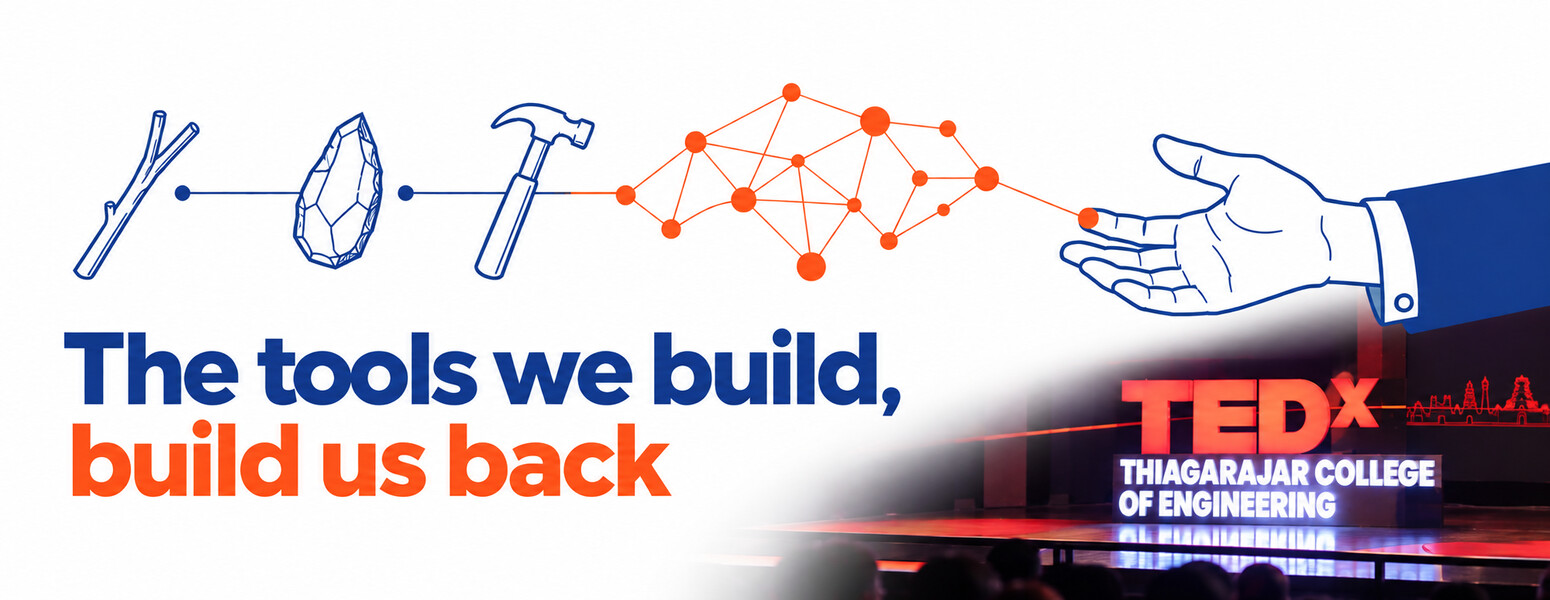
Three weeks ago I stood on the TEDxTCE stage in Madurai and told a room full of engineering students a story that actually began 3.3 million years before any of us were born — a shaped stone found at a place called Lomekwi in Kenya, older than our own species. I told them about a chimpanzee Jane Goodall watched in 1960, stripping a twig and poking it into a termite mound. And I told them what every tool since then — the hammer, the book, the compiler, the search engine, my own LIFCO dictionaries, my own Easytools.com, the LED clocks I used to burn out as a teenager — had in common.
Every single one of them waited for a hand to pick them up and decide what happens next.
That is not true anymore, and this is the part that should matter to a founder reading this, not just to a hall full of students.
For thirty years I built tools the old way: I had an idea, I decided what should happen, and the tool executed it — a compiler, a piece of taxi-booking software, a company. Somewhere around 2023 that changed. The tool in your pocket now does not wait for you to think first. It thinks first, hands you an answer already chewed, already judged, and waits for you to agree. Every large language model you use to write a pitch deck, a hiring email, or your own version of this blog post is doing exactly that.
I found out how far this goes the hard way, twice.
The first time was building a Tamil text editor last year. I did not write a single line of its code myself — not one — for the first time in thirty years of building software. I described the problem, and the machine wrote it. Somewhere in that project I stopped being a coder and became something closer to a specification: a person who describes what he wants and approves what comes back. That is a genuinely useful shift for a founder to notice — the distance between an idea and a working product has collapsed, and it is now open to anyone, not only to people who happened to grow up near the right engineering colleges.
The second time was writing my book, The Founder Catalyst — yes, where this newsletter gets its name — and later, this very talk. I gave an AI my draft and asked it to clean it up. It fixed my grammar. Then it fixed my sentences. Then, without asking, it quietly dropped the one story that mattered most to me — my grandfather’s dictionary business, and the one rule my father ran it on for fifty years: an unquestioned refund, even years after the sale, even for a single missing page. The AI’s version read beautifully. It was also not mine anymore, and it was far less useful to another founder than the actual, messy truth of how my father built customer trust over five decades.
That is the risk I actually want founders to sit with. These models are trained on the average of everything human beings have written, and what they hand back is that average. The deals you got wrong, the hires you regret, the one policy that cost you money in the short term and earned you a customer for life — none of that is in the average. It is exactly what makes your business yours, and it is precisely what a well-meaning AI edit will smooth away first, because it reads as too much detail.
None of this is an argument against using these tools. I would not have built that Tamil editor without one, and I no longer believe founders should be writing code by hand either. Use the motor. I only know when it is pulling me in the wrong direction because I spent thirty years riding without one — and that is the part I would ask any founder to hold on to. Take on the projects that felt impossible before. Just do not hand over the deciding.
We built the system. It is now good enough to build us back, one polished suggestion at a time. Whether it does depends entirely on what we let it delete.
I go into the fuller argument in the complete 18-minute talk — including why access to expertise, and not talent, was always the real gap between an engineer in Bangalore and one in Madurai, and why that gap has just closed for good.
In ten years of running Käse, Anuradha Krishnamoorthy has never paid for a single line of press coverage. No influencer budget, no marketing retainer, no PR agency on monthly fees. Yet the brand has been written about repeatedly, has won at the World Cheese Awards, and now ships across India from a kitchen in Chennai.
When she said this to me recently in the Founder Catalyst studio, my first instinct was to treat it as a nice story about a niche business getting lucky with the press. It is not. Sitting with the rest of the conversation, I think it is the most instructive thing about how she and her co-founder built this company, and it connects to almost everything else they did differently.
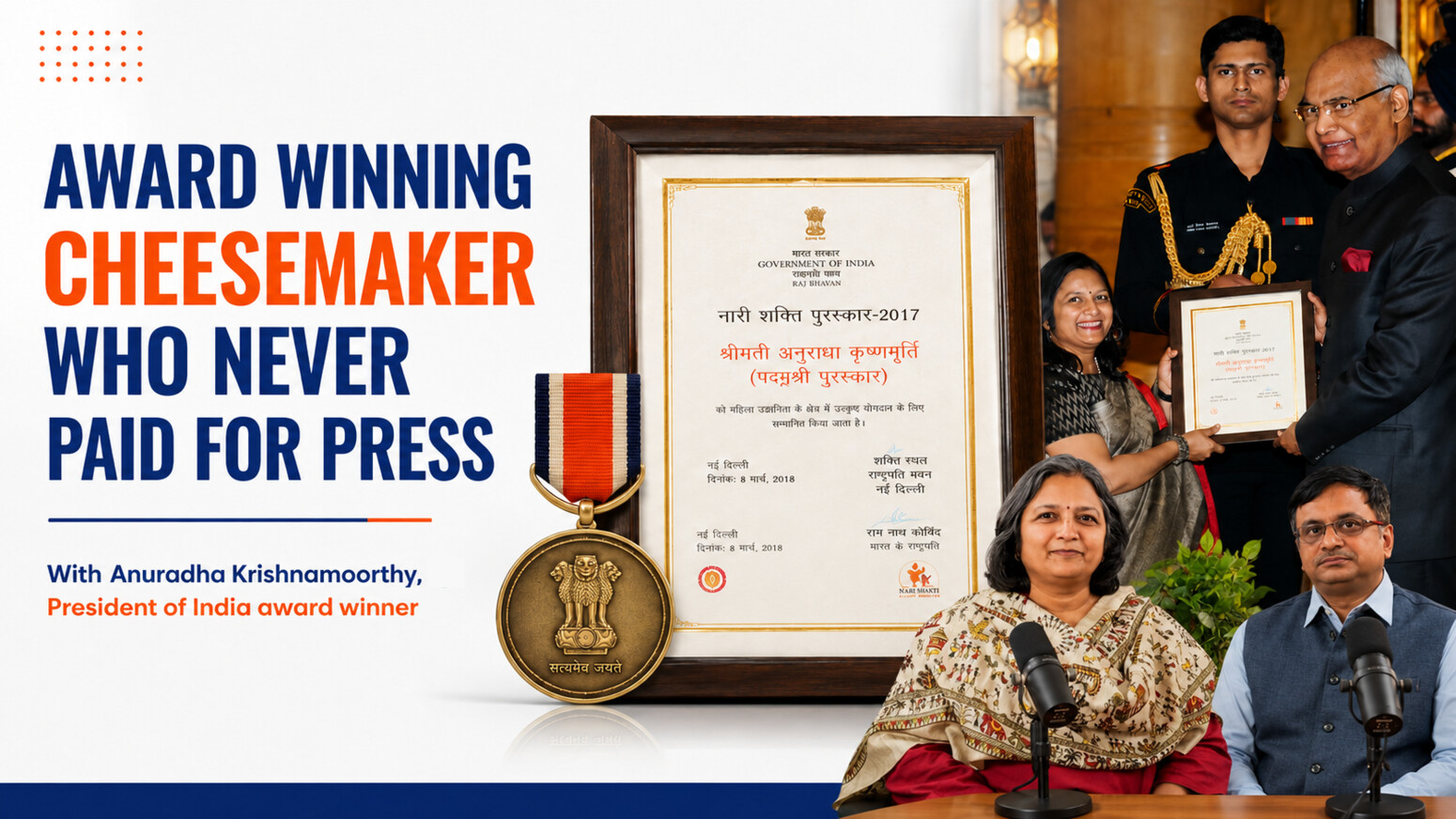
Anuradha is a friend, and this was a conversation I had wanted to record for a long time. She is the co-founder and director of Kirke Cheese Pvt Ltd, which runs the brand Käse. She and her co-founder Namrata Sundaresan received the Nari Shakti Puraskar for 2017, presented by the President of India at Rashtrapati Bhavan in March 2018, on International Women’s Day. Käse turned ten this year.
The business that started as a training programme
The origin story is not a food story. Anuradha has a masters in social work, and before cheese she was running CAN DO, a venture she developed as an ISB 10,000 Women scholar. CAN DO trained and employed people with disabilities in telecalling, data validation and research work. At one point it ran a forty seat operation employing people with hearing impairment and people with visual impairment.
Two mothers came to her about their daughters, both with hearing impairment, both unable to complete their graduation. They asked whether Anuradha could help find the girls work. She began looking at setting up a baking unit, since baking was a skill the girls could take with them and use independently later.
She approached Namrata to help set it up. Namrata had learnt cheesemaking during a farm stay in Coonoor over a break, and suggested cheese instead of bread. That conversation is the entire founding decision. Within a year, two girls with hearing impairment were part of the team at Käse.
What strikes me about this is that the business did not begin with a market opportunity. It began with a specific problem for two specific people, and the product was chosen because it happened to be a teachable skill. Most founders would consider that backwards. Ten years on, it has produced a pan India brand.
Why the phone changed her mind about hiring
The part of the conversation I keep returning to is her explanation of why employing people with disabilities worked commercially, not just morally.
Her point was simple. When someone is speaking to you on a telephone, you have no idea whether they have a visual impairment. There is no visible cue, so there is no room for the usual hesitation or discomfort. Only the work is visible. The prejudice never gets a chance to form.
She paired that with something sharper. The moment you think of employing a person with a disability as charity, she said, the work ends right there. These are individuals looking for an opportunity, and they are resources like anybody else on the payroll.
I put the founder’s objection to her directly, because I hear it often. Founders and CEOs are already under pressure. They worry about hiring someone, finding it does not work, and then being in the difficult position of having to let them go. They also worry about causing offence, because most of us were never trained as a society to work alongside people with disabilities.
Her answer was that hiring a person with a disability changes the team, not just the headcount. She described how the person with hearing impairment and the person with visual impairment worked as a genuinely effective pair. One handled data mining and database validation, the other made the calls. Screen readers and magnifiers, much of it open source, made the second half possible. That was a decade ago. The tooling is far better now.
Several people who worked at CAN DO went on to government and bank jobs, roles that are heavily sought after. They still come back and tell her that the first chance to prove themselves is what made those jobs possible.
Anyone starting this today has better technology, better software, and a larger pool of people who have already been through skills training. The founders who are getting this right are treating it as recruitment, not as a corporate social responsibility line item.
The pricing decision that most founders get wrong
Käse decided early that it would be a hundred per cent preservative free brand and that the milk would come from grass fed cows on small farms. That decision has consequences. One litre of milk yields roughly a hundred grams of milk solids, so a kilogram of cheese requires around ten litres of milk. Skimmed or toned milk will not work, because the fat content carries the quality through to the cheese.
The arithmetic makes a premium price unavoidable. What took nerve was holding that price in Chennai, a market everyone told them was difficult to crack.
Anuradha gave me a number that I think every founder in food should sit with. On a five hundred rupee pizza, the actual ingredient cost is around thirty per cent. That thirty per cent is the only lever a business has if profit is the sole objective, so the pressure is always to compress it further. Being in the food business, she said, opens your eyes to what goes into food, including in kitchens at star hotels.
Käse went the other way. They raised quality, accepted the cost, and priced accordingly.
I see the opposite mistake constantly. Only the other day I was speaking with a founder running a services company with a genuinely good offering who is struggling, purely because his price point is wrong. Raise it and he is in a different orbit entirely. We come from a conservative business culture where the instinct is to be the cheapest. Being the cheapest is a strategy, but it is Walmart’s strategy, and it requires a scale most founders will never have.
The Tata Nano Car is the example I keep coming back to. It was engineered well and marketed as the cheapest car available, and that positioning is a large part of why it failed. Today the equivalent segment sells at ten to twelve lakhs quite comfortably.
Käse spent its first year at seventeen artisan markets in a single calendar year. Unless people taste the product and find value in it, no price point survives. That is the work that earns the right to charge more.
How the press actually happened
This brings us back to where we started. The press came, and it came free, for reasons that have very little to do with press strategy.
There are only thirty to forty artisan cheese makers in a country of this size, so the category itself is unusual. Then there was the product. They made a cheddar with molagapodi, the chilli powder that ordinarily goes with idli and dosa. Cheese and Chennai do not sit naturally in the same sentence, and molagapodi and cheddar sit even less naturally together. People had something to talk about.
Alongside that was the hiring story, which visitors and journalists noticed on their own.
Neither of these was manufactured. You cannot run a brainstorming session and arrive at an authentic differentiator. They hired the girls because that was the reason the business existed. They made molagapodi cheddar because they are in Chennai. The stories fed each other.
Her view on influencer budgets follows from this. Influencers have a role to play, but at a later stage, when you can afford it and you are scaling something that already works. When you are a niche brand with no outside capital, spending there first is the wrong order of operations. Reviews can be bought. Loyalty cannot. She made the point that if she has a genuinely good evening at a restaurant with her family, she will want to write a good review without being asked, and no budget replicates that.
Most Käse customers today arrive through recommendations from other customers.
On co-founders and the honeymoon ending
I asked her about the co-founder relationship, because I see so many partnerships drift apart a few years in, often after success rather than before it. She agreed with the comparison to a marriage. The honeymoon ends, reality arrives, and expectations diverge.
What has held theirs together is a clean division of ownership. Anything product related is Namrata’s call, because she is the cheesemaker and Anuradha describes herself as her student on that front. Operations and finance sit with Anuradha. They consult each other on most decisions, but each decision has a single owner.
That last part matters more than it sounds. Splitting responsibility is easy. Someone still has to own cash flow and pricing, because salaries have to be paid on time regardless of who feels responsible.
They were acquaintances rather than close friends when they started Käse, and the friendship deepened through the business rather than being risked by it. Neither of them was a first time founder either, which I suspect explains more than they give it credit for.
The number she wants to change
The last stretch of our conversation was about women founders, which was one of the main reasons I wanted to record this episode. The numbers suggest the proportion of women entrepreneurs in India has risen substantially over the last two decades. I do not doubt the direction, but in the mentoring sessions and angel meetings I sit through, I am still not seeing it.
Anuradha was direct about why. Indian women often start out on genuinely equal footing, and the divergence appears later, when the role that a woman is expected to carry at home begins to compete with the role she is building outside it.
She has decided to change the ratio in the only place she fully controls. Käse’s expansion, which is now under way with a significant increase in production capacity, will remain a women led and women run business.
She also had a warning that applies beyond food. There is an enormous amount of information available now, and no reliable way for most people to tell information from misinformation. Do not treat everything on the internet as settled truth. Do some digging yourself before you act on it. She was pleased, though, to see younger customers reading labels closely. That awareness is itself an opening for anyone building an honest product.
What I took away
The unpaid press, the premium pricing, the hiring, and the co-founder discipline all look like separate decisions. They are not. They are the same decision made four times.
In each case Anuradha and Namrata chose the thing that was genuinely true about their business over the thing that would have been easier to execute or explain. Grass fed milk, so the price is high. A social work background, so the hiring reflects it. Chennai, so the cheddar has molagapodi in it. None of it was designed to be interesting. It became interesting because it was real, and the coverage followed on its own.
Marketing budgets are usually the price you pay for a business that has nothing worth talking about.
The full conversation is on the Founder Catalyst podcast and YouTube channel:
A D2C founder running an Ayurvedic skincare brand, doing about 8 crore in revenue, put it simply. AI is helping everyone create ads, write product descriptions, launch stores faster. My fear is not the technology. My fear is that AI makes every brand look equally good. If everyone has the same marketing superpower, where does my differentiation come from?
Vineeth Vijayaraghavan, who I have known for over thirty years and who advises VCs, family offices and startups on AI strategy, did not pretend there was a tidy answer. This needs introspection, he said. But he had a reframe worth sitting with.
Most of us think about AI inside a business as either software or marketing. Those are the obvious places. What he is seeing some founders do instead is use AI to build capability they could never have afforded before, inside the core of the business itself. He gave the example of a chemical engineering company where the founder now has six AI agents working alongside him on R&D, something that used to require hiring people the business simply could not access or afford. The same logic applies to a skincare brand. AI for product research and literature review is not a bad place to start, he said, though obviously with a healthy dose of scepticism, especially in a category where claims need real verification.
The differentiation question does not disappear. But it shifts from what does my marketing look like to what am I now capable of building that I was not before.
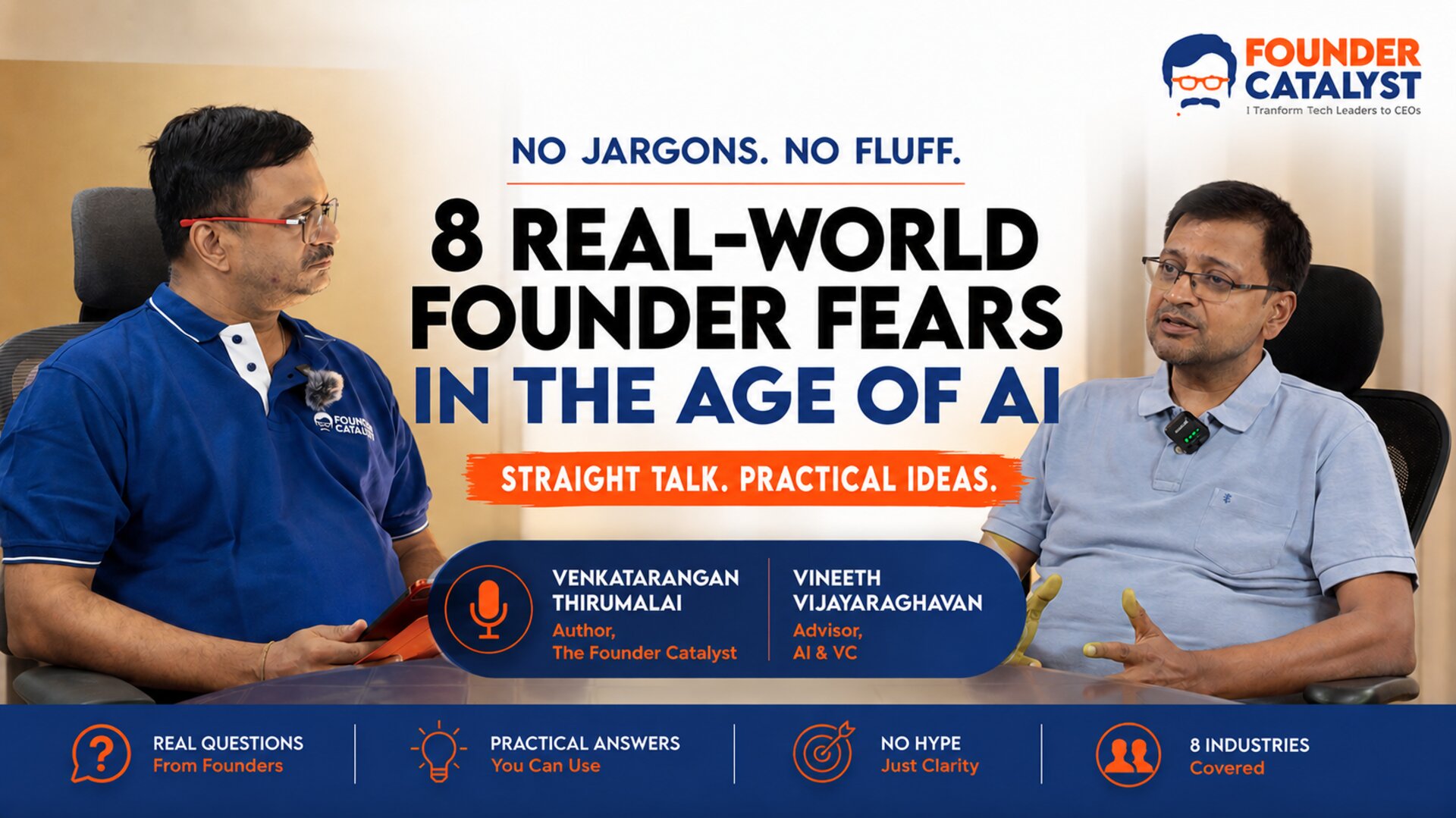
This was one of eight real founder fears we worked through on a new episode of The Founder Catalyst, recorded this month in Chennai. Instead of the usual interview, we sourced questions directly from founders across industries and went through them one by one, no scripts, no theory.
A custom software services founder in Coimbatore is not worried about his developers using AI. He is worried his US clients will stop asking for large projects and instead ask for one senior engineer doing the work of five, slowly turning his company into a staffing business with shrinking margins. Vineeth’s answer, the volume of smaller, faster engagements is going up industry-wide, and the founders doing well are the ones who can turn around small projects quickly and let those grow into larger ones over time, rather than chasing fewer, bigger contracts.
A recruitment firm placing engineers for startups fears that AI screening and ranking candidates makes recruiters irrelevant. Vineeth flipped this one. As AI competency becomes harder to evaluate, not easier, because a test or a hackathon no longer tells you much, the recruiter who has spoken to hundreds of candidates and can spot what is real becomes more valuable, not less.
A chartered accountancy firm is not afraid of losing clients. Being a regulated profession, that part feels safe. The fear is clients expecting the same work for half the fee. Vineeth’s response, look at firms already doing this well. He described one CA firm in Chennai that grew from 14 to 60 people, with AI handling the routine compliance work and a small number of AI-native young developers building internal tools, while the chartered accountants focus on the judgment calls AI still cannot make. That firm, he added, is now raising serious investment, including from outside India.
We also went through fears from an automobile manufacturing unit near Hosur worried about larger competitors using AI to out-pace them on pricing and forecasting, a legal services firm worried about how junior lawyers get trained if AI does their early work, and a logistics company with 70 trucks wondering whether technology becomes the real competitive edge over operational excellence.
We closed with an imaginary scenario. Three founders in a room, a SaaS founder doing 10 crore in ARR, a services founder with a hundred people, and a manufacturing business doing 50 crore. Which one should be most worried about AI, and which the least? Vineeth’s answer was not about industry at all. It was about culture, and the willingness to act.
Watch the full conversation here:
If you are a founder or business leader trying to make sense of what AI actually means for your business, beyond the hype, this conversation is for you.
About the guest:
Vineeth Vijayaraghavan advises companies, family offices, and VC boards on technology and investment strategy, with a particular focus on AI.
About the host:
Venkatarangan Thirumalai is the author of The Founder Catalyst and writes and speaks on AI, leadership, and founder strategy. More at thefoundercatalyst.com
When I work with founders on this, the conversation rarely starts with the technology. It starts with what people are afraid of losing, and whether that fear points them toward the right question or the wrong one.
November 2024
Innovation in Business Magazine, a premier publication owned by the UK-based AI Global Media, has named Founder Catalyst as the Most Empowering AI Digital Transformation Consultancy 2024 – Tamil Nadu. This prestigious accolade recognizes the boutique consultancy’s trailblazing contributions to AI-driven transformation.
Transforming Businesses with AI
In an era where Artificial Intelligence reshapes industries, Founder Catalyst stands out for its specialized approach to AI consulting. The consultancy has been instrumental in helping businesses across diverse sectors adopt AI responsibly, enabling them to reimagine their processes, enhance productivity, and unlock new opportunities.
Founder Catalyst specializes in integrating Generative AI and Large Language Models (LLMs) into core business solutions. Through focused consulting engagements, clients receive guidance on both the opportunities and challenges of AI adoption, ensuring balanced and practical implementation strategies.
Expert Leadership
Founder Catalyst is led by Venkatarangan Thirumalai, a software services veteran with over 25 years of experience in technology innovation. As a Microsoft Regional Director since 1999 and an IEEE Senior Member, Venkatarangan brings deep expertise in AI transformation and business strategy to each client engagement.
His journey spans from building inventory systems in the 1990s to developing Simpligic, a patented AI-powered news app. A few years he cofounded the fintech startup Docu3C, a document centric approach for compliance and comprehension. Through mentorship programs like Microsoft for Startups, he has guided numerous startups in effectively integrating AI into their solutions.
About the Award
The Innovation in Business Magazine celebrates organizations that pioneer innovative approaches to business challenges. This award recognizes Founder Catalyst’s ability to identify and address the unique AI transformation needs of its clients, ensuring sustainable growth and excellence.
The Founder Catalyst AdvantageSpecialized AI Expertise: Deep knowledge in Generative AI and LLMs for delivering practical business solutions
Personalized Consultation: Direct access to expert guidance tailored to each client’s unique goals
Proven Track Record: Successfully guided organizations from startups to established businesses in AI adoption
Professional Recognition
On receiving the award, Venkatarangan Thirumalai expressed gratitude for the recognition, emphasizing how thoughtful AI implementation can create lasting value for businesses. The award acknowledges his role in advancing AI digital transformation through focused, expert-led consulting services.
This recognition reinforces Founder Catalyst’s position as a trusted advisor in the AI transformation landscape, delivering specialized expertise to businesses navigating the complexities of AI adoption.
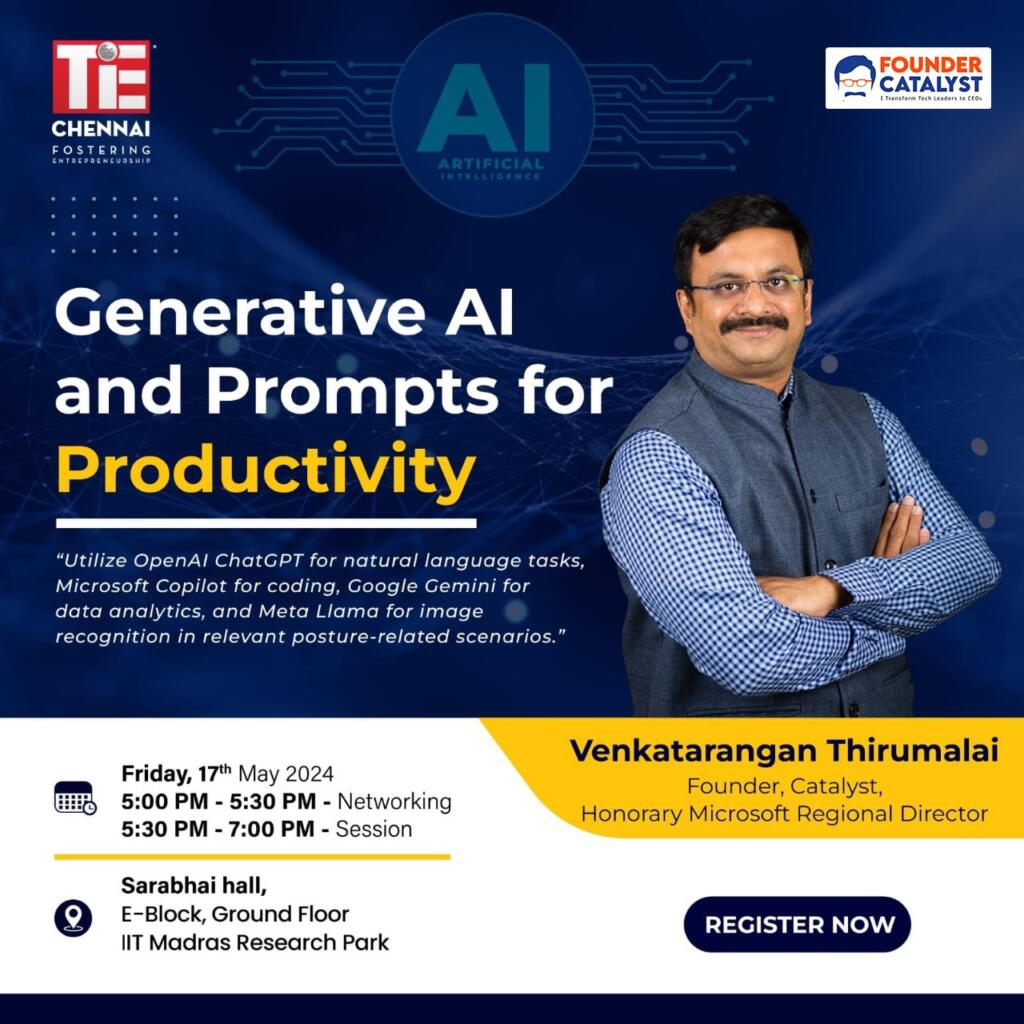
We’re thrilled to invite you to a groundbreaking TiE Talk on May 17th at 5 PM, hosted at the prestigious IIT Madras Research Park. Delving into the intriguing topic of “Generative AI and Prompts for Productivity,” this session promises to be a game-changer for entrepreneurs, managers, and team leads alike.
What to Expect:
In this dynamic one-hour session, participants will embark on a journey to master the art of crafting effective prompts, unlocking the full potential of Generative AI technologies. From understanding the intricacies of prompt design to harnessing the transformative power of AI-driven productivity tools, this event is designed to equip you with actionable insights that will revolutionize your approach to business operations.
AI Session Highlights:
Join us for a dynamic one-hour session where you will learn to master the art of crafting effective prompts to optimize your use of Generative AI technologies.
Discover how Microsoft Copilot can transform your productivity within the Microsoft Office Suite.
Gain insights into the strategic application of leading AI tools, including OpenAI ChatGPT, Microsoft Copilot, Google Gemini, and Meta Llama, identifying the best contexts and scenarios for their use.
Who Should Attend:
This session is tailor-made for founders, managers, and team leads who are eager to harness the power of Generative AI tools to enhance their business operations. No prior programming expertise is required – our expert speaker will guide you through every step of the way. However, for those with technical skills, there will be additional value in the content presented.
Meet the Speaker:
Venkatarangan Thirumalai, a distinguished Founder Catalyst, Honorary Microsoft Regional Director, and tech visionary with over 25 years of experience in building software solutions, as our esteemed speaker. With a track record of promoting digital advancements and prioritizing user-centric innovation, Venkatarangan brings a wealth of expertise to the table. Explore his deep insights at venkatarangan.com.
Don’t Miss Out:
Join us for this exclusive TiE Talk and unlock the transformative potential of Generative AI in your business journey. Mark your calendars, set your reminders, and get ready to embark on a path of innovation and growth.
Register Now:Secure your spot today by registering here and take the first step towards revolutionizing your approach to productivity and business optimization.
At Founder Catalyst, we’re committed to empowering entrepreneurs with the knowledge and tools they need to thrive in today’s ever-evolving digital landscape. Join us on May 17th and let’s shape the future together!
Many colleagues and business contacts expressed interest in learning how to leverage Generative AI for everyday work tasks. They were eager to see practical applications of tools like ChatGPT and Microsoft Copilot, understand how these tools work together, and explore Prompt Engineering for increased efficiency.
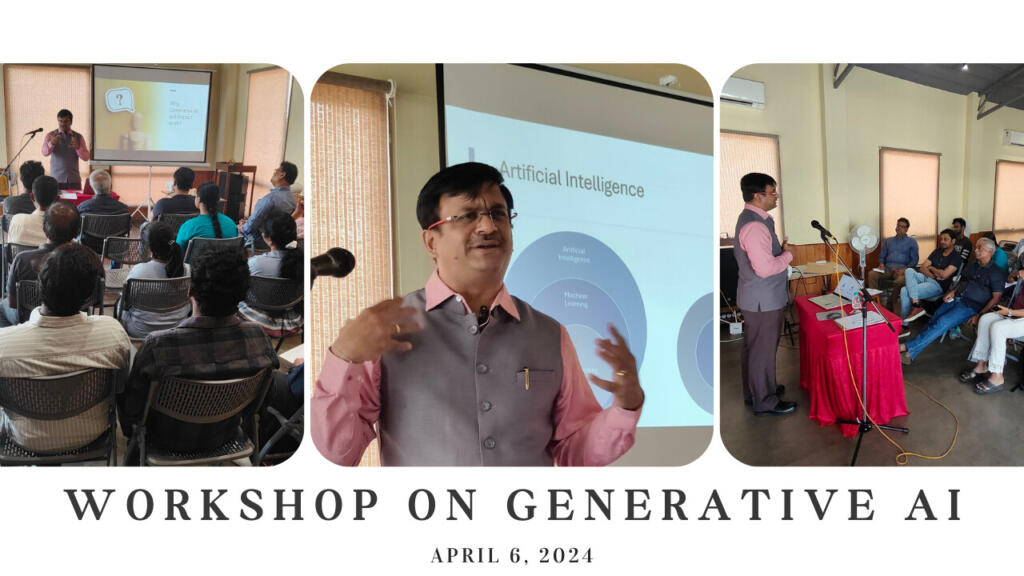
To address this growing demand, I hosted a sold-out Generative AI workshop in Chennai on April 6th, 2024. The workshop attracted CEOs from leading technology firms in the city, highlighting the increasing adoption of AI technologies.
A big thank you to everyone who participated, especially the CEOs who shared their valuable feedback, and the engineers and managers who joined the session!
Workshop Deep Dive: Unlocking the Power of Generative AI
The 3-hour workshop focused on the core principles of Prompt Engineering and explored effective strategies for utilizing Generative AI tools. Here’s a breakdown of the key topics covered:
Boosting Business Productivity with Generative AI: We explored how AI can streamline workflows and enhance overall efficiency.
Crafting Effective Prompts: Attendees learned how to create prompts that yield optimal results from AI tools.
AI-powered Content Creation: Techniques for generating engaging content using ChatGPT were covered.
AI Summarization & Research: Harnessing AI for quick and accurate information gathering was discussed.
AI Brainstorming: Leveraging AI to boost creativity and ideation processes was explored.
Exploring New Topics with AI: Attendees learned how to delve into unfamiliar subjects with ease using AI tools.
Enhanced Customer Communication & Proposals: We discussed how AI can improve client interactions and proposal writing.
Social Media Management with AI: Utilizing AI tools to streamline social media tasks was covered.
Supercharged Spreadsheets & Presentations: Techniques for enhancing productivity in spreadsheets and presentations with Microsoft Copilot were explored.
The Ethical Landscape & Future of Work: We discussed the ethical considerations and potential future implications of AI in the workplace.
A Journey Through AI’s Origins
The workshop also included a segment exploring the origins of AI, venturing back to concepts developed over 800 years ago! A clip from this fascinating exploration is available below.
Positive Feedback & Growing Interest in AI
Participants found the workshop to be insightful, practical, and inspiring, equipping them with valuable knowledge on integrating Generative AI into their business workflows. Here’s a video showcasing their testimonials.
Overall, the workshop was a rewarding experience that highlighted the growing enthusiasm and engagement surrounding AI for business productivity. The positive feedback reinforces the value proposition of leveraging AI for enhanced efficiency and innovation.
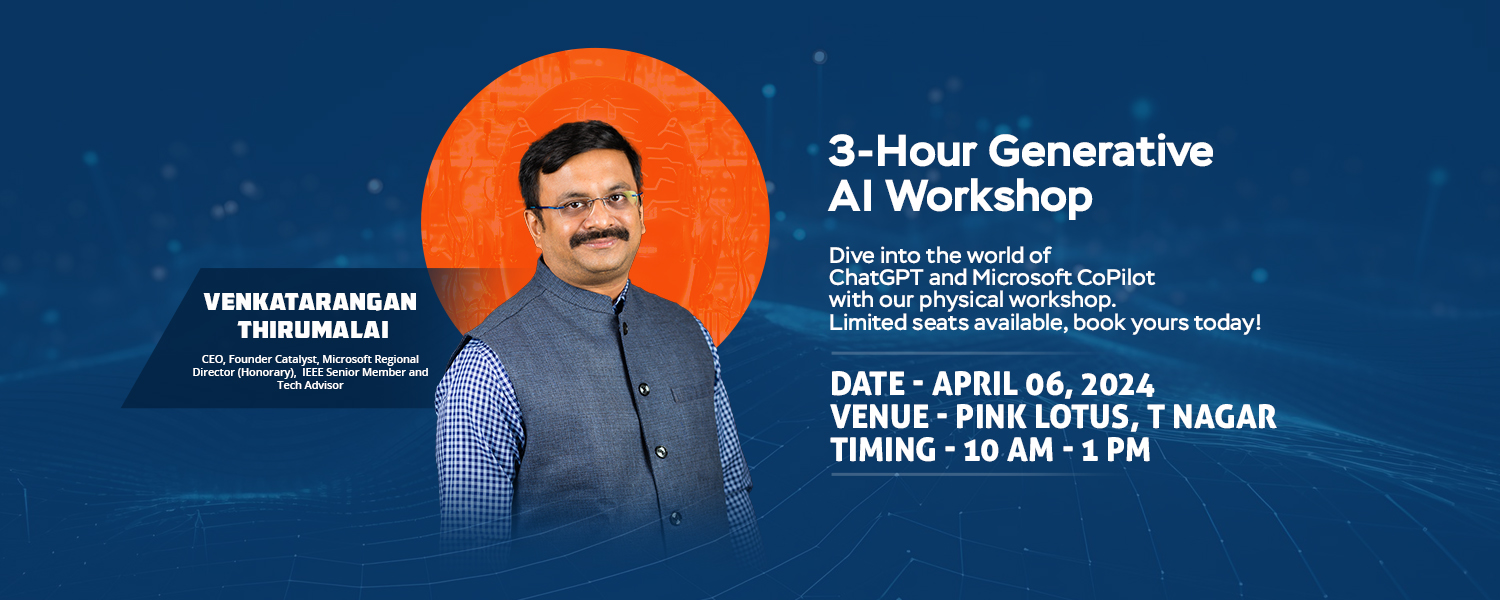
Are you ready to unlock the potential of Generative AI and revolutionize your business strategies? Join us for an immersive physical workshop on Generative AI and Prompt Engineering, where you’ll gain invaluable insights into leveraging cutting-edge AI technology to drive innovation and productivity.
Event Details:Registration Link: Expired
Date: April 6th, 2024
Time: 10:00 AM – 1:00 PM
Location: Pink Lotus, T.Nagar, Chennai
Workshop Highlights:Open Registration: This workshop is ideal for professionals eager to expand their skill set at a nominal fee.
Comprehensive Learning: Dive deep into the essentials of Prompt Engineering and discover effective ways to harness the power of Generative AI tools.
Networking Opportunity: Connect with like-minded professionals and industry experts, fostering collaboration and knowledge exchange.
Uncover the Potential of Generative AI:
In this 3-hour workshop, you’ll explore various modules designed to empower you with the latest AI techniques and methodologies:
Boosting Business Productivity with Generative AI
Crafting Effective Prompts for AI Interaction
Creating Compelling Content with ChatGPT
AI-powered Summarization & Research Techniques
Amplifying Idea Generation with AI Brainstorming
Exploring New Topics through AI
Enhancing Customer Communication & Proposals with AI
Streamlining Social Media Management with AI
Supercharging Spreadsheets & Presentations with Microsoft Copilot
Navigating the Ethical Landscape & Future of Work with Generative AI
Led by Venkatarangan Thirumalai, CEO, Founder Catalyst and Microsoft Regional Director (Honorary), this exclusive workshop promises to provide actionable insights and practical knowledge to transform your business strategies.
Registration Link: Secure Your Spot
Don’t miss out on this unparalleled opportunity to enhance your skills, network with industry leaders, and stay ahead in the rapidly evolving landscape of AI technology. Reserve your spot now and embark on a journey of professional growth and innovation!
In today’s rapidly evolving business landscape, the role of managers is more challenging than ever. From overseeing daily operations to driving strategic initiatives, managers are tasked with ensuring their teams perform at their best to achieve organizational goals. To meet these demands and stay ahead in a competitive environment, managers should consider leveraging the power of artificial intelligence (AI). AI has the potential to transform the way managers work and lead their teams, offering a range of benefits that can enhance productivity, decision-making, and overall performance.
Here are some compelling reasons why managers should embrace AI in the workplace:Enhanced Decision-Making: AI can analyse vast amounts of data quickly and accurately, providing managers with valuable insights to make informed decisions. Whether it’s forecasting sales, optimizing production schedules, or identifying market trends, AI can help managers make smarter choices that drive business growth.
Improved Efficiency: AI-powered tools can automate repetitive tasks, such as data entry, report generation, and scheduling, allowing managers to focus on more strategic aspects of their work. This can lead to increased productivity and time savings, ultimately benefiting the entire organization.
Better Talent Management: AI can assist managers in recruiting and retaining top talent. AI-powered recruitment tools can analyse resumes, screen candidates, and even conduct initial interviews, streamlining the hiring process. Additionally, AI can help managers identify employee skill gaps and recommend personalized training programs to enhance employee development.
Enhanced Customer Experience: AI can help managers deliver better customer service by analyzing customer data to personalize interactions and anticipate customer needs. Chatbots powered by AI can provide instant support to customers, improving satisfaction and loyalty.
Risk Management: AI can help managers identify and mitigate risks more effectively. By analyzing historical data and patterns, AI can alert managers to potential risks and suggest preventive measures, helping to avoid costly mistakes.
Innovation and Creativity: AI can spark innovation and creativity within teams. AI-powered tools can assist managers in brainstorming new ideas, exploring different possibilities, and even predicting future trends, leading to more innovative solutions and products.
Cost Savings: Implementing AI can lead to significant cost savings for organizations. By automating tasks and improving efficiency, AI can help reduce operational costs and improve the bottom line.
AI has the potential to revolutionize the way managers work and lead their teams. By embracing AI in the workplace, managers can enhance decision-making, improve efficiency, and drive innovation, ultimately leading to greater success for their teams and organizations. Training in AI generation is important for individuals and organizations looking to stay competitive, drive innovation, and make informed decisions in an increasingly AI-driven world.
The Founder Catalyst conducts AI Generative workshops.
Please contact Mr Manikandan C at +919445422346 or email v@thefoundercatalyst.in to have your team enrolled.