
On sequencing, readiness, and resisting the urge to optimise too soon
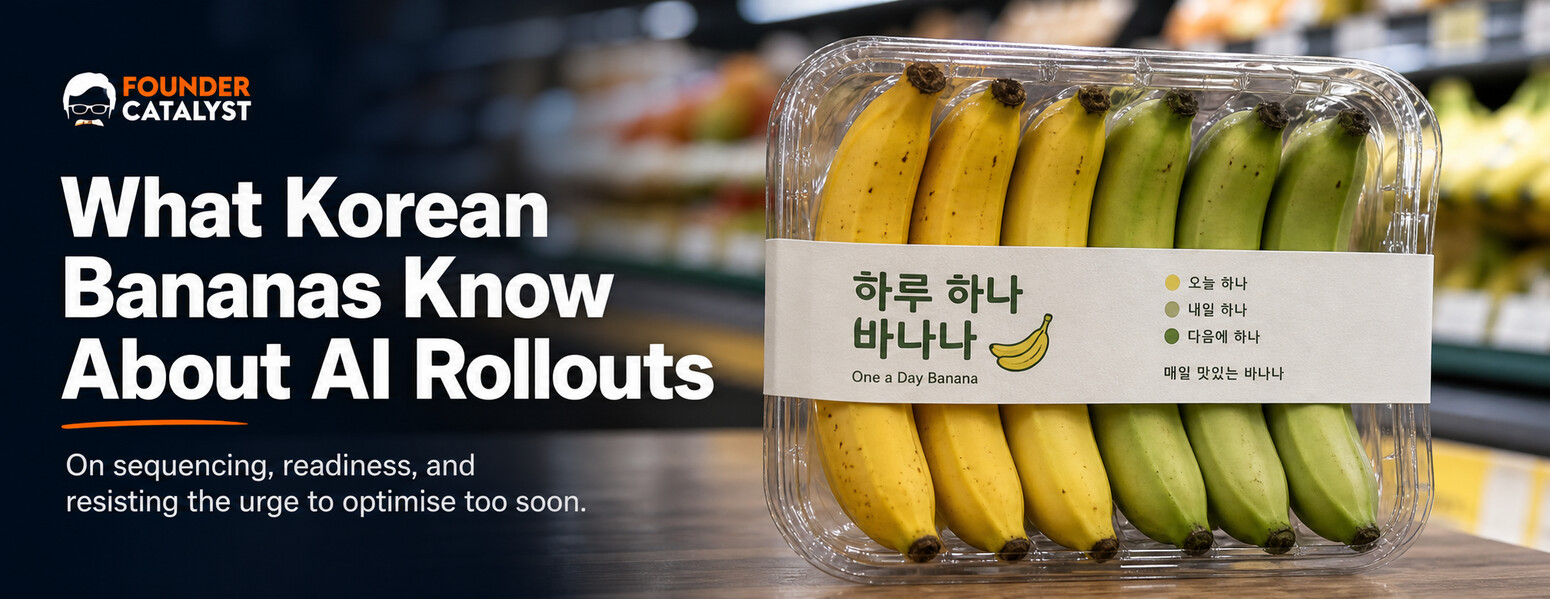
I first saw the “Haru Hana Banana” pack in a South Korean grocery store. It held 5–7 bananas at different ripeness levels: one yellow and ready now, the next a bit greener for tomorrow, and the others still green for days ahead. No instructions, no app – just simple packaging aligned with how people actually eat bananas. This simple design stuck with me not as a hack, but as a new way to think about sequencing initiatives.
Most founders and leaders want all their initiatives fully ripe at once.
They launch every project, hire every role, or deploy every feature together. It feels like momentum – but too often it becomes a mess. The Korean banana pack succeeds by doing the opposite: it staggers readiness to match demand. Whoever designed it chose customer reality over operational convenience.
In a big company, you might expect a push to standardise and optimise logistics. Instead, the grocery chain sacrificed some simplicity to solve the real problem: avoiding waste and giving customers a fresh banana each day.
This idea applies beyond fruit.
When rolling out AI or any new technology in an enterprise, leaders face the same instinct: go big now, or wait until everything is certain. Both extremes fail. Rushing everything risks breakdowns; waiting wastes time and lets others leap ahead. A better question is: What do we ripen today, what do we plant for next quarter, and what do we keep green for now? In practice, the best teams run multiple tracks in parallel. Some pilots are live with real users, some proofs of concept are being tested, and new ideas are still hazy. They’re comfortable with uneven progress.
Avoid “Big Bang” launches.
Instead, break work into phases. For example, an AI system can be piloted in one department before rolling out company-wide. A product can launch with a minimal feature set, then add more features after learning from users.
Don’t wait for perfection. As Agile principles teach, deliver value frequently in short sprints. Each release is like picking the next-ripe banana – it feeds users today and yields insight.
Match customer usage.
Design solutions around how people will use them, not how easy they are to build. The banana pack works because people eat one banana a day; the designer aligned the product with that habit. Similarly, if customers will adopt one AI assistant a week, don’t dump a dozen at once.
Build a balanced pipeline.
Think in horizons or stages: today’s operations (ripe bananas), tomorrow’s enhancements (tending bananas), and longer-term R&D (green bananas). A common rule is to allocate resources across these stages (for example, 70% on core business, 20% on adjacent growth, 10% on new ideas). This keeps today’s business running while new innovations mature.
Framework:
Now (ripe): Move forward on initiatives that are ready and will pay off immediately. Deploy proven AI tools in one team to build confidence. Launch product features that clearly solve current user needs.
Soon (ripening): Pilot upcoming ideas in controlled settings. Collect data and feedback. For example, run an AI chatbot pilot with a small user group, or A/B test a new feature with select customers.
Later (green): Research and incubate long-term bets. Keep these unripe for now – think of them as experiments or skunkworks that may take months to mature. They shouldn’t block the main effort, but they shouldn’t be forgotten either.
Checklist for leaders:
Are we trying to do everything at once? If so, pause and pick the highest-impact slice first.
What does success look like at each stage? Set clear metrics for today’s release, tomorrow’s pilot, and so on.
Have we planned feedback loops? Like banana peels, failures will show us ripe spots. Incorporate learnings quickly.
Are we optimising for the customer’s journey or for internal convenience? Always put the customer reality first.
Leave a Reply