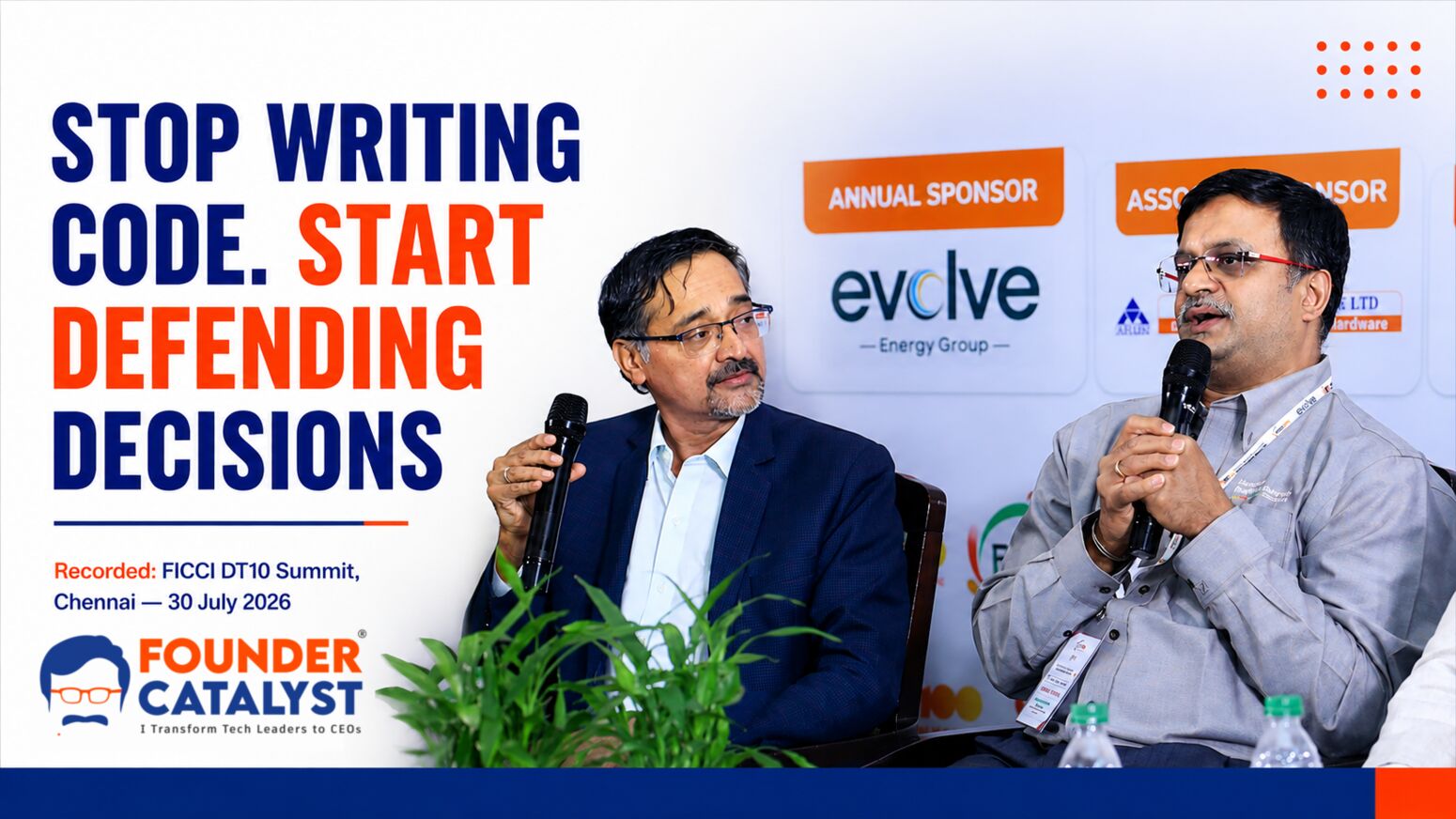
Last month I was on stage at Hotel Ramada Plaza, Guindy, for FICCI’s Digital Disruption and Transformation International Summit 2026 — part of FICCI’s 100-year celebrations. The panel was called “How We Build the Future & Lead with AI?”, moderated by Chandrashekar Kupperi, Founder of ANOVA M&A and Fundraising Advisory, with a lineup covering talent, leadership, MSME, and the future of work.
I only got asked two of those four — talent and leadership — plus a sharp follow-up from the audience on hiring. That was enough to make me say some things out loud that I’d only written about before. Here’s the expanded version.
Talent: the learning loop, and a question I’m not going to answer
Chandrashekar’s first question was built on something I wrote a while back — that an organisation’s real advantage in AI isn’t access to models or tools, it’s the ability to keep learning. Before I answered, I gave the room a question instead of a point, and I’ll do the same here.
Imagine it’s 2036. A new hire joins your organisation. Ask them to write a proposal — they’ve never opened Word. Ask for an analysis — they’ve never touched Excel. They’ve never opened a PDF to read one. I’m not saying that’s good or bad. I’m saying it’s close enough that talent conversations have to start accounting for it, and most don’t.
Now, the learning loop itself. Satya Nadella has talked about this, and it comes down to one observation: today, the questions we ask AI carry as much intelligence as the answers we get back. Intelligence agencies have known this for decades under a different name — metadata. Who you talk to, when, how often, tells you almost as much as what was said. The same is true of our prompts. And right now, almost all of that signal walks straight out of the building. We ask, we get an answer, we move on. If the AI company retrains on it, fine — assume they don’t, even. Either way, your organisation keeps none of it.
Compare that to how learning used to work. A fresher joins, does something, gets it wrong, a senior corrects them — and that correction becomes both the individual’s judgement and the organisation’s institutional memory. AI is now doing a growing share of that work, which means that correction loop, if you don’t design for it deliberately, simply stops happening. The knowledge stays trapped in the AI layer instead of compounding inside your company.
There’s no off-the-shelf product that fixes this yet. But there are things you can start doing today. Singapore’s Foreign Minister, Vivian Balakrishnan — also, remarkably, a trained orthopedic surgeon — has built himself what he calls a second brain, and put his own working documents into it so he can query his own accumulated judgement. Look up his talk on it; it’s worth twenty minutes. I built something similar for myself, which I call an LLM Wiki, based on Andrej Karpathy’s original idea — LLM plus Wiki. If you want one, you don’t need to build it from scratch: open Claude or ChatGPT, ask it to build you an LLM Wiki, feed it your own documents and emails, and it’ll walk you through it, running entirely on your own machine. Enterprises need a more custom version of this — the frameworks are still evolving — but individuals can start now.
If you’re serious about building this loop, it comes down to four Cs:
- Capture what you’re doing with your AI systems.
- Correct it — flag what was right, wrong, or almost right.
- Curate and codify it into something reusable.
- Circulate it through the organisation.
If you’ve studied control systems as an engineer, none of this is new. It’s the same feedback loop, applied to how a company learns.
Your learning loop is your real moat. Skills, prompts, and tools are rented — the feedback loop around your business is the only thing that compounds.
Leadership: use AI as a cycle, not as a car
The second question was about where a leader draws the line as AI agents get more capable of deciding and acting on their own. Before I answer that, credit where it’s due — the framing I use belongs to Dr. Pratyush Kumar, Co-Founder of Sarvam AI, from an interview worth watching in full. He draws a parallel between what’s happening in AI today and the old East India Company pattern: raw cotton taken out, spun into textiles elsewhere, sold back at a markup. Data and usage flow out; intelligence comes back priced. His conclusion from that: use AI as a cycle, not as a car.
Don’t take the wrong lesson from that line. It is not an argument for slowing down. When you can’t out-race the competition, the tempting shortcut is regulation that brings everyone down to your speed — and as a nation, that’s a losing move. The point of the cycle is narrower and more useful: on a bicycle, your hands stay on the handlebars and your feet stay on the pedals. You’re still steering, at speed. That’s the posture leaders need with AI — not less speed, just retained control of the direction.
Practically, this comes down to three Ds:
Delegate. Hand off anything routine and repeatable — the tasks where you’re not applying judgement, only time. Writing Excel formulas used to cost you half a day of trial and error; today AI writes it in five seconds. Extend that all the way to code. I don’t think humans should be writing code by hand much longer — we’re not particularly good at it, and machines should be writing machine code. There’s a framework going around called “Caveman” — literally instructing the AI to drop the verbosity, the adjectives, the padding, and answer you the way a caveman would talk. Worth Googling. It’s a good instinct: most AI verbosity today exists because token-maxing is profitable for the companies selling you tokens, not because you need 200 pages for a two-word question.
Decide. Once the routine work is delegated, the human’s job shifts to choosing between the options AI surfaces — not doing the legwork to get to those options. Today you have to go and click through everything before you can even decide. It should work the other way: AI opens your day, tells you what’s come in, lays out the decisions in front of you with the pros and cons, like a menu — and you choose.
Defend. This is the one leaders skip, and it’s the one that matters most. Responsibility for an AI-assisted decision stays with the human who made the call — full stop. I envy auditors, lawyers, and doctors for exactly this reason: they need a license to practice, so accountability is built into the profession. Software engineering never required one — anybody can call themselves a software engineer, and now AI can write the code besides. IEEE has argued for fifty years that software should be a licensed discipline; it probably never will be. But whether or not the industry licenses it, the standard should still apply: when something an AI did goes wrong, you as the leader call the person responsible and ask them to defend it. “I used AI and it failed” cannot be where that conversation ends — the learning from that failure has to go back to the individual, back to the organisation, and back into the AI system itself. Which brings you right back to the learning loop.
Delegate, decide, defend. That’s it. There’s no contest between you and AI here — the same way none of us think of a computer or a phone as competing with us at work. AI will get there too.
The audience question that actually proved the point
The last question came from the floor, not from Chandrashekar: with AI doing so much of the entry-level work, are we setting the bar impossibly high for people just starting out?
I answered with a story instead of a theory. A couple of months back I was interviewing startup interns from VIT Bhopal, including two students from a state programme for high-achieving rural students — students who’d studied in Hindi, with limited English, and had touched a computer for the first time only in 11th grade. I told them upfront: show me your approach, don’t explain the code line by line, because I already know AI wrote most of it.
One of them had taken a genuinely different approach to the problem. I asked how he’d landed on it. He told me AI had surfaced two candidate algorithms, he’d gone and read the actual papers behind them himself, and then implemented it in Python and demonstrated it working. That’s the part that matters — not that AI wrote the code, but that he’d gone one level deeper than the tool gave him.
Four years ago, at the same stage of education, that same student would have failed a basic Python question outright, and I’d have written him off. He had a 98% in maths and could explain the algorithm clearly — AI hadn’t replaced his thinking, it had given him a running start he’d never have had otherwise. That’s the empowerment case for AI, and it’s the one we undersell.
Which is also my answer to the IT industry’s old habit, the one I’ve watched for thirty years: hiring people to code without asking whether they understood the problem they were coding for. Those jobs are gone, and they’re not coming back. What’s left — the part that was always the actual job — is understanding the business problem well enough to direct the machine that writes the code. So no, we’re not setting the bar too high. For the first time, we’re finally asking the right question of people two years into learning computers.
This piece is based on my session at FICCI’s Digital Disruption and Transformation International Summit 2026, on the panel “How We Build the Future & Lead with AI?”, moderated by Chandrashekar Kupperi. Video of the full session is on my YouTube channel.