Category: Founders & leadership

  • What is the AI question most founders are missing?

    What is the AI question most founders are missing?

    Most founders I meet are still asking the wrong AI question.

    They ask,

    “How do we use AI?”

    The better question today is,

    “What exactly is becoming undefendable?”

    I watched the recent Davos conversation between Dario Amodei of Anthropic and Demis Hassabis of Google DeepMind with that lens. Not as a technologist. As a founder who has seen waves come and go.

    The signal was clear. Coding is no longer the bottleneck. Thinking still is.

    When the CEO of a frontier AI company says his engineers no longer write code, only review it, founders should pause. This is not a future scenario. This is a current operating model.

    For Indian services and SaaS companies, this reveals uncomfortable truths.

    First, speed is no longer a moat.

    If your advantage is faster delivery, cheaper teams, or more engineers, assume that edge is already leaking. AI compresses time brutally. What differentiated you last year will be table stakes next year.

    Second, effort-based business models are breaking silently.

    Services companies are the first to feel it. Clients will not pay for hours (T&M) once outcomes are predictable. Billing models may lag reality, but not for long.

    This is not a sudden shift, nor are IT majors unaware of it.

    Tech Mahindra has publicly acknowledged that client conversations are moving from input-based billing to outcome-based models, where value is measured in tangible business impact.

    TCS has echoed the same reality, noting that many clients start projects on T&M and then transition to fixed-price or outcome-linked models once value becomes visible.

    Third, junior-heavy pyramids will strain.

    Entry-level roles will not disappear overnight. But hiring will slow. We are already seeing this in the recent quarterly results of Indian IT majors. Expectations from clients will rise. A fresher with AI fluency will outperform a five-year engineer who resists change.

    I see founders making one critical mistake. They are waiting for clarity.

    Clarity will not come. Capability will.

    The winners in the next 24 months will not be the ones with the best AI strategy decks. They will be the ones who redesign how work actually gets done and delivered.

    For services companies, the shift is painful but necessary. You must stop selling people. Start selling outcomes. Build internal platforms. Even if clients never see them. Treat AI as infrastructure, not tooling.

    For SaaS founders, the discomfort is different. Features will get copied faster than ever. Defensibility will move away from clever engineering. It will sit in deep customer context, data gravity, and the cost for customers to switch providers.

    This is also why large SaaS vendors like Microsoft, Google, HubSpot, and Zendesk have been able to raise prices and introduce more complex pricing tiers over the last year. Not because switching is easy, but because it is not. Customers complain, but they stay. That is what real switching costs look like.

    The AI in your product does not defend it.

    Dependency does. AI only accelerates that dependency.

    The real work, then, is not adding AI features. It is figuring out how the AI in your product becomes part of the customer’s daily decision-making. How it embeds itself into workflows, defaults, and judgement. How you go deeper without turning yourself into a services company.

    The question every SaaS founder should eventually reach is not “How do we use AI?”

    It is “How does the AI in our product make it harder for customers to leave us?”

    This is where founder behaviour matters.

    1. If you are not personally using AI daily, you are already late.
    1. If your team uses AI but your processes assume old timelines, you are self-sabotaging.
    1. If your roadmap assumes stable pricing models, roles and skills, it is fiction.

    I am not pessimistic. I am practical.

    Every technology wave flattens something. This one flattens execution advantage. What remains is judgment, trust, and responsibility.

    Founders who accept this early will redesign calmly. Founders who deny it will call it disruption later.

    As Spock says to Bele in Star Trek The Original Series,

    ‘Change is the essential process of all existence.’

    Reflection:

    AI will not kill businesses. Delay will. The next two years are not about prediction. They are about honest redesign.


    👉 If you want to discuss AI for your venture, reach out for a consultation: v@thefoundercatalyst.com

    📩 And if you’d prefer to receive more of these insights directly, subscribe to my Founder Catalyst Digest, where I share practical lessons on leadership, AI, and building companies that last.
  • Remembering Louis Gerstner and the Elephant That Learned to Dance

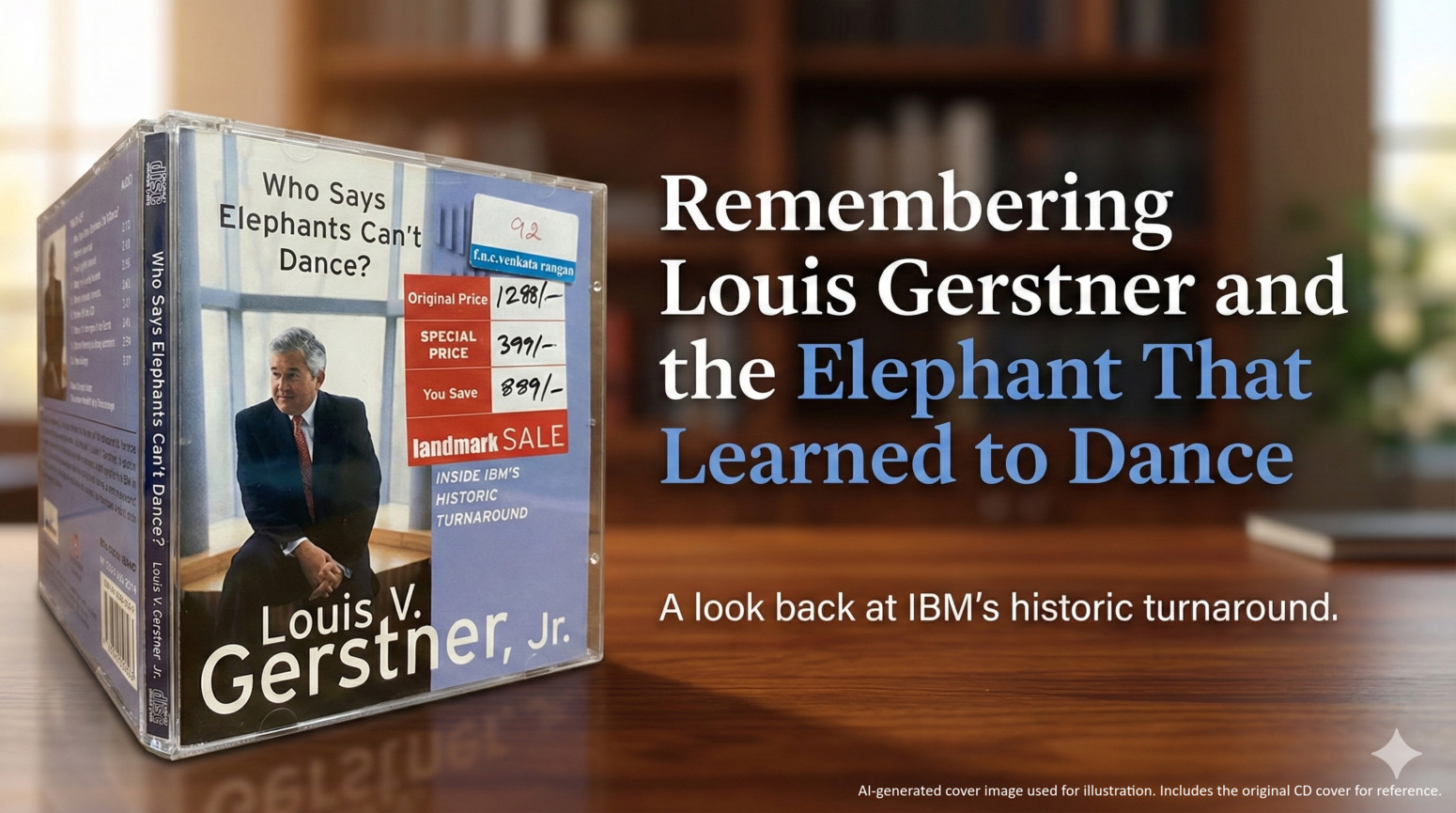
    Remembering Louis Gerstner and the Elephant That Learned to Dance

    I learnt on 27 December 2025 that Louis V. Gerstner Jr. had passed away. That news made me pause. It took me back more than two decades, to a phase when I was still finding my feet as a CEO, and to a book that quietly but firmly shaped how I looked at leadership.

    I first read Who Says Elephants Can’t Dance in the early 2000s. At that time, I was far more comfortable being close to technology than being close to people problems. Management felt like something I had to do, not something I wanted to learn. Gerstner’s book did not try to inspire me with slogans. It simply showed me, page after page, that leadership is about decisions, execution, and an honest understanding of how organisations really behave.

    One anecdote from the book has stayed with me. This is recalled from memory. Soon after accepting the CEO role, Gerstner visited IBM’s headquarters in Armonk, New York. He is stopped by a security guard because he does not yet have an identification card. Even after explaining that he is the new CEO, he is not allowed inside. He later reflects on this moment as a small but telling sign of how deeply bureaucracy had set in at IBM. What struck me was not the incident itself, but his ability to see it as a system problem, not a personal slight.

    By the end of his roughly decade-long tenure, IBM had become a very different organisation. More open. More responsive. More willing to confront reality. The contrast between those two moments says more about leadership than any abstract theory ever could. Culture does not change through speeches. It changes through consistent actions and clear priorities.

    When asked, soon after stepping into IBM, what his vision for the company was, Gerstner answered without flourish or theory. “The last thing IBM needs right now is a vision.”

    As a founder, what I took away from the book then, and what still resonates now, is Gerstner’s refusal to romanticise leadership. He was clear that turnarounds are messy. Those tough calls cannot be delegated. That listening matters, but so does deciding. These are lessons I have carried with me, and ones I have referenced in my own book, The Founder Catalyst, because they remain relevant for founders and CEOs even today.

    In an age where leadership advice is often reduced to sound bites, Who Says Elephants Can’t Dance continues to stand out for its honesty and practicality. I still recommend it to founders who are making the uncomfortable shift from builder to leader.

    Looking back, Louis Gerstner did not try to teach the world how to dance. He simply showed, through his work, that even the largest and most tired organisations can relearn the steps when led with clarity and courage. I realise how much that lesson shaped my own thinking as a founder. My quiet respect to him and to a legacy that influenced many of us more than we understood at the time.

  • Running Generative AI Models Locally Is Now Easy

    Running Generative AI Models Locally Is Now Easy

    Want to explore Generative AI without sending your data to the cloud? Running models locally on your PC or Mac is now surprisingly simple.
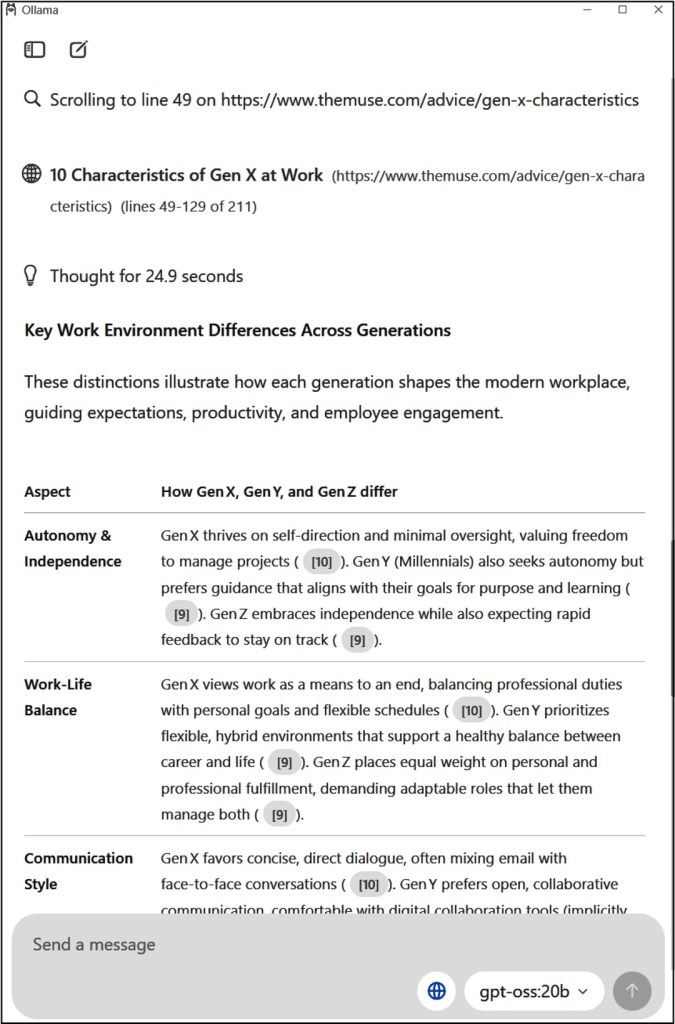
    Start with Ollama, a lightweight framework that makes it easy to run AI models locally on your computer. It supports both open-weight models and open-source models. Together, these models have made hands-on AI experimentation accessible to anyone with a capable machine, without depending entirely on cloud APIs. Ollama recently added a clean, chat-style desktop app to its command-line interface. I’ve been testing OpenAI’s GPT-OSS 20B open-weight reasoning models, which run locally through Ollama and even support limited web search. For routine tasks — summarising, drafting, quick analysis — it’s remarkably capable.
    Sample Output from GPT-OSS model running locally in a PC with Ollama
    Sample Output from GPT-OSS model running locally on a PC with Ollama
    Another option is Msty Studio, a free tool (for non-commercial use) that gives a visual interface to run these open models on your system. It connects seamlessly with Ollama and supports models from Hugging Face. Ideal for hands-on experimentation before making big AI bets. Why does this matter for founders and CEOs? 1. Data Privacy and Control – Running locally means your business data never leaves your system. For regulated industries, that’s a real advantage. 2. Independence and Learning – Most AI transformations rely on commercial APIs. Testing open models locally helps your team learn, experiment safely, and reduce vendor dependence. 3. Strategic Experimentation – Founders who explore AI hands-on make sharper choices about when to buy, build, or partner. It’s the difference between hearing about AI and understanding it. Two things to note: 1. Large models need powerful hardware — GPUs with high VRAM or plenty of system memory. 2. “Open” doesn’t mean “risk-free.” You’ll handle updates, licenses, and security yourself. Local AI isn’t replacing the cloud — it’s giving leaders another layer of control and insight. I cover these shifts — from cloud dependence to local AI — in my keynotes for decision makers. To invite me for a corporate talk, contact Kural at leadership@kuralkonnect.com
  • How can founders protect their secret sauce?

    How can founders protect their secret sauce?

    Every company has its own version of the “secret sauce.”

    It might be a piece of intellectual property, a supply chain partner, a machine, or even an AI framework from a large vendor. At first glance, these look like commodities—always available, always affordable. But history has shown us that what looks abundant today can turn scarce overnight. A pandemic, a trade war, or a sudden regulation can rip away what you thought was permanent.

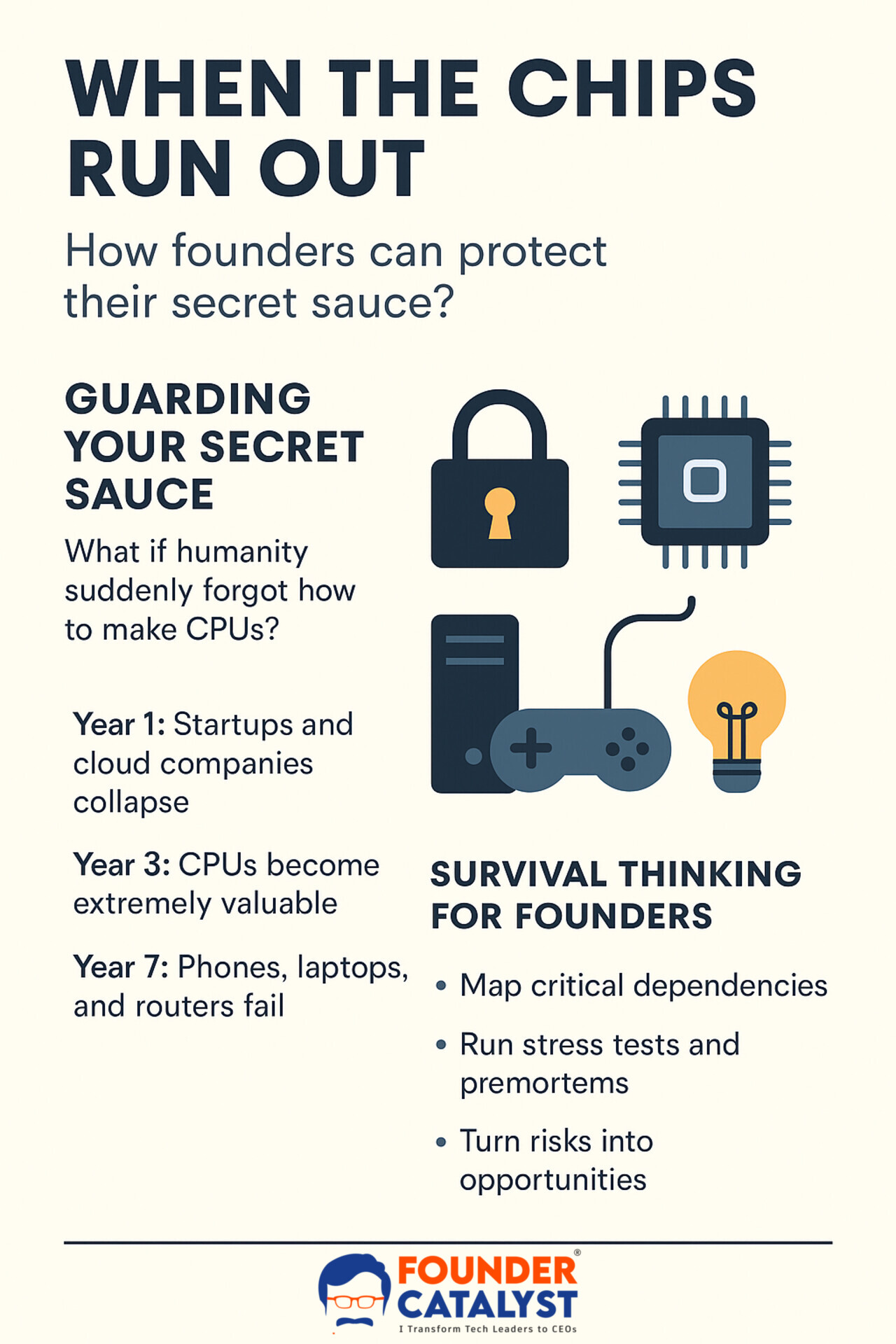
    When the Chips Run Out

    I was reminded of this when I came across a fascinating thought experiment: what if humanity suddenly forgot how to make CPUs?The tiny chips we barely notice, but which sit inside every laptop, phone, car, and washing machine.

    The video by Laurie Kirk [@lauriewired], that I watched walks through what would happen year by year.

    In the first year itself, startups and cloud companies would collapse.

    No new servers could be built, and even running a simple website would become expensive. People would desperately try to keep machines alive, sometimes even cooling them manually, while older, bulkier computers would outlast the sleek modern ones.

    By the third year, CPUs would be so precious that black markets would appear.

    Governments would seize remaining stockpiles for essentials like electricity grids and banks. Entertainment and “luxury” uses such as gaming or crypto mining would be banned.

    By year seven, phones and laptops would stop working, routers would fail, and the internet would begin to disintegrate.

    Data would once again travel by physical drives and compact disks.

    By year fifteen, the internet as we know it would collapse.

    By thirty years, only the most basic machines from the 1980s would still run, thanks to Black’s equation.

    This scenario is deliberately extreme, but it forces us to confront a crucial question: how much of our business is dependent on a single line of technology, partner, or process?

    For founders, that’s not a theoretical question—it’s survival.

    WHEN THE CHIPS
RUN OUT - How founders can protect
their secret sauce?
    WHEN THE CHIPS
    RUN OUT – How founders can protect
    their secret sauce?

    Guarding Your Secret Sauce

    What should you do?

    Start with awareness. Map your critical dependencies. If your product relies entirely on one AI API, ask what happens if that API suddenly changes pricing or access terms. If your supply chain runs through a single country, model the impact of a sudden disruption. The exercise may feel uncomfortable, but it builds resilience.

    Next, run stress tests and premortems. Imagine your key system is suddenly gone—what would break first? Could you pivot to alternatives? Could you scale back to a simpler but still functional model of your service? Large enterprises call this “business continuity planning,” but for founders, it’s simply a good survival instinct. This is something I often write about in my book, Founder Catalyst —the need for founders to shift from reacting to crises toward building the clarity and discipline of a CEO, while still staying true to their founder instincts.

    Finally, don’t just mitigate risks—turn them into strategic opportunities. Some of the biggest companies today were born during times of scarcity because they found creative substitutes, simpler models, or new markets when the old ones collapsed. Resilience isn’t only about surviving; it is also about positioning yourself to grow while others are paralysed.

    Founders who do this work early are not pessimists—they are realists.

    You can’t control pandemics or geopolitics, but you can control how prepared you are. That preparation could be the difference between a business that collapses when the chips run out and one that finds new ways to thrive.


    💡 As a founder, your “secret sauce” can be your biggest strength, but also your biggest risk if it’s fragile.

    That’s why I work with founders to stress-test their strategies, map dependencies, and build resilience into their businesses.

    👉 If you’d like to explore this for your venture, reach out for a consultation: v@thefoundercatalyst.com

    📩 And if you’d prefer to receive more of these insights directly, subscribe to my Founder Catalyst Digest, where I share practical lessons on leadership, AI, and building companies that last.
    #FounderCatalyst #Entrepreneurship #Leadership #Resilience #StartupLessons

  • How Founders Can Turn Crisis into Growth

    How Founders Can Turn Crisis into Growth

    Founders don’t get the luxury of calm waters.

    The world throws storms, and our job is to sail through and still find new harbours.

    The latest wave is particularly heavy. The U.S. has piled on steep tariffs for imports from multiple countries, slapped a $100,000 fee on each H-1B visa, and is even debating a 50% tax on offshored work. For Indian IT outsourcing, which built its scale on affordable cross-border talent, this is the toughest challenge since its birth. Added to these are sizable pressures from Generative AI automating coding, testing, and support.

    And just when we need steady hands, Gen-Z managers, who have never seen a serious downturn, are stepping into middle management.

    This is not only about Indian IT services.

    The shock will ripple into allied industries, global startups, and every enterprise IT department that depends on talent from India. With fewer engineers available, projects to adopt AI or modernise technology will slow down. Innovation across industries will feel the pinch. Tariffs will also raise costs for hardware and software imports, hurting startups that depend on global supply chains to deliver to customers.

    But history reminds us: Downturns create openings, and survival is only the first half of the game.

    The second half is how you prepare your company to leap forward once the clouds clear.

    Of course, these restructuring and growth plans may sound good on paper, but the immediate reality is often brutal. For many founders, simply surviving to see tomorrow will test every ounce of mental strength. The stress rests squarely on the founder’s shoulders, where the ultimate buck stops. If your company is carrying debt, any move becomes even harder. Sometimes the right call is to take fresh capital at a lower valuation, or even sell to a strategic buyer.

    I went through this myself during the aftermath of the 2008 subprime crisis; debt servicing then was the most difficult period of my career.

    These strains also ripple far beyond the boardroom. Employees feel the pain, yes, but so do families. As a founder, you cannot leave your immediate family in the dark. You need their moral support to get through the turbulence, and you need to share the journey with them. Don’t underestimate this — resilience is not built in isolation.

    So what can founders do?

    One, retrain your talent map.

    A crisis forces everyone to pay attention. When external shocks hit — tariffs, visa fees, offshoring taxes, or AI taking over routine work — even the most change-resistant teams realise the old ways won’t hold. This is the best time to shake up how your organisation is structured. Companies that use downturns to reskill their talent, upskill managers, and rewire processes often emerge leaner, sharper, and more loyal to the mission. In the long run, investors get stronger returns, employees gain future-proof careers, and the company earns resilience it wouldn’t have built in calmer times.

    Two, experiment with new markets.

    Many boards say no to risky adjacencies when times are good. In a crisis, you get a free pass to test them. Airbnb started by renting out airbeds to strangers — an odd experiment in a downturn that grew into a $30 billion travel company. What market can you test now that would have been rejected in normal times? Boards and teams accept hard changes in a crisis that they resist in normal times — use that consent wisely.

    Three, invest in R&D and talent.

    Crises change the cost–benefit math. The projects your board once dismissed as “too risky” or “low returns” — experimental products, AI-driven tools, or bold market pivots — suddenly become essential for survival. Remember how cloud computing looked like a distraction in the 2000s, until companies that embraced it early pulled ahead? The same will be true with Generative AI and automation. Use this period to hire the best engineers and talented researchers who may not be available in normal times, and give them the mandate to work on bets that shape the next decade. In downturns, survival is not about holding ground; it is about creating the breakthroughs that make you indispensable when the market rebounds.

    Four, raise capital with courage.

    Funding may look tight, but investors always have dry powder for bold founders. If you can show you are steady and preparing for growth, you will find money. In 2009, a number of Indian SaaS firms quietly raised bridge rounds in the middle of the slowdown — that capital later fuelled their expansion into the U.S. market. Other deal terms may also be better in downturns than when valuations are inflated in good times.

    Five, expand your circle.

    When it was business as usual, founders barely had time to look up from their own companies. In a slowdown, the pace of business eases. Use this to get out of your bubble. Attend industry events, participate in community forums, network with peers, and exchange notes. You’ll learn how others are tackling the same challenges, and sometimes, a single conversation can spark a new path for your business.

    And don’t forget leadership. Crises test not just business models, but people.Gen-Z managers stepping into middle roles today have never lived through the dotcom bust of 2001 or the financial meltdown of 2008. Their instincts are untested in turbulence.

    This is where the founder’s role as mentor becomes non-negotiable.

    In my book, The Founder Catalyst, I wrote that “every founder needs a mentor — and every founder must also be one.”

    Your role is to model calm under pressure and guide managers on handling stalled clients, shifting projects, and keeping teams motivated. Involve them in tough calls and investor discussions — the resilience they gain now will shape your company’s culture for years. And remember, even founders need mentors during turbulence; clarity is easier when you are not carrying the storm alone.

    Every crisis feels like the deadliest when you’re inside it. Ask those who survived before — they thought the same. Microsoft was born in a recession. So were Airbnb and Uber. What mattered was that the founders didn’t waste their crisis.

    So, founders, don’t just cut expenses. Use the turbulence. Expand into spaces adjacent to your core. Enter markets that earlier seemed out of reach. Hire the talent others are letting go. Turn your company from a survivor into a growth engine.

    As I often remind myself — the role of a founder is not to predict the storm, but to prepare the ship.


    Founder Catalyst is a no-nonsense guide for startup founders who want to become decisive, authentic CEOs—without losing their soul along the way.

    Grab your copy here: https://mybook.to/foundercatalyst

  • Productive founders avoid recurring meetings

    Productive founders avoid recurring meetings

    Recently in a podcast interview, Jason Citron, founder and former CEO of Discord, shared an approach to management that struck me as both simple and transformative.

    In most companies, product reviews involve lengthy meetings with multiple stakeholders. At Discord, Jason flipped this model.

    Instead of live demonstrations filling up calendars, his product managers send him short Loom(Video) recordings explaining the new feature, why it matters, and how it works. Jason watches them at his convenience, usually the same day, and replies—often with his own recorded video, screenshots, and comments.

    This asynchronous method removes the bottleneck of aligning busy schedules.

    Reviews happen wherever Jason is, not just in a meeting room.

    He is quick to point out that not every conversation can be handled this way. Issues involving conflicts, priorities, or resources still require live discussions. But the number of recurring meetings has gone down sharply. Jason has even removed most of his standing meetings, keeping only those he genuinely finds rewarding.

    Many management experts now recommend a similar rule of thumb: recurring meetings should take up no more than 20% of a leader’s week.

    His idea resonated with me. In The Founder Catalyst book, I wrote about how large group meetings often mask the fact that only two or three people are really engaged, while the rest sit passively. Moving those conversations into focused one-on-one discussions dramatically improves both quality and efficiency.

    When mentoring young founders, I caution them not to fall for the glamour of chairing big meetings. A townhall to rally the company is valuable, yes, but those are special occasions, not everyday rituals. In a remote-first setup, large group calls can become exhausting time sinks. Short, focused check-ins and some casual conversation with the team are far more effective.

    Studies validate this. A 2024 Microsoft Research study (Yasaman Hosseinkashi et al.) showed that adding just two more people to a meeting lowers effectiveness and inclusiveness ratings by one percentage point. This is especially damaging in cross-departmental meetings where attendance is already large.

    The evidence is clear- more people in the room rarely means better outcomes.

    Reflection: Meetings should be chosen with care. When possible, make them asynchronous. When they must be live, keep them small and purposeful. What matters isn’t the number of people listening, but the clarity of decisions made.


    Article content

    Founder Catalyst is a no-nonsense guide for startup founders who want to become decisive, authentic CEOs—without losing their soul along the way.

    Grab your copy here: https://mybook.to/foundercatalyst


    For more leadership & AI insights, subscribe to my newsletter.

  • AI can draft your email, not your strategy

    AI can draft your email, not your strategy

    The UK government recently published an evaluation of Microsoft 365 Copilot after running a pilot across 1,000 employees in the Department for Business and Trade. The findings are refreshingly honest—and deeply relevant for founders.

    The results show Copilot is very good at what I call the “work hygiene” layer.

    Drafting emails, summarising meetings, cleaning up documents—these were faster, easier, and often of higher quality with Copilot. Employees reported high satisfaction:

    72% said they were happy with the tool, and many felt its absence when the trial ended.

    But when the task demanded nuance or contextual judgement, the cracks showed. Excel analysis was slower and less accurate. PowerPoint decks were created more quickly but to poorer quality, requiring rework.

    The conclusion was clear: satisfaction went up, but productivity did not.


    For founders, there are three lessons here.

    First, AI excels at removing drudgery. That is no small thing. Routine admin has always been a hidden tax on teams. Freeing up even 20 minutes a day compounds into time for deeper work or simply sharper focus. Some pilot users said the time saved let them step away for training—or even a walk at lunch. That matters.

    Second, AI amplifies, but it doesn’t substitute judgement. In my own work, I use ChatGPT and Copilot daily. They are brilliant partners for ideation, rewriting, or testing a line of thought. But the final call—the decision that affects people, customers, or strategy—cannot be outsourced. That requires context, empathy, and leadership.

    Third, the human multiplier effect. The study found neurodiverse colleagues and non-native English speakers benefitted significantly. This shows that AI’s value is not just in efficiency but in accessibility. As founders, we should recognise this and design adoption in ways that genuinely empower people.

    In my book “The Founder Catalyst” [https://mybook.to/foundercatalyst], I argued that leadership is not about doing more, it is about doing what matters. AI gives us breathing space. The question is how we use it. Do we fill the gap with more low-value work, or do we redirect it towards strategy, empathy, and leadership—the places only humans can thrive?

    AI today is not a magic productivity machine. It is a capable assistant, still learning.Treat it as such, and it can make your organisation more thoughtful and more resilient. Expect it to replace human judgement, and you will be disappointed.


    The full report, “The Evaluation of the M365 Copilot Pilot in the Department for Business and Trade, UK”, is here:

    https://assets.publishing.service.gov.uk/media/68adbe409e1cebdd2c96a19d/dbt-microsoft-365-copilot-evaluation.pdf


    For AI keynote inquiries, reach Kural through WhatsApp or write to v@thefoundercatalyst.com.

  • ChatGPT messed up the script of my AI talk!

    ChatGPT messed up the script of my AI talk!

    Generative AI tools like ChatGPT are a huge productivity booster. I use them daily as a writer and speaker. But here’s what I’ve learnt the hard way: they are not magic lamps, and when not handled correctly, they can take you further away from your own voice. When I was preparing for my talk on “How AI can coach Gen Z and Gen A to lead”, I started with my outline and gave it to ChatGPT for expansion. Instead of polishing my ideas, it kept rearranging the flow and adding new ones. After a few iterations, the draft looked polished, but it no longer sounded like me. It was generic and stripped of the personal experiences I wanted to share with founders and CEOs. So, I went back to basics. Whiteboard, pen and paper, rehearsal recording. Then I brought AI back into the process differently: I used it to transcribe my rehearsal, give me feedback, identify the low points, validate the ideas, and suggest improvements. This time, AI became a coach rather than a ghostwriter—and the final talk landed well with the audience. That’s the point I want to leave with founders: AI is excellent for ideation, for breaking a blank page, or for polishing drafts into the right tone. But it can’t replace your lived experience. If you let AI own the core of your message, you risk becoming a parrot of machine text. Your value as a founder is in bringing your own stories, scars, and convictions to the table. In my book The Founder Catalyst, I argue that the future of leadership is about combining technology with what humans do best—strategy, empathy, and authenticity. The same principle applies here: let AI make you sharper, not faceless.
  • How AI Can Coach Gen Z and Gen A to Lead?

    How AI Can Coach Gen Z and Gen A to Lead?

    How technology can accelerate the leadership journey of next-gen leaders

    Every senior leader I meet—whether in a boardroom in Bengaluru, a startup hub in Chennai, or a CEO retreat in Singapore—shares the same worry. The leadership pipeline is thinning. The first line is often strong: functional heads, seasoned managers, directors who know the business well. But the second line? That is where the silence falls.

    We expect Gen Z, and soon Gen Alpha, to fill that gap. They are bright, digital-first, and fearless in experimentation. But leadership is not built on digital fluency alone. It requires judgment, resilience, and confidence—qualities that usually take years to grow. The question is: can AI accelerate that journey?

    Part One: AI as a Coach for Gen Z and Gen A

    In my book The Founder Catalyst, I argued that every CEO needs a mentor. Feedback and course correction cannot wait for an annual review; it has to be continuous. The same holds true for young leaders. AI can step into this role—not replacing human mentors, but acting as an always-on coach.

    1. Practice Before It Matters

    Harvard Kennedy School research shows that behaviour in AI-led simulations often predicts how the same individual performs in real groups. In short: practising leadership with AI makes you better at practising it with people. AI provides safe spaces to try tough conversations, rehearse boardroom pitches, or negotiate under pressure—without the career risk of failing in public.

    2. Build by Doing

    Gen Z and Gen A are builders. They don’t want to just consume; they want to create. Razorpay understood this and did something unusual: they asked every leader—finance, HR, marketing—to build something with AI, not just the engineers. No spectators, only hands-on creation. The head of marketing won by prototyping an AI-powered customer support tool. The lesson was not the tool, but the shift in confidence. Leaders began asking: “Why should this take three weeks? I can do this in a day with AI.”

    3. Everyday Empowerment

    Leadership is not only about big strategy moments; it is about everyday initiative. At Zerodha, a business analyst—not an engineer—used AI to automate accounting checks, freeing up hours. That small act is what second-line initiative looks like when empowered. With AI, even non-technical leaders can step up, experiment, and contribute beyond their job description.

    4. Feedback Without Delay

    This is where AI truly shines. Imagine a 24/7 sparring partner: always available, always patient, never judgmental. With data drawn from emails, calls, presentations, and projects (handled responsibly and with consent), young leaders can get real-time insights. It’s like a coach whispering in the background, nudging them to improve.

    Think of it as a feedback loop with three faces:

    • Mentor – guiding and suggesting.
    • Sparring partner – challenging and stress-testing.
    • Mirror – reflecting back strengths and weaknesses clearly.

    All three reinforce the same principle: leadership skills grow when practised, not when observed.

    Part Two: How CEOs Use AI to Build the Second Line

    Leadership coaching for individuals is powerful. But to solve the pipeline problem, CEOs must think in systems. AI can help here in three critical ways: hiring, mobility, and succession.

    1. Smarter Hiring with Skills at the Centre

    Too often, hiring depends on pedigree—degrees, titles, brand names. AI enables a shift to skills. By analysing candidates’ work samples, projects, and problem-solving patterns, AI can surface people who may not look impressive on paper but can perform and adapt in practice.

    This widens the talent pool, makes hiring fairer, and ensures organisations don’t miss out on hidden gems. AI-assisted assessments can also reduce bias when designed carefully, focusing on skills and outcomes instead of background.

    2. Internal Mobility and Talent Marketplaces

    Retention is the hidden cost of leadership failure. Young employees don’t leave because of pay alone; they leave when they don’t see growth. Schneider Electric faced this problem head-on. They launched an AI-powered internal “open talent marketplace.” Within two months, 60% of employees had signed up, unlocking 127,000 hours of hidden talent. Thousands explored new roles inside instead of leaving.

    Practical moves for any CEO:

    • List ten real projects needing help for four to six weeks.
    • Let AI match volunteers by skills and goals.
    • Recognise managers who release talent for these gigs—they are building your bench.

    Mobility lets young leaders “try before they leap.” They test themselves, find fit, and build networks across functions. And the organisation saves both time and trust.

    3. Succession as a Living System

    Succession is not about filling a chart with names. It is about ensuring the organisation is ready when leadership gaps appear. AI allows succession planning to become real-time:

    • Tracking skills and leadership readiness across levels.
    • Predicting who could step into new roles.
    • Simulating scenarios—who can lead if a key person leaves suddenly.

    This makes succession dynamic and evidence-driven, not a once-a-year ritual. As Google DeepMind’s Nicky Vallelly puts it: “Gen Z values learning and development opportunities. If you’re not investing in their growth, you will not hold them.” AI makes that investment visible and consistent.

    Balancing AI with Human Leadership

    Let’s be clear: AI cannot replace human qualities. Leadership still needs empathy, ethics, and wisdom. Gartner calls the most effective leaders of the future “Human Leaders”—authentic, empathetic, adaptive. AI can sharpen skills, but only human mentors can model care, trust, and flexibility in the real world.

    The role of the CEO is to set these ground rules:

    • Use AI for data and insights.
    • Ensure transparency and fairness in every process.
    • Keep humans responsible for final judgment.

    Three steps you can begin tomorrow:

    1. Adopt skills-based hiring and experiment. Move beyond degrees and titles, and run small AI pilots—mock interviews, leadership simulations, or feedback loops.
    1. Make growth visible. Build an internal marketplace, even simple at first. Map who is ready, who is next, and support them.
    1. Model what machines cannot. Authenticity, empathy, adaptability—these must come from leaders themselves.

    Reflection

    The leadership pipeline is thinning, but the tools to fix it are here. For Gen Z and Gen A, AI is a mentor, sparring partner, and mirror. For CEOs, it is a system for fairer hiring, smarter mobility, and living succession.

    The future will belong to leaders who learn to work with AI—not as a crutch, but as a partner in growth. With AI as coach and CEOs as enablers, tomorrow’s leaders can step forward—with confidence and clarity.

    Article content
  • AI is eating your profits

    AI is eating your profits

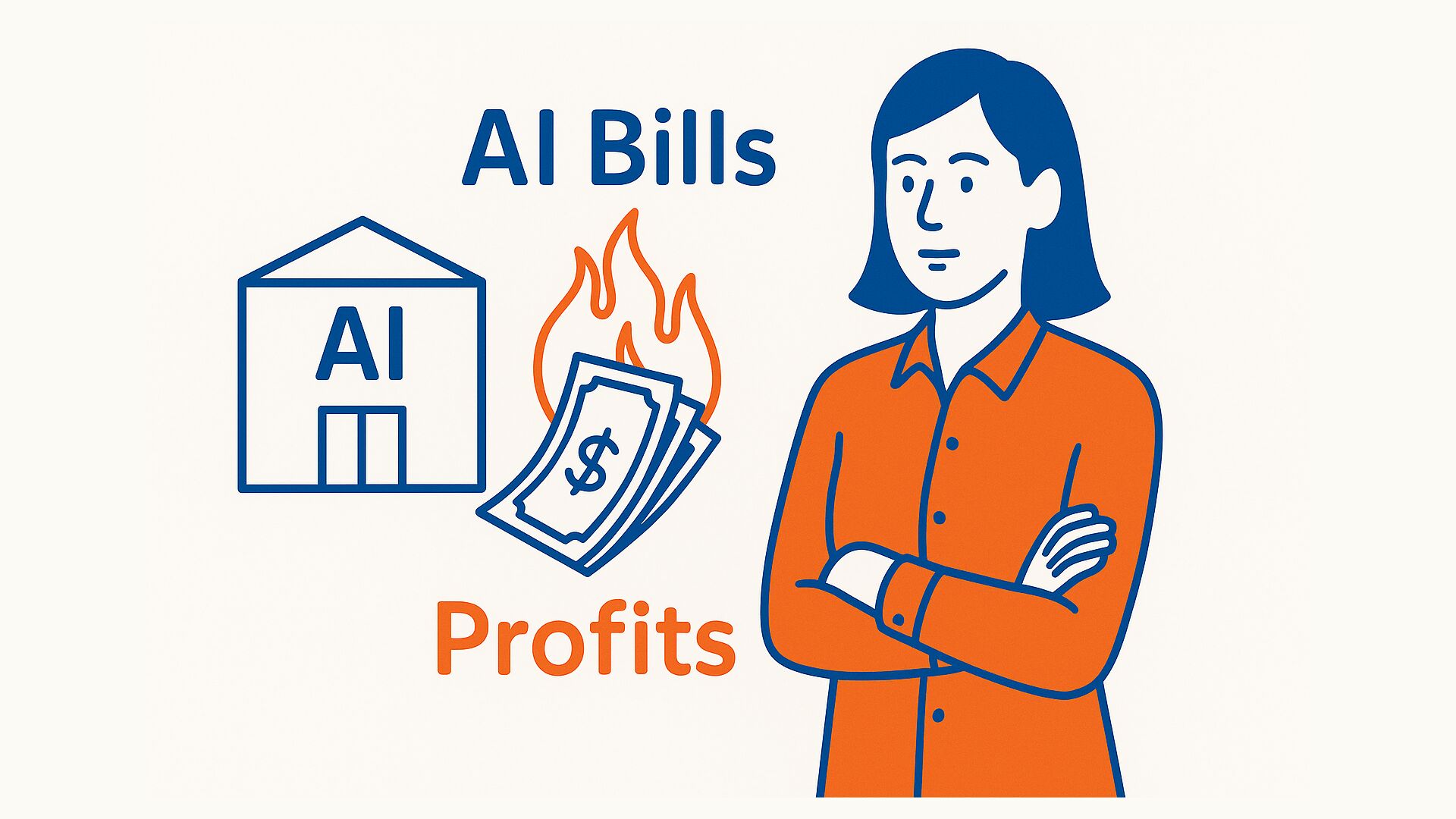
    Notion’s CEO recently revealed that 10% of their profits now go towards AI bills. That’s a significant shift for a SaaS company—and a warning sign for founders.

    AI was supposed to get cheaper. Instead, it’s becoming a major expense. The latest models are smarter, yes, but they also consume far more tokens. Especially when used for agent workflows, deep research, or coding tasks, the costs can spiral quickly.

    As a founder, you don’t always need the most advanced model. With clever prompts and a bit of experimentation, your team can often achieve great results using smaller or open models. This isn’t just about saving money—it’s about designing solutions that fit your business needs.

    From my book Founder Catalyst, I’ve written about the hidden costs of adopting new technologies. With AI, these include:

    1. Time spent learning new tools and interfaces
    2. Integration challenges across teams
    3. Legal risks from unlicensed datasets
    4. Vendor lock-in and platform dependency

    AI can bring productivity and a competitive advantage. But it must be implemented with clarity and expertise.

    Design before deploy. Profits still matter.

    If you’re a founder or CXO thinking of scaling AI across your organisation, don’t do it blindly. AI is not just another tool—it’s a shift in how your teams think, build, and deliver. But without the right guidance, it can also become a costly distraction.

    As a founder and CEO, with over 30 years in tech and a front-row seat to every major platform shift—from desktop to mobile to cloud—I help leaders cut through the noise. My keynotes and masterclasses are not about hype. They’re about clarity, context, and practical frameworks your team can act on.

    Let’s talk if your team needs:

    • A clear-eyed view of what AI can (and can’t) do
    • Real-world examples of how startups and enterprises are using AI
    • A roadmap to adopt AI responsibly, without burning budgets

    You don’t need more AI tools. You need better AI thinking.

    For keynote inquiries, call Kural through WhatsApp or write to v@thefoundercatalyst.com.

  • How AI can coach Gen Z and Gen A to lead?

    How AI can coach Gen Z and Gen A to lead?

    Every senior leader I speak with shares a common concern: the leadership pipeline is thinning. The first line is solid, but the second line is not so much. Gen Z is stepping up. They are fast and curious, but as digital natives, they learn and train differently. Traditional training and leadership grooming don’t match their pace.

    Enter Artificial Intelligence—not as a replacement for human leadership and mentorship, but as a powerful ally in developing it. AI can serve as their personal coach, offering real-time feedback, personalised learning paths, and scalable mentorship. Empowering your team with AI is how you build a strong second line in 2025.

    Join me on 5th September 2025 from 6 PM at Tagore Film Centre, Chennai, for a 12-minute power talk organised by Kural. No jargon, no hype—just practical plays you can start on Monday. Simple and straightforward. See you there. Register now.

  • What Captain Kirk can teach founder CEOs?

    What Captain Kirk can teach founder CEOs?

    This week’s Star Trek SNW TV Show episode “The Sehlat Who Ate Its Tail” resonated with me in a surprising way. When I began my business nearly three decades ago, straight out of college, there were many moments when I felt like I had been pushed into the deep end without ever learning how to swim. No management book or autobiography really prepares you for the instant when your team turns to you for a critical decision. In this episode, First Officer James Kirk suddenly finds himself in command of the Farragut. With the lives of his ship, the Enterprise crew, and even millions on a pre-warp planet at stake, he could not afford endless consultation. The buck stopped with him, and he had to decide. But he froze. Many founder CEOs fall into the trap of asking for suggestions and confirmation until decision paralysis sets in. But there comes a moment when the role demands clarity and conviction—when you have to throw everything you have into a decision, knowing responsibility rests with you. PS: And a fun detail I enjoyed as an engineer, when wireless communications were jammed, the crew fell back on RJ11 analogue phones and copper wires. Sometimes the simplest, oldest tools can save the day—a reminder worth keeping even in the AI age.