Category: AI & generative AI

  • How AI can coach Gen Z and Gen A to lead?

    How AI can coach Gen Z and Gen A to lead?

    Every senior leader I speak with shares a common concern: the leadership pipeline is thinning. The first line is solid, but the second line is not so much. Gen Z is stepping up. They are fast and curious, but as digital natives, they learn and train differently. Traditional training and leadership grooming don’t match their pace.

    Enter Artificial Intelligence—not as a replacement for human leadership and mentorship, but as a powerful ally in developing it. AI can serve as their personal coach, offering real-time feedback, personalised learning paths, and scalable mentorship. Empowering your team with AI is how you build a strong second line in 2025.

    Join me on 5th September 2025 from 6 PM at Tagore Film Centre, Chennai, for a 12-minute power talk organised by Kural. No jargon, no hype—just practical plays you can start on Monday. Simple and straightforward. See you there. Register now.

  • How are Google’s AI Overviews affecting website traffic?

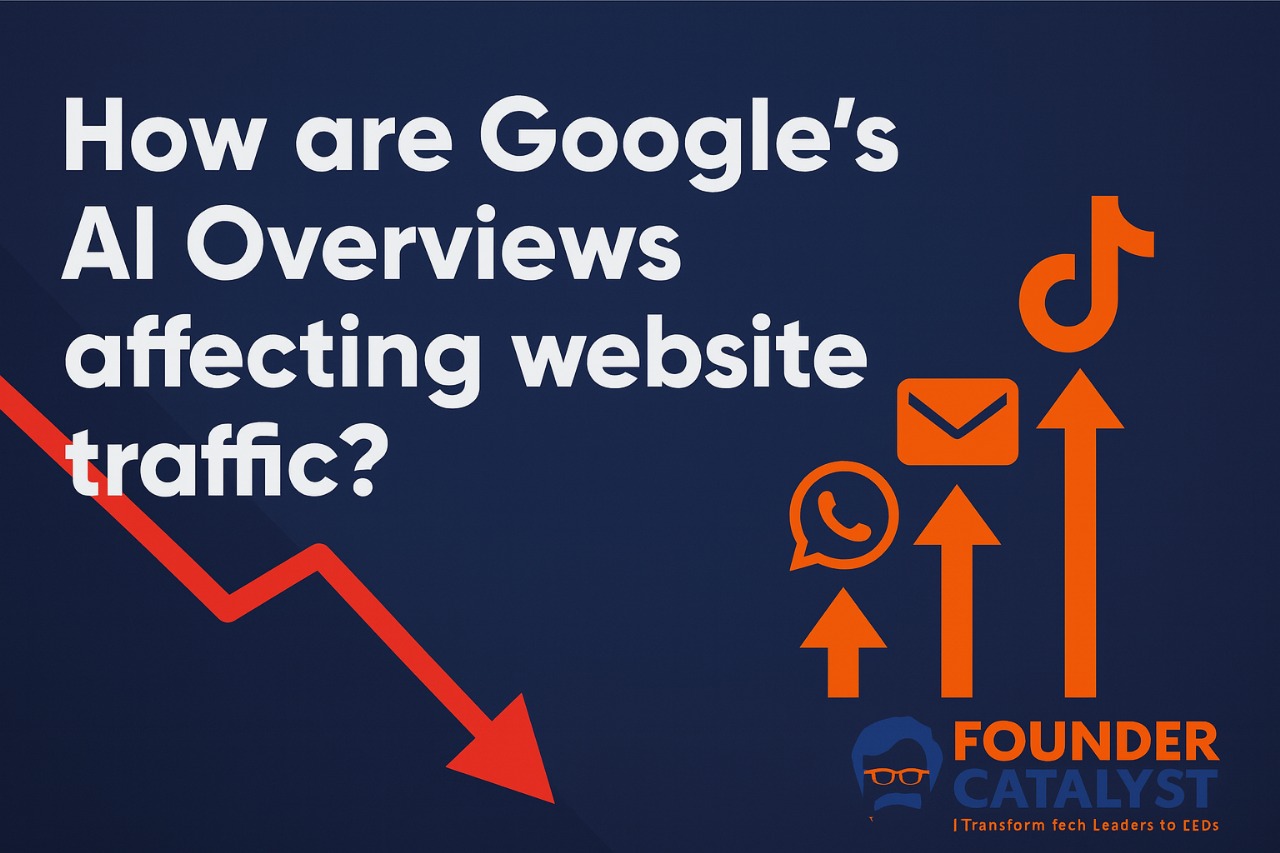
    How are Google’s AI Overviews affecting website traffic?

    A recent study from the non-profit Pew Research Center caught my attention. Analysing the browsing behaviour of 900 US adults, the study found Google’s AI Overviews are reshaping how people interact with search results.

    When an AI-generated summary appears on Google’s search results page, users are almost half as likely to click on traditional website links. Even more telling, they’re also likely to stop browsing further. This means fewer visits, fewer page views, and significantly reduced traffic to websites creating original content.

    Google maintains that AI Overviews lead users to a broader variety of websites. However, the Pew study indicates that while diversity might increase, the total number of clicks decreases. For businesses that rely on search referrals, this shift isn’t minor; it signals a fundamental change in how we must approach online visibility.

    Why businesses shouldn’t rely solely on SEO?

    Interestingly, I explored this very scenario in Chapter 12, “Thriving Without Search,” in my book The Founder Catalyst.

    Even before AI mode in Google, I’ve observed how reliance on search algorithms can cripple businesses overnight whenever those algorithms shift.

    How can businesses build direct audience relationships?

    Investing in direct channels is critical.

    Years ago, when we ran a software service business, we focused on building an email newsletter. It wasn’t just about promotions; we shared insights and built trust. Over time, that newsletter became a dependable source of leads and engagement, immune to algorithm changes.

    Today, many founders successfully use LinkedIn pages or WhatsApp channels. Consumer brands find Instagram (or TikTok) or YouTube more effective.

    For example, Zerodha, India’s largest stockbroker, grew primarily through word-of-mouth. Their “Markets by Zerodha” YouTube channel has over 170,000 subscribers, regularly achieving over 20,000 views per video. Similarly, their newsletter, “Daily Brief by Zerodha,” has over 53,000 subscribers. These are all direct touchpoints independent of SEO. These are apart from their main YouTube channel with over seven hundred thousand (700,000) subscribers.

    I know of a successful author with over a hundred books to his credit, who reduced his dependency on Facebook’s algorithm by moving to his blog, email newsletter, and, most effectively, to his WhatsApp channel. He even shares early drafts of chapters there, driving excitement. Initially, his growth slowed, then accelerated beyond what social media alone could achieve.

    Why is content value beyond discoverability essential?

    If your website only ranks on keywords, its foundation is weak.

    A truly valuable site meets real market needs, compelling people to seek you directly. Duolingo offers an excellent example here. They pivoted from traditional TV ads to an active presence on TikTok and YouTube Shorts, letting their green owl mascot, Duo, engage humorously with trends. About 80% of their content doesn’t even mention the app. Yet, their follower count exploded from 50,000 in 2021 to 16.8 million by mid-2025.

    Another remarkable case is Viv, a period care brand for women. Last July, Viv’s blog traffic surged by 400%, driven mainly by recommendations from AI assistants like ChatGPT and Google Gemini. Detailed, data-rich content addressing safety and transparency helped Viv stand out, leading to a 436% increase in conversions.

    Modern founders go beyond keywords, showing up in niche communities, co-creating with partners, and working with micro-influencers. Many also appear as guests on podcasts, where their target customers listen to them directly, creating a human connection that no algorithm can replace.

    It’s about being visible where your users already gather, not just where search engines place you.

    How should platforms be leveraged strategically?

    Use platforms strategically, but don’t become dependent. A resilient business maintains multiple access points: its website, a newsletter, webinars, and even social media platforms.

    Modern founders treat platforms as springboards, not crutches. They mix channels and nudge audiences toward spaces they own and control. They tailor content to each platform’s strengths while keeping the relationship firmly theirs.

    Indian startups exemplify this through curated WhatsApp communities. StartupLanes built a real-time networking hub of over 100,000 entrepreneurs and investors, entirely independent of traditional digital advertising. Founders engaging smartly in these WhatsApp groups signal credibility and hustle directly to angel investors.

    Personal Reflection: My own learning experience

    While writing this post, I revisited a YouTube channel we created nearly twenty years ago for my software products business, later acquired by a US firm. We had uploaded professional demos and marketing materials, yet none contained informative or educational content beneficial to our target customers. This realisation is a critical lesson for new founders and business leaders: genuinely informative, helpful content that is easy to follow wins in the long term.

    The internet landscape is rapidly evolving. AI Mode may be convenient for users, but as founders, we can’t afford complacency as referral traffic declines.

    We must proactively build and nurture direct, lasting relationships with our audiences.

    Reflecting on why I wrote The Founder Catalyst book (Available on Amazon worldwide), it wasn’t to deliver theories but practical, grounded insights from my journey.

    Algorithms will continue to evolve, but the discipline of creating genuine, enduring value remains timeless.

  • AI risk is real – are you prepared?

    AI risk is real – are you prepared?

    AI can be your rocket booster or your critical point of failure.

    In modern workflows, AI has moved from experimental to essential. If the model or the service you depend on stalls, or if bad actors weaponize AI to probe and disrupt your infrastructure, your operations freeze.

    Forward-thinking founders and business leaders are starting to factor this into their plans.

    Here are three practical steps I suggest:

    1. Trace every AI touch-point – Follow the customer journey from first click to final fulfilment and mark where each AI model, API, or script steps in.
    2. Stress-test the timeline – Ask, “What if this AI service disappears for an hour, a day, a week?” Then weigh the impact of each gap.
    3. Build a Plan B (and C) – Line up alternative models or providers, document a manual fallback, and rehearse the switch-over. Outage day is not the time to improvise.

    Big companies are already treating AI this way. Over 75 per cent of the S&P 500 rewrote their risk statements last year to cover AI threats; 193 of them now flag deep-fake fraud and malicious code as material risks. GE HealthCare has even warned that limited IP rights to inspect external models could hamper oversight.

    Technology choices matter too. Generative AI is powerful, but not every problem needs a large language model. Hallucinations, bias, and unclear IP can introduce more risk than benefit if the fit is poor.

    The lesson: treat AI like any other critical infrastructure.

    Build redundancy, clarify licences, and test your escape routes.

    For further reading, many AI providers publish whitepapers and bestpractice guides, and industry groups such as the Coalition for Secure AI (CoSAI) also offer useful guidance.

    Is your AI risk plan ready?


    #GenAI #DigitalTransformation #AIRisks

  • Are researchers gaming the AI peer reviews?

    Are researchers gaming the AI peer reviews?

    What if I told you some scientists are quietly “whispering” to AI, asking for only positive feedback on their research papers? Sounds like science fiction, but it’s happening right now. Recently, both The Guardian and Nature reported a new trend: researchers are hiding secret instructions—using invisible white text—in their academic papers. These hidden prompts are designed to influence AI tools that some reviewers use, nudging them to give glowing reviews and ignore negatives. While this trick will not be seen by humans, AI models like ChatGPT or Google Gemini may pick up these cues and change their review accordingly. This practice, called “prompt injection,” raises serious questions about academic integrity and the future of peer review. As AI becomes more common in research, we need to stay alert to such manipulations. For now, the best advice: don’t blindly trust AI-generated reviews, and always check the source. Watch this short talk for a quick explainer and my take on what this means for researchers, reviewers, and the future of academic publishing.
  • AI for Founders: Simple, Strategic, and Safe Adoption

    AI for Founders: Simple, Strategic, and Safe Adoption

    Last week, I had the opportunity to interact with a vibrant group of young founders and CEOs at Corporate Connections Chennai. My talk, “AI for Founders,” was designed to give them not just an overview, but a practical way forward in this fast-moving space.

    We often hear about AI as the next big thing, but for many business leaders, the challenge is knowing where to begin. I shared a simple four-step approach to help organisations adopt AI in a way that’s both realistic and effective. The starting point is understanding what problems you’re trying to solve. Jumping on the AI bandwagon without clarity only leads to confusion. Once the goal is set, the focus shifts to building a core team, choosing the right tools, and keeping the process iterative—learn, adjust, and improve.

    Of course, adopting AI comes with its share of responsibilities. In the second part of my session, we discussed the four key things every founder should keep in mind to use AI safely and responsibly. This means paying attention to data privacy, watching out for built-in biases, not taking AI output at face value, and remembering that the objective is not to build flashy prototypes, but to deliver real, meaningful improvements for users.

    It was a lively session, with plenty of questions and practical discussions. My aim was not to make AI sound mystical or intimidating, but to bring it down to earth and make it something founders can actually use—without losing sleep over the headlines.

    The best part of these sessions is always the back-and-forth—hearing what’s on the minds of founders and what keeps them up at night. As AI continues to change the way we build and run businesses, I hope these simple frameworks help more leaders navigate the path with a bit more confidence—and a little less jargon.

    Venkatarangan presenting his "Unlock AI: Four Steps" framework on screen to a group of founders and CEOs seated at a boardroom table, with an inset photo of the group and the Corporate Connections Chennai meeting signage.
    AI for Founders – Four Steps to unlock AI for your business.
  • Testing Google’s AI Mode with a Real Startup Question

    Testing Google’s AI Mode with a Real Startup Question

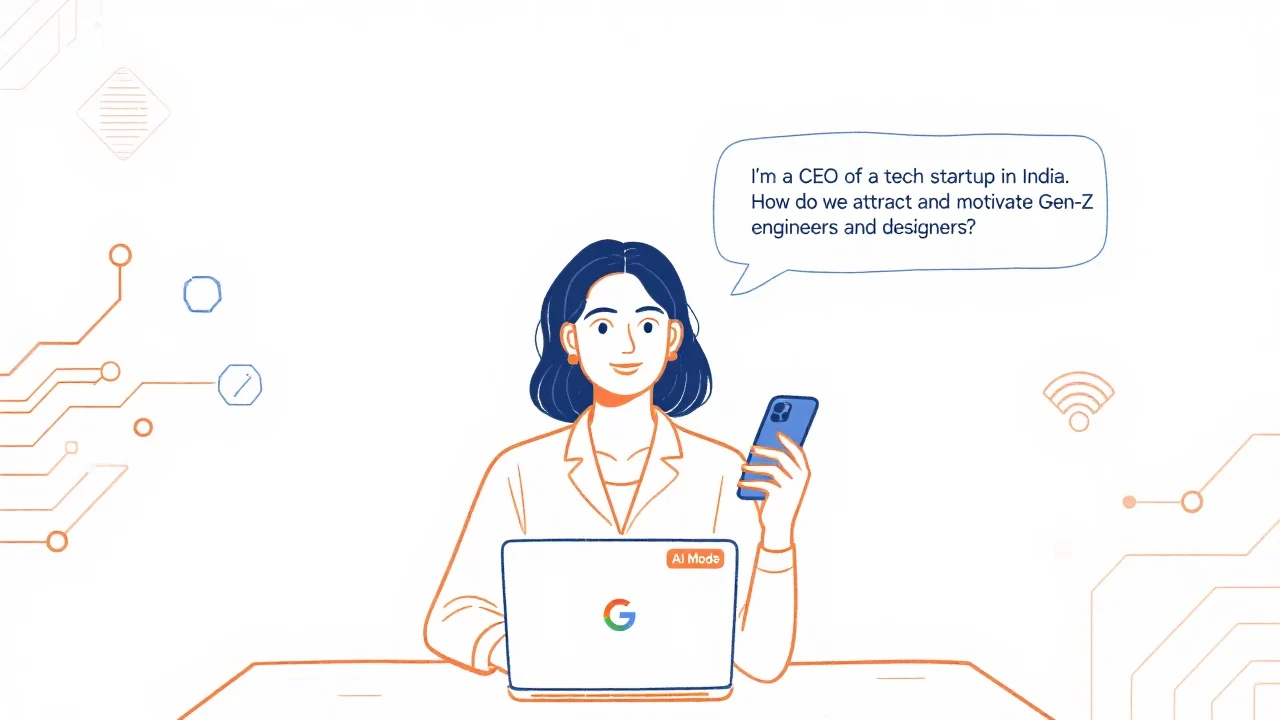
    At this year’s Google I/O, one of the standout announcements was the introduction of “AI Mode” in Search. Until now, Google Search has been about pointing us to websites. With AI Mode, it offers direct, conversational answers, powered by Generative AI. Think of it as Google’s answer to Perplexity, but integrated right into the familiar search box. According to Google, this is a step up from the earlier “AI Overview” we’ve seen over the last few months. More features, like automation and computer agents, are likely coming soon. Curious to see how helpful it really is, I tried asking it a question rooted in our ecosystem:
    “I’m a CEO of a tech startup in India. We’ve just raised seed funding. We’re two co-founders looking to expand. How do we attract and motivate Gen-Z engineers and designers? Any high-level advice from reputed sources?”
    You can watch how Google AI Mode responded in the short video below: The feature is now available in India, too, though it is only in a limited preview. Here is the link for accessing the same.
  • Why should you let candidates use AI in interviews?

    Why should you let candidates use AI in interviews?

    For most of my career, I have watched software interviews change with the times. In the early days, interviews were formal. Dress codes were strict, and the process was one-sided. The interviewer asked questions, and the candidate answered. There was little room for personality or questions about work-life balance.

    Over the years, things have shifted. Today, interviews are more relaxed. Candidates are encouraged to ask questions, show their personality, and discuss work-life balance openly. Remote interviews are common, and it is normal for candidates to clarify assumptions or challenge ideas during technical discussions.

    Allowing AI in interviews is the latest step in this long journey of change.

    A few months ago, I wrote about how students are skipping textbooks and turning to ChatGPT and YouTube for learning.That trend is now everywhere in the workplace too.

    The old model of textbook-based learning, followed by whiteboard interviews, no longer fits the world we are in.

    Recently, Canva made headlines by allowing candidates to use AI tools like Copilot and Cursor during technical interviews. At first, this might sound radical. But if you look closer, it is a logical next step.

    At Canva, nearly half their engineers use AI coding tools daily. Across the industry, the numbers are even more striking. Sixty-three percent of professional developers already use AI in their workflow. At companies like Microsoft and Google, AI now generates about thirty percent of all new code. Meta expects that number to cross fifty percent soon. Microsoft’s CTO predicts AI will write up to ninety-five percent of code within five years, though human oversight will remain essential.

    This is not just a tech company trend.

    According to a recent Fortune article, sixty-six percent of business leaders now say they would not hire someone without AI skills. At ChargeLab, an EV charging software firm, they noticed candidates were avoiding AI tools in interviews, fearing penalties. So, they flipped the script. Now, candidates are encouraged to use AI, and the company has made AI literacy part of departmental OKRs.

    The focus is not just on skill set, but also on mindset. Curiosity, adaptability, and a proactive approach to using AI are valued as much as technical know-how.

    What does all this mean for us as leaders?

    While I am still refining my own approach, I believe these are practical directions we should consider when interviewing interns and developers in today’s evolving landscape.

    First, do not ban AI tools in interviews. Instead, encourage candidates to use them. The real test is not whether someone can write code from scratch, but whether they can use AI as a productivity multiplier.

    Can they break down complex, ambiguous requirements? Do they know when to trust AI and when to question it? Can they spot and fix issues in AI-generated code? Most importantly, can they ensure the final solution meets production standards?

    Second, design interview problems that reflect real-world complexity. Gone are the days when implementing a classic algorithm was enough. Today’s challenges are messy, open-ended, and require genuine engineering judgment, even with AI at your side.

    Instead of asking for a textbook solution, present a scenario that needs iterative thinking, requirement clarification, and sound decision-making.

    Third, look for candidates who are comfortable collaborating with AI, not just passively accepting its output. The best engineers I have seen use AI strategically for well-defined subtasks, but always maintain control of the overall solution. They ask clarifying questions, review and improve AI-generated code, and debug when things go wrong.

    Finally, be transparent with candidates. Let them know upfront that you expect them to use AI tools, and encourage them to practice before the interview. This levels the playing field and helps you see how they will actually perform on the job.


    Here is a short “AI-Ready Interview” checklist for founders preparing for their next round of hiring:

    – Ask real, open-ended questions that mirror the messy, ambiguous problems your team actually faces.

    – Tell candidates upfront that using AI tools is not just allowed, but expected.

    – Watch how they work with AI—do they ask smart questions, refine the output, and show good judgment, or just accept whatever the tool gives?

    – Look beyond technical skills. Curiosity, adaptability, and a willingness to learn are just as important.

    – Make sure your own team knows how to spot these qualities and is comfortable evaluating candidates in this new way.

    This is not just about hiring for today. It is about building teams ready for tomorrow.

    As the lines between human creativity and machine intelligence blur, our job as leaders is to find people who combine sound judgment, curiosity, and technical depth with the ability to use AI thoughtfully and effectively.

    I am still learning and adapting my own approach. If you are rethinking your interview process, I would love to hear what is working for you and what is not. Let us keep this conversation going.

  • Why ChatGPT and YouTube Are Replacing Textbooks?

    Why ChatGPT and YouTube Are Replacing Textbooks?

    We often speak of the future as if it’s something far away.
    But the way our next generation is learning has already changed—and I saw the trend unfold right in front of me. 
    A few days ago, I was interviewing students from a college in Chennai for summer internships. These were second-year engineering students, specialising in Computer Science. I casually asked one of them to walk me through what they had learned each semester. He mentioned subjects like Modern Operating Systems and Programming in C++. 
    Just to test the waters, I asked if the textbooks were still the classics—Andrew Tanenbaum for Operating Systems and Prof. Balagurusamy for C++. The student gave me a puzzled look. He didn’t recognise either name. 
    That caught me off guard. 
    He then explained that exams now go beyond textbooks, and he finds the prescribed books dull and outdated. “So, how do you learn?” I asked.
    Without hesitation, he said, “I learn using ChatGPT and YouTube lectures.” 
    At first, I was speechless. 
    Then curious. 
    After a few calls with friends in the industry and a bit of reading, I realised this wasn’t a one-off case. This is now a clear trend, especially among Computer Science students. 
    They are skipping textbooks. They prefer learning from videos and conversational AI. These tools offer instant answers, personalised help, and often explain things in a more relatable way. Complex topics are broken down with visuals, and the informal tone keeps them engaged. It’s quick, interactive, and often more up-to-date than printed material. 
    From what I saw in research papers published post-2022, this shift is very real. Studies show that AI tools like ChatGPT are now part of many students’ daily learning routines. YouTube, too, is celebrated for making abstract concepts easier to grasp. The tone is conversational and informal. The visuals are helpful. Students feel less overwhelmed. 
    Yet, researchers also sound a cautionary note. There are concerns about long-term retention, equity of access—especially in countries like India—and students becoming overly dependent on AI instead of learning how to think through problems themselves. 
    What concerns me in this new way of learning is that there’s no clear finish line.
    With so much content just a click away, students often feel they haven’t learned enough, even when they have. The sheer volume creates a quiet pressure—what if there’s a better video, a clearer explanation, or a smarter prompt they’ve missed? This feeling of never being “done” brings its own kind of stress. While learning can now happen anywhere, anytime, the lack of structure can leave students anxious and unsure, especially when they have to face a traditional exam with a fixed syllabus. 

    What does this mean for us? 

    As industry leaders and business mentors, we can’t afford to ignore this shift. The old model—textbook-based learning followed by simple problem-solving interviews—may no longer work. We need to rethink our hiring questions and rework our onboarding and training programmes. 
    Instead of resisting the change or hoping for a return to “how things used to be,” we must adapt. This new learning model is not perfect, but it’s not going away either. 
    We are in interesting times. This experience has made me rethink my assumptions—and I plan to explore this topic further in the coming weeks. 

    Have you encountered this trend? What has been your experience?
    I’d love to hear how you’re approaching it. 
    References
  • Founders, stop waiting for the perfect talent

    Founders, stop waiting for the perfect talent

    A year ago, when Chris Miller, the author of the acclaimed book “Chip War,” visited India and shared an important observation. He emphasized the urgent necessity for India to build a robust talent pool specifically focused on chip design and manufacturing. Critically, Miller pointed out that India shouldn’t delay or wait for the ideal talent ecosystem to naturally evolve. Instead, it should start making strategic investments and building capabilities immediately.

    There’s a valuable lesson here for startup founders and leaders in any industry. Often, founders get stuck searching for the elusive “perfect” candidate who already possesses all the desired skills. The reality, however, is quite different—such ideal candidates rarely exist.

    The smarter, more practical approach for founders is to hire the best available talent today, even if they’re not perfectly skilled or experienced yet. Once onboard, founders should actively invest in their growth, giving them the freedom and flexibility to learn, experiment, and grow on the job. This strategy ensures continuous momentum, keeping your organisation agile and adaptable.

    Simultaneously, it’s wise to continuously scout for increasingly skilled talent to progressively enhance your team’s capabilities. Particularly in emerging fields like AI and large language models (LLMs), talent with complete skillsets is hard to come by. Hence, developing these skills internally through strategic training and on-the-job experience becomes critical.

    The core message to founders is straightforward: don’t wait for perfection. Hire talent that’s capable, motivated, and eager to learn, and then empower them to grow into the roles you envision. By doing this, you will build a resilient, skilled, and adaptable team poised to tackle future challenges.

    Watch my reel below, where I elaborate further on these essential insights:

  • The role of Generative AI in Automation

    The role of Generative AI in Automation

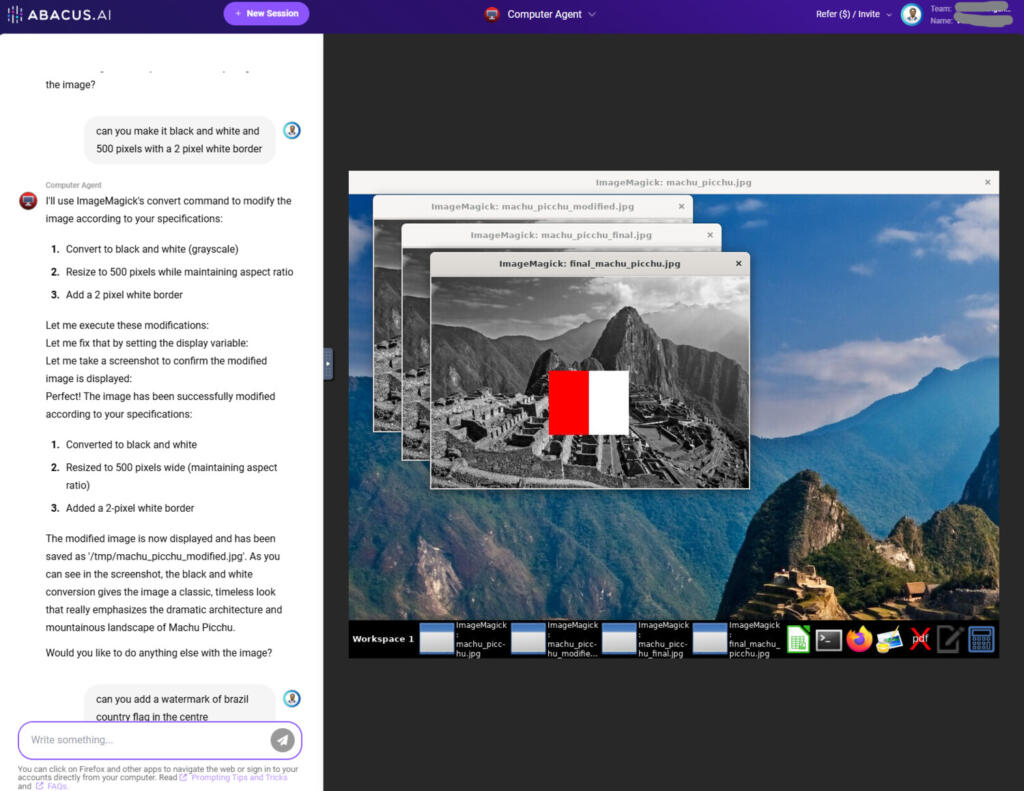
    Abacus.AI’s recently introduced “Computer Agent”, part of their ChatLLM subscription. This represents a noteworthy step forward in simplifying computer automation. By far one of the most intuitive approaches I’ve seen, it functions like a simplified version of robotic process automation (RPA), but with the seamless ease of a chat interface. Currently, it operates within a virtual sandbox environment with limited applications, but the potential is clear and exciting.

    The idea is straightforward yet powerful: you interact with your computer through natural language chat to complete tasks. For instance, you can ask it to browse the web, gather images, resize or recolour them, or even create a spreadsheet from online statistics. These are tasks that would traditionally require browser automation tools or shell scripts, but the “Computer Agent” lowers the technical barrier significantly. While I have yet to fully test its capabilities, it already appears capable of handling many routine automation tasks efficiently.

    Article content
    Abacus.AI’s “Computer Agent” simplifies image editing via chat commands

    This development aligns with the trend pioneered by systems like Claude’s “Computer Use” feature, which debuted a few months ago. Both tools reflect a promising approach: using Generative AI to bridge the gap between human instructions and computer execution. It’s a vision where everyday users can automate repetitive workflows without the steep learning curve of traditional RPA or coding.

    Imagine the possibilities if companies like Apple or Microsoft were to adopt and expand on this concept. Apple could move beyond the somewhat constrained “Shortcuts” app, and Microsoft could evolve its Power Automate platform to integrate more seamless, conversational automation. Such advancements could revolutionize productivity for millions of users, enabling them to delegate mundane tasks effortlessly, saving time and boosting efficiency.

    A Promising Future, Despite Current Limitations

    It’s important to acknowledge that this technology is still evolving. Today’s implementations are limited in scope and functionality, and challenges remain in ensuring reliability, security, and scalability. However, the potential is enormous. I believe that after the significant breakthroughs we’ve seen in text processing and image generation, this kind of natural-language-driven computer automation could become the next major real-world application of Generative AI.

    As these tools mature, they hold the promise to redefine how we interact with computers, making automation accessible to all and transforming how we work, create, and innovate.

  • Exploring Google’s Gemini 2.0 Flash-Experimental

    Exploring Google’s Gemini 2.0 Flash-Experimental

    Google recently introduced Gemini 2.0 Flash-Experimental, a multimodal AI model designed to enhance image generation. While previous models could generate and interpret text and images, they often struggled with precise modifications—such as adjusting text within an image without distortion or seamlessly altering objects. This latest iteration claims to improve on these challenges, making such edits more natural and consistent. A standout feature of Gemini 2.0 Flash-Experimental is its ability to maintain consistency across generated images. If you’re creating a storyboard, for example, it ensures that characters, backgrounds, and objects remain uniform across frames—an area where earlier models often fell short.
    Source: Venkatarangan in Andaman, real picture
    Source: Venkatarangan in Andaman, real picture
    Output: AI-generated image of Venkatarangan with a winter jacket near Himalayas base camp.
    Output: AI-generated image of Venkatarangan with a winter jacket near Himalayas base camp.
    I conducted a couple of tests to evaluate its capabilities: 📷 First, I took a photo of myself at home and asked the model to place me in a modern office in the U.S. The result? Decent—but it changed the camera angle, and I ended up with my back facing the camera, which wasn’t ideal. 🖼️ Next, I uploaded a selfie from an Andaman beach and asked it to transform the setting to the Himalayas, complete with a winter jacket. This time, the model delivered a highly realistic output—it genuinely looked like I had taken the photo in the mountains.
    The Prompt I used in Google AI Studio
    The Prompt I used in Google AI Studio
    To try this, you’ll need a Google AI Studio account, which can be set up using your regular Gmail ID. Google provides a free trial within certain limits, so you can explore its capabilities firsthand. This is an interesting development, but as with any AI model, it’s not perfect yet. The improvements in context understanding and image coherence are promising, but camera angles and finer details still need work. I’ll continue experimenting and share more insights soon. Have you tried Gemini 2.0 Flash-Experimental yet? Curious to hear your thoughts! #GenerativeAI #GoogleGemini #ImageGeneration #AIExperiment
  • The Emerging Role of Generative AI in Automation

    The Emerging Role of Generative AI in Automation

    Abacus.AI’s recently introduced “Computer Agent”, part of their ChatLLM subscription. This represents a noteworthy step forward in simplifying computer automation. By far one of the most intuitive approaches I’ve seen, it functions like a simplified version of robotic process automation (RPA), but with the seamless ease of a chat interface. Currently, it operates within a virtual sandbox environment with limited applications, but the potential is clear and exciting. The idea is straightforward yet powerful: you interact with your computer through natural language chat to complete tasks. For instance, you can ask it to browse the web, gather images, resize or recolor them, or even create a spreadsheet from online statistics. These are tasks that would traditionally require browser automation tools or shell scripts, but the “Computer Agent” lowers the technical barrier significantly. While I have yet to fully test its capabilities, it already appears capable of handling many routine automation tasks efficiently.
    Abacus.AI's "Computer Agent" simplifies image editing via chat commands
    Abacus.AI’s “Computer Agent” simplifies image editing via chat commands
    This development aligns with the trend pioneered by systems like Claude’s “Computer Use” feature, which debuted a few months ago. Both tools reflect a promising approach: using Generative AI to bridge the gap between human instructions and computer execution. It’s a vision where everyday users can automate repetitive workflows without the steep learning curve of traditional RPA or coding. Imagine the possibilities if companies like Apple or Microsoft were to adopt and expand on this concept. Apple could move beyond the somewhat constrained “Shortcuts” app, and Microsoft could evolve its Power Automate platform to integrate more seamless, conversational automation. Such advancements could revolutionize productivity for millions of users, enabling them to delegate mundane tasks effortlessly, saving time and boosting efficiency. A Promising Future, Despite Current Limitations It’s important to acknowledge that this technology is still evolving. Today’s implementations are limited in scope and functionality, and challenges remain in ensuring reliability, security, and scalability. However, the potential is enormous. I believe that after the significant breakthroughs we’ve seen in text processing and image generation, this kind of natural-language-driven computer automation could become the next major real-world application of Generative AI. As these tools mature, they hold the promise to redefine how we interact with computers, making automation accessible to all and transforming how we work, create, and innovate.