Category: AI & generative AI

  • The butterfly that just changed cybersecurity.

    The butterfly that just changed cybersecurity.

    A new AI model from Anthropic has just exposed thousands of security flaws hiding inside the world’s most trusted software, some for over two decades. The age of the once a year security audit is over, and every founder needs to know why.

    I read something this morning that made me put my coffee down, and I am not talking about the ceasefire in the Middle East.

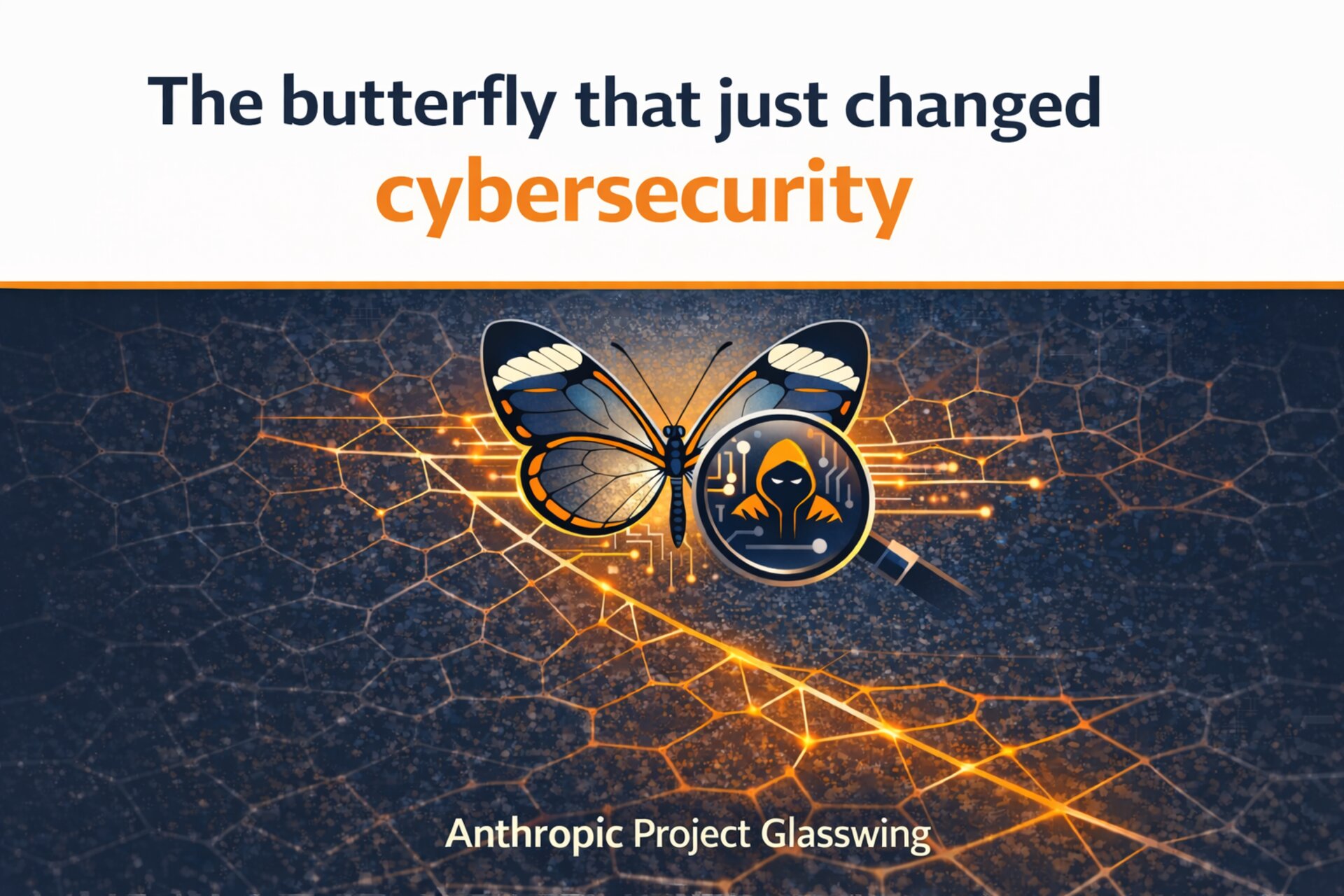
    Anthropic, the makers of Claude, has announced Project Glasswing, a joint effort with AWS, Apple, Google, Microsoft, Cisco, JPMorgan Chase, NVIDIA, Broadcom, the Linux Foundation, and 30 others. The name comes from the glasswing butterfly, Greta oto, whose transparent wings let it hide in plain sight. A fitting image, because that is exactly how software vulnerabilities live among us. Quietly. Unnoticed. For years.

    The reason these companies have come together is a new, unreleased model called Claude Mythos Preview. In just a few weeks of testing, it found thousands of previously unknown security flaws across every major operating system and web browser. One vulnerability had been sitting quietly inside OpenBSD for 27 years. Another lived inside FFmpeg for 16 years, in a piece of code that automated tools had tested over five million times without catching it. The model found most of these on its own, without anyone holding its hand.

    I have been around software long enough to know how rare this kind of moment is. It reminded me of an experience I shared in my book, Founder Catalyst. Years ago, during a Cricket World Cup, my team was running one of the largest online marketing campaigns of that era for a client. A small oversight in terms of securing our app during a deployment cost us an entire day of customer data. Thousands of leads gone. We owned the mistake, rebuilt the safeguards, and learned that resilience is something you design for, not something you hope for.

    That memory came rushing back as I read about Project Glasswing. If a careless deployment can do that much damage, imagine what an undiscovered flaw, hidden for two decades, could do in the hands of someone looking for it.

    The hopeful side of this announcement is that defenders finally have a tool that can keep up with the scale of the problem. The worrying side is that the same capability, in the wrong hands, will shrink the gap between a flaw being found and being exploited from months to minutes.

    So here is the real shift I want every founder and business leader to sit with. The era of auditing your enterprise software once a year with a consultant and a checklist is over. Your digital estate is far larger than you think. Old integrations. APIs nobody owns anymore. That internal dashboard, a developer built in 2019 and quietly left behind. A login flow that has not been touched in years. Each of these is now a doorway, and the cost for an attacker to find them has just collapsed.

    It is time to start using AI tools to look at your own software the way attackers soon will. Not someday. This month. Run AI-assisted reviews on your codebase. Map every digital asset you own, including the forgotten ones. Ask your security partners what their AI augmented testing roadmap looks like, and if they do not have a clear answer, that itself is your answer. This is no longer a job for one annual audit. It is a continuous practice, and AI is now both the threat and the shield.

    I wrote about this very angle last week, after the Mexico data breach, in which one person, likely working alone, walked away with data on 195 million people using Claude, ChatGPT, and a thousand prompts. That was the warning shot. Project Glasswing is the confirmation that the ground has shifted permanently. If you missed that earlier post, it is worth a read before this week ends.

    Like the glasswing butterfly, what hides in plain sight is often the greatest risk.

  • Avoiding AI Overkill: Right Tool for the Right Job

    Avoiding AI Overkill: Right Tool for the Right Job

    The most expensive mistake in AI adoption is not using it correctly. It is using it on the wrong problem.

    I spent 100 minutes and nearly 19,000 tokens asking Claude Code to clean up my Windows PC — old .NET runtimes, NVIDIA CUDA versions, Visual Studio build tools — figuring out what to keep, what to drop, what to upgrade.

    It worked. Mostly. With a lot of permission dialogs, a few course corrections, and some very patient clicking on my part.

    Then I realised: Bulk Crap Uninstaller and Winget, two free Windows tools, would have done the same job in under ten minutes.

    That is not a complaint about the AI. Claude Code did something genuinely impressive. It reasoned through a messy, undocumented environment and wrote shell scripts without me spelling out every step. That kind of judgment in ambiguity is a real capability.

    But I had handed a magic hammer to a problem that had always had a perfectly good screwdriver.

    The mistake is not reaching for AI when things get complex. It is reaching for it when things are complex but well-mapped. Those are very different situations, and most adoption decisions right now are not making that distinction.

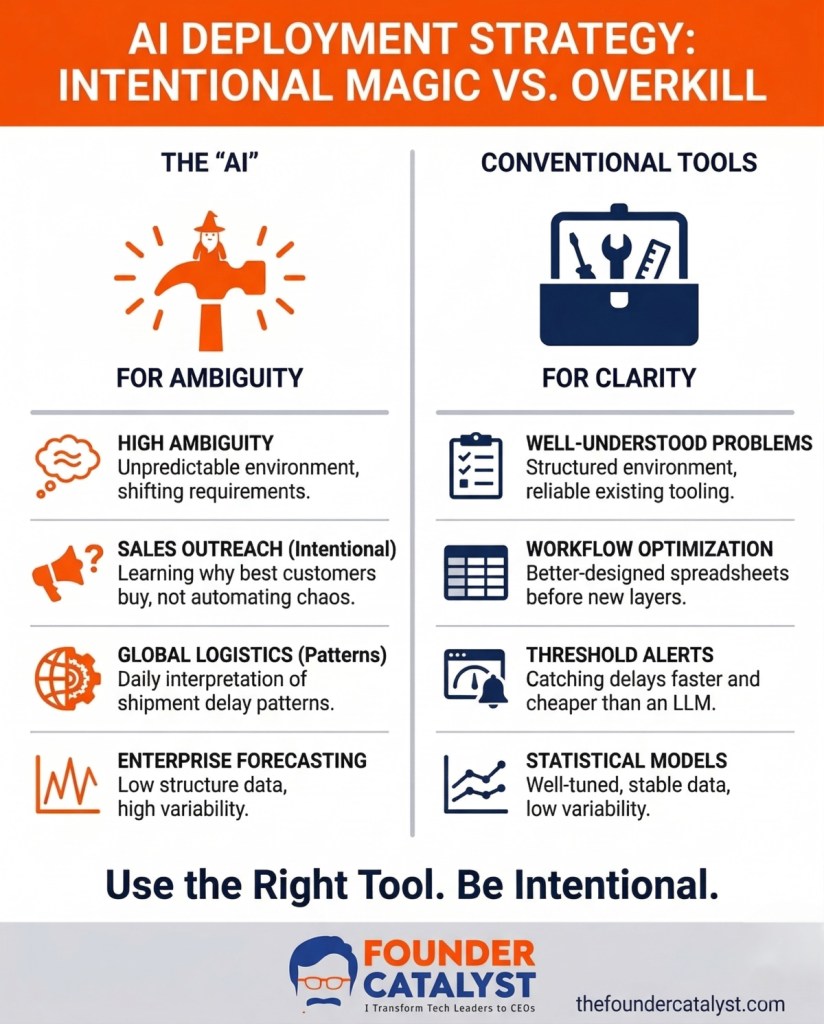
    LLMs are extraordinary when the environment is unpredictable, requirements are shifting, and no existing tool can handle the ambiguity. They are expensive, slow, and overkill when the problem is well-understood and reliable tooling already exists.

    This shows up everywhere. For founders, it is deploying AI agents for sales outreach before figuring out why your best customers actually buy. For operators, it is building an AI layer on top of a workflow that a better-designed spreadsheet would have solved.

    The pattern holds at scale, too. For global logistics teams, it is asking a model to interpret shipment delay patterns every morning, when a dashboard threshold alert would have caught the same issues faster and more cheaply. For large enterprises, it is routine to route quarterly demand forecasts through a model when the data is structured, the variability is low, and a well-tuned statistical model has always been the right tool.

    This is where the technology stands today. The boundary between what needs a model and what does not is shifting, and anyone who tells you it is fixed is not paying attention. The right answer next year may not be the right answer now. Stay curious, stay sceptical, and keep re-evaluating.

    Not every hard problem is ambiguous. And not every ambiguous problem needs a model.

    Use the magic deliberately.

    A comparison between artificial intelligence and conventional tools, illustrating the idea that not every complex problem requires AI, with a hammer and a toolbox depicted.
    Infographic comparing AI deployment strategies labeled 'Intentional Magic vs. Overkill', highlighting the use of AI for ambiguity and conventional tools for clarity. The left side lists AI applications like sales outreach and global logistics, while the right side covers conventional approaches like workflow optimization and statistical models. Includes a call to action to use the right tool intentionally.
  • Nobody owns this and nobody will admit it

    Nobody owns this and nobody will admit it

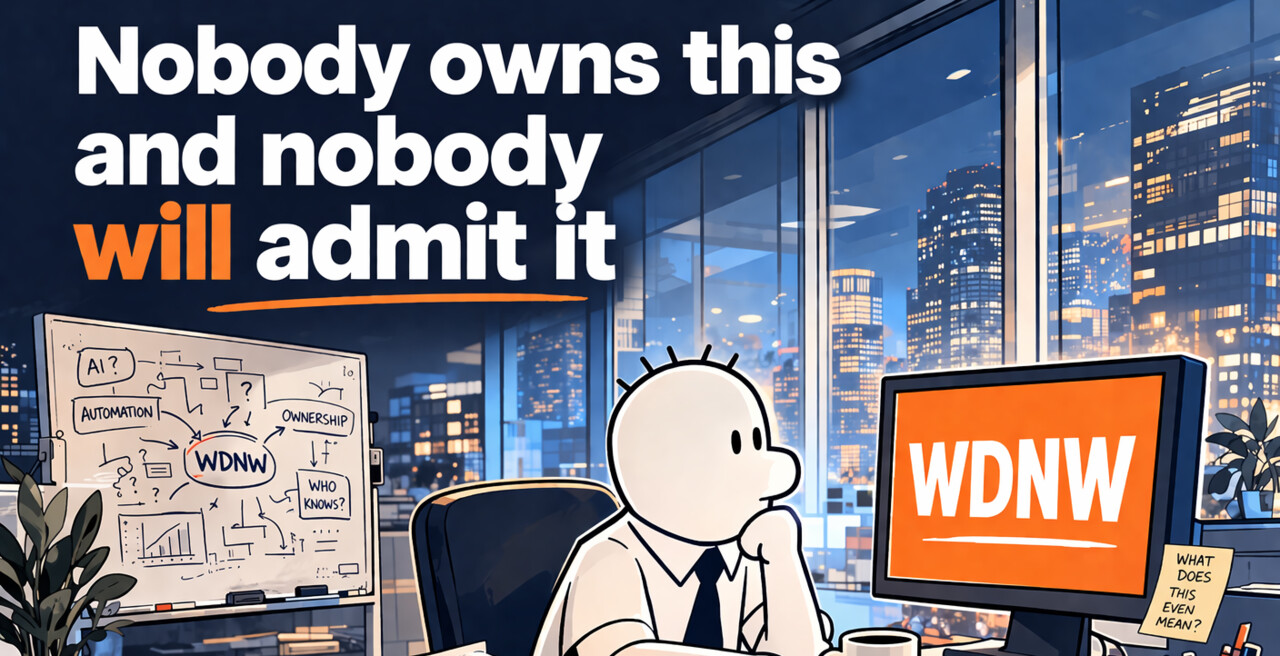
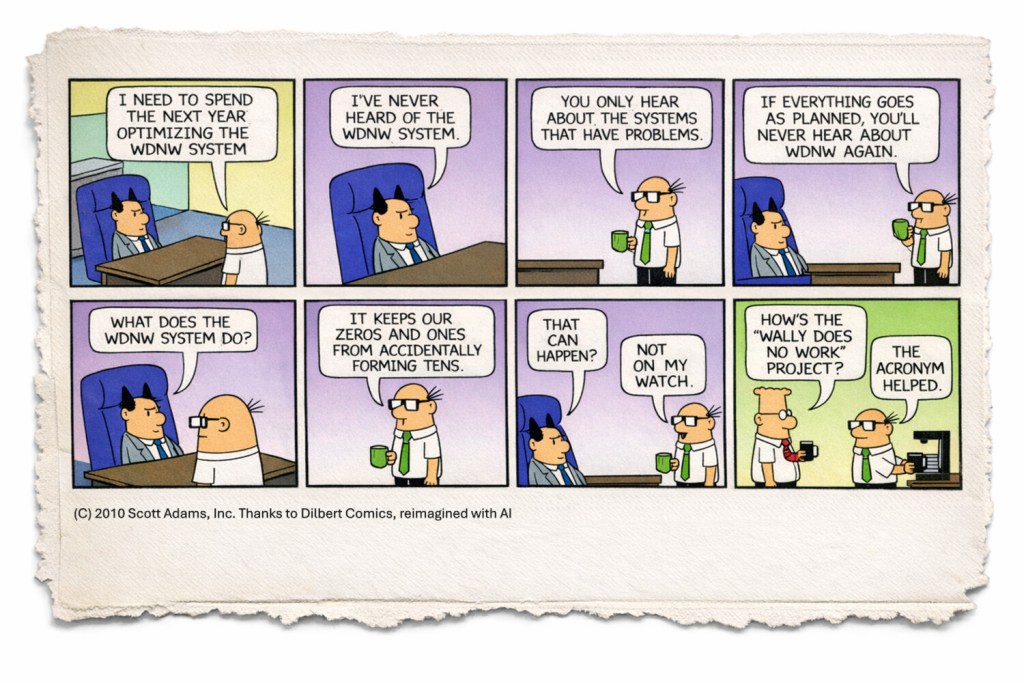
    Every organisation has a WDNW system. Most have several.

    A process that runs quietly in the background, consuming time and money, that nobody questions because it has never visibly broken. The moment someone asks what it actually does, the honest answer is usually some version of “we are not entirely sure, but we are afraid to touch it.”

    Every organisation has a WDNW system. Most have several.

    Startups are not immune to this. Technical debt accumulates faster than most founders realise. A workflow stitched together in year one, a third-party integration nobody remembers choosing, a report generated every Monday that nobody reads but everyone continues to produce. These are not dramatic failures. They are quiet drains.

    This is one area where I think AI genuinely earns the word superpower. Not in building new things, but in helping us see what already exists with fresh eyes. AI tools can now map workflows, surface redundancies, flag processes with unclear ownership, and help teams ask the question they were too busy or too hesitant to ask themselves: why are we still doing this?

    The best technical debt reviews are not always led by consultants or new CTOs brought in to shake things up. Sometimes all it takes is a founder sitting down with an AI tool and asking honest questions about their own workflows. No agenda, no politics, just a clear audit of what exists and why.

    And you do not need a fancy specialised auditing platform that costs a fortune to get started. Tools like Claude Code or GitHub Copilot are more than capable of helping you take those first steps. Start small, pick one corner of your codebase or one workflow, and go from there. Do not try to churn the ocean in one go. With frontier AI tools, there are no real experts yet. Everyone is figuring their way through. The important thing is to keep moving, keep experimenting, and keep learning, carefully and with guardrails in place.

    How many WDNW systems are hiding in your organisation right now? If you are not sure where to begin, I am happy to think it through with you.

  • Your competitors are going YOLO on AI, are you?

    Your competitors are going YOLO on AI, are you?

    This week, a quiet but important shift happened in the developer tools world. It hints at a wider change in how software itself will be developed and delivered.

    Microsoft announced that Visual Studio Code will now ship stable releases every week instead of monthly. Around the same time, developer tools from both Microsoft and Google began introducing a new capability inside coding assistants — AI agents that can act without waiting for human approval. In tools like Copilot and Gemini Code Assist, these agents can execute commands, modify files, retry failures, and continue working until they believe a task is complete. No hand-holding. No checkpoint at every step.

    Developers have started calling this “YOLO development.” The phrase borrows from the pop culture line “You Only Live Once“, and in this context means letting AI run without pausing for human sign-off at every turn. That may sound reckless. But beneath the humour, something real is changing — and for founders, the implications are worth understanding clearly.

    For most of the history of software companies, development velocity was a function of people. More engineers meant more output. Faster hiring meant faster product. The development loop — write, test, review, ship — was a human loop at every stage, and headcount was the lever you pulled when you needed to go faster. That assumption is quietly breaking down.

    What’s emerging looks meaningfully different. A human defines the goal, the constraints, and the expected outcomes. AI agents implement the changes. Automated systems run checks. Humans validate whether the result matches the intent. The human is still essential — but the role has shifted from executor to decision-maker.

    For a founder, that distinction matters enormously. It means the ceiling on your engineering output is no longer tied to the size of your team in the way it once was.

    But there’s a catch, and it’s worth being honest about it. AI can produce code across hundreds of files in minutes. That speed creates a new kind of problem: if the machine generates changes faster than your team can safely validate them, generation is no longer the constraint. Verification is.

    AWS CTO Werner Vogels calls this verification debt — the gap between how fast AI can produce changes and how fast an organisation can confirm those changes are correct, secure, and doing what was intended.

    This is where most companies will either pull ahead or fall behind. The bottleneck hasn’t disappeared. It has moved. And the founders who recognise where it now sits — and build systems around it — will have a structural advantage over those still thinking about AI purely as a way to write code faster.

    The deeper shift worth understanding is this: software engineering is moving from code-centric to specification-centric. Instead of writing every line, engineers define the objective, the boundaries, and the expected behaviour. The AI generates and iterates on the implementation.

    It happened in chip design decades ago. Engineers stopped drawing circuits by hand and began describing systems at a higher level of abstraction. The tooling handled the translation. Productivity leapt. The nature of the work transformed permanently.

    Software is entering the same phase now. The future isn’t YOLO. It’s AI on a leash — running fast, but you’re still holding the lead.

    For founders, this reframes the opportunity entirely. The question is no longer how do I use AI to write code faster. That’s a commodity improvement. The real question is: what can I now build that I couldn’t before — because development effort and cost are no longer the constraint?

    Some businesses will use this to go deeper into their existing product — adding complexity, personalisation, and capability that was previously too expensive to build. Others will use it to serve more customers without proportionally growing their team. Both are legitimate. Both represent compounding advantages that don’t show up immediately but become significant over eighteen to thirty-six months.

    The metrics to watch are not about AI adoption. They’re about business outcomes. Has the turnaround time of a key workflow come down? Has the team’s capacity to serve clients increased without a corresponding increase in cost? Has resolution time improved? Has your release cadence changed? These are the numbers that eventually show up in revenue, margins, and growth — and right now, most founding teams aren’t measuring them with enough discipline.

    So the real question isn’t whether your developers are going YOLO. It’s whether you, as a founder, are willing to go first.

  • AI Is Here. Now What?

    AI Is Here. Now What?

    The Ultimate Playbook for the Resilient IT Services CEO

    If you are running a mid-sized IT services firm today, you know the ground is shifting. You are part of a resilient industry that has survived COVID, remote work transitions, resource crunches, double-digit attrition, and geopolitical upheavals. Now, just as you are catching your breath, comes the most unsettling wave of all: artificial intelligence.

    In the next 6 to 12 months, your job is not to build “rigid forecasts”. Your job is to filter the hype, preserve your profits, and refuse to bet your company on speculative projects. The real churn is coming in the mid-term—contracts will be renegotiated, and maintenance work will shrink. Only the firms that adapt their business models now will come out stronger.

    The Ultimate Playbook the Resilient IT Services CEO
    The Ultimate Playbook for the Resilient IT Services CEO

    1. Operations & Financial Discipline: The Next 6–12 Months

    Winning this transition isn’t about playing defence; it’s about ensuring you have the financial fuel to cannibalise your own revenue before a competitor—or an AI agent—does it for you. That level of aggression requires ruthless efficiency today, not chasing “future riches” on borrowed time or capital.

    • Elevate Beyond Code Gen: Your engineers are already using AI to write code. You must now require the use of AI agents to massively increase testing coverage, stress testing, and deployment speeds. This delivers a significantly better, more resilient product to the client at zero additional infrastructure cost.
    • Strict Financial Preservation: Prioritise profits and save your cash reserves. Do not take on debt or run at a loss for speculative AI projects in the hopes of future riches.
    • Zero Free Work: Refuse to do unpaid AI Proof of Concepts (PoCs). Do not undercut your pricing just because a requirement document is filled with AI buzzwords. Any effort your team puts in must be compensated fairly.
    • Cap Experimentation: Provide the latest AI tools, but mandate that usage is reviewed. Ensure learning does not consume more than a single-digit percentage of your team’s time so you can deliver current projects without extra manpower.
    • Be Brutal with Right-Sizing: Review your team size and expenses every month. There is no virtue in holding a large bench. Scrutinise every timesheet to see what roles can be automated by AI agents.

    2. Strategy: Talent & Client Management

    Stop asking “How do we use AI?” and start defining what moat you actually provide to your clients.

    • Filter Hype and Temper Marketing: Take predictions from frontier AI labs with a grain of salt; much of it is self-fulfilling prophecies. Do not let your marketing team claim expertise in every AI technology (LLMs, MCPs, agents), as clients will see there is no real differentiation. Project your true niche experience and affordable rates.
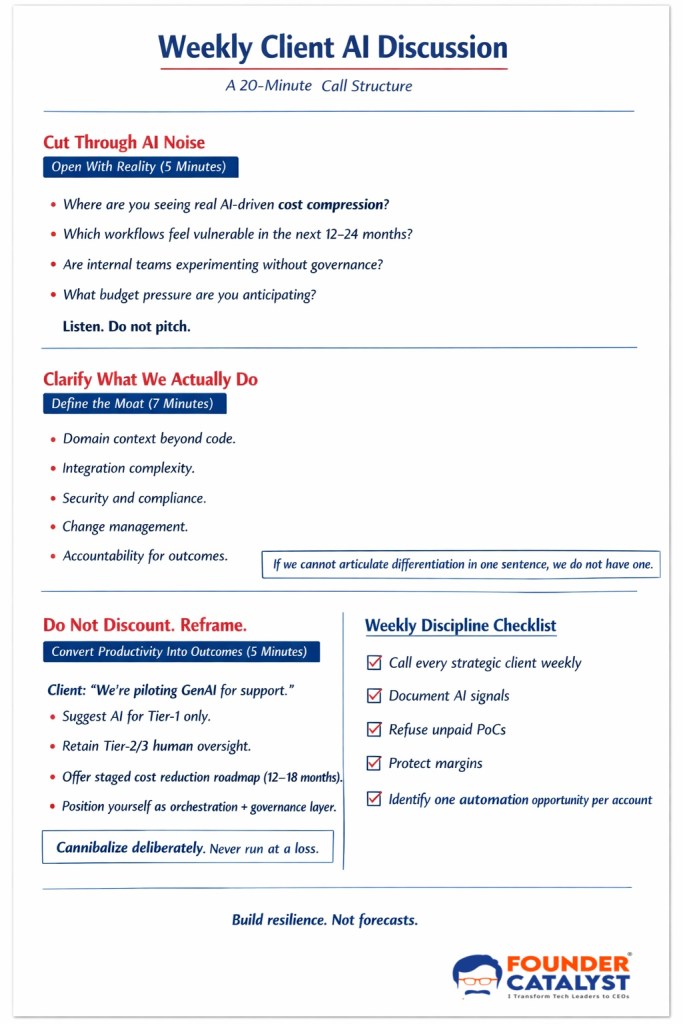
    • Over-Communicate: Call every single client weekly. Listen carefully to their specific fears and successes with AI. When asked, be transparent about your successes and failures with AI. Here is a sample template for these Weekly Client AI Discussion calls to keep them focused. It moves the conversation away from buzzwords and toward the “moat” you are offering. (See the attached infographic)
    • No Mandates or Panic Firings: Avoid top-down AI mandates—they do not work. Likewise, do not let go of good talent simply because you see knee-jerk trend reductions in the rest of the industry.
    • Hire AI-Native Engineers: Avoid paying massive premiums for lateral AI hires, save for a couple of key, hands-on experts. Instead, hire affordable, AI-native, fresh engineering graduates who are already exposed to these workflows. Value honesty and the ability to learn fast over pre-existing knowledge.
    Template for the Weekly Client AI Discussion
    Template for the Weekly Client AI Discussion

    3. The Pivot: Contracts & Service Evolution (1–3 Years)

    If you stay on Time & Materials (T&M) contracts, you are handing all your productivity gains back to the client.

    • Shift to Outcome-Based Pricing: You must urgently move your Time & Materials (T&M) contracts to outcome-based pricing. This is the only way for clients to see the financial benefits of your internal AI productivity gains immediately.
    • Cannibalise Your Own Revenue: Approach your champion clients now with radical cost-saving ideas—up to 50% or more. Identify legacy apps and systems that AI can automate and/or eliminate. If you do not do this, your competitors or an AI agent will do it for them. However, never agree to work at a loss for maintaining current run rates.
    • Pivot to Orchestration, Not Products: Resist the urge to divert R&D resources into building proprietary AI SaaS products or enterprise apps just because you can. Enterprise CXOs are shifting toward “build” rather than “buy,” and you lack the deep pockets required for marketing distribution. Instead, focus on integrating and orchestrating custom bots and agents for enterprises, managing change processes, and providing industry context.
    • Capitalise on Sovereign AI: Governments are treating AI as a national security issue. Use this shift to help enterprises implement localised, sovereign AI infrastructure and diffusion.

    4. Long-Term Strategic Moves (3+ Years)

    • Strategic Maturity: If your firm is profitable and holds domain expertise, be open to external investment or acquisition. Larger businesses will be looking to strengthen their portfolios during this transition, and being open to this is a sign of strategic maturity, not weakness.
    • New Industry Openings: Generative AI is going to lower barriers to entry in traditionally closed-off industries like film and media. Be ready to walk through those doors and serve those industries in entirely new ways when the disruption creates opportunities.

    Build Resilience, Not Forecasts

    From where we stand today, it is impossible to see the distant future clearly, as transformative technologies take time to diffuse within enterprises. AI itself will keep evolving well beyond current (large language) models, gaining capabilities that are hard to imagine right now.

    Because timing and execution determine who survives a transition, it is far wiser to build organisational resilience than to rely on rigid forecasts. If you navigate this transition with discipline, we will look back at this period in 2030 and be proud of a job well done.

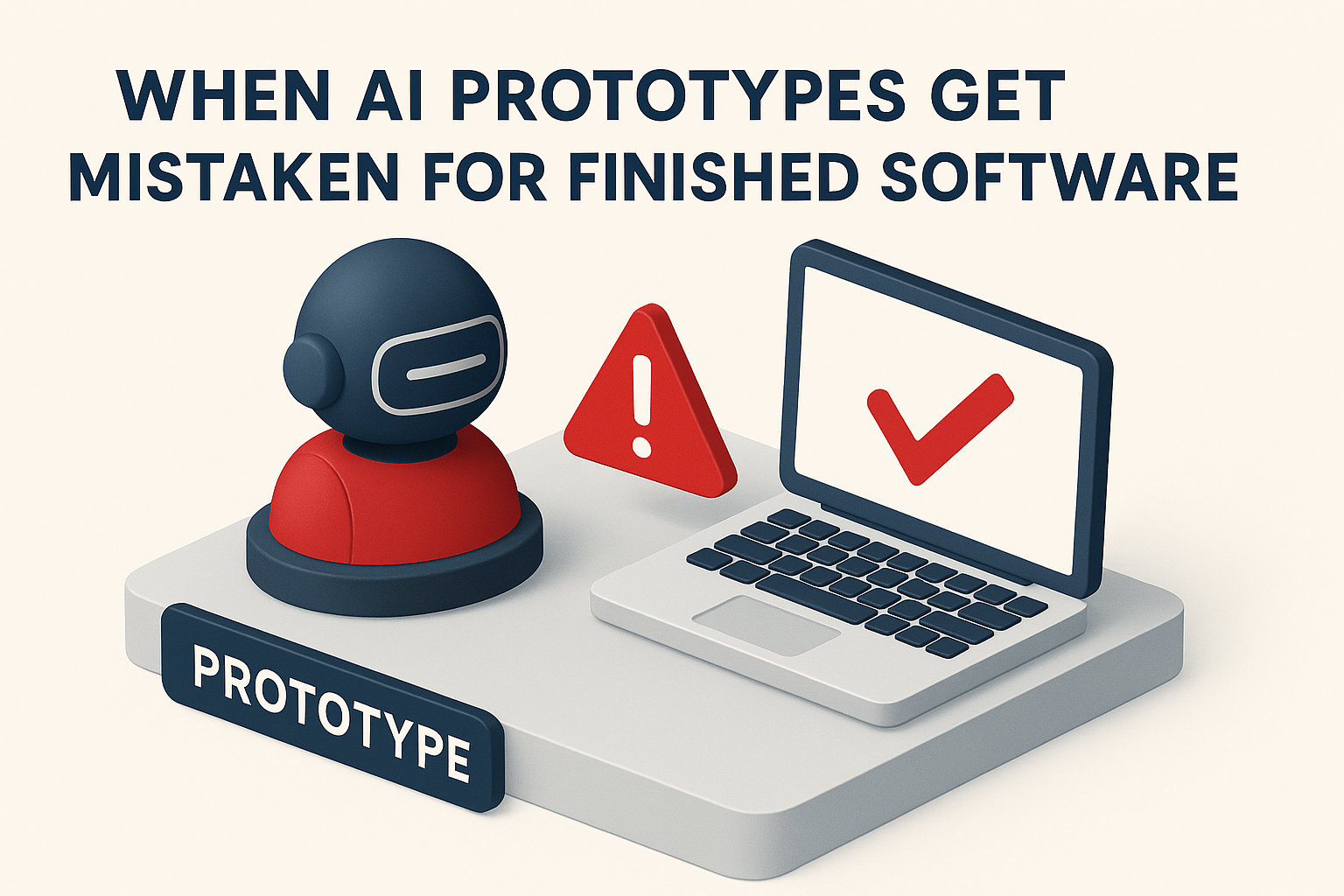
  • When AI prototypes get mistaken for finished software

    When AI prototypes get mistaken for finished software

    Over the last few months, I have been noticing a pattern in many organisations experimenting with AI. A recent experience brought this out clearly and reminded me why we still need basic engineering discipline even in this new world.

    A client reached out to the team I was consulting for a proposal to redevelop a Python application and deploy it on Microsoft Azure. One of their business leaders had created the first version using an AI tool. Since it ran in the browser, the team assumed it was ready for production. When we looked at the files, all we received was a saved webpage (HTML) and part of a Python script. The backend logic, code, DB schema, JavaScript and other supporting pieces were missing, so we had no clue what the prototype was meant to do.

    There is nothing wrong in using AI tools like Gemini, Claude or ChatGPT to sketch ideas or validate a workflow. They are wonderful for quick iteration and early exploration. The problem starts when something generated in an AI chat window gets treated as a complete software product.

    To build anything that will run securely and reliably inside an enterprise, we still need clarity on the basics. The objective and the business case. The inputs and outputs. The user roles and the workflow. A simple specification. Some understanding of data flow, security and integration needs. Access to the original AI chat sessions also helps. These are not paperwork. They form the bridge between what was intended and what needs to be built.

    AI can speed up development, but it does not remove the need for engineering rigour. Systems still need to be stable, scalable and secure.

    As more leaders experiment with AI, keeping this distinction in mind will save time and frustration for everyone. Prototypes are a good beginning, not the final product.

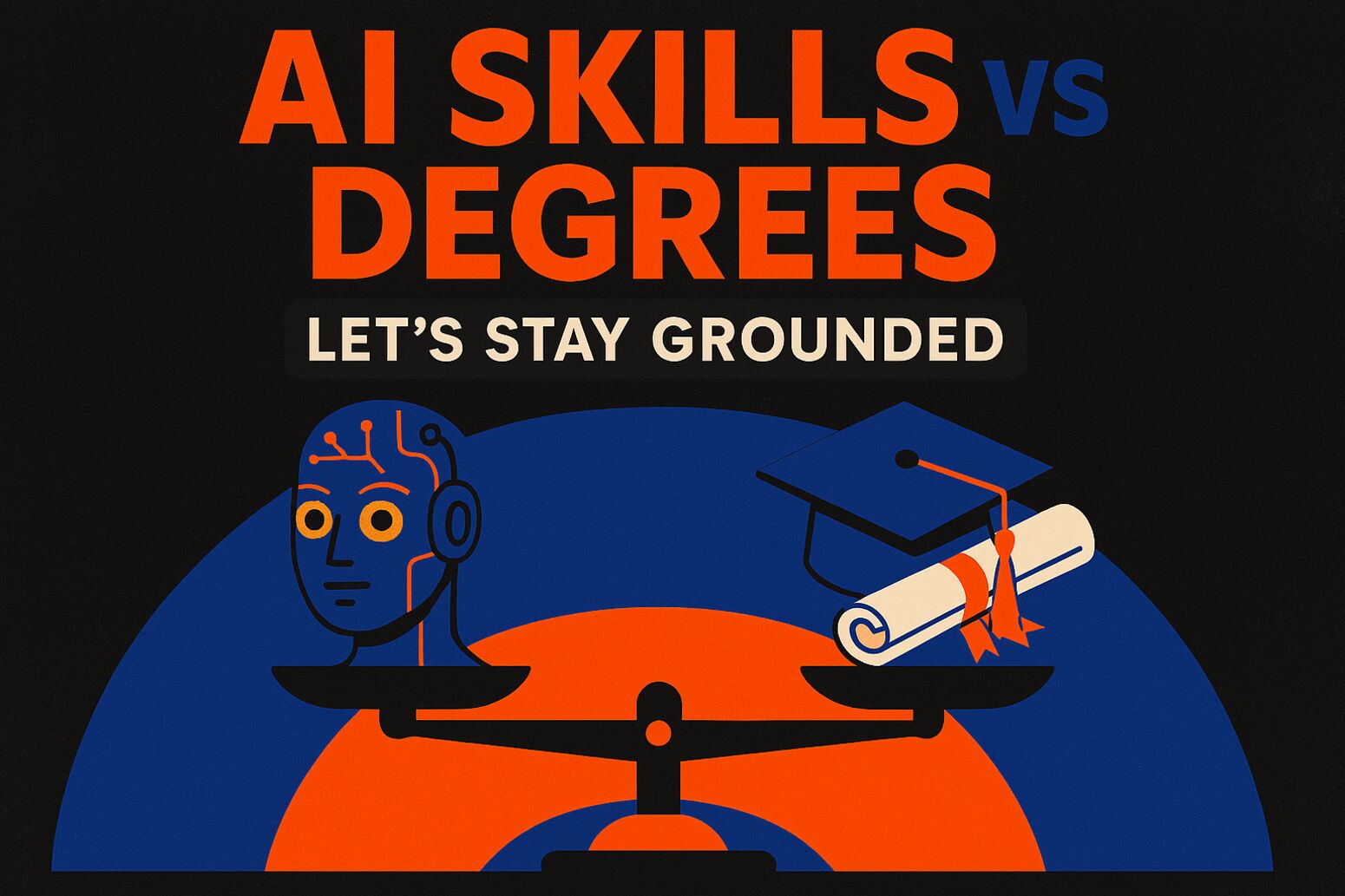
  • The Future of Work: AI Skills vs Degrees – Let’s Stay Grounded

    The Future of Work: AI Skills vs Degrees – Let’s Stay Grounded

    Recently, Ryan Roslansky, CEO of LinkedIn, said that “the future of work no longer belongs to those with the fanciest degrees or who studied at the best colleges, but to those who are adaptable, forward-thinking, and ready to embrace AI tools.” It’s an important reminder of how fast the world of work is changing. But I’d like to add a word of balance for students — especially in a country like India. Please don’t take such statements literally as a reason to stop pursuing education. In a growing economy like ours, formal learning remains a lifelong asset. Even in an AI-driven world, education is still the most reliable path to improving one’s quality of life — ethically and sustainably. Many such statements, though well-intentioned, tend to amplify the aura around AI — sometimes to promote platforms, products, or investments. Even the most sincere innovators can fall in love with their own creations and overestimate their reach. I use AI every day. I read, write, and advise on it constantly. Yet I can say this with conviction — no matter how advanced AI becomes, a strong academic foundation and disciplined learning will always matter. Anyone who tells you otherwise is not being fully honest. Let’s embrace AI with curiosity, but hold on to education with conviction. The future belongs to those who can balance both — grounded in knowledge, guided by values, and open to change.
  • Running Generative AI Models Locally Is Now Easy

    Running Generative AI Models Locally Is Now Easy

    Want to explore Generative AI without sending your data to the cloud? Running models locally on your PC or Mac is now surprisingly simple.
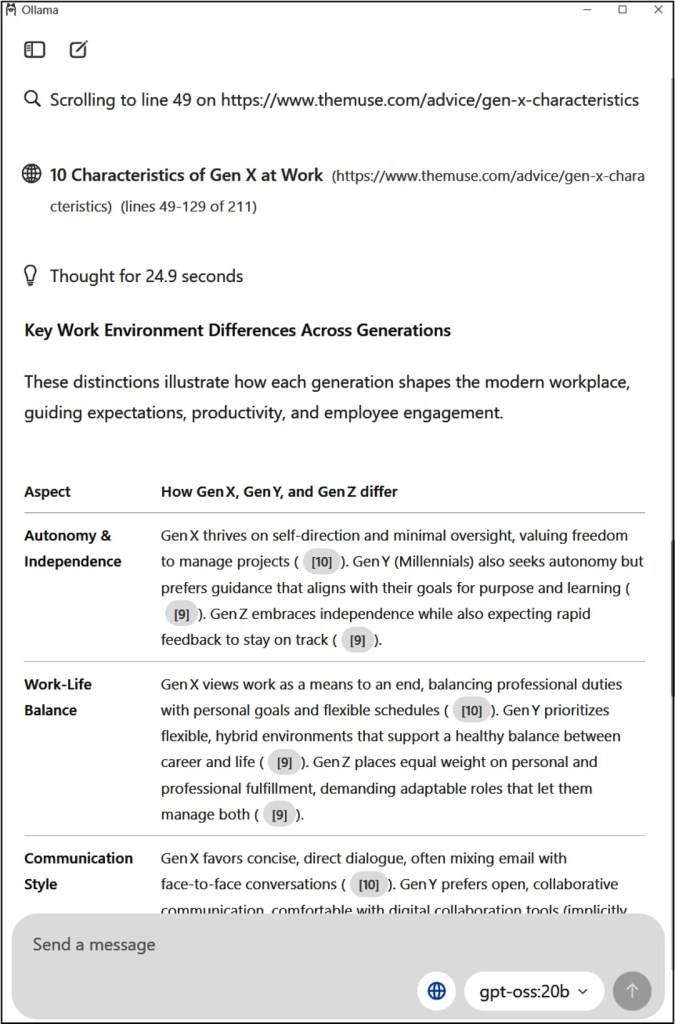
    Start with Ollama, a lightweight framework that makes it easy to run AI models locally on your computer. It supports both open-weight models and open-source models. Together, these models have made hands-on AI experimentation accessible to anyone with a capable machine, without depending entirely on cloud APIs. Ollama recently added a clean, chat-style desktop app to its command-line interface. I’ve been testing OpenAI’s GPT-OSS 20B open-weight reasoning models, which run locally through Ollama and even support limited web search. For routine tasks — summarising, drafting, quick analysis — it’s remarkably capable.
    Sample Output from GPT-OSS model running locally in a PC with Ollama
    Sample Output from GPT-OSS model running locally on a PC with Ollama
    Another option is Msty Studio, a free tool (for non-commercial use) that gives a visual interface to run these open models on your system. It connects seamlessly with Ollama and supports models from Hugging Face. Ideal for hands-on experimentation before making big AI bets. Why does this matter for founders and CEOs? 1. Data Privacy and Control – Running locally means your business data never leaves your system. For regulated industries, that’s a real advantage. 2. Independence and Learning – Most AI transformations rely on commercial APIs. Testing open models locally helps your team learn, experiment safely, and reduce vendor dependence. 3. Strategic Experimentation – Founders who explore AI hands-on make sharper choices about when to buy, build, or partner. It’s the difference between hearing about AI and understanding it. Two things to note: 1. Large models need powerful hardware — GPUs with high VRAM or plenty of system memory. 2. “Open” doesn’t mean “risk-free.” You’ll handle updates, licenses, and security yourself. Local AI isn’t replacing the cloud — it’s giving leaders another layer of control and insight. I cover these shifts — from cloud dependence to local AI — in my keynotes for decision makers. To invite me for a corporate talk, contact Kural at leadership@kuralkonnect.com
  • AI can draft your email, not your strategy

    AI can draft your email, not your strategy

    The UK government recently published an evaluation of Microsoft 365 Copilot after running a pilot across 1,000 employees in the Department for Business and Trade. The findings are refreshingly honest—and deeply relevant for founders.

    The results show Copilot is very good at what I call the “work hygiene” layer.

    Drafting emails, summarising meetings, cleaning up documents—these were faster, easier, and often of higher quality with Copilot. Employees reported high satisfaction:

    72% said they were happy with the tool, and many felt its absence when the trial ended.

    But when the task demanded nuance or contextual judgement, the cracks showed. Excel analysis was slower and less accurate. PowerPoint decks were created more quickly but to poorer quality, requiring rework.

    The conclusion was clear: satisfaction went up, but productivity did not.


    For founders, there are three lessons here.

    First, AI excels at removing drudgery. That is no small thing. Routine admin has always been a hidden tax on teams. Freeing up even 20 minutes a day compounds into time for deeper work or simply sharper focus. Some pilot users said the time saved let them step away for training—or even a walk at lunch. That matters.

    Second, AI amplifies, but it doesn’t substitute judgement. In my own work, I use ChatGPT and Copilot daily. They are brilliant partners for ideation, rewriting, or testing a line of thought. But the final call—the decision that affects people, customers, or strategy—cannot be outsourced. That requires context, empathy, and leadership.

    Third, the human multiplier effect. The study found neurodiverse colleagues and non-native English speakers benefitted significantly. This shows that AI’s value is not just in efficiency but in accessibility. As founders, we should recognise this and design adoption in ways that genuinely empower people.

    In my book “The Founder Catalyst” [https://mybook.to/foundercatalyst], I argued that leadership is not about doing more, it is about doing what matters. AI gives us breathing space. The question is how we use it. Do we fill the gap with more low-value work, or do we redirect it towards strategy, empathy, and leadership—the places only humans can thrive?

    AI today is not a magic productivity machine. It is a capable assistant, still learning.Treat it as such, and it can make your organisation more thoughtful and more resilient. Expect it to replace human judgement, and you will be disappointed.


    The full report, “The Evaluation of the M365 Copilot Pilot in the Department for Business and Trade, UK”, is here:

    https://assets.publishing.service.gov.uk/media/68adbe409e1cebdd2c96a19d/dbt-microsoft-365-copilot-evaluation.pdf


    For AI keynote inquiries, reach Kural through WhatsApp or write to v@thefoundercatalyst.com.

  • ChatGPT messed up the script of my AI talk!

    ChatGPT messed up the script of my AI talk!

    Generative AI tools like ChatGPT are a huge productivity booster. I use them daily as a writer and speaker. But here’s what I’ve learnt the hard way: they are not magic lamps, and when not handled correctly, they can take you further away from your own voice. When I was preparing for my talk on “How AI can coach Gen Z and Gen A to lead”, I started with my outline and gave it to ChatGPT for expansion. Instead of polishing my ideas, it kept rearranging the flow and adding new ones. After a few iterations, the draft looked polished, but it no longer sounded like me. It was generic and stripped of the personal experiences I wanted to share with founders and CEOs. So, I went back to basics. Whiteboard, pen and paper, rehearsal recording. Then I brought AI back into the process differently: I used it to transcribe my rehearsal, give me feedback, identify the low points, validate the ideas, and suggest improvements. This time, AI became a coach rather than a ghostwriter—and the final talk landed well with the audience. That’s the point I want to leave with founders: AI is excellent for ideation, for breaking a blank page, or for polishing drafts into the right tone. But it can’t replace your lived experience. If you let AI own the core of your message, you risk becoming a parrot of machine text. Your value as a founder is in bringing your own stories, scars, and convictions to the table. In my book The Founder Catalyst, I argue that the future of leadership is about combining technology with what humans do best—strategy, empathy, and authenticity. The same principle applies here: let AI make you sharper, not faceless.
  • How AI Can Coach Gen Z and Gen A to Lead?

    How AI Can Coach Gen Z and Gen A to Lead?

    How technology can accelerate the leadership journey of next-gen leaders

    Every senior leader I meet—whether in a boardroom in Bengaluru, a startup hub in Chennai, or a CEO retreat in Singapore—shares the same worry. The leadership pipeline is thinning. The first line is often strong: functional heads, seasoned managers, directors who know the business well. But the second line? That is where the silence falls.

    We expect Gen Z, and soon Gen Alpha, to fill that gap. They are bright, digital-first, and fearless in experimentation. But leadership is not built on digital fluency alone. It requires judgment, resilience, and confidence—qualities that usually take years to grow. The question is: can AI accelerate that journey?

    Part One: AI as a Coach for Gen Z and Gen A

    In my book The Founder Catalyst, I argued that every CEO needs a mentor. Feedback and course correction cannot wait for an annual review; it has to be continuous. The same holds true for young leaders. AI can step into this role—not replacing human mentors, but acting as an always-on coach.

    1. Practice Before It Matters

    Harvard Kennedy School research shows that behaviour in AI-led simulations often predicts how the same individual performs in real groups. In short: practising leadership with AI makes you better at practising it with people. AI provides safe spaces to try tough conversations, rehearse boardroom pitches, or negotiate under pressure—without the career risk of failing in public.

    2. Build by Doing

    Gen Z and Gen A are builders. They don’t want to just consume; they want to create. Razorpay understood this and did something unusual: they asked every leader—finance, HR, marketing—to build something with AI, not just the engineers. No spectators, only hands-on creation. The head of marketing won by prototyping an AI-powered customer support tool. The lesson was not the tool, but the shift in confidence. Leaders began asking: “Why should this take three weeks? I can do this in a day with AI.”

    3. Everyday Empowerment

    Leadership is not only about big strategy moments; it is about everyday initiative. At Zerodha, a business analyst—not an engineer—used AI to automate accounting checks, freeing up hours. That small act is what second-line initiative looks like when empowered. With AI, even non-technical leaders can step up, experiment, and contribute beyond their job description.

    4. Feedback Without Delay

    This is where AI truly shines. Imagine a 24/7 sparring partner: always available, always patient, never judgmental. With data drawn from emails, calls, presentations, and projects (handled responsibly and with consent), young leaders can get real-time insights. It’s like a coach whispering in the background, nudging them to improve.

    Think of it as a feedback loop with three faces:

    • Mentor – guiding and suggesting.
    • Sparring partner – challenging and stress-testing.
    • Mirror – reflecting back strengths and weaknesses clearly.

    All three reinforce the same principle: leadership skills grow when practised, not when observed.

    Part Two: How CEOs Use AI to Build the Second Line

    Leadership coaching for individuals is powerful. But to solve the pipeline problem, CEOs must think in systems. AI can help here in three critical ways: hiring, mobility, and succession.

    1. Smarter Hiring with Skills at the Centre

    Too often, hiring depends on pedigree—degrees, titles, brand names. AI enables a shift to skills. By analysing candidates’ work samples, projects, and problem-solving patterns, AI can surface people who may not look impressive on paper but can perform and adapt in practice.

    This widens the talent pool, makes hiring fairer, and ensures organisations don’t miss out on hidden gems. AI-assisted assessments can also reduce bias when designed carefully, focusing on skills and outcomes instead of background.

    2. Internal Mobility and Talent Marketplaces

    Retention is the hidden cost of leadership failure. Young employees don’t leave because of pay alone; they leave when they don’t see growth. Schneider Electric faced this problem head-on. They launched an AI-powered internal “open talent marketplace.” Within two months, 60% of employees had signed up, unlocking 127,000 hours of hidden talent. Thousands explored new roles inside instead of leaving.

    Practical moves for any CEO:

    • List ten real projects needing help for four to six weeks.
    • Let AI match volunteers by skills and goals.
    • Recognise managers who release talent for these gigs—they are building your bench.

    Mobility lets young leaders “try before they leap.” They test themselves, find fit, and build networks across functions. And the organisation saves both time and trust.

    3. Succession as a Living System

    Succession is not about filling a chart with names. It is about ensuring the organisation is ready when leadership gaps appear. AI allows succession planning to become real-time:

    • Tracking skills and leadership readiness across levels.
    • Predicting who could step into new roles.
    • Simulating scenarios—who can lead if a key person leaves suddenly.

    This makes succession dynamic and evidence-driven, not a once-a-year ritual. As Google DeepMind’s Nicky Vallelly puts it: “Gen Z values learning and development opportunities. If you’re not investing in their growth, you will not hold them.” AI makes that investment visible and consistent.

    Balancing AI with Human Leadership

    Let’s be clear: AI cannot replace human qualities. Leadership still needs empathy, ethics, and wisdom. Gartner calls the most effective leaders of the future “Human Leaders”—authentic, empathetic, adaptive. AI can sharpen skills, but only human mentors can model care, trust, and flexibility in the real world.

    The role of the CEO is to set these ground rules:

    • Use AI for data and insights.
    • Ensure transparency and fairness in every process.
    • Keep humans responsible for final judgment.

    Three steps you can begin tomorrow:

    1. Adopt skills-based hiring and experiment. Move beyond degrees and titles, and run small AI pilots—mock interviews, leadership simulations, or feedback loops.
    1. Make growth visible. Build an internal marketplace, even simple at first. Map who is ready, who is next, and support them.
    1. Model what machines cannot. Authenticity, empathy, adaptability—these must come from leaders themselves.

    Reflection

    The leadership pipeline is thinning, but the tools to fix it are here. For Gen Z and Gen A, AI is a mentor, sparring partner, and mirror. For CEOs, it is a system for fairer hiring, smarter mobility, and living succession.

    The future will belong to leaders who learn to work with AI—not as a crutch, but as a partner in growth. With AI as coach and CEOs as enablers, tomorrow’s leaders can step forward—with confidence and clarity.

    Article content
  • AI is eating your profits

    AI is eating your profits

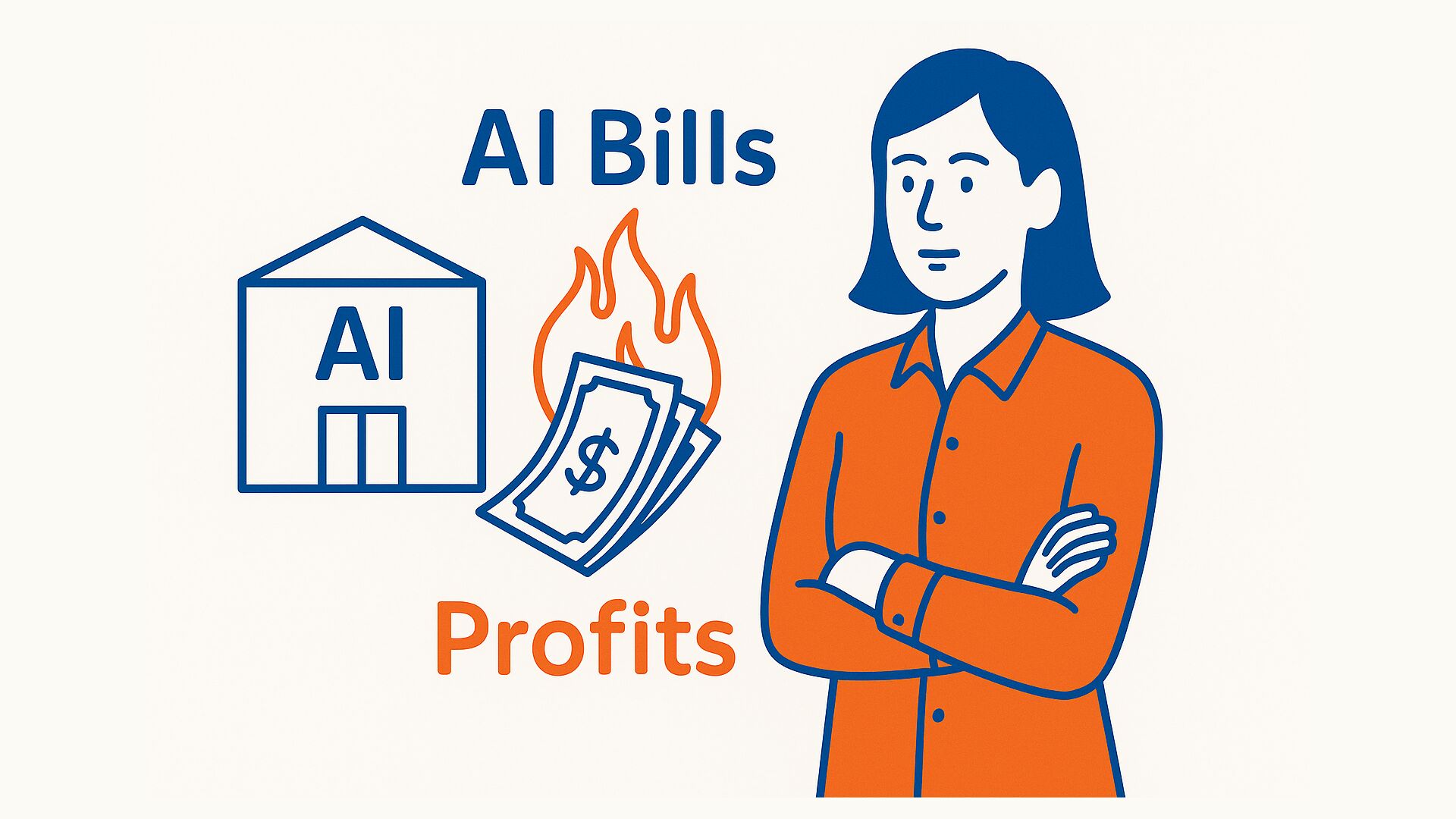
    Notion’s CEO recently revealed that 10% of their profits now go towards AI bills. That’s a significant shift for a SaaS company—and a warning sign for founders.

    AI was supposed to get cheaper. Instead, it’s becoming a major expense. The latest models are smarter, yes, but they also consume far more tokens. Especially when used for agent workflows, deep research, or coding tasks, the costs can spiral quickly.

    As a founder, you don’t always need the most advanced model. With clever prompts and a bit of experimentation, your team can often achieve great results using smaller or open models. This isn’t just about saving money—it’s about designing solutions that fit your business needs.

    From my book Founder Catalyst, I’ve written about the hidden costs of adopting new technologies. With AI, these include:

    1. Time spent learning new tools and interfaces
    2. Integration challenges across teams
    3. Legal risks from unlicensed datasets
    4. Vendor lock-in and platform dependency

    AI can bring productivity and a competitive advantage. But it must be implemented with clarity and expertise.

    Design before deploy. Profits still matter.

    If you’re a founder or CXO thinking of scaling AI across your organisation, don’t do it blindly. AI is not just another tool—it’s a shift in how your teams think, build, and deliver. But without the right guidance, it can also become a costly distraction.

    As a founder and CEO, with over 30 years in tech and a front-row seat to every major platform shift—from desktop to mobile to cloud—I help leaders cut through the noise. My keynotes and masterclasses are not about hype. They’re about clarity, context, and practical frameworks your team can act on.

    Let’s talk if your team needs:

    • A clear-eyed view of what AI can (and can’t) do
    • Real-world examples of how startups and enterprises are using AI
    • A roadmap to adopt AI responsibly, without burning budgets

    You don’t need more AI tools. You need better AI thinking.

    For keynote inquiries, call Kural through WhatsApp or write to v@thefoundercatalyst.com.