I was interviewing a student from VIT Bhopal for an internship. Somewhere in the conversation, she mentioned a course called Technology Entrepreneurship. I asked her to show me the syllabus.
It read like a list of things I wish someone had told me three decades back.
I finished my engineering degree knowing electronics and how to write code. I did not know how to read a balance sheet. A profit and loss statement made no sense to me either. Taxation was worse. So I read what books I could find and worked it out as I went. There was no other way to run a company. I have written about this in my book, The Founder Catalyst.
What stayed with me was not the mistakes I made while catching up. It was the time it took. Every hour I spent understanding the numbers was an hour I did not spend on the product. I was an engineer who wanted to solve problems, and a good part of my energy went into things nobody had taught me.
Her syllabus talks about customers and whether they really want what you are building. It talks about protecting what you build. It talks about money, about incubators and government support, and about selling across borders. I learnt each of these the hard way.
A large client once came to us because of a small tool we had built. They were using it in ways I had never imagined. About twenty years ago, we built a content management system for news and media companies. We charged a licence fee on top of our services. The market did not like it. We ended up giving the system away as part of the service. I found out what customers would pay for only after the product was built.
My first product was EasyPass, a shareware security tool that found buyers in over fifty countries. One of my early collaborators took a copy of the code and began selling it as his own. I learnt of it only afterwards. No one had taught me anything about intellectual property before that day.
Around 2007, I expanded into the US and the UK at the same time, and I borrowed to do it. Growth came before the reserves. It was a close call. Today’s founders step into a far more supportive ecosystem than the one I began in. Incubators, angel networks and government schemes exist now. That support helps only a founder who knows about it.
Let me be fair to the classroom. It is not the field. Forty-five hours of lectures cannot teach what a first customer saying no will teach. Students will still learn the hardest parts by doing them. But there is a difference between meeting these ideas cold and meeting them as old acquaintances.
These are the engineers who will join your teams over the next few years. A college like VIT Bhopal now teaches this in a full semester course. They will arrive with cash flow, customers, patents and markets already in their vocabulary. I expect the questions in your review meetings to get better.
Founders have something to offer here. Internships and mentoring hours give students the practice a lecture hall cannot. I head the mentoring programme at TiE Chennai. We see young startups welcoming the initiative and finding it useful. I suspect students would feel the same.
An engineer’s attention is the scarcest thing a young company has. I spent a good part of mine catching up on basics. If a classroom can spare the next generation that effort, they can put it into the problems they care about. I learnt these words by making mistakes. They will learn the words first, and spend their mistakes on harder problems.
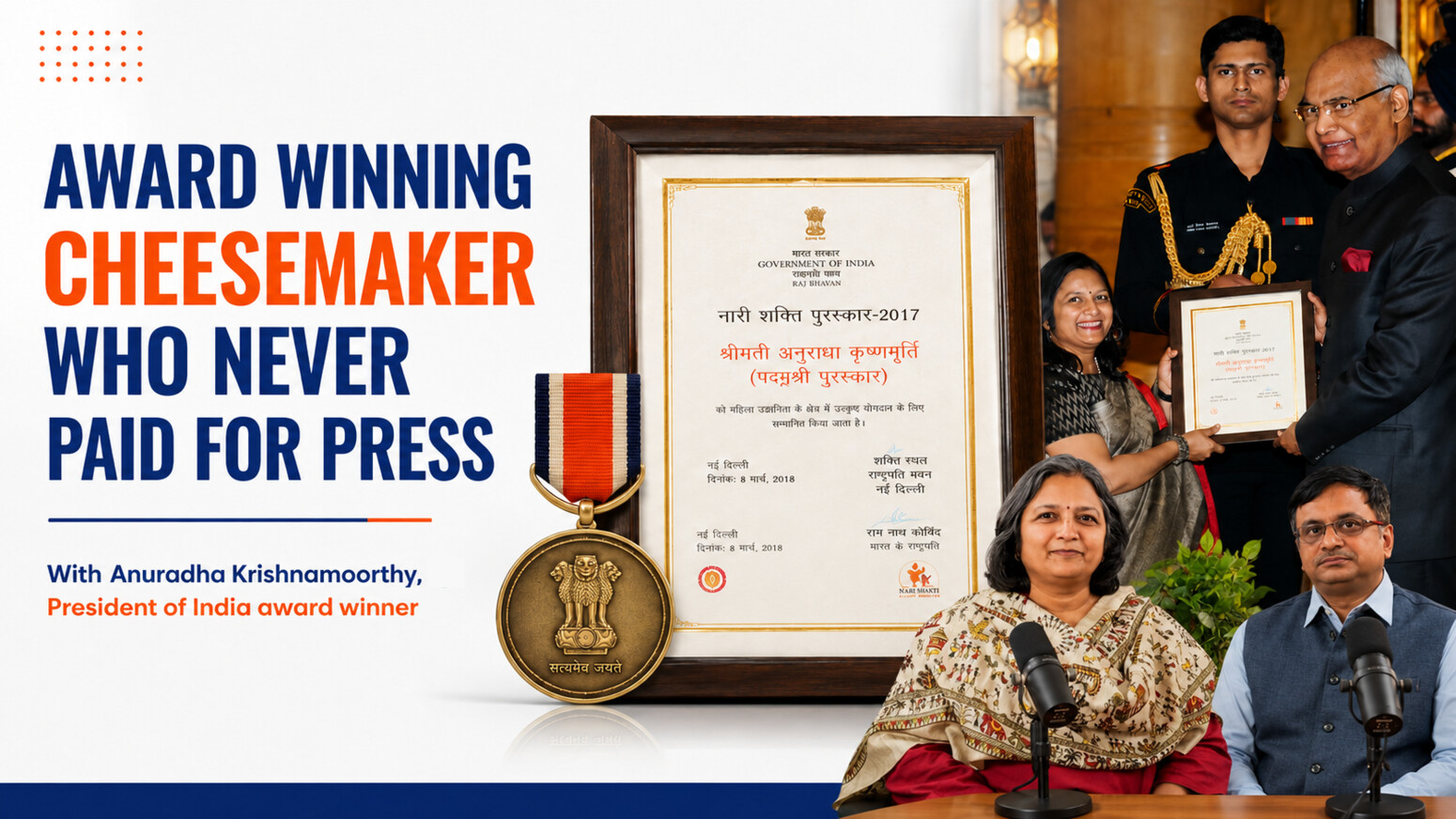
In ten years of running Käse, Anuradha Krishnamoorthy has never paid for a single line of press coverage. No influencer budget, no marketing retainer, no PR agency on monthly fees. Yet the brand has been written about repeatedly, has won at the World Cheese Awards, and now ships across India from a kitchen in Chennai.
When she said this to me recently in the Founder Catalyst studio, my first instinct was to treat it as a nice story about a niche business getting lucky with the press. It is not. Sitting with the rest of the conversation, I think it is the most instructive thing about how she and her co-founder built this company, and it connects to almost everything else they did differently.
Anuradha is a friend, and this was a conversation I had wanted to record for a long time. She is the co-founder and director of Kirke Cheese Pvt Ltd, which runs the brand Käse. She and her co-founder Namrata Sundaresan received the Nari Shakti Puraskar for 2017, presented by the President of India at Rashtrapati Bhavan in March 2018, on International Women’s Day. Käse turned ten this year.
The business that started as a training programme
The origin story is not a food story. Anuradha has a masters in social work, and before cheese she was running CAN DO, a venture she developed as an ISB 10,000 Women scholar. CAN DO trained and employed people with disabilities in telecalling, data validation and research work. At one point it ran a forty seat operation employing people with hearing impairment and people with visual impairment.
Two mothers came to her about their daughters, both with hearing impairment, both unable to complete their graduation. They asked whether Anuradha could help find the girls work. She began looking at setting up a baking unit, since baking was a skill the girls could take with them and use independently later.
She approached Namrata to help set it up. Namrata had learnt cheesemaking during a farm stay in Coonoor over a break, and suggested cheese instead of bread. That conversation is the entire founding decision. Within a year, two girls with hearing impairment were part of the team at Käse.
What strikes me about this is that the business did not begin with a market opportunity. It began with a specific problem for two specific people, and the product was chosen because it happened to be a teachable skill. Most founders would consider that backwards. Ten years on, it has produced a pan India brand.
Why the phone changed her mind about hiring
The part of the conversation I keep returning to is her explanation of why employing people with disabilities worked commercially, not just morally.
Her point was simple. When someone is speaking to you on a telephone, you have no idea whether they have a visual impairment. There is no visible cue, so there is no room for the usual hesitation or discomfort. Only the work is visible. The prejudice never gets a chance to form.
She paired that with something sharper. The moment you think of employing a person with a disability as charity, she said, the work ends right there. These are individuals looking for an opportunity, and they are resources like anybody else on the payroll.
I put the founder’s objection to her directly, because I hear it often. Founders and CEOs are already under pressure. They worry about hiring someone, finding it does not work, and then being in the difficult position of having to let them go. They also worry about causing offence, because most of us were never trained as a society to work alongside people with disabilities.
Her answer was that hiring a person with a disability changes the team, not just the headcount. She described how the person with hearing impairment and the person with visual impairment worked as a genuinely effective pair. One handled data mining and database validation, the other made the calls. Screen readers and magnifiers, much of it open source, made the second half possible. That was a decade ago. The tooling is far better now.
Several people who worked at CAN DO went on to government and bank jobs, roles that are heavily sought after. They still come back and tell her that the first chance to prove themselves is what made those jobs possible.
Anyone starting this today has better technology, better software, and a larger pool of people who have already been through skills training. The founders who are getting this right are treating it as recruitment, not as a corporate social responsibility line item.
The pricing decision that most founders get wrong
Käse decided early that it would be a hundred per cent preservative free brand and that the milk would come from grass fed cows on small farms. That decision has consequences. One litre of milk yields roughly a hundred grams of milk solids, so a kilogram of cheese requires around ten litres of milk. Skimmed or toned milk will not work, because the fat content carries the quality through to the cheese.
The arithmetic makes a premium price unavoidable. What took nerve was holding that price in Chennai, a market everyone told them was difficult to crack.
Anuradha gave me a number that I think every founder in food should sit with. On a five hundred rupee pizza, the actual ingredient cost is around thirty per cent. That thirty per cent is the only lever a business has if profit is the sole objective, so the pressure is always to compress it further. Being in the food business, she said, opens your eyes to what goes into food, including in kitchens at star hotels.
Käse went the other way. They raised quality, accepted the cost, and priced accordingly.
I see the opposite mistake constantly. Only the other day I was speaking with a founder running a services company with a genuinely good offering who is struggling, purely because his price point is wrong. Raise it and he is in a different orbit entirely. We come from a conservative business culture where the instinct is to be the cheapest. Being the cheapest is a strategy, but it is Walmart’s strategy, and it requires a scale most founders will never have.
The Tata Nano Car is the example I keep coming back to. It was engineered well and marketed as the cheapest car available, and that positioning is a large part of why it failed. Today the equivalent segment sells at ten to twelve lakhs quite comfortably.
Käse spent its first year at seventeen artisan markets in a single calendar year. Unless people taste the product and find value in it, no price point survives. That is the work that earns the right to charge more.
How the press actually happened
This brings us back to where we started. The press came, and it came free, for reasons that have very little to do with press strategy.
There are only thirty to forty artisan cheese makers in a country of this size, so the category itself is unusual. Then there was the product. They made a cheddar with molagapodi, the chilli powder that ordinarily goes with idli and dosa. Cheese and Chennai do not sit naturally in the same sentence, and molagapodi and cheddar sit even less naturally together. People had something to talk about.
Alongside that was the hiring story, which visitors and journalists noticed on their own.
Neither of these was manufactured. You cannot run a brainstorming session and arrive at an authentic differentiator. They hired the girls because that was the reason the business existed. They made molagapodi cheddar because they are in Chennai. The stories fed each other.
Her view on influencer budgets follows from this. Influencers have a role to play, but at a later stage, when you can afford it and you are scaling something that already works. When you are a niche brand with no outside capital, spending there first is the wrong order of operations. Reviews can be bought. Loyalty cannot. She made the point that if she has a genuinely good evening at a restaurant with her family, she will want to write a good review without being asked, and no budget replicates that.
Most Käse customers today arrive through recommendations from other customers.
On co-founders and the honeymoon ending
I asked her about the co-founder relationship, because I see so many partnerships drift apart a few years in, often after success rather than before it. She agreed with the comparison to a marriage. The honeymoon ends, reality arrives, and expectations diverge.
What has held theirs together is a clean division of ownership. Anything product related is Namrata’s call, because she is the cheesemaker and Anuradha describes herself as her student on that front. Operations and finance sit with Anuradha. They consult each other on most decisions, but each decision has a single owner.
That last part matters more than it sounds. Splitting responsibility is easy. Someone still has to own cash flow and pricing, because salaries have to be paid on time regardless of who feels responsible.
They were acquaintances rather than close friends when they started Käse, and the friendship deepened through the business rather than being risked by it. Neither of them was a first time founder either, which I suspect explains more than they give it credit for.
The number she wants to change
The last stretch of our conversation was about women founders, which was one of the main reasons I wanted to record this episode. The numbers suggest the proportion of women entrepreneurs in India has risen substantially over the last two decades. I do not doubt the direction, but in the mentoring sessions and angel meetings I sit through, I am still not seeing it.
Anuradha was direct about why. Indian women often start out on genuinely equal footing, and the divergence appears later, when the role that a woman is expected to carry at home begins to compete with the role she is building outside it.
She has decided to change the ratio in the only place she fully controls. Käse’s expansion, which is now under way with a significant increase in production capacity, will remain a women led and women run business.
She also had a warning that applies beyond food. There is an enormous amount of information available now, and no reliable way for most people to tell information from misinformation. Do not treat everything on the internet as settled truth. Do some digging yourself before you act on it. She was pleased, though, to see younger customers reading labels closely. That awareness is itself an opening for anyone building an honest product.
What I took away
The unpaid press, the premium pricing, the hiring, and the co-founder discipline all look like separate decisions. They are not. They are the same decision made four times.
In each case Anuradha and Namrata chose the thing that was genuinely true about their business over the thing that would have been easier to execute or explain. Grass fed milk, so the price is high. A social work background, so the hiring reflects it. Chennai, so the cheddar has molagapodi in it. None of it was designed to be interesting. It became interesting because it was real, and the coverage followed on its own.
Marketing budgets are usually the price you pay for a business that has nothing worth talking about.
The full conversation is on the Founder Catalyst podcast and YouTube channel:
A CEO walks into his office lobby and finds a young man sitting on the sofa, scrolling on his phone. What are you doing here, he asks. Waiting to get paid, comes the reply.
The CEO, a little annoyed, asks how much he earns in a week. A thousand dollars, the fellow says. The CEO pulls out two thousand, hands it over, and tells him to leave and never come back. Pleased with how decisively he handled that, he turns to the receptionist and asks who the loafer was. That was the pizza delivery boy, she says.
I keep coming back to that old joke because it captures something most founders are never told out loud.
Deciding fast on thin information is not a weakness. In the early years it is the whole job.
When you are building something out of nothing, nobody hands you a full picture. You commit with what little you have, and you correct course as you go. Every founder I know built their company on this instinct. It is the reason anything got made at all.
I have lived the sharp end of this myself. Around 2008, during the subprime crisis, one of our largest clients in the United States cancelled their order almost overnight. This was days after I had returned from a trip there, where their manager had assured me all was well. We lost more than half our revenue in one stroke. The very next day I called a townhall. I did not have the full numbers yet. But I knew we had to let go of nearly a hundred people, and I announced a severance well above the statutory norm, which meant borrowing more than we comfortably could. It was the hardest call I have made. It was also made on incomplete information, because waiting for certainty was not an option the moment allowed.
The trouble is that nobody teaches you when to soften that instinct. The CEO in the joke never changed his mode. The company simply grew larger around a man who was still firing pizza boys with total confidence. That is the trap. The instinct that built the company quietly becomes the instinct that starts breaking it, and the founder is usually the last to notice.
This is why the founder mode debate from a couple of years ago struck such a nerve. When Airbnb CEO Brian Chesky spoke at a Y Combinator gathering in 2024, Paul Graham turned the talk into his widely read essay, Founder Mode. Chesky argued that as Airbnb grew, the standard advice to delegate more and step back hurt the company. When he became more directly involved again—developing a leadership style inspired in part by Steve Jobs—Airbnb improved. The essay spread rapidly through founder circles because it challenged conventional management wisdom and validated the instincts of many founders.
Experienced operators pushed back just as hard, because what works beautifully at two hundred people can create a bottleneck at two thousand. That tension has never really been settled, and I do not think it will be, because both sides are describing the same person at different stages of the same journey.
The more useful question is not whether to stay hands-on. It is knowing which room you are standing in before you act.
Look at how Nithin Kamath has run Zerodha. In an interview with Outlook Business early last year, he said something worth sitting with. Even before Covid, Zerodha had around 1,100 people. Today it is roughly 1,200 to 1,250, while the business has grown about ten times over. He said most of his own time now goes into making sure the decision-making philosophy holds even when he is not in the room, so that ten or fifteen people carry it forward without him. That is a founder who kept his sharpness but moved it upstream, from making every call himself to protecting how the calls get made. The instinct is intact. Where he applies it has shifted.
Kamath has been candid about the cost of not doing this. Marking Zerodha’s fifteenth year, he wrote about how chasing month-on-month or quarter-on-quarter numbers can mislead you, and how they prefer to read five-year trends instead. That is the same decisiveness of the early founder, only pointed at a longer horizon. The speed did not disappear. It grew up.
None of this means slowing down. The founders who make this shift well are not more cautious than the rest. They still decide quickly, still act on incomplete information, still refuse to wait for a certainty that never arrives. What changes is a small pause before the decisive part. A few seconds, long enough to ask one question. Who is actually in this room, and what am I about to fire.
The joke lands because we recognise the man. Fast, certain, and completely wrong about what he was looking at. The founders who last are not the ones who lose that speed. They are the ones who learn, quietly and usually the hard way, to check the room before they swing.
The researchers are Caitlin K. Myers and Ezekiel Hooper. Their approach is careful. Rather than speculating about smartphones and social behaviour in general, they found a natural experiment embedded in the iPhone’s launch history. From 2007 to 2011, AT&T was the only carrier that sold iPhones in the United States. This meant that counties with strong AT&T mobile broadband coverage received early access, while counties without it did not. The researchers compared birth-rate trends between those two groups across the same period.
The finding is striking.
They estimate that access to the iPhone reduced birth rates among teenagers by 4.5% to 8% and among adults in their early twenties by 3.2% to 6.6%. Across the broader population, their model suggests the iPhone’s diffusion may account for roughly one-third to one-half of the overall decline in the US general fertility rate between 2007 and 2011.
To be fair about what this paper is and is not: it is a working paper, not yet peer-reviewed.
The researchers are careful to say they have identified a strong correlation through a well-constructed natural experiment, and that the evidence is consistent with causation, but the mechanisms remain indirect. They ran robustness checks using Verizon and Sprint coverage data, neither of which showed comparable effects before those carriers gained access to iPhones, strengthening their argument. But the final causal verdict belongs to future research.
What the paper proposes, and what I find worth sitting with, is not that the iPhone is contraception. The argument is subtler. The iPhone appears to have reshaped how young people spend time together. More hours alone or online. Less face-to-face socialising. Declining sexual activity, which national surveys independently confirm, was already falling among young adults. Greater access to digital entertainment as a substitute for in-person relationships. And separately, easier access to information about reproductive choices. None of these individually is a bombshell. Collectively, and tied to a specific, measurable event like the iPhone’s arrival, the picture becomes harder to dismiss.
I have been thinking about this from a different angle.
We often discuss technology’s impact on work, on decision-making, and on how organisations run. We talk less about how deeply technology reshapes the texture of private life, the kind of socialising people do, and the pace and nature of their relationships. The fertility finding, if it holds up under further scrutiny, is one of the most concrete empirical signals we have that a single technology product reshaped private human behaviour at scale within just a few years of its introduction.
That has implications far beyond demography. For anyone advising companies on how they introduce technology to their people, or thinking about what sustained digital saturation does to the human beings inside an organisation, this research is worth reading carefully.
The paper is available on the NBER website. The full citation is Myers, Caitlin K. and Hooper, Ezekiel, published June 2026.
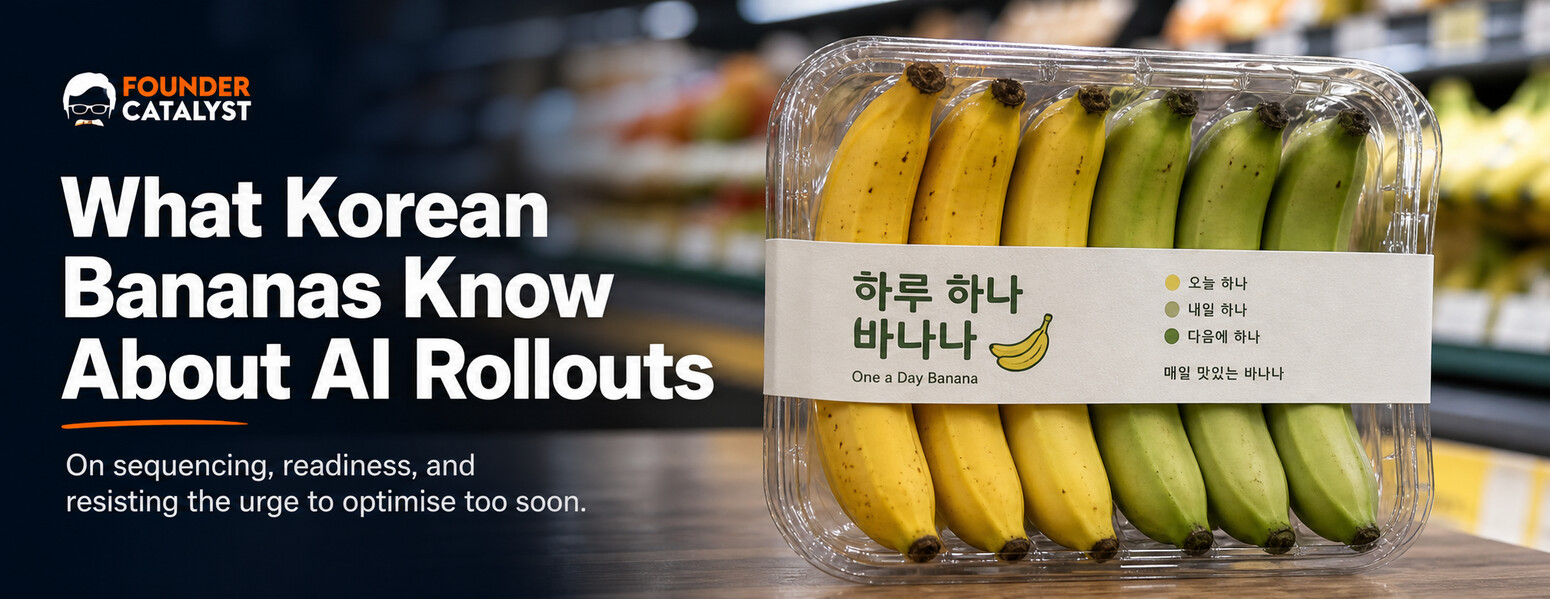
On sequencing, readiness, and resisting the urge to optimise too soon
I first saw the “Haru Hana Banana” pack in a South Korean grocery store. It held 5–7 bananas at different ripeness levels: one yellow and ready now, the next a bit greener for tomorrow, and the others still green for days ahead. No instructions, no app – just simple packaging aligned with how people actually eat bananas. This simple design stuck with me not as a hack, but as a new way to think about sequencing initiatives.
Most founders and leaders want all their initiatives fully ripe at once.
They launch every project, hire every role, or deploy every feature together. It feels like momentum – but too often it becomes a mess. The Korean banana pack succeeds by doing the opposite: it staggers readiness to match demand. Whoever designed it chose customer reality over operational convenience.
In a big company, you might expect a push to standardise and optimise logistics. Instead, the grocery chain sacrificed some simplicity to solve the real problem: avoiding waste and giving customers a fresh banana each day.
This idea applies beyond fruit.
When rolling out AI or any new technology in an enterprise, leaders face the same instinct: go big now, or wait until everything is certain. Both extremes fail. Rushing everything risks breakdowns; waiting wastes time and lets others leap ahead. A better question is: What do we ripen today, what do we plant for next quarter, and what do we keep green for now? In practice, the best teams run multiple tracks in parallel. Some pilots are live with real users, some proofs of concept are being tested, and new ideas are still hazy. They’re comfortable with uneven progress.
Avoid “Big Bang” launches.
Instead, break work into phases. For example, an AI system can be piloted in one department before rolling out company-wide. A product can launch with a minimal feature set, then add more features after learning from users.
Don’t wait for perfection. As Agile principles teach, deliver value frequently in short sprints. Each release is like picking the next-ripe banana – it feeds users today and yields insight.
Match customer usage.
Design solutions around how people will use them, not how easy they are to build. The banana pack works because people eat one banana a day; the designer aligned the product with that habit. Similarly, if customers will adopt one AI assistant a week, don’t dump a dozen at once.
Build a balanced pipeline.
Think in horizons or stages: today’s operations (ripe bananas), tomorrow’s enhancements (tending bananas), and longer-term R&D (green bananas). A common rule is to allocate resources across these stages (for example, 70% on core business, 20% on adjacent growth, 10% on new ideas). This keeps today’s business running while new innovations mature.
Framework:
Now (ripe): Move forward on initiatives that are ready and will pay off immediately. Deploy proven AI tools in one team to build confidence. Launch product features that clearly solve current user needs.
Soon (ripening): Pilot upcoming ideas in controlled settings. Collect data and feedback. For example, run an AI chatbot pilot with a small user group, or A/B test a new feature with select customers.
Later (green): Research and incubate long-term bets. Keep these unripe for now – think of them as experiments or skunkworks that may take months to mature. They shouldn’t block the main effort, but they shouldn’t be forgotten either.
Checklist for leaders:
Are we trying to do everything at once? If so, pause and pick the highest-impact slice first.
What does success look like at each stage? Set clear metrics for today’s release, tomorrow’s pilot, and so on.
Have we planned feedback loops? Like banana peels, failures will show us ripe spots. Incorporate learnings quickly.
Are we optimising for the customer’s journey or for internal convenience? Always put the customer reality first.
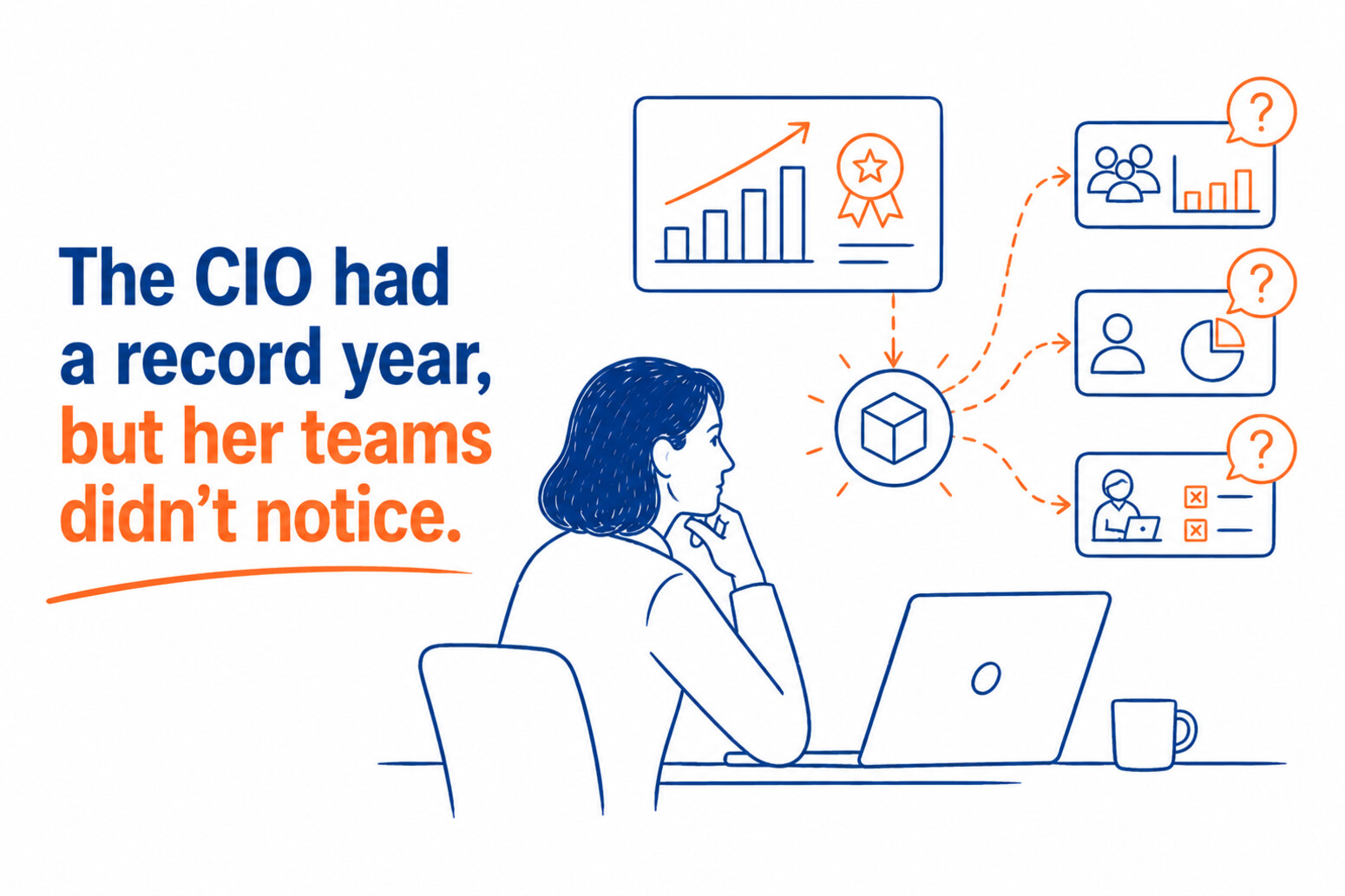
The CIO had every reason to be pleased. She wasn’t.
Board visibility. CEO approval. Record numbers of internal apps shipped. Her IT team was delivering at a pace that would have been unthinkable twelve months ago.
When I joined the call, I expected good news. I heard hesitation instead.
It took me a few minutes to notice what was missing from her update. She never mentioned the line managers. Not once. I asked her directly: Were the department heads actually seeing productivity gains from these applications?
“Venkat, you guessed it. That’s exactly my problem.”
Her team had been shipping AI-built internal applications continuously for nearly a year. Every department was requesting bespoke tools — automation utilities, reporting dashboards, workflow agents — for specialised use cases that previously would never have cleared a development backlog. The economics had changed. AI made these builds fast and cheap. Requests kept coming. Delivery kept pace.
But the telemetry told a different story. Usage in single digits. For large teams where even ten percent adoption would register clearly, the numbers were flat.
The apps were built. They sat unused.
This is not a story about AI failing. It is a story about a safeguard disappearing.
Before AI entered the picture, cost and engineering bandwidth acted as a natural filter on internal tool requests. Most ideas died quietly in the queue — not because anyone evaluated them and said no, but because the cost of building was real and the wait was long. That friction, however crude, forced a basic form of demand validation. Only requests with genuine organisational pull survived it.
AI has removed that friction almost entirely. And most organisations have not replaced it with anything.
What happens next is predictable. A manager spots a genuine gap — usually a real one. A request goes in. The tool gets built without meaningful involvement from the people who would actually use it. No end-user consultation. No workflow integration thinking. The manager accepts delivery. The team quietly returns to what they already know.
The app joins a growing collection of well-intentioned software that nobody opens.
The frustrating part is that the productivity gains from AI are real, and the evidence is unambiguous. EY’s chief economist, citing Federal Reserve Bank of St. Louis data at Davos 2026, found that generative AI is already saving workers the equivalent of 1.6% of total work hours. A randomised experiment with 1,174 adults (NBER, 2026) found AI closed nearly three-quarters of the productivity gap between higher and lower-educated workers. And a University of Hong Kong study (2026) found that untrained AI access actually hurt performance, while even a brief training intervention significantly improved both adoption and outcomes. The technology delivers. The variable is always the people side.
I have seen this pattern repeat across organisations, and it connects to something I write about in my book. Twenty-five years ago, I built inventory software for my father’s publishing firm — convinced that the clear benefits would drive adoption on their own. The staff resisted. Not because the tool was bad, but because nobody had brought them into the process. The breakthrough came only when the firm’s general manager, a man deeply rooted in the old ways, took a personal interest in learning the system. His endorsement shifted the entire team’s behaviour. The technology did not change. The human dynamic did.
That lesson has not aged. If anything, AI has made it more urgent.
Speed is easy to measure. Adoption is what moves the business
Most AI tool deployments follow the same top-down pattern. A business leader identifies the gap. IT builds the solution. The actual users — the ones whose daily habits need to change — are consulted last, if at all.
Users in large organisations carry significant inertia toward familiar tools and established routines. That inertia does not dissolve because a new application exists. It dissolves through involvement, through relevance, and through time. None of those three things gets faster just because the build cycle did.
The fix is not more training sessions or better change management communications. Those are responses to a symptom.
The deeper problem is that the old economic forcing function has gone, and nothing has taken its place. What needs rebuilding is a lightweight governance layer. Before any internal AI tool gets approved, two questions should have clear answers.
Is there genuine pull from the people who will use it — not just from the manager who requested it?
Does an existing tool or workflow already adequately cover this need?
That gate does not need to be bureaucratic. It needs to exist.
AI has made building cheap. It has not made building the right thing any easier. If anything, it has made that harder — because the friction that used to quietly filter out weak ideas is gone, and most organisations have not noticed yet.
Speed of delivery is easy to measure and tempting to celebrate.
Depth of adoption is what actually moves the business.
If questions like these sit at the intersection of technology and leadership for your organisation, this is what I focus on at The Founder Catalyst. Happy to continue the conversation in the comments or connect directly.
Over the past week, two of India’s most respected IT firms have been in the headlines for reasons none of us wants to associate with the industry we grew up in. Tata Consultancy Services is facing a serious investigation in Nashik, with multiple police complaints, arrests, and a formal inquiry ordered by the Tata Sons Chairman himself. Infosys is responding to allegations surfacing on social media about its Pune operations. Both have shaken the industry.
Having spent three decades in this space, I have no doubt the veterans at both firms, known for their integrity, will follow due process and address whatever is found. That is not what I want to write about today.
I want to write to the young founders and early-stage CEOs who read my posts.
Because the lessons here are not really about large firms with 100,000 employees. They are about what happens in your firm of twenty, fifty, or two hundred people, long before any headline is possible.
The instinct that quietly hurts young firms
When I started out almost three decades ago, I used to take every piece of misconduct in my firm personally. Thankfully, there were not many. But when something did happen, I felt it reflected on me as the founder. It took years, and guidance from my mentors, to understand that this view, while well-meaning, was not quite right.
No founder can build a perfect firm. We must aspire to one and keep working towards it. What matters far more is whether your people have a safe, trusted way to raise concerns, and whether you act on them the moment they come in. That single question, asked honestly, will tell you more about your culture than any town hall ever will.
In The Founder Catalyst, I devote an entire chapter to the idea that trust is the quiet currency of a business. It does not appear on any balance sheet, but it underwrites everything else. It is earned slowly, through small repeated acts of doing the right thing, and it can be damaged quickly, sometimes by a single moment of looking the other way. I wrote about a travel agent I had used for years, who processed a refund I was due, but only after I spotted the error myself. The money came back, but a small dent remained in my confidence. That is how trust works. It notices the moments when you could have acted and did not.
Why young firms get this wrong
In the early years,founders rarely have the experience or the tools to handle harassment complaints well. The instinct is often to downplay, to manage, to protect the team you worked so hard to build. That instinct, however understandable, is exactly how small problems become large ones.
There is also a second trap. In a small firm, the accused is often someone the founder personally recruited, worked alongside in the trenches, and considers a friend. Objectivity becomes genuinely hard. This is precisely why the complaint process cannot rest on the founder’s judgement alone. It needs to sit with people who can act without that emotional entanglement, follow a defined process, and report findings honestly.
I learnt a related lesson early in my publishing family’s business, which I write about in a chapter on guiding people through change. When I introduced new software into my father’s firm, the resistance came not from the technology but from people’s fear of the unfamiliar. I eventually realised that the breakthrough came through an unexpected internal champion, the senior-most manager, whose endorsement made the change acceptable to everyone else. The same principle applies here. A workplace safety policy on paper changes nothing. A respected senior person inside the firm, visibly committed to taking complaints seriously, changes everything.
The founder sets the ceiling
There is something I often remind myself. A team will not take safety, fairness, or ethics more seriously than the founder visibly does. If the founder rolls their eyes at compliance training, so will everyone else. If the founder treats an uncomfortable complaint as an inconvenience to be managed, the team learns that such complaints are inconvenient to raise.
The same applies to safety. A founder who signals, through action, that no revenue target and no star performer is more important than the dignity of the team builds a firm that people stay in and recommend. A founder who signals the opposite, often without realising it, builds something more fragile than they know.
What to do before you need to
The good news is that today, unlike when I started, there are serious professionals who help firms build the right systems. My friend Viji Hari has spent years doing this work, and her book Behind Closed Cubicles is one I often recommend to founders. Industry bodies and local business chambers also run regular workplace conduct and anti-harassment programs for founders and their teams. Please attend them. Send your HR lead. Send yourself.
A few practical steps any founder can take this quarter:
I am not the person to give you a checklist for building these systems. That work belongs to specialists who spend their careers on it, and the rules vary by country, by industry, and by the size of your firm. What I can offer is a few questions worth asking yourself this quarter, the same questions I have seen good founders ask when I mentor them.
Does every person in your firm know, without hesitation, whom they would go to if something happened?
Is that person someone with enough independence to act, or someone who reports to the alleged offender?
When was the last time you, as the founder, personally sat in a workplace conduct training session rather than sending a calendar decline?
If a complaint landed on your desk tomorrow, do you have a clear process to follow, or would you be figuring it out under pressure?
None of these questions has a universal answer. But sitting with them honestly and then finding people who do have expertise in your context is itself the first step. Speak to a lawyer who specialises in employment matters in your country. Speak to HR professionals who have built these systems in firms larger than yours. Speak to founders who have quietly handled difficult situations well; they exist, and most are willing to share if you ask privately.
The long view
When I look at firms that have lasted across generations, and I have studied many of them, including my own family’s seventy-year-old publishing business, one thing stands out. They treated the quiet, unglamorous work of keeping faith with their people as seriously as the glamorous work of winning new customers. They paid salaries on time, kept a clean record with vendors and governments, and when something went wrong, they fixed it without being asked twice.
The firms that will earn the trust of the next generation of employees, customers, and investors are the ones that take workplace safety as seriously as product quality. In a world where every incident travels on social media within minutes, there is no quiet way to handle these things later. Only an honest way to prevent them now.
Do not wait for a problem to force the learning.
What are you doing this quarter to make sure someone in your firm can speak up without fear?
Every quarter, someone in tech quietly walks back a confident prediction they made not long ago.
In January 2026, Forrester published research showing that over half of all AI-attributed layoffs are likely to be reversed, because companies cut headcount based on AI promises that the technology was not yet ready to keep. The same month, Gartner forecast that generative AI in customer service would cost more than offshore human agents by 2030, prompting a pointed rebuttal from industry practitioners who argued Gartner was describing a vendor pricing failure, not an AI failure.
The retractions are usually healthier than the original predictions. They just get a fraction of the attention.
In October 2021, a year before ChatGPT, I delivered a talk called “The Future of Software Developers by 2040” to a developer conference. Looking back now is not about whether I got things right. The more useful question is which assumptions survived contact with a shock nobody saw coming.
A few stood up reasonably well. The talk argued the (Indian) IT hiring boom would not last. TCS, Infosys, Wipro and HCL were on record quarters then, with attrition above 20 per cent. The direction was right, though the mechanism I imagined, gradual automation and growth of the global capability centres, turned out to be the smaller story. The larger one was a foundation AI model that could write working code from a plain English comment.
One slide, titled “Going to be upside-down,” argued that the work mix in software would invert: more time on business understanding and customer needs, less on writing and testing code. That was framed as a gradual shift toward 2040. It is largely the reality in 2026 itself.
The line that aged the worst was the one I closed with: let machines be machines, and let humans be human. It earned a warm nod in the room. Five years on, it has the ring of a sentence printed over a stock photo of a sunrise. Tidy aphorisms assume the boundary they describe will hold still. This one has not.
Nobody in this industry predicts precisely. The people who navigate these shifts well are not the ones with the sharpest forecasts. They are the ones who revise quickly when the ground moves, before it costs them too much.
There is a Chinese proverb associated with Deng Xiaoping: crossing the river by feeling the stones. You do not map the riverbed in advance. You step, test your footing, adjust, and step again. The destination matters. But the only honest method is one stone at a time.
The next five years will not reward people who pick a single thesis and hold it. They will reward those who can hold a direction loosely, gather evidence weekly, and change their mind without ego when the facts demand it.
The cost of a wrong forecast held too long is now measured in quarters, not years. The cost of revising one in public is mostly ego. And ego is the cheapest thing to spend.
The forecasts that age worst are usually the ones that sound the wisest at the time.
Early in my career, I travelled across India with a desktop PC. I was delivering a keynote on a Microsoft web platform. The platform was still in beta.
During one session, the power failed. The generator struggled to start. My PC rebooted slowly in front of a silent room.
Those minutes felt endless.
That moment stayed with me.
The reason was not the failure of technology. Instead, it taught me that professional speaking is less about the perfect demo. It relies more on preparation, experience, and learning from those who have walked the path before me.
Over the years, my own path on stage has evolved toward a central question. How do technology and AI truly help businesses and founders? It is a conversation rooted in real-world application, not just theory.
Today, we can watch the masters online, but I still deeply value speaker communities. The ones where learning happens in conversation, through honest feedback, and over dinner with people who take the craft seriously.
That is why I am looking forward to PSS 2026 this weekend. The annual summit of the Professional Speakers Association of India. I still enjoy being in rooms where speakers come together to learn, unlearn, and quietly get better.
A meaningful bonus this year. It is happening right here in Chennai, my home city.
If you are attending, let us connect. If you are curious about the craft, I am happy to share what I learn.
Over the last few months, I have been noticing a pattern in many organisations experimenting with AI. A recent experience brought this out clearly and reminded me why we still need basic engineering discipline even in this new world.
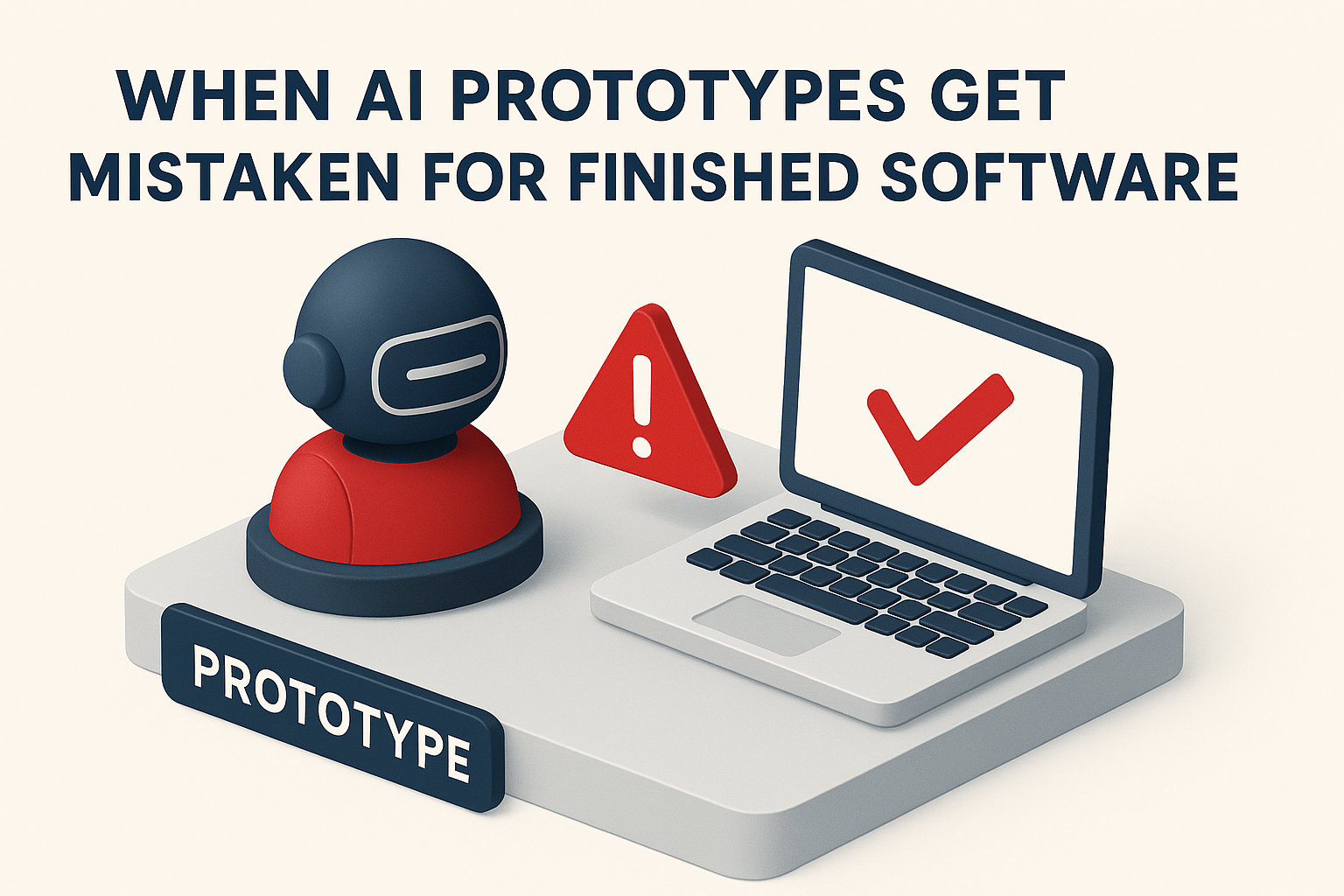
A client reached out to the team I was consulting for a proposal to redevelop a Python application and deploy it on Microsoft Azure. One of their business leaders had created the first version using an AI tool. Since it ran in the browser, the team assumed it was ready for production. When we looked at the files, all we received was a saved webpage (HTML) and part of a Python script. The backend logic, code, DB schema, JavaScript and other supporting pieces were missing, so we had no clue what the prototype was meant to do.
There is nothing wrong in using AI tools like Gemini, Claude or ChatGPT to sketch ideas or validate a workflow. They are wonderful for quick iteration and early exploration. The problem starts when something generated in an AI chat window gets treated as a complete software product.
To build anything that will run securely and reliably inside an enterprise, we still need clarity on the basics. The objective and the business case. The inputs and outputs. The user roles and the workflow. A simple specification. Some understanding of data flow, security and integration needs. Access to the original AI chat sessions also helps. These are not paperwork. They form the bridge between what was intended and what needs to be built.
AI can speed up development, but it does not remove the need for engineering rigour. Systems still need to be stable, scalable and secure.
As more leaders experiment with AI, keeping this distinction in mind will save time and frustration for everyone. Prototypes are a good beginning, not the final product.
This week’s Star Trek SNW TV Show episode “The Sehlat Who Ate Its Tail” resonated with me in a surprising way.
When I began my business nearly three decades ago, straight out of college, there were many moments when I felt like I had been pushed into the deep end without ever learning how to swim. No management book or autobiography really prepares you for the instant when your team turns to you for a critical decision.
In this episode, First Officer James Kirk suddenly finds himself in command of the Farragut. With the lives of his ship, the Enterprise crew, and even millions on a pre-warp planet at stake, he could not afford endless consultation. The buck stopped with him, and he had to decide. But he froze.
Many founder CEOs fall into the trap of asking for suggestions and confirmation until decision paralysis sets in. But there comes a moment when the role demands clarity and conviction—when you have to throw everything you have into a decision, knowing responsibility rests with you.
PS: And a fun detail I enjoyed as an engineer, when wireless communications were jammed, the crew fell back on RJ11 analogue phones and copper wires. Sometimes the simplest, oldest tools can save the day—a reminder worth keeping even in the AI age.
Effective communication with stakeholders — whether they are investors, customers, or employees — is critical for any founder’s success. To illustrate this, let’s journey back 54 years to an IBM manufacturing research facility in East Fishkill, New York. Back then, IBM was a leading manufacturer of integrated circuits (ICs), the backbone of modern computing. The story of one man’s determination in this facility holds a valuable lesson for today’s leaders.
A Vision for Change
In the 1970s, producing ICs was an arduous process, often taking weeks, if not months. But one man, William “Bill” Harding, a World War II veteran, envisioned a groundbreaking goal: transforming plain silicon wafers into integrated circuits in a single day. Achieving this required a significant investment, but convincing IBM’s headquarters, known for its bureaucracy, was no easy feat.
The Power of Rehearsed Communication
Harding’s strategy was as innovative as his technical vision. He used his weekly staff meetings to rehearse the message he intended to deliver to IBM’s top management. During these meetings, Harding presented reports and reiterated the importance of the project, even when his staff were already familiar with the details. Why? He was fine-tuning his pitch.
Over three years, Harding continually practiced and refined his communication, incorporating feedback from his team to perfect his arguments. This disciplined preparation ensured that when he finally presented to IBM’s headquarters, his pitch was flawless and persuasive. The result? Harding secured the necessary budget and succeeded in his ambitious endeavor.
Lessons for Founders
Harding’s story underscores a vital lesson for today’s founders: effective communication doesn’t happen by chance. It requires deliberate effort, repetition, and refinement. Here’s how you can apply this principle:
Rehearse Your Message: Treat every opportunity to communicate as a chance to practice. Whether addressing your team or investors, rehearsing helps you refine your ideas.
Seek Feedback: Encourage stakeholders to provide constructive feedback. Use it to adjust and improve your message.
Embrace Repetition: Repeating your message ensures clarity and alignment among all stakeholders. Don’t shy away from reiterating your vision.
Adapt and Evolve: As you gather feedback, be willing to adapt. A message that resonates today might need tweaking tomorrow.
Final Thoughts
Great communication isn’t a one-time effort; it’s an ongoing process. By following Harding’s example, founders can craft compelling narratives that resonate with stakeholders, secure buy-in, and drive success. Remember, the path to mastery is paved with practice and persistence. Start refining your message today, and watch your vision come to life.