
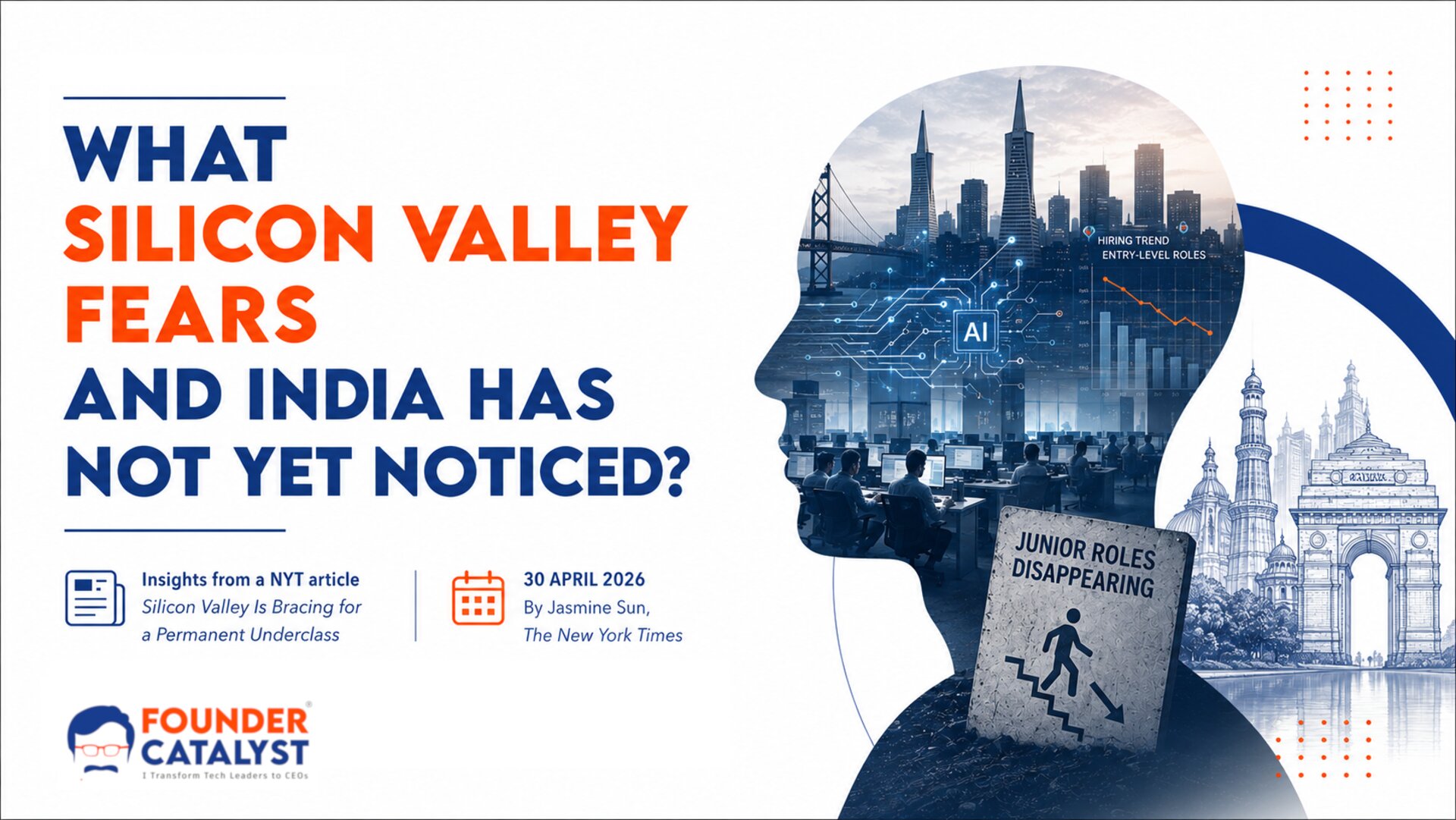
A piece published in The New York Times on 30 April 2026, written by Jasmine Sun, deserves a careful read. Sun writes about AI and Silicon Valley culture and spent considerable time speaking with researchers, founders, economists and policy experts across the major AI labs. The article is titled “Silicon Valley Is Bracing for a Permanent Underclass.“
Three ideas from it stay with me:
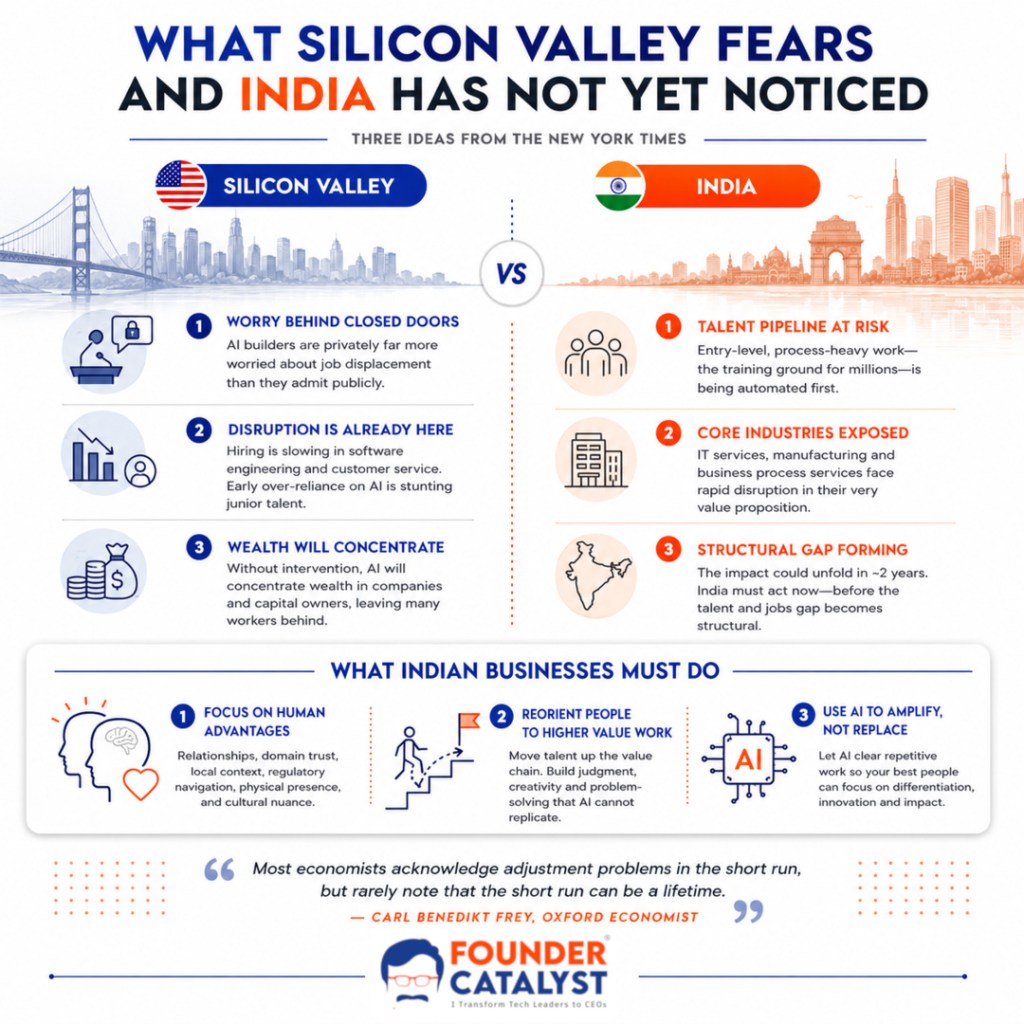
- The people building AI are privately far more worried about job displacement than they say publicly. The gap between what they say on stage and what they say in private is uncomfortably wide.
- The disruption is already showing up, not in some future scenario. Hiring is slowing in software engineering and customer service, and junior workers are stunting their own skill development by leaning on AI tools before they have built foundational competence.
- The default path, if left unaddressed, concentrates wealth in AI companies and existing capital owners while stranding a large section of the workforce.
The Oxford economist Carl Benedikt Frey puts it plainly in the article: “most economists acknowledge adjustment problems in the short run, but rarely note that the short run can be a lifetime”.
Most of the debate in the article is American. But I feel it matters more deeply to Indian businesses, and we are not paying enough attention to it. I am a technology optimist, but even those of us in the forefront of technology cannot predict the next phase and its pace.
India’s exposure is specific.
The IT services industry is built on a model where labour arbitrage is a central value proposition. AI agents are not replacing the most complex work first. They are replacing entry-level, process-heavy, high-volume tasks that have historically been the training ground for an entire generation of Indian technology professionals. Indian IT firms are already seeing this inside their own delivery centres, even if the conversation stays internal.
For manufacturing, the picture is more layered but no less urgent. India has been counting on a China-plus-one moment to build industrial scale. The article’s observation that AI-driven displacement could happen in two years, compared to the several years it took deindustrialisation to unfold in the West, is worth sitting with. Indian manufacturers investing in scale right now need to ask hard questions about workforce composition five years from now.
For services businesses, whether legal process outsourcing, accounting, medical transcription, or customer operations, the threat is not hypothetical. The article notes that AI benchmarks are now measuring performance against investment bankers, management consultants, and primary care physicians, with win rates against human professionals crossing eighty percent. Indian firms in these spaces have competed on cost and quality. Both advantages narrow as AI capability improves.
The question I keep putting to founders and CXOs is this: Does your business have genuine differentiation beyond what an AI agent can replicate at scale? Relationships, domain trust, local context, regulatory navigation, physical presence, and cultural nuance remain human advantages. The companies getting this right are reorienting their people toward that work and using AI to clear everything else that was consuming their best people’s time.
The article quotes a former deputy director of the US National Economic Council, saying the China shock unfolded over several years, but this could happen in two years. India was both a beneficiary and a casualty of that earlier shock.
This time, the displacement is happening in office buildings in Chennai, Bengaluru, Hyderabad, and Pune, not in a factory in Ohio. The structural gap forming in India’s talent pipeline is real, and the conversation between businesses, institutions, and policymakers cannot wait and needs to start now.
Leave a Reply