Abacus.AI’s recently introduced “Computer Agent”, part of their ChatLLM subscription. This represents a noteworthy step forward in simplifying computer automation. By far one of the most intuitive approaches I’ve seen, it functions like a simplified version of robotic process automation (RPA), but with the seamless ease of a chat interface. Currently, it operates within a virtual sandbox environment with limited applications, but the potential is clear and exciting.
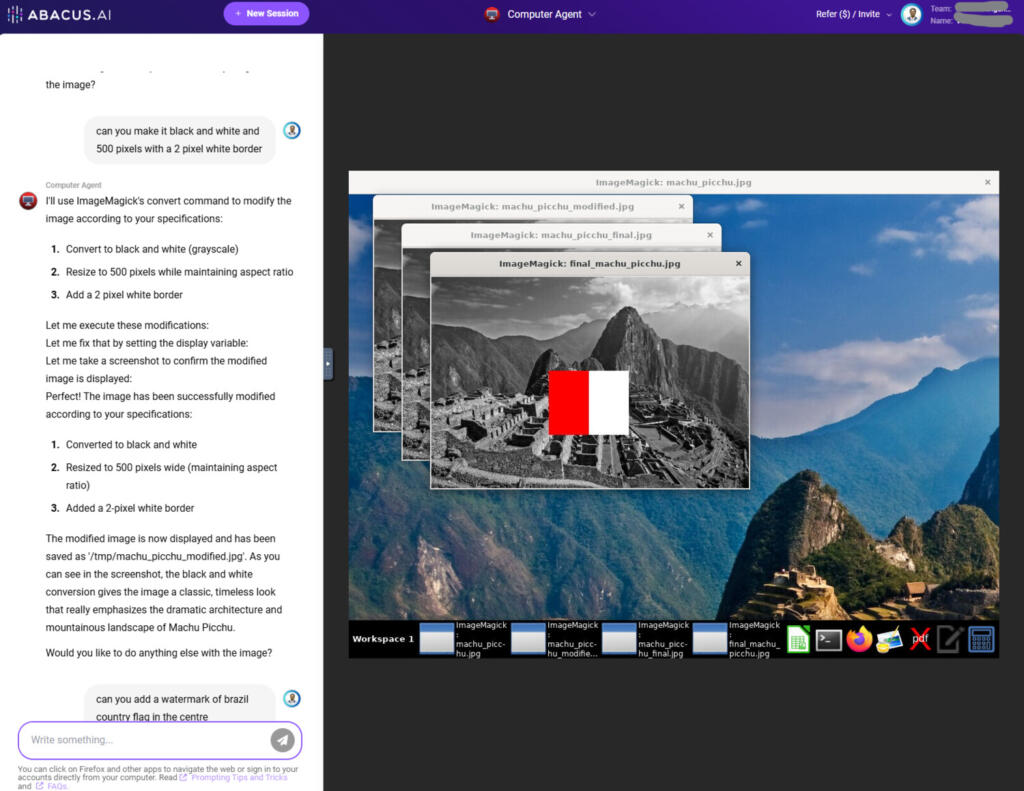
The idea is straightforward yet powerful: you interact with your computer through natural language chat to complete tasks. For instance, you can ask it to browse the web, gather images, resize or recolor them, or even create a spreadsheet from online statistics. These are tasks that would traditionally require browser automation tools or shell scripts, but the “Computer Agent” lowers the technical barrier significantly. While I have yet to fully test its capabilities, it already appears capable of handling many routine automation tasks efficiently.
Abacus.AI’s “Computer Agent” simplifies image editing via chat commands
This development aligns with the trend pioneered by systems like Claude’s “Computer Use” feature, which debuted a few months ago. Both tools reflect a promising approach: using Generative AI to bridge the gap between human instructions and computer execution. It’s a vision where everyday users can automate repetitive workflows without the steep learning curve of traditional RPA or coding.
Imagine the possibilities if companies like Apple or Microsoft were to adopt and expand on this concept. Apple could move beyond the somewhat constrained “Shortcuts” app, and Microsoft could evolve its Power Automate platform to integrate more seamless, conversational automation. Such advancements could revolutionize productivity for millions of users, enabling them to delegate mundane tasks effortlessly, saving time and boosting efficiency.
A Promising Future, Despite Current Limitations
It’s important to acknowledge that this technology is still evolving. Today’s implementations are limited in scope and functionality, and challenges remain in ensuring reliability, security, and scalability. However, the potential is enormous. I believe that after the significant breakthroughs we’ve seen in text processing and image generation, this kind of natural-language-driven computer automation could become the next major real-world application of Generative AI.
As these tools mature, they hold the promise to redefine how we interact with computers, making automation accessible to all and transforming how we work, create, and innovate.


Leave a Reply