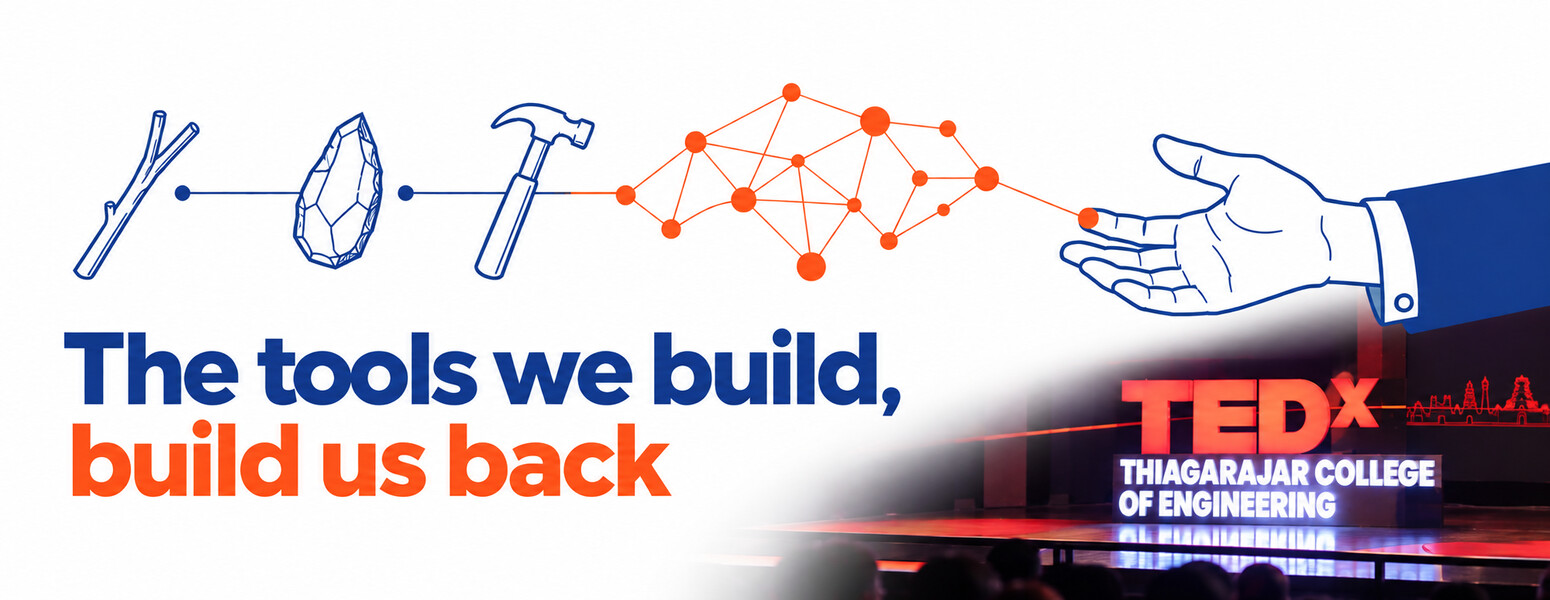
Three weeks ago I stood on the TEDxTCE stage in Madurai and told a room full of engineering students a story that actually began 3.3 million years before any of us were born — a shaped stone found at a place called Lomekwi in Kenya, older than our own species. I told them about a chimpanzee Jane Goodall watched in 1960, stripping a twig and poking it into a termite mound. And I told them what every tool since then — the hammer, the book, the compiler, the search engine, my own LIFCO dictionaries, my own Easytools.com, the LED clocks I used to burn out as a teenager — had in common.
Every single one of them waited for a hand to pick them up and decide what happens next.
That is not true anymore, and this is the part that should matter to a founder reading this, not just to a hall full of students.
For thirty years I built tools the old way: I had an idea, I decided what should happen, and the tool executed it — a compiler, a piece of taxi-booking software, a company. Somewhere around 2023 that changed. The tool in your pocket now does not wait for you to think first. It thinks first, hands you an answer already chewed, already judged, and waits for you to agree. Every large language model you use to write a pitch deck, a hiring email, or your own version of this blog post is doing exactly that.
I found out how far this goes the hard way, twice.
The first time was building a Tamil text editor last year. I did not write a single line of its code myself — not one — for the first time in thirty years of building software. I described the problem, and the machine wrote it. Somewhere in that project I stopped being a coder and became something closer to a specification: a person who describes what he wants and approves what comes back. That is a genuinely useful shift for a founder to notice — the distance between an idea and a working product has collapsed, and it is now open to anyone, not only to people who happened to grow up near the right engineering colleges.
The second time was writing my book, The Founder Catalyst — yes, where this newsletter gets its name — and later, this very talk. I gave an AI my draft and asked it to clean it up. It fixed my grammar. Then it fixed my sentences. Then, without asking, it quietly dropped the one story that mattered most to me — my grandfather’s dictionary business, and the one rule my father ran it on for fifty years: an unquestioned refund, even years after the sale, even for a single missing page. The AI’s version read beautifully. It was also not mine anymore, and it was far less useful to another founder than the actual, messy truth of how my father built customer trust over five decades.
That is the risk I actually want founders to sit with. These models are trained on the average of everything human beings have written, and what they hand back is that average. The deals you got wrong, the hires you regret, the one policy that cost you money in the short term and earned you a customer for life — none of that is in the average. It is exactly what makes your business yours, and it is precisely what a well-meaning AI edit will smooth away first, because it reads as too much detail.
None of this is an argument against using these tools. I would not have built that Tamil editor without one, and I no longer believe founders should be writing code by hand either. Use the motor. I only know when it is pulling me in the wrong direction because I spent thirty years riding without one — and that is the part I would ask any founder to hold on to. Take on the projects that felt impossible before. Just do not hand over the deciding.
We built the system. It is now good enough to build us back, one polished suggestion at a time. Whether it does depends entirely on what we let it delete.
I go into the fuller argument in the complete 18-minute talk — including why access to expertise, and not talent, was always the real gap between an engineer in Bangalore and one in Madurai, and why that gap has just closed for good.
Watch the full talk here: