Tag: Interviews

  • AI still needs your brain

    AI still needs your brain

    “Oh, she’s just a midwife.”

    Charlotte Williams says that is how some people look at her.

    Then she tells you about her GitHub account, her repos, the API keys she learnt about, and the 72-page website she built with her bots.

    Charlotte trained as a midwife with the NHS in the UK and has been a midwife for nearly 20 years. She moved to the USA, and in 2022 she started My Bump My Baby, bringing ultrasound into the home. Now she is building My Bump Hub, which she calls “the Google for maternal health”. The app launches at Thanksgiving, 26 November 2026.

    I spoke to Charlotte on 5 November 2026. I enjoy bringing founders from outside the usual circles onto the show, and this was one of the most energetic conversations I have had. We planned to talk for 20 minutes and went on for nearly 40.

    Be your best lazy self, with a bot

    When Charlotte started My Bump Hub, she hired a number of salespeople. She asked each of them to send just 50 emails a day. Some said they did it and didn’t. Some left. Some kicked up a fuss. Today her bots send hundreds of emails a day.

    That does not mean she thinks bots replace people. Her view is that if you give even the laziest person AI, they can stay lazy and still be productive. All they have to do is tell the bot, “Continue. No. Say that. Do that.” “Be your best lazy self, right? But do it with a bot.”

    She still needs that human. Someone has to watch the bots, because, as she put it, they like to spiral and start thinking for themselves. If you have already committed to hiring and training a person, why not help them help you?

    This is close to what I keep telling the companies I consult. Look at AI as a way to do things you could not do before. If you are doing the same things with AI, you have probably got it wrong.

    From the NHS to a village for maternal health

    Charlotte loves the NHS. She trained there and worked there. But as a young midwife full of ideas, she felt she could not reach the people who could help her make them real. So she picked up her two children and moved to America.

    In 2022, she started My Bump My Baby and brought ultrasound into the home. Quickly, she saw that some families could not afford it. Machines are expensive, sonographers need to be paid, and doctors need to review the scans. So she set up the My Bump My Baby My World Foundation to offer the same service for free.

    Then came the advertising bills. She had to pay Google and Meta to promote a service that was free. She saw doctors dancing on TikTok to win patients, and decided she had to stop and bring everything together in one place. Google and Meta, she said, were not made for healthcare, and definitely not for maternal health.

    My Bump Hub is her answer. It is a two-sided village. On one side are women looking for services, from clinical care in pregnancy to wellness, yoga and even their hair and nails. On the other side are providers, from midwives, doulas and obstetricians to chiropractors and pelvic floor specialists, who are looking for those women. Many women, she said, do not know what they don’t know.

    Members are ID-verified, and there are no bots in the village. The only AI allowed in is Bump Buddy, which helps families find what they need. It is free for women, their partners and families, doulas and nonprofit organisations. Providers who want to reach the village pay a founding rate of $250 a year, which she calls their advertisement. She compares it with Zocdoc, where she paid $40 per booking, even when the patient did not show up. As she put it, a lot of money is being made on the hopes and dreams of small businesses.

    Every founder needs a village

    I asked Charlotte the question I ask many founders. With four children, a job and a business that gives its services away free, where did the courage and the money come from?

    Her first answer was her fiancé, Marvin. “You can’t have two crazy people in a relationship,” she said. One of you has to be the stable one who keeps the household going. Marvin funded much of the foundation’s start, paying sonographers and for the premises. Family friends who believed in her mission became what she calls her angel investors. Her live-in nanny pulls her away from the computer when it is time for homework. She calls her mother and sister in England every single day.

    She tried to do this alone before, and it only took off when she had that support around her. You can do it without a village, she said, but it makes it a lot harder.

    We see founders on stage collecting awards. We rarely see the spouse, the partner and the family behind them. Charlotte was honest about the other side too: unpaid bills, robbing Peter to pay Paul, and the lonely place you can get into when all you can think is, “I need to get this finished.” Sometimes you need someone to tell you to take a walk, eat something and drink some water.

    When I said a founder has to be a little crazy, she laughed and said she had found her people. As a midwife, she moved between hospitals whenever she was treated badly, and a mentor warned her she would never be promoted that way. She now sees that experience across hospitals and different groups of women as a strength, not a weakness.

    AI as a filter and a translator

    Charlotte was an AI sceptic. When her brother told the family to get ChatGPT, her answer was that she had real brains and didn’t need it. She worried it would make her stupid. It was Marvin who brought her into AI, and today she says AI has made her smarter.

    Two ideas from her stayed with me. The first is AI as a filter. People have always told her she has no filter. Now, when she is irritated, AI helps her say what she means without starting an argument. She has started speaking that way even with her family.

    The second is AI as a translator. Before, only coders could talk to the machine, because you had to speak in code. Now she describes what she wants in plain language, and AI translates it into code. She no longer has to explain her vision to someone else and hope they understand it.

    I shared how AI has made me more curious. The other day I was listening to a podcast on British history and had questions I would never have gone and read up on. Sitting in India, I don’t know that background. Now I can simply ask.

    The $10,000 prototype and the $30,000 website

    I asked Charlotte about her low points. The first was her first attempt at the app. She did not know what vibe coding was. Marvin told her she would need a developer, and she said, “Nah, I could do this.” She built a CRM first, which she says was much easier than an app, then went on with Replit and an Apple TestFlight account. She saw a Google login screen appear and got very excited. Then she downloaded the app from TestFlight, and it just kept making a ping. She could not even tell where it went wrong, and it broke her heart.

    She had tried the proper route first. One developer wanted 10 grand for a prototype without asking her anything, and said “yep” to everything. Marvin noticed he was saying yes too much. As I told her, that is not how software works. That developer charged her $10,000, and it did not work. The next company asked all the right questions, but weeks passed between meetings and what came back was never quite right. That company charged her just over $30,000. They didn’t build the app, and the website they made was one she hated.

    So she built her own website with her bots. It runs to 72 pages, built page by page and link by link. She worked on it around the clock, as she said, like a crazy person who would not stop until it was done. She believes it would have cost thousands of dollars if a company had done it. She is clear that if My Bump Hub takes off, she will need a full development team. But building her own prototype removes that first 10 grand that so many founders spend months trying to raise.

    AI still needs your brain

    This was the part I most wanted founders to hear. People see what AI built and think it was a single prompt. It isn’t. “Don’t think you can do what I’ve done with AI. AI still needs my brain,” Charlotte said.

    She questions it, and she says she and her AI fight all the time. She is polite but assertive, because if you let a capable bot run, it goes off on a tangent. When she asks who told it to do that, it says sorry; it did it by itself. Over time, her tools have learnt how she talks and what she dislikes. Top of that list is the em dash. She tells every new AI never to use one, because she sees it as the first telltale sign that something was written with AI. I told her that AI even adds em dashes in Tamil, my mother tongue, where we rarely use such punctuation.

    I have been an engineer all my working life. What I liked about this conversation is that it came from someone who never planned to touch code. Charlotte did not let a lack of technical training, or a lack of money, stop her. But she also did not pretend that AI did the work for her. The effort, the questions and the judgment were hers. That is the lesson I would take away for any founder watching their budget.

    This interview is not sponsored. Any companies, products or websites mentioned are part of Charlotte’s story and are shared for context only.

    If you are a founder weighing how far AI can take you before you hire, and want more conversations with founders and leaders like this one, subscribe to The Founder Catalyst newsletter.
  • Why AI pilots work but rollouts stall?

    Why AI pilots work but rollouts stall?

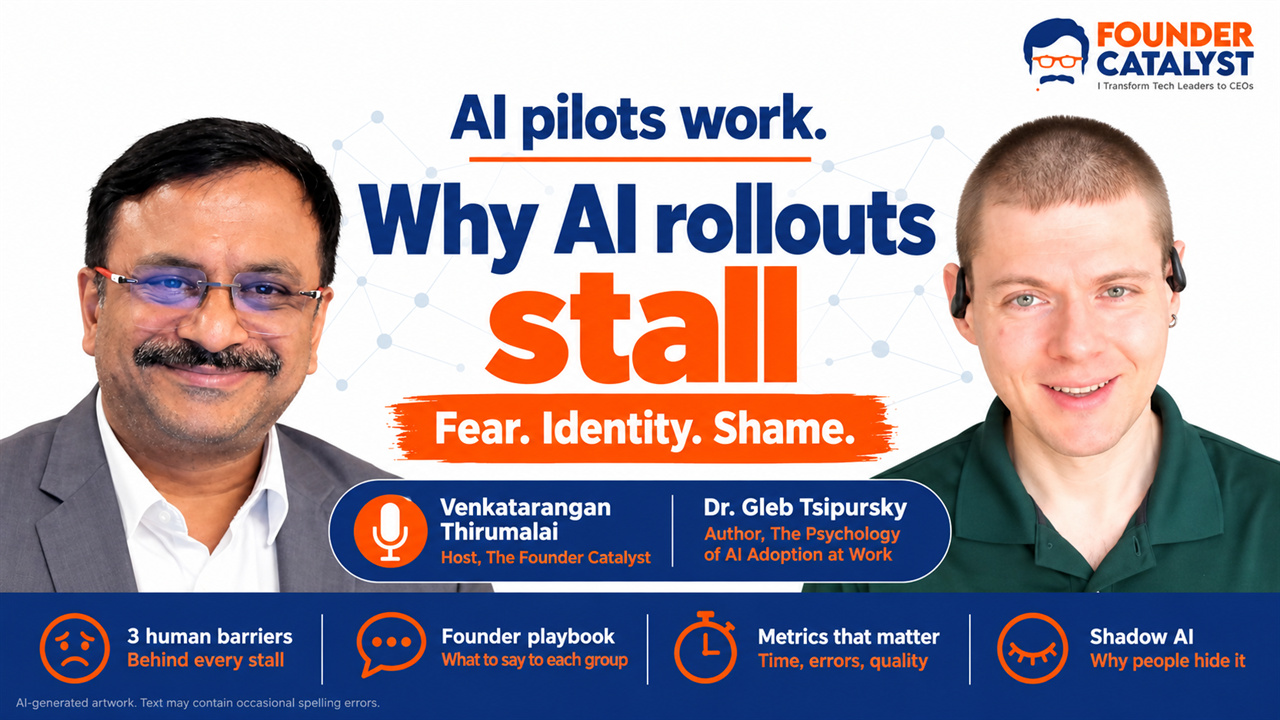
    Dr Gleb Tsipursky described an employee I suspect most of us have met in some form. She uses an AI tool to do her work, and she finishes early. She tells no one. Not her supervisor, not her colleagues. She spends the extra time on herself, and the company’s numbers never show any of it.

    She is not lazy or dishonest. She fears what her colleagues will say.

    I spoke to Dr Gleb recently about his new book, The Psychology of AI Adoption at Work: From Resistance to Results. It was published by Georgetown University Press on 1 September 2026, with a foreword by Nick Bloom of Stanford. It was the first AI interview I have done that focused more on people and emotions than models.

    The gap between the pilot and the rollout

    Dr Gleb sees the same pattern in company after company. A founder gets excited about an AI tool. A small group on the team picks it up and likes it. The pilot works. Then the founder rolls it out to everyone else, and it goes nowhere.

    He pointed to an MIT study that found 95% of the generative AI pilots it examined delivered no measurable return. He also cited Pew Research, where 52% of people said they were more concerned than excited about AI, and only about one in ten said they were more excited than concerned. Leaders sit in the excited group. So does a small share of their employees. Most people do not.

    He calls this the emotional gap, or the empathy gap, and says most leaders aren’t thinking about it.

    Take a CRM rollout. The hard part is making people learn new screens and follow a standard process. Top-down SOPs work there. AI tools are easy to learn, because you simply talk to them. But they are flexible, so one SOP cannot fit them. The head of IT does not know what a claims agent does all day. Even the head of claims doesn’t know every agent’s workflow. So each employee has to customise the tool for their own work, and that needs willing people. It does not happen when they are anxious.

    Three groups, three different fears

    Dr Gleb describes three groups, and each needs its own response.

    He calls the first group the AI Alarmists. Their emotion is fear and anxiety. They think they are training their own replacements. His advice to founders is to get the leadership team aligned on a job-neutral promise. The company may not hire more people, but it will not cut jobs because of AI. The focus goes on growth and on winning market share. He believes this is doable. I would only say that a promise like this is as good as the founder’s cash position, so it should not be made lightly. He also suggested telling them that the people who keep their jobs will be the most productive, and those will be the people using AI well.

    The second group is the Pragmatic Resistors. Their emotion is identity threat. Nobody feels threatened by a CRM. But when a tool can write a good sales email or a financial analysis, it touches what people take pride in. Companies often make it worse by automating exactly that work first. Dr Gleb does the opposite. He surveys the team on the tasks they hate, and on what blocks the work they love. Then he builds prompts and agents for those. He calls it “go slow to go fast”.

    The third group is the Reluctant Adopters. They do use AI, but quietly. The emotion is shame and social stigma. For them, he suggests three things. Leaders should talk openly about how they use AI themselves. The same training that helps the second group widens what feels acceptable. And there should be a channel, in a weekly meeting or on Slack or Teams, where people share their AI wins and even their prompts, with leadership praising them for it.

    Hiding AI use, and why India feels it more

    Why do people hide it? Dr Gleb said the shame comes from colleagues. If someone is doing a job well and fast with AI, the anxious majority around them may say, “You’re cheating, you’re lazy.“

    He said he has seen this more strongly in India than in the United States. He said the United States is more individualistic, and India is more collective, so the pull of what the group thinks is stronger. He called it a serious issue that leaders in India need to address.

    I also asked whether startups, family businesses and large enterprises differ. He said the three groups appear everywhere, but in different proportions. Family businesses tend to be reluctant to lay people off, so there is less job anxiety and fewer AI Alarmists. They have more Reluctant Adopters, because the stigma around AI is stronger. Startups are the other way round. There is some stigma, as with developers, but more worry about losing jobs.

    Measure the work, not the usage

    Dr Gleb says too many leaders measure how much people use AI. That tells you little, because you can use AI badly. The term for this is AI workslop, from a study published in Harvard Business Review with Stanford and BetterUp. As Dr Gleb cited it, people estimate that around 15% of the work they receive from colleagues is workslop.

    He measures three things with his clients. Time saved per workflow, such as writing a claims letter, a sales email or a PowerPoint. Error rates. And quality, since an email can be error-free and still have little impact.

    Workslop is also where malicious compliance lives. People who fear AI or feel threatened by it, and who are forced to use it, may use it badly on purpose. They give a poor prompt and send the output without editing it. When the boss complains, they say they only did what they were told. The tool then looks like it doesn’t work. I called it active sabotage, and Dr. Gleb agreed.

    His answer is to fix the motivation first. After that, training matters less than founders’ fear. The tools are not technically hard. He said a founder with more time than money can take five times as long and work it out alone, without hiring him.

    Where human judgment stays

    I closed by asking whether we give human judgment too much importance. He gave three reasons to keep it. In many cases, human judgment is still better than AI judgment, which is why people should edit what AI drafts. People would also feel a much bigger identity threat if the tool made the final call. And in regulated areas such as insurance, regulators require the final judgment to be human. As entrepreneurs, he said, we probably do not want governments stepping into more areas than they have to.

    I have been an engineer all my working life, and I tend to look at everything from the technology side. After running a business for 30 years, I’ve learned that people make it. This conversation put that in sharper form for me. An AI tool is only as useful as the willingness of the person using it.

    If you are weighing how to take AI beyond a pilot in your own organisation, and want more conversations with founders and leaders like this one, subscribe to The Founder Catalyst newsletter.

  • Award winning cheesemaker never paid for press

    Award winning cheesemaker never paid for press

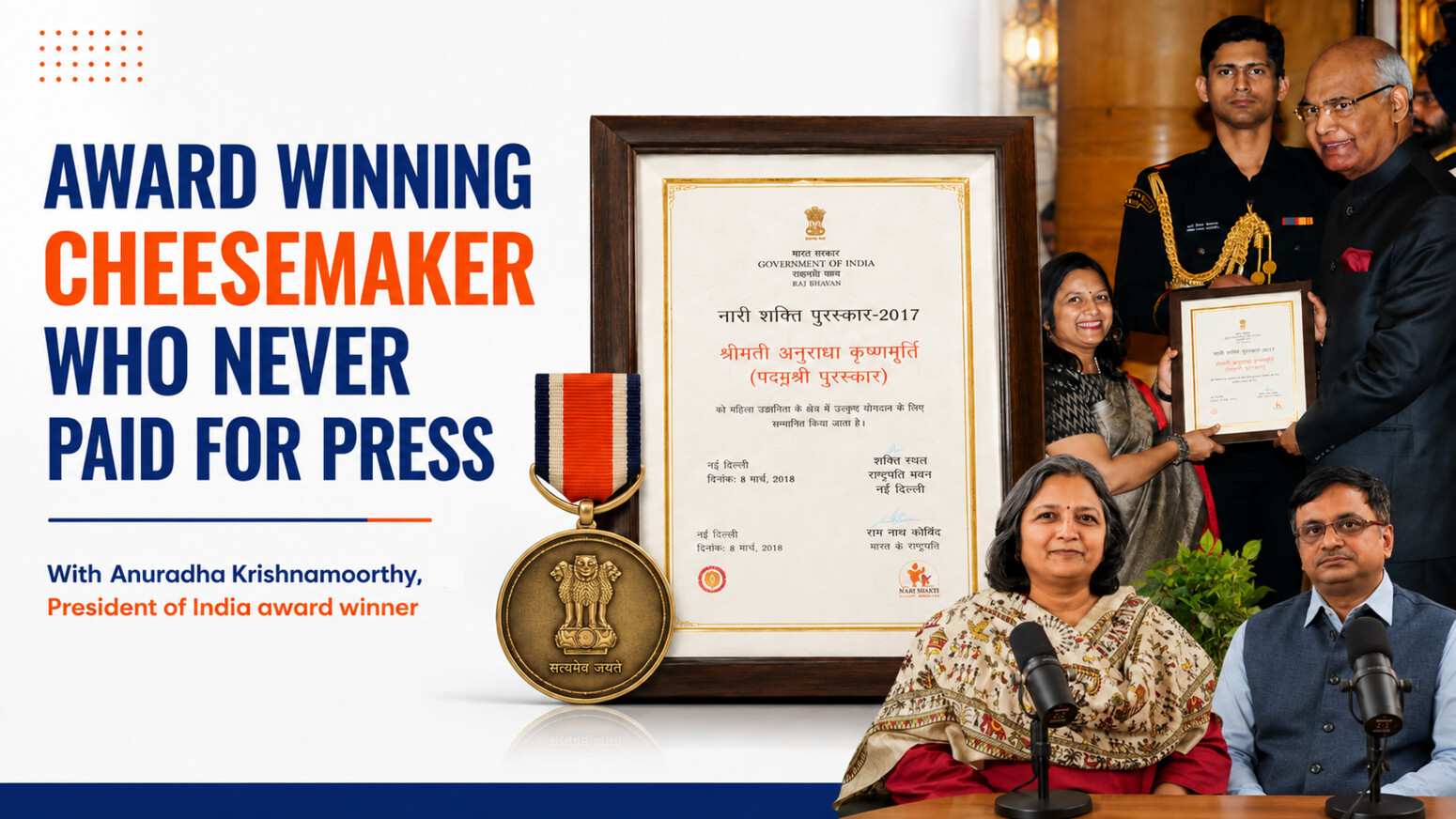
    In ten years of running Käse, Anuradha Krishnamoorthy has never paid for a single line of press coverage. No influencer budget, no marketing retainer, no PR agency on monthly fees. Yet the brand has been written about repeatedly, has won at the World Cheese Awards, and now ships across India from a kitchen in Chennai.

    When she said this to me recently in the Founder Catalyst studio, my first instinct was to treat it as a nice story about a niche business getting lucky with the press. It is not. Sitting with the rest of the conversation, I think it is the most instructive thing about how she and her co-founder built this company, and it connects to almost everything else they did differently.

    Anuradha is a friend, and this was a conversation I had wanted to record for a long time. She is the co-founder and director of Kirke Cheese Pvt Ltd, which runs the brand Käse. She and her co-founder Namrata Sundaresan received the Nari Shakti Puraskar for 2017, presented by the President of India at Rashtrapati Bhavan in March 2018, on International Women’s Day. Käse turned ten this year.

    The business that started as a training programme

    The origin story is not a food story. Anuradha has a masters in social work, and before cheese she was running CAN DO, a venture she developed as an ISB 10,000 Women scholar. CAN DO trained and employed people with disabilities in telecalling, data validation and research work. At one point it ran a forty seat operation employing people with hearing impairment and people with visual impairment.

    Two mothers came to her about their daughters, both with hearing impairment, both unable to complete their graduation. They asked whether Anuradha could help find the girls work. She began looking at setting up a baking unit, since baking was a skill the girls could take with them and use independently later.

    She approached Namrata to help set it up. Namrata had learnt cheesemaking during a farm stay in Coonoor over a break, and suggested cheese instead of bread. That conversation is the entire founding decision. Within a year, two girls with hearing impairment were part of the team at Käse.

    What strikes me about this is that the business did not begin with a market opportunity. It began with a specific problem for two specific people, and the product was chosen because it happened to be a teachable skill. Most founders would consider that backwards. Ten years on, it has produced a pan India brand.

    Why the phone changed her mind about hiring

    The part of the conversation I keep returning to is her explanation of why employing people with disabilities worked commercially, not just morally.

    Her point was simple. When someone is speaking to you on a telephone, you have no idea whether they have a visual impairment. There is no visible cue, so there is no room for the usual hesitation or discomfort. Only the work is visible. The prejudice never gets a chance to form.

    She paired that with something sharper. The moment you think of employing a person with a disability as charity, she said, the work ends right there. These are individuals looking for an opportunity, and they are resources like anybody else on the payroll.

    I put the founder’s objection to her directly, because I hear it often. Founders and CEOs are already under pressure. They worry about hiring someone, finding it does not work, and then being in the difficult position of having to let them go. They also worry about causing offence, because most of us were never trained as a society to work alongside people with disabilities.

    Her answer was that hiring a person with a disability changes the team, not just the headcount. She described how the person with hearing impairment and the person with visual impairment worked as a genuinely effective pair. One handled data mining and database validation, the other made the calls. Screen readers and magnifiers, much of it open source, made the second half possible. That was a decade ago. The tooling is far better now.

    Several people who worked at CAN DO went on to government and bank jobs, roles that are heavily sought after. They still come back and tell her that the first chance to prove themselves is what made those jobs possible.

    Anyone starting this today has better technology, better software, and a larger pool of people who have already been through skills training. The founders who are getting this right are treating it as recruitment, not as a corporate social responsibility line item.

    The pricing decision that most founders get wrong

    Käse decided early that it would be a hundred per cent preservative free brand and that the milk would come from grass fed cows on small farms. That decision has consequences. One litre of milk yields roughly a hundred grams of milk solids, so a kilogram of cheese requires around ten litres of milk. Skimmed or toned milk will not work, because the fat content carries the quality through to the cheese.

    The arithmetic makes a premium price unavoidable. What took nerve was holding that price in Chennai, a market everyone told them was difficult to crack.

    Anuradha gave me a number that I think every founder in food should sit with. On a five hundred rupee pizza, the actual ingredient cost is around thirty per cent. That thirty per cent is the only lever a business has if profit is the sole objective, so the pressure is always to compress it further. Being in the food business, she said, opens your eyes to what goes into food, including in kitchens at star hotels.

    Käse went the other way. They raised quality, accepted the cost, and priced accordingly.

    I see the opposite mistake constantly. Only the other day I was speaking with a founder running a services company with a genuinely good offering who is struggling, purely because his price point is wrong. Raise it and he is in a different orbit entirely. We come from a conservative business culture where the instinct is to be the cheapest. Being the cheapest is a strategy, but it is Walmart’s strategy, and it requires a scale most founders will never have.

    The Tata Nano Car is the example I keep coming back to. It was engineered well and marketed as the cheapest car available, and that positioning is a large part of why it failed. Today the equivalent segment sells at ten to twelve lakhs quite comfortably.

    Käse spent its first year at seventeen artisan markets in a single calendar year. Unless people taste the product and find value in it, no price point survives. That is the work that earns the right to charge more.

    How the press actually happened

    This brings us back to where we started. The press came, and it came free, for reasons that have very little to do with press strategy.

    There are only thirty to forty artisan cheese makers in a country of this size, so the category itself is unusual. Then there was the product. They made a cheddar with molagapodi, the chilli powder that ordinarily goes with idli and dosa. Cheese and Chennai do not sit naturally in the same sentence, and molagapodi and cheddar sit even less naturally together. People had something to talk about.

    Alongside that was the hiring story, which visitors and journalists noticed on their own.

    Neither of these was manufactured. You cannot run a brainstorming session and arrive at an authentic differentiator. They hired the girls because that was the reason the business existed. They made molagapodi cheddar because they are in Chennai. The stories fed each other.

    Her view on influencer budgets follows from this. Influencers have a role to play, but at a later stage, when you can afford it and you are scaling something that already works. When you are a niche brand with no outside capital, spending there first is the wrong order of operations. Reviews can be bought. Loyalty cannot. She made the point that if she has a genuinely good evening at a restaurant with her family, she will want to write a good review without being asked, and no budget replicates that.

    Most Käse customers today arrive through recommendations from other customers.

    On co-founders and the honeymoon ending

    I asked her about the co-founder relationship, because I see so many partnerships drift apart a few years in, often after success rather than before it. She agreed with the comparison to a marriage. The honeymoon ends, reality arrives, and expectations diverge.

    What has held theirs together is a clean division of ownership. Anything product related is Namrata’s call, because she is the cheesemaker and Anuradha describes herself as her student on that front. Operations and finance sit with Anuradha. They consult each other on most decisions, but each decision has a single owner.

    That last part matters more than it sounds. Splitting responsibility is easy. Someone still has to own cash flow and pricing, because salaries have to be paid on time regardless of who feels responsible.

    They were acquaintances rather than close friends when they started Käse, and the friendship deepened through the business rather than being risked by it. Neither of them was a first time founder either, which I suspect explains more than they give it credit for.

    The number she wants to change

    The last stretch of our conversation was about women founders, which was one of the main reasons I wanted to record this episode. The numbers suggest the proportion of women entrepreneurs in India has risen substantially over the last two decades. I do not doubt the direction, but in the mentoring sessions and angel meetings I sit through, I am still not seeing it.

    Anuradha was direct about why. Indian women often start out on genuinely equal footing, and the divergence appears later, when the role that a woman is expected to carry at home begins to compete with the role she is building outside it.

    She has decided to change the ratio in the only place she fully controls. Käse’s expansion, which is now under way with a significant increase in production capacity, will remain a women led and women run business.

    She also had a warning that applies beyond food. There is an enormous amount of information available now, and no reliable way for most people to tell information from misinformation. Do not treat everything on the internet as settled truth. Do some digging yourself before you act on it. She was pleased, though, to see younger customers reading labels closely. That awareness is itself an opening for anyone building an honest product.

    What I took away

    The unpaid press, the premium pricing, the hiring, and the co-founder discipline all look like separate decisions. They are not. They are the same decision made four times.

    In each case Anuradha and Namrata chose the thing that was genuinely true about their business over the thing that would have been easier to execute or explain. Grass fed milk, so the price is high. A social work background, so the hiring reflects it. Chennai, so the cheddar has molagapodi in it. None of it was designed to be interesting. It became interesting because it was real, and the coverage followed on its own.

    Marketing budgets are usually the price you pay for a business that has nothing worth talking about.

    The full conversation is on the Founder Catalyst podcast and YouTube channel: