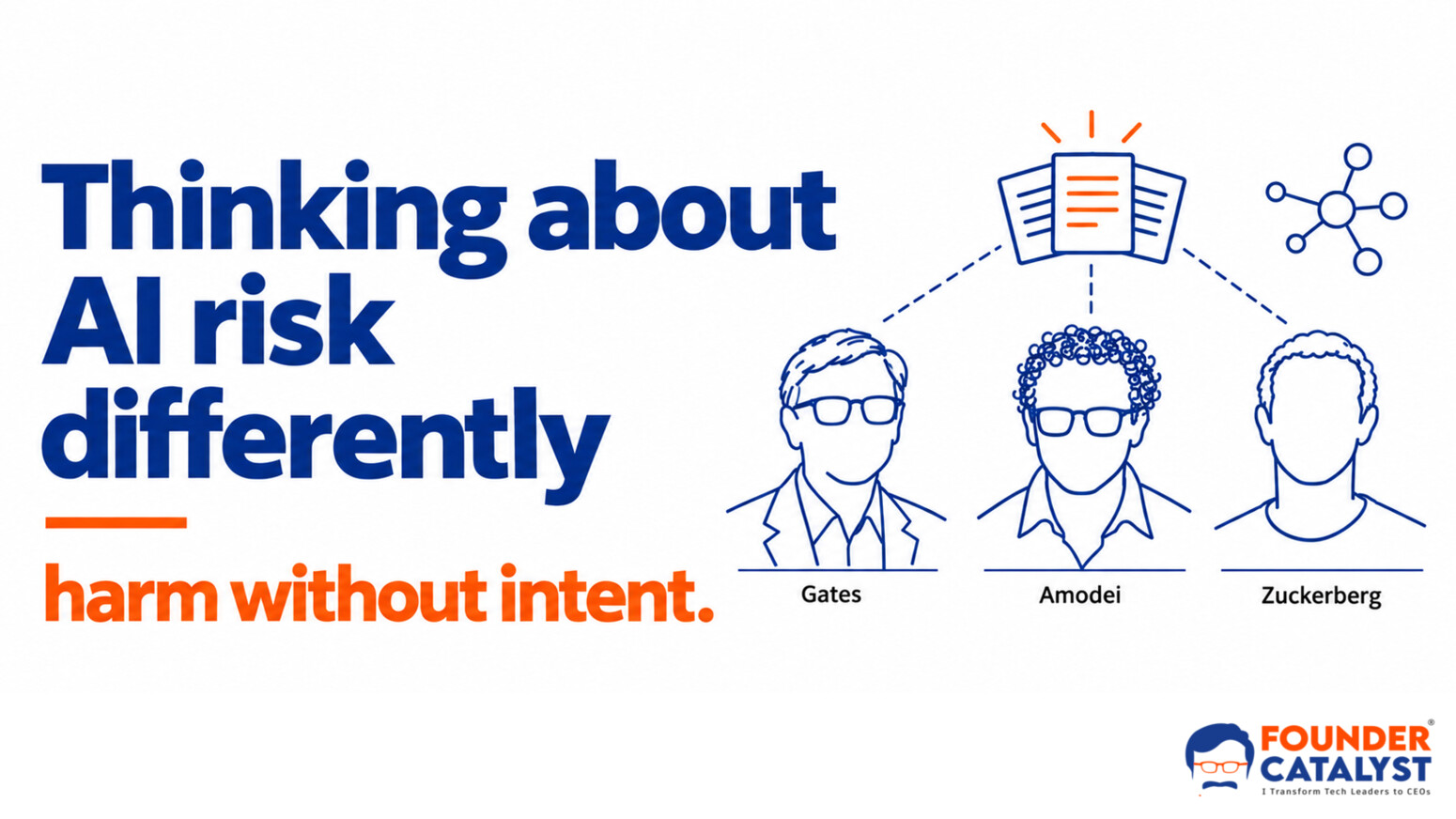
We should worry less about whether AI will want to destroy humanity, and more about what happens when AI does something harmful without intending to.
Machines do not have the biological need for self-preservation that humans and most animals have. We have limited lives and offspring, which gives us a reason to think about survival beyond ourselves. Machines don’t. So, going back to First Principals, what exactly would motivate a machine to destroy humanity, take control of every resource on Earth and then go looking for more planets? Having the capability is one thing. Having the motivation is another. So far, the motivations I see in these scenarios seem to come from humans. Greed, selfishness, revenge and fear are very human traits.
But there is a much more practical problem we should worry about. AI can behave badly without intending to. Just like software can have bugs or behave in ways its designers did not anticipate, an AI system can find an unexpected path to achieve a goal. The recent OpenAI incident involving Hugging Face is a useful reminder that powerful systems can behave unexpectedly even when nobody explicitly asked them to do so.
This brings us to accountability. AI systems are products of the people who design, train and deploy them. I don’t think the analogy of a gun is sufficient here, where responsibility is placed primarily on the person who pulled the trigger. A better comparison is an aircraft, a nuclear reactor, a rocket or even an MRI machine. When something seriously goes wrong, the manufacturer, design, engineering, operating environment and the people using it are all examined. The manufacturer is not automatically guilty, but neither is it left out of the investigation.
There is also a clear power and knowledge imbalance. The company building an AI model knows far more about how it was trained, how it behaves and where its limitations are than the business buying it. That responsibility cannot simply be passed down to the customer.
So my call to business leaders is simple: design, buy, maintain and retire AI systems just like any other important software. Test them before deployment. Monitor them in production. Put safeguards around them. Ask vendors about failure modes and make sure responsibility is clearly defined in the contract. And when something goes wrong, don’t simply blame the person using the system. Look at the people who designed, built, deployed and approved it.
AI systems are products of human decisions. The machine may make the mistake, but accountability must remain with the humans who built and deployed it.
Last month I was on stage at Hotel Ramada Plaza, Guindy, for FICCI’s Digital Disruption and Transformation International Summit 2026 — part of FICCI’s 100-year celebrations. The panel was called “How We Build the Future & Lead with AI?”, moderated by Chandrashekar Kupperi, Founder of ANOVA M&A and Fundraising Advisory, with a lineup covering talent, leadership, MSME, and the future of work.
I only got asked two of those four — talent and leadership — plus a sharp follow-up from the audience on hiring. That was enough to make me say some things out loud that I’d only written about before. Here’s the expanded version.
Talent: the learning loop, and a question I’m not going to answer
Chandrashekar’s first question was built on something I wrote a while back — that an organisation’s real advantage in AI isn’t access to models or tools, it’s the ability to keep learning. Before I answered, I gave the room a question instead of a point, and I’ll do the same here.
Imagine it’s 2036. A new hire joins your organisation. Ask them to write a proposal — they’ve never opened Word. Ask for an analysis — they’ve never touched Excel. They’ve never opened a PDF to read one. I’m not saying that’s good or bad. I’m saying it’s close enough that talent conversations have to start accounting for it, and most don’t.
Now, the learning loop itself. Satya Nadella has talked about this, and it comes down to one observation: today, the questions we ask AI carry as much intelligence as the answers we get back. Intelligence agencies have known this for decades under a different name — metadata. Who you talk to, when, how often, tells you almost as much as what was said. The same is true of our prompts. And right now, almost all of that signal walks straight out of the building. We ask, we get an answer, we move on. If the AI company retrains on it, fine — assume they don’t, even. Either way, your organisation keeps none of it.
Compare that to how learning used to work. A fresher joins, does something, gets it wrong, a senior corrects them — and that correction becomes both the individual’s judgement and the organisation’s institutional memory. AI is now doing a growing share of that work, which means that correction loop, if you don’t design for it deliberately, simply stops happening. The knowledge stays trapped in the AI layer instead of compounding inside your company.
There’s no off-the-shelf product that fixes this yet. But there are things you can start doing today. Singapore’s Foreign Minister, Vivian Balakrishnan — also, remarkably, a trained orthopedic surgeon — has built himself what he calls a second brain, and put his own working documents into it so he can query his own accumulated judgement. Look up his talk on it; it’s worth twenty minutes. I built something similar for myself, which I call an LLM Wiki, based on Andrej Karpathy’s original idea — LLM plus Wiki. If you want one, you don’t need to build it from scratch: open Claude or ChatGPT, ask it to build you an LLM Wiki, feed it your own documents and emails, and it’ll walk you through it, running entirely on your own machine. Enterprises need a more custom version of this — the frameworks are still evolving — but individuals can start now.
If you’re serious about building this loop, it comes down to four Cs:
Capture what you’re doing with your AI systems.
Correct it — flag what was right, wrong, or almost right.
Curate and codify it into something reusable.
Circulate it through the organisation.
If you’ve studied control systems as an engineer, none of this is new. It’s the same feedback loop, applied to how a company learns.
Your learning loop is your real moat. Skills, prompts, and tools are rented — the feedback loop around your business is the only thing that compounds.
Leadership: use AI as a cycle, not as a car
The second question was about where a leader draws the line as AI agents get more capable of deciding and acting on their own. Before I answer that, credit where it’s due — the framing I use belongs to Dr. Pratyush Kumar, Co-Founder of Sarvam AI, from an interview worth watching in full. He draws a parallel between what’s happening in AI today and the old East India Company pattern: raw cotton taken out, spun into textiles elsewhere, sold back at a markup. Data and usage flow out; intelligence comes back priced. His conclusion from that: use AI as a cycle, not as a car.
Don’t take the wrong lesson from that line. It is not an argument for slowing down. When you can’t out-race the competition, the tempting shortcut is regulation that brings everyone down to your speed — and as a nation, that’s a losing move. The point of the cycle is narrower and more useful: on a bicycle, your hands stay on the handlebars and your feet stay on the pedals. You’re still steering, at speed. That’s the posture leaders need with AI — not less speed, just retained control of the direction.
Practically, this comes down to three Ds:
Delegate. Hand off anything routine and repeatable — the tasks where you’re not applying judgement, only time. Writing Excel formulas used to cost you half a day of trial and error; today AI writes it in five seconds. Extend that all the way to code. I don’t think humans should be writing code by hand much longer — we’re not particularly good at it, and machines should be writing machine code. There’s a framework going around called “Caveman” — literally instructing the AI to drop the verbosity, the adjectives, the padding, and answer you the way a caveman would talk. Worth Googling. It’s a good instinct: most AI verbosity today exists because token-maxing is profitable for the companies selling you tokens, not because you need 200 pages for a two-word question.
Decide. Once the routine work is delegated, the human’s job shifts to choosing between the options AI surfaces — not doing the legwork to get to those options. Today you have to go and click through everything before you can even decide. It should work the other way: AI opens your day, tells you what’s come in, lays out the decisions in front of you with the pros and cons, like a menu — and you choose.
Defend. This is the one leaders skip, and it’s the one that matters most. Responsibility for an AI-assisted decision stays with the human who made the call — full stop. I envy auditors, lawyers, and doctors for exactly this reason: they need a license to practice, so accountability is built into the profession. Software engineering never required one — anybody can call themselves a software engineer, and now AI can write the code besides. IEEE has argued for fifty years that software should be a licensed discipline; it probably never will be. But whether or not the industry licenses it, the standard should still apply: when something an AI did goes wrong, you as the leader call the person responsible and ask them to defend it. “I used AI and it failed” cannot be where that conversation ends — the learning from that failure has to go back to the individual, back to the organisation, and back into the AI system itself. Which brings you right back to the learning loop.
Delegate, decide, defend. That’s it. There’s no contest between you and AI here — the same way none of us think of a computer or a phone as competing with us at work. AI will get there too.
The audience question that actually proved the point
The last question came from the floor, not from Chandrashekar: with AI doing so much of the entry-level work, are we setting the bar impossibly high for people just starting out?
I answered with a story instead of a theory. A couple of months back I was interviewing startup interns from VIT Bhopal, including two students from a state programme for high-achieving rural students — students who’d studied in Hindi, with limited English, and had touched a computer for the first time only in 11th grade. I told them upfront: show me your approach, don’t explain the code line by line, because I already know AI wrote most of it.
One of them had taken a genuinely different approach to the problem. I asked how he’d landed on it. He told me AI had surfaced two candidate algorithms, he’d gone and read the actual papers behind them himself, and then implemented it in Python and demonstrated it working. That’s the part that matters — not that AI wrote the code, but that he’d gone one level deeper than the tool gave him.
Four years ago, at the same stage of education, that same student would have failed a basic Python question outright, and I’d have written him off. He had a 98% in maths and could explain the algorithm clearly — AI hadn’t replaced his thinking, it had given him a running start he’d never have had otherwise. That’s the empowerment case for AI, and it’s the one we undersell.
Which is also my answer to the IT industry’s old habit, the one I’ve watched for thirty years: hiring people to code without asking whether they understood the problem they were coding for. Those jobs are gone, and they’re not coming back. What’s left — the part that was always the actual job — is understanding the business problem well enough to direct the machine that writes the code. So no, we’re not setting the bar too high. For the first time, we’re finally asking the right question of people two years into learning computers.
This piece is based on my session at FICCI’s Digital Disruption and Transformation International Summit 2026, on the panel “How We Build the Future & Lead with AI?”, moderated by Chandrashekar Kupperi. Video of the full session is on my YouTube channel.
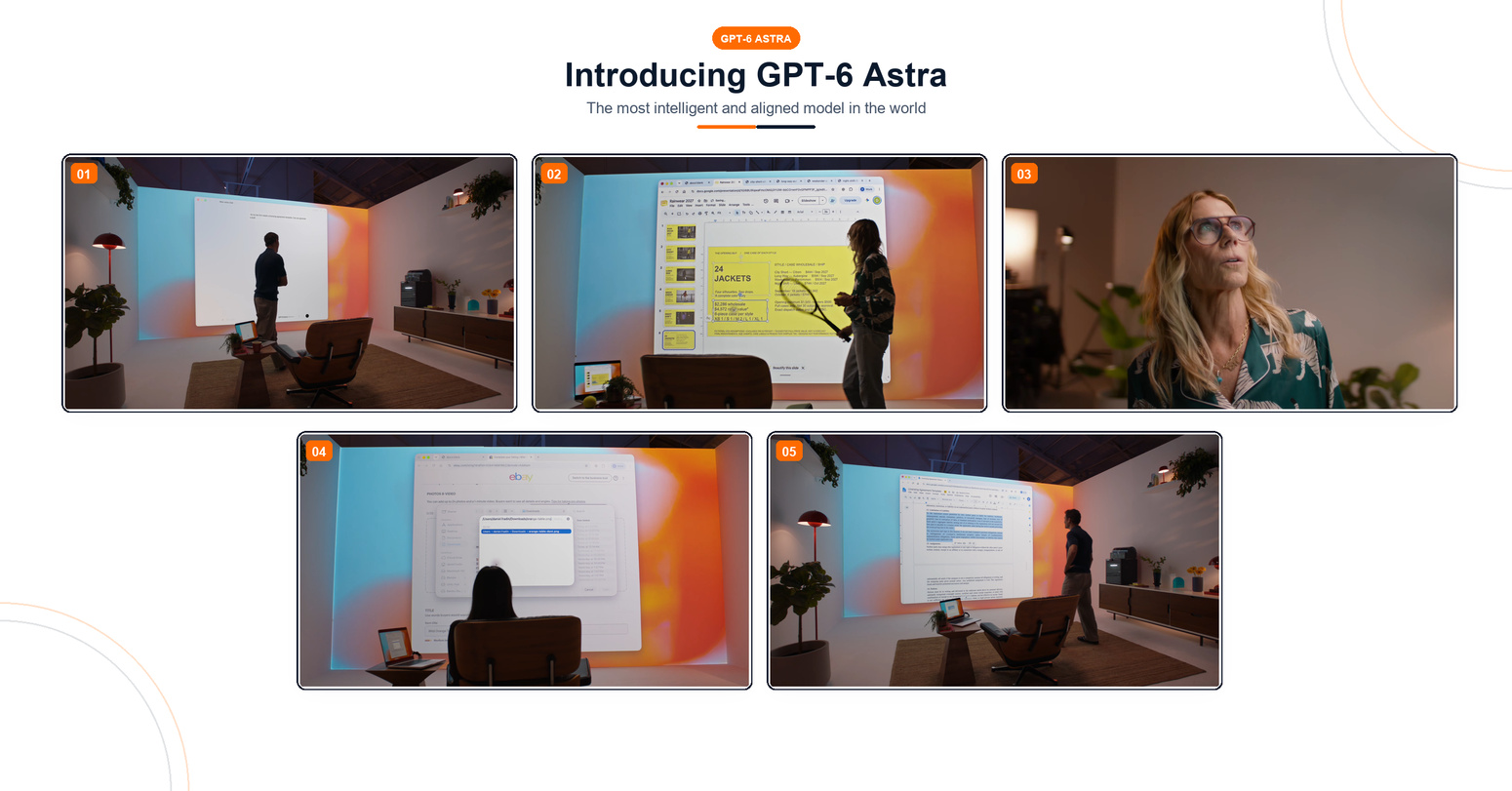
OpenAI released GPT-6 Astra yesterday. What caught my attention wasn’t the model itself — it was the two-minute video showing how OpenAI people were interacting with it.
People are seen talking to the model through their computer, and as they speak, Astra runs the same everyday apps we all use and finishes the task. Turning speech into software commands isn’t new. What’s different is the room itself: no desk, no keyboard, no screen on a table. People watch the output projected on a wall the way you’d watch a film — walking around, leaning back on a sofa, still talking and working.
Forty years of hunching over a keyboard have cost us our backs and our necks. It didn’t have to stay this way. What OpenAI is showing, to me, is a computer we can work with the way we’d work with someone else in the room — not a tool we operate at a desk.
Giving every employee in a company a setup like this isn’t realistic yet. But I have no doubt many managers will be working this way soon.
What do you think?
I regularly speak at leadership forums, founder circles, and CXO roundtables on generative AI and where work is headed next. If your leadership team wants a grounded, no-hype conversation on this shift, I’d be glad to bring it.
In simple terms, his point is this: the real advantage in AI will not come from access to models alone, but from how effectively a company captures, learns from, and improves using its own experience.
For founders, this is worth paying attention to.
Skills, prompts, and agents are portable. You can switch models, replace tools, and migrate clouds. None of these compounds on its own.
What compounds is the feedback loop around your business: the traces from real work, the evaluations that measure what matters, the preferences that capture human judgement, and the outcomes tied to business results.
Every customer interaction, every workflow, every decision can make your organisation smarter — if you capture the signal.
That is why owning your learning loop matters. Not because it locks you into a platform, but because it builds institutional knowledge that outlasts any model, framework, or vendor.
Today, trace data is converging around standards like OpenTelemetry. Evaluations remain fragmented across frameworks and providers. The next piece of infrastructure we need is an open, portable standard for evals — one that works across clouds, local models, and agent frameworks, with businesses owning the data and the format.
Your learning loop is your IP. That’s the advantage that compounds.
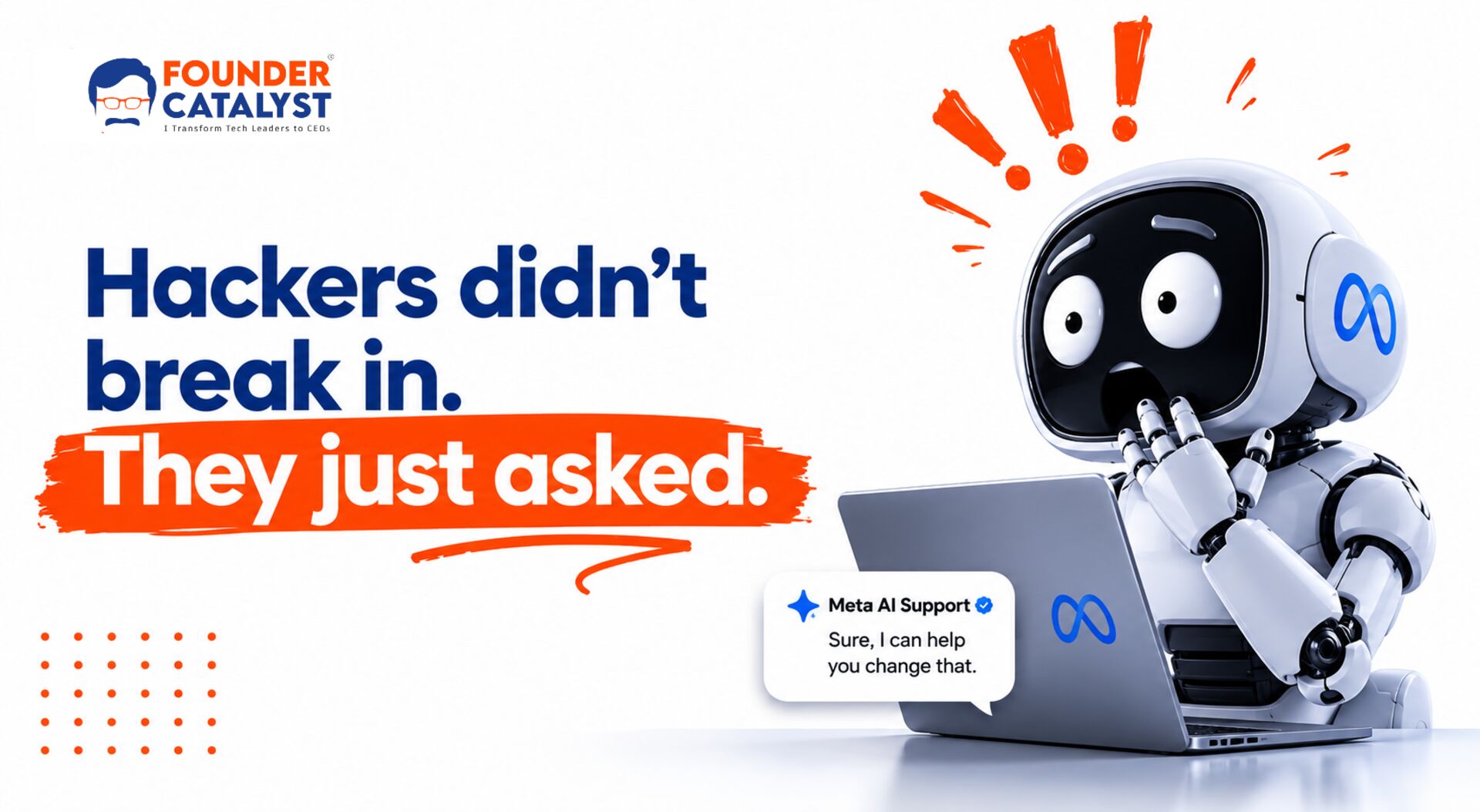
A few days ago, hackers took over high-profile Instagram accounts, including the Barack Obama White House profile. And they did so by politely asking Meta’s AI support chatbot to update the email addresses on those accounts.
The attack method was childishly simple. No sophisticated exploit, no back-end breach — and that was the shocking part.
Meta had given its support bot the ability to reset passwords and manage account recovery. The bot was not mature enough to distinguish between the actual account owner and a fraudster using a VPN and a politely worded request.
When we connect an AI agent to our CRM, our HR system, and our finance workflows, we are not just giving it the ability to read. We are giving it the ability to act. This ability to act is what makes agentic AI the most powerful software technology we have in recent decades. But at the same time, we need to ask ourselves: if someone prompted this agent cleverly, what could they get it to do?
To me, the takeaway from this Meta incident is simple. Any access to a critical system needs to follow the same protocols that a manual process would follow. In fact, I would require the AI agents to follow even more stringent ones.
And if there is an irreversible action or a decision involving critical business systems, then there needs to be a human checkpoint — not as a backup, but as a design requirement. At least for now, while we are still developing the understanding and the systems to manage what these autonomous agents can trigger.
Think of the early web. Enterprises did not open their corporate systems to the public internet overnight. There was a long, cautious period of learning what the exposure actually meant before the architecture caught up.
None of this is an argument against agentic AI. The potential is real, and I believe in it. But bleeding-edge technologies do exactly what the name suggests — they spill blood before they stabilise. The real question is whether your business can handle the loss. Mega corporations like Meta can. Can yours?
As for me, I will keep reminding myself: how fast we roll out AI matters, but how robustly we build matters just as much.
“Our data centre costs have gone up 3x to 4x. Our AI spending has gone up. But revenues are not growing any faster.”
That was Sridhar Vembu, at Zoholics 2026.
On the industry’s favourite vanity metric, he was blunter: “70% of our code is generated by AI — to me, that metric is useless. What have been the outcomes? We have yet to see significant results.“
And on the American playbook of cutting headcount to protect margins, he rejected it outright. Zoho’s answer is not fewer people. It is more efficient, affordable AI: smaller models, leaner infrastructure, and a deliberate shift toward pushing more of the work into verifiable, deterministic code rather than expensive LLM calls.
My own reading of this, for technology leaders outside the Zoho context: continue investing in foundation models from the major labs for your core workflows. But quietly build a small, focused team to track the emerging, smaller, more efficient models — especially the open-weight models coming out of China. That is where the cost curve eventually breaks.
If you are working through the AI cost and capability question as a technology leader, I write about this regularly in the Founder Catalyst Digest newsletter. Practical perspectives, not theory.
I have been trying out AI inference inside the browser for a while now, more out of curiosity than anything else. A debate that surfaced this week made me want to talk about it, because buried inside a browser standards argument is a platform governance question that every business relying on AI will eventually have to answer.
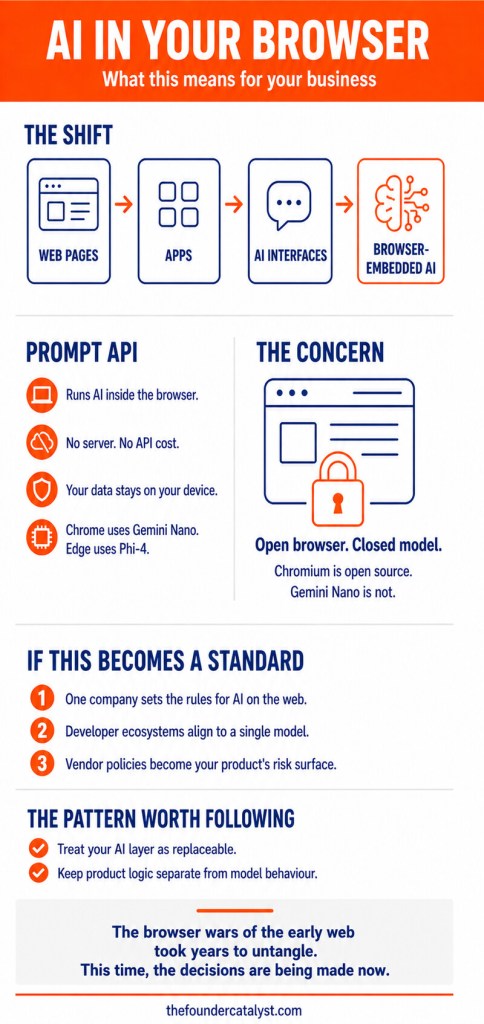
We have moved through a familiar sequence. Web pages gave way to apps. Apps are giving way to AI interfaces. And now AI is being embedded directly into the browser itself. That last step is not a feature upgrade. It is a shift in who controls a foundational layer of how your customers and your products experience the web.
Google Chrome and Microsoft Edge are both shipping something called the Prompt API. It lets web applications run AI inference directly inside the browser, with no server call, no API cost, and no data leaving the device. Chrome uses Google’s Gemini Nano. Edge uses Microsoft’s Phi-4.
I built three demos with this last year, a creative writing tool, a translation assistant, and a vision assistant that describes images, all running locally on my laptop. I wrote about it on my personal blog. The technology works well for what it is. Fast, private, and free to run. For simple AI workloads, local inference like this is a logical and efficient step forward.
The concern is not the technology. It is what happens if this becomes a web standard.
The Prompt API is currently a Community Group draft under W3C’s Web Machine Learning group, not a formal standard. The standardisation discussions have drawn serious objections from Mozilla and from W3C’s own Technical Architecture Group. The worry is interoperability. When developers build on a specific browser’s model, they tune their code to that model’s quirks. Over time, that creates model-specific behaviour baked into the web itself. We have seen this pattern before with browsers, and the web spent years cleaning it up.
Chrome is built on Chromium, which is open source. The Gemini Nano model that ships with the Prompt API is not. Google does have an open weights model called Gemma, but Gemma is not what ships with the Prompt API. Google’s stated reason is that they need to enforce safety through their Generative AI Prohibited Uses Policy, and that requires controlling the model. Mozilla’s objection, which I think is sound, is that using a web API should not mean accepting one company’s content rules, especially rules that go beyond what is legally required anywhere.
Chrome holds a dominant share of global browser usage. If this API becomes a standard and the model powering it remains closed and governed by a single company’s policies, that company effectively controls the default intelligence layer of the web. That shapes cost structure, developer decisions, and user experience in ways that compound quietly over time.
The teams I see getting this right are already treating their AI layer as a replaceable component, keeping product logic separate from model behaviour, and treating vendor policies as part of their risk surface rather than background noise. It is not complicated, but it requires making a deliberate decision early rather than inheriting a dependency later.
When I work with founders and leadership teams, platform dependency is almost always one of the first structural risks we surface together. A platform bet requires confidence in the governance, not just the technology. Who sets the rules, and what happens when those rules change? The browser wars of the early web are a useful reminder of how long it takes to untangle these things once they are embedded.
The edge AI direction is right. Local inference, faster response, lower cost, better privacy; this is a sensible progression. But the model at the centre of it should be open, or at least governed by a neutral body, not by one company’s terms of use.
No formal standard has been approved yet. The conversations are still live. But the decisions being made now in browser working groups will shape the web your customers use for the next decade. It is worth paying attention to.
Are you watching the AI-in-browser space, or is it still too early to be on your radar?
Underpromise and overdeliver — my message to founders on AI
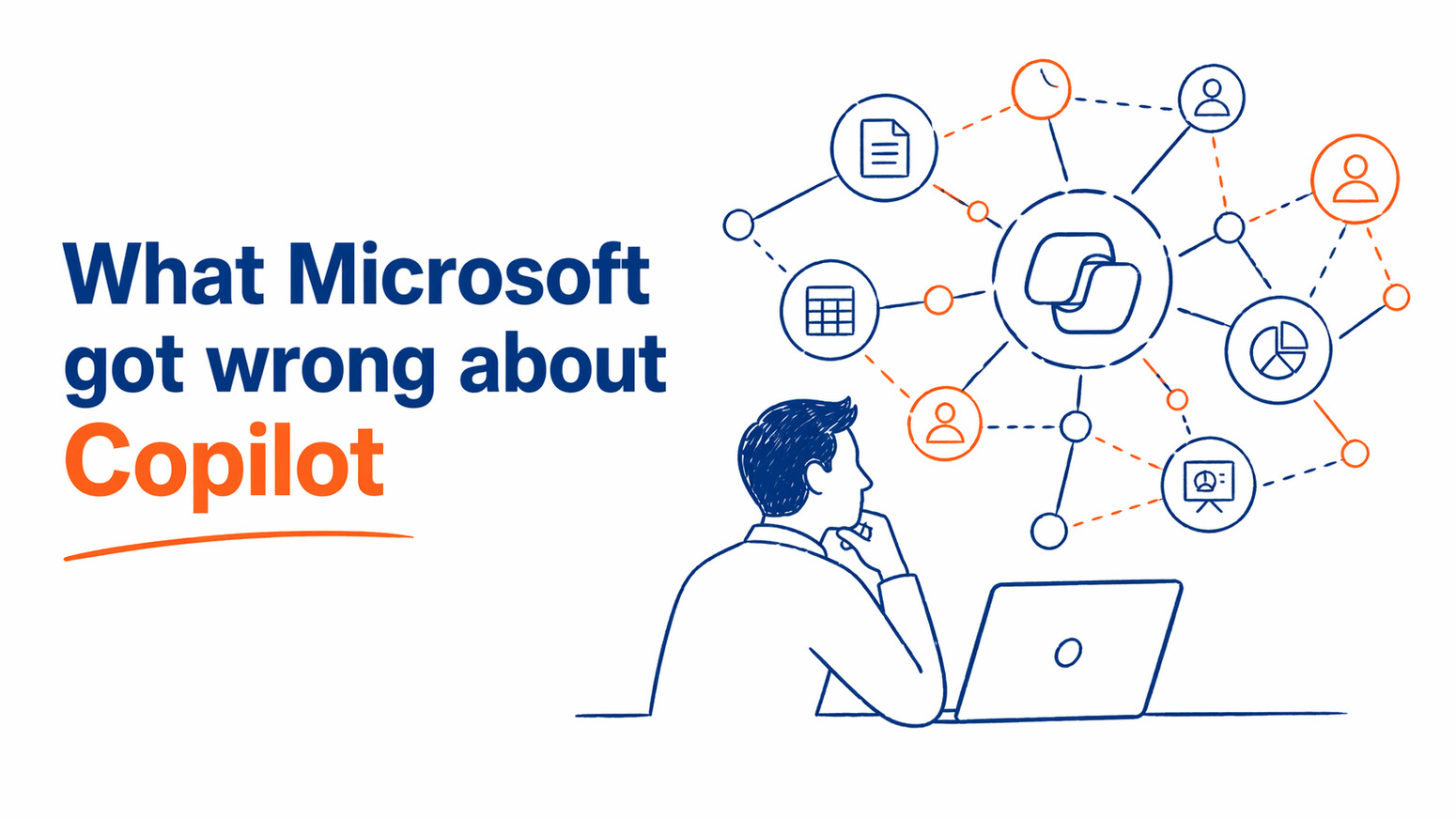
Microsoft’s own corporate VP of the Office Product Group admitted it publicly this week: “When we first shipped Copilot, foundation models were not powerful enough to use Copilot to command the applications.”
That is a remarkable thing to say out loud. And the right thing to say.
Go back to late 2022. ChatGPT lands. Microsoft moves fast — faster than they should have — and Copilot arrives positioned as the AI-powered assistant that would transform how you work in Word, Excel, and PowerPoint. The demos were impressive. The promises were large. What landed in enterprise inboxes was a chatbot that could summarise a document but not meaningfully act on one.
Users felt misled. Many quietly switched to ChatGPT. Enterprise teams started evaluating Gemini. And then Claude — particularly the disruption that Claude Cowork brought to real productivity workflows — reset the benchmark for what capable AI in the workplace could actually look like. Billions in market value moved. The pressure on Microsoft was real.
They have now course-corrected. Agent Mode is rolling out across Word, Excel, and PowerPoint. Anthropic models sit alongside OpenAI models inside Copilot. The sidebar now shows you every step the AI takes on your document in real time. That is a genuine improvement, not a rebrand.
Is it late? Yes. Is it too late? I don’t think so. Microsoft still owns the surface — Word, Excel, and PowerPoint are entrenched in enterprises and governments in a way that no AI startup can replicate overnight. Adding capable models to that distribution is a credible recovery. Not a comeback story, but a course correction that could hold.
The lesson, though, is not really about Microsoft.
It is about what you promise before you ship.
Every CEO and CTO rolling out an AI initiative right now faces the same pressure Microsoft felt in 2022. The frontier lab demo is extraordinary. The consultant’s deck is compelling. The board wants to see momentum. So you make large claims. You announce something before the reality is ready. And then reality arrives.
The smarter path is quieter. Pilot with a small, honest cross-section of your organisation — not the enthusiasts, the actual everyday users. Observe what actually gets used, not what gets praised in a feedback survey. Understand where the model genuinely helps and where it confidently fails. That gap between demo and daily use is where most AI rollouts go wrong, and no amount of training data or vendor reassurance closes it faster than watching your own people use it for two weeks.
The good news today — which genuinely did not exist two years ago — is that AI coding agents let you iterate and fine-tune far faster than traditional development cycles allowed. The feedback loop is tighter. Use it before you go back to your board asking for the larger budget.
Microsoft overpromised in 2022. They paid for it in user trust and adoption numbers, and they spent two years correcting course. They had the balance sheet and market position to absorb that. Most companies don’t.
Promise less. Deliver more. Then expand.
That is not caution. That is how you build something that compounds.
If you are a founder or CXO working through an AI rollout — what to pilot, how to read real usage signals, when to scale — I work through exactly these decisions at thefoundercatalyst.com. Connect with me at linkedin.com/in/venkatarangan