Tag: AI Keynote

  • How forecasts age in an AI moment?

    How forecasts age in an AI moment?

    Every quarter, someone in tech quietly walks back a confident prediction they made not long ago.

    In January 2026, Forrester published research showing that over half of all AI-attributed layoffs are likely to be reversed, because companies cut headcount based on AI promises that the technology was not yet ready to keep. The same month, Gartner forecast that generative AI in customer service would cost more than offshore human agents by 2030, prompting a pointed rebuttal from industry practitioners who argued Gartner was describing a vendor pricing failure, not an AI failure.

    The retractions are usually healthier than the original predictions. They just get a fraction of the attention.

    In October 2021, a year before ChatGPT, I delivered a talk called “The Future of Software Developers by 2040” to a developer conference. Looking back now is not about whether I got things right. The more useful question is which assumptions survived contact with a shock nobody saw coming.

    A few stood up reasonably well. The talk argued the (Indian) IT hiring boom would not last. TCS, Infosys, Wipro and HCL were on record quarters then, with attrition above 20 per cent. The direction was right, though the mechanism I imagined, gradual automation and growth of the global capability centres, turned out to be the smaller story. The larger one was a foundation AI model that could write working code from a plain English comment.

    One slide, titled “Going to be upside-down,” argued that the work mix in software would invert: more time on business understanding and customer needs, less on writing and testing code. That was framed as a gradual shift toward 2040. It is largely the reality in 2026 itself.

    The line that aged the worst was the one I closed with: let machines be machines, and let humans be human. It earned a warm nod in the room. Five years on, it has the ring of a sentence printed over a stock photo of a sunrise. Tidy aphorisms assume the boundary they describe will hold still. This one has not.

    Nobody in this industry predicts precisely. The people who navigate these shifts well are not the ones with the sharpest forecasts. They are the ones who revise quickly when the ground moves, before it costs them too much.

    There is a Chinese proverb associated with Deng Xiaoping: crossing the river by feeling the stones. You do not map the riverbed in advance. You step, test your footing, adjust, and step again. The destination matters. But the only honest method is one stone at a time.

    The next five years will not reward people who pick a single thesis and hold it. They will reward those who can hold a direction loosely, gather evidence weekly, and change their mind without ego when the facts demand it.

    The cost of a wrong forecast held too long is now measured in quarters, not years. The cost of revising one in public is mostly ego. And ego is the cheapest thing to spend.

    The forecasts that age worst are usually the ones that sound the wisest at the time.
  • The Secrets to Successful AI Implementation Revealed

    The Secrets to Successful AI Implementation Revealed

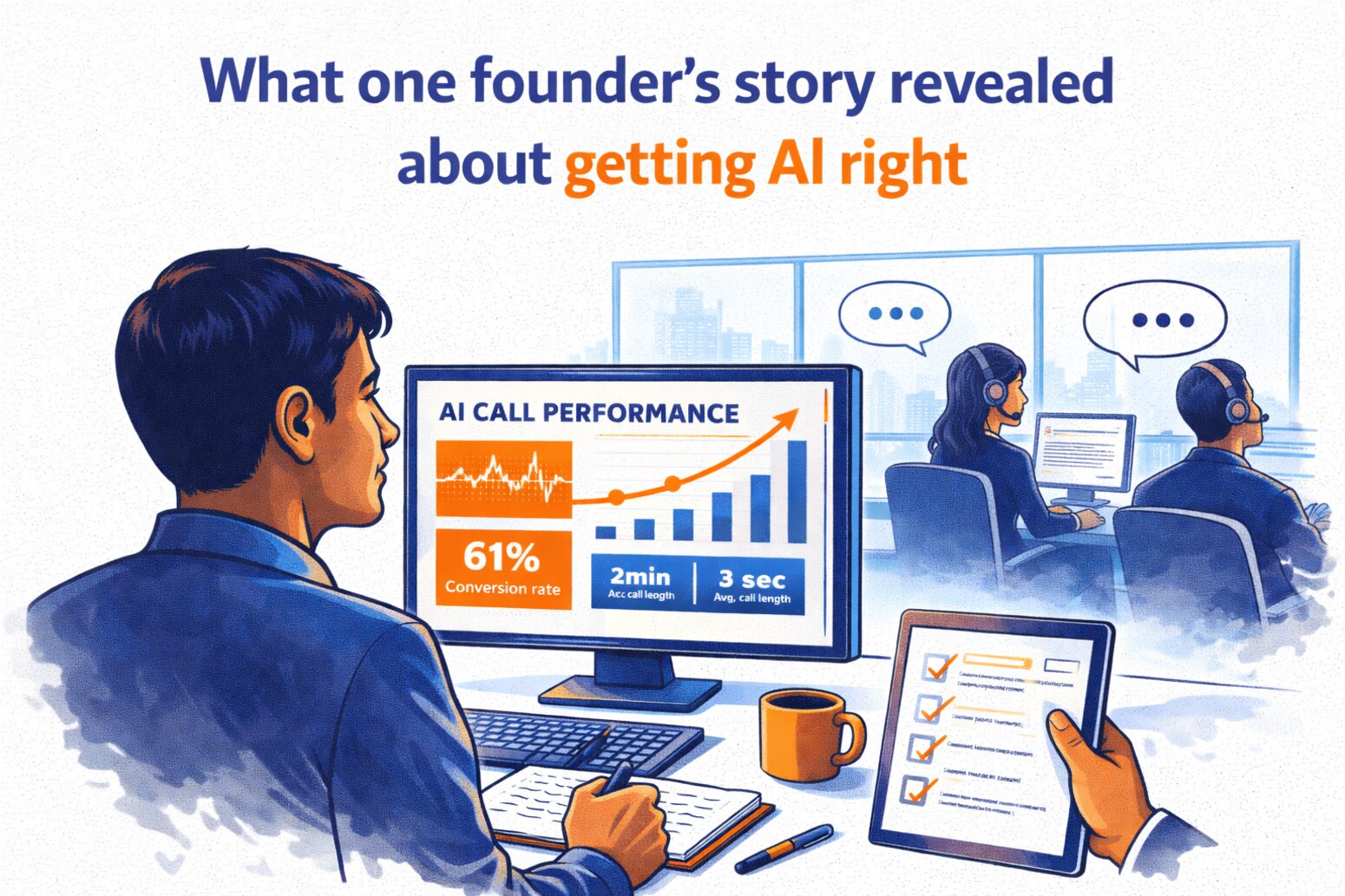
    Last week, a founder from Indore (India) shared a thread about deploying AI voice calling at scale. I could not put it down. Because the real lessons have nothing to do with voice calls.

    Strip away the telephony context, and what you have is a masterclass in how to deploy any AI solution in an enterprise. Here is what stood out.

    The first lesson is about trust, not technology. Their AI voice was technically flawless. Too flawless. People hung up. The moment they added small imperfections, pauses, and a little background noise, conversion went up 40%. The lesson here is not about phone calls. It is about how humans receive AI-assisted interactions in any setting. Perfection triggers suspicion. Naturalness builds trust. Keep that in mind, whether you are deploying an AI chatbot, an AI-assisted email, or an internal co-pilot for your team.

    The second lesson is about the real competitive advantage. Their human QA team could review 30 calls a day. The AI system lets them audit every single conversation, spot patterns, rewrite responses, and redeploy within the hour. Five improvement cycles in a day versus five in a quarter. That compounding speed of learning is what separates organisations that achieve extraordinary results with AI from those that achieve mediocre ones.

    The technology is not the edge. The speed of learning from it is.

    The third lesson is the one I want every CXO reading this to write down. They went through three vendors before they understood the real problem. Every vendor built them a technically functional system that did not convert. Because no vendor knows your business well enough. The vendor knows the platform. You know what your customer means when they pause before answering. You know when a “call me later” is a genuine request and when it is a polite exit. You know what a good conversation in your context sounds like.

    This is exactly the mistake I see enterprises make repeatedly with AI deployments. They treat it like an infrastructure purchase. Hand over the requirements, receive the system, and declare it live. Then, wonder why the numbers are disappointing.

    Every successful AI deployment I have seen has one thing in common. Not a premium vendor. Not a cutting-edge model. One internal person who owns the prompt. Who listens, observes, refines, and iterates daily. Someone who understands the customer deeply and has the judgment to shape how the AI responds.

    That person is not an AI engineer. They are a domain expert with curiosity and ownership. And they are the difference between a deployment that impresses in a boardroom presentation and one that actually moves the needle.

    Where did your AI deployment surprise you the most, in a good way or a bad way?